

Entrepreneurship, Innovation & Product
Certified Business Analysis Professional (CBAP) Preparation
Independent CBAP preparation across six business-analysis knowledge areas, with cases, internal assessment and a short readiness check.
Free
Entry Certificate in Business Analysis (ECBA) Preparation is a free program on ARPS, the Arab Platform for Professional Studies. Bilingual ECBA preparation aligned to IIBA Blueprint V1.1: thirty-six lessons across nine business analysis domains, explained practice, a separate internal completion assessment and an independent readiness mock.
Important notice: Independent ECBA preparation. Arab Platform for Professional Studies (ARPS) does not administer IIBA’s official exam, award ECBA, or claim IIBA partnership or endorsement.

Optional certificate fee 50% launch discount
$90 instead of $180
331 AED or 338 SAR
The program moves from business analysis concepts and professional mindset to change, need, solution, stakeholder, value and context. Each lesson includes explanation, a fictional worked case and two exercises with observable outputs and guidance, followed by a short learning check. Nine integrated reviews connect the domains before an internal completion assessment and a fifty-item, seventy-five-minute readiness mock. Its domain allocation follows ECBA Blueprint V1.1: 20/14/6/10/10/10/10/10/10. Questions are original to this program, not IIBA items, and an internal score does not predict an external pass. Arabic instruction is paired with equivalent English; the currently updated exam version checked with IIBA was available in English.
Cases use fictional organizations in named Arab cities as learning settings, not claims about real firms or local law. Learners produce scope maps, option matrices, decision logs and reproducible indicators. They can transfer methods to a familiar generic case without uploading personal or confidential records.
Candidates may recognize BACCM and technique names without knowing which fact changes a decision in a real case. This program explains why a plausible alternative becomes weaker when need, constraint or authority differs. It progresses from outcome definition to worked reasoning, practice and situational questions, then reviews connections between domains rather than memorizing blueprint headings.
It suits people entering business analysis or moving into it who want to organize decisions for users, sponsors and delivery teams. They practice framing need, tracing change impact, specifying a requirement, evaluating solutions and measuring value. It promises no job, promotion or external certification application approval.
This module begins with the role of business analysis in understanding change before selecting a solution.
This module practices disciplined curiosity instead of accepting the first assumption or dismissing it without inquiry.
This module shows how business analysis operates through roles and responsibilities rather than job titles alone.
This module treats change as a shift in work driven by internal or external conditions, not merely a screen release.
This module starts with neutral elicitation of a real case and distinguishes observation, interpretation and proposed fix.
This module connects solution to need through validation of the full user path, not one successful button or screen.
This module treats a stakeholder as a holder of need, evidence or authority, not a name on a list.
This module explains the path from a delivered output to an observed benefit.
This module places each decision in its information, constraint, technology and standards context.
Subjects unlock in sequence as you progress.
ECBA Blueprint V1.1, the issuer handbook, syllabus map and The Business Analysis Standard support scope and practice; WCAG 2.2 is a technical reference for one standards lesson. Citation does not imply publisher endorsement.
The nine ECBA domains and activity statements map to original lessons, applications and items. Internal assessment, mock and official exam remain separate; inference and source support require review before acceptance.
Professional Certification Preparation programs help learners prepare for a recognized external certification through structured knowledge, review, practice questions, and readiness assessments. Arab Platform for Professional Studies (ARPS) does not administer the certification owner's official exam.
Structured self-paced study aligned to the current external certification scope, with knowledge review, practice questions, readiness checks, and internal mock assessments.
The route includes an internal assessment for Arab Platform for Professional Studies (ARPS) completion eligibility and separate mock/readiness assessments that are not the external official exam.
Assessment attempts: 2 per assessment, 7 days apart
The pass mark is announced before the program is published.
The Arab Platform for Professional Studies (ARPS) credential confirms completion of the preparation program only; the target professional certification requires passing the external issuer's examination under its rules.
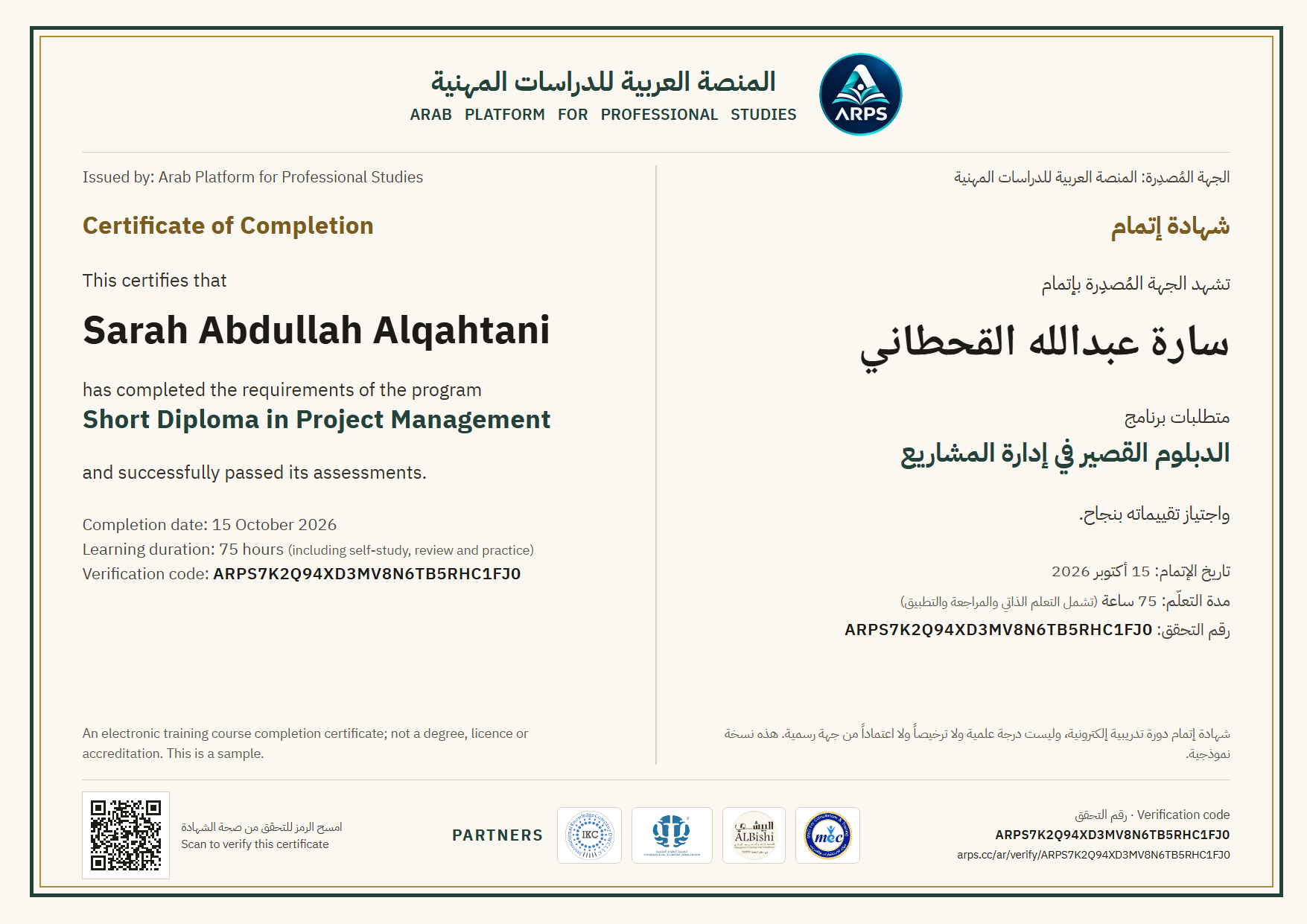
Every certificate has a public verification code. Verify a certificate
The real design with fictional details; opens in a new window.
Verification example: a real issued certificate
Disclaimer: Any internal completion record is for this preparation program only; it is not ECBA, professional licensure, or IIBA endorsement.
No. IIBA administers the external exam. This program offers original teaching, internal assessment and readiness practice.
No. Internal completion is separate from ECBA awarded by IIBA under its conditions.
Lessons are Arabic and English. The updated exam version on the IIBA page checked here was available in English; verify current language options before booking.
Fifty original situational and choice questions over seventy-five minutes, with the blueprint domain allocation. It does not reproduce the IIBA interface or guarantee an exam pass.
Return to the lesson and decisive fact, then explain why each other option is weaker here and what evidence could change the decision.
Yes. Entry Certificate in Business Analysis (ECBA) Preparation is free on ARPS: every lesson, exercise and assessment is free, the first subject is open to read without an account, and the program is available in Arabic and English. Issuing a certificate is optional; it is a training completion certificate showing you passed the program's assessments, not a university degree, a professional licence or an endorsement by an external body.
The subject of this program is also known as: ECBA, entry certificate in business analysis, business analysis fundamentals. Learners usually find it by searching for: ECBA exam prep, ECBA certification preparation, ECBA test prep, ECBA exam practice questions, how to prepare for ECBA certification, what is ECBA certification, ECBA exam requirements, ECBA course in Arabic.
Programs from the same field or route that may complement what you learn here.
Entrepreneurship, Innovation & Product
Independent CBAP preparation across six business-analysis knowledge areas, with cases, internal assessment and a short readiness check.

Entrepreneurship, Innovation & Product
Practice product decisions from problem diagnosis to impact measurement through worked booking, invitation and file cases.

Entrepreneurship, Innovation & Product
A foundational diploma on moving from product problems and users to value, strategy, priorities and roadmaps, then collaborating on delivery and launch, measuring outcomes and learning through experiments after release.

Finance, Accounting, Banking, Insurance & Compliance
A bilingual preparation program aligned to CFA Institute’s 2026 Level I topic outline. Ten domains and forty lessons combine worked cases, separate exercises, and original practice items. It does not administer the issuer exam or guarantee a pass.