

Data, AI, Digital, IT & Cybersecurity
CompTIA Security+ Preparation
Bilingual preparation for all five Security+ SY0-701 domains through applied teaching and original questions.
Free
Specialist Preparation Program in Cybersecurity for Business is a free program on ARPS, the Arab Platform for Professional Studies. Applied preparation for inspectable cybersecurity work products connecting business services, risk, controls, evidence, incidents and improvement decisions. Practitioners map a service and dependencies, frame business-impact risk, specify controls, review identity, data and suppliers, triage incidents, validate recovery and turn results into.

Optional certificate fee 50% launch discount
$90 instead of $180
331 AED or 338 SAR
Practitioners map a service and dependencies, frame business-impact risk, specify controls, review identity, data and suppliers, triage incidents, validate recovery and turn results into a roadmap and decision brief. Cases use fictional data and identify evidence, ownership and authority limits.
Outputs can transfer to organizational registers and tools after context and authority are checked; learning requires no real organizational data.
Business cybersecurity requires connecting technology to service and decision, not a tool list. The program builds a trail from input to verification and escalation.
This module connects a business-service outcome to the assets, data, people and suppliers that enable it, then converts that understanding into reviewable risk scenarios. Learners map dependency direction, estimate time-based business impact, build a purpose-bounded threat model, and verify that each scenario states cause, event and consequence rather than a list of concerns. They also apply treatment and exception choices with an owner, expiry and exit indicator. The outputs are a service map, impact analysis, risk register and treatment decision that a service owner can review without false precision or unauthorized risk acceptance.
This module turns priority risks into testable controls by defining the outcome, tested account or asset scope, owner, evidence and failure condition. Practice then expands to identity lifecycle and privileged access, data classification and minimization, and supplier and cloud-service assurance. Learners separate control design from operation and distinguish supplier assertions from evidence covering the relevant service, period and entity. They test allow, deny, revoke and recovery cases instead of relying on policy documents. Outputs include control cards, an access review, a data-flow record and a supplier-assurance package linking each gap to an action, due date and escalation boundary. Review conclusions remain limited to the service, period, and account or asset scope actually tested.
This module joins detection, response, recovery and improvement into one decision chain. Learners begin with a specific detection question and known log source, then test coverage, alert behavior and failure cases. During an incident they separate facts from hypotheses, preserve a decision log, and tailor communication to audience, confidentiality and timing. After containment, component startup is not treated as recovery; business transactions, data integrity and support capacity must be demonstrated. The module concludes by converting observations into actions with owners, measurable denominators and escalation thresholds. Outputs are a detection rule, incident record, communication plan, recovery test and trackable learning review.
Subjects unlock in sequence as you progress.
Concepts use official NIST and CISA sources and original fictional examples. Mentioning a source confers no external accreditation or legal judgment.
Official primary sources, original fictional cases and semantic linkage among claims, teaching and assessment.
Assessments follow the program blueprint and may use module assessments, a final assessment, or a combination, under the approved attempt policy.
Assessment attempts: 2 per assessment, 7 days apart
The pass mark is announced before the program is published.
The credential confirms completion and successful assessment; it does not represent professional licensure unless explicitly and lawfully stated.
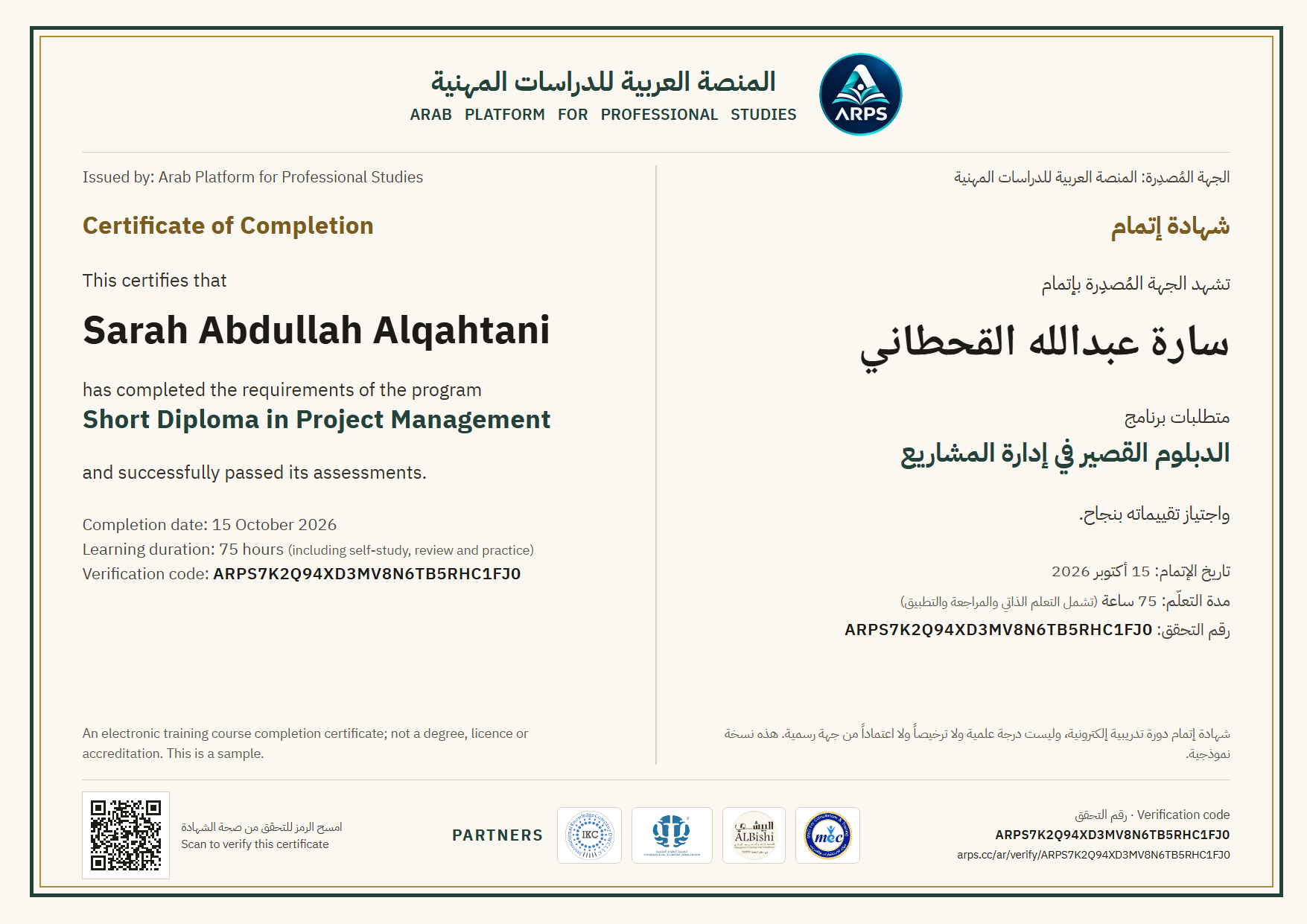
Every certificate has a public verification code. Verify a certificate
The real design with fictional details; opens in a new window.
No. It teaches specifications, checks and escalation; authorized roles retain implementation authority.
Cases are fictional and country-neutral and do not replace local legal or regulatory requirements.
No official hours are set; displayed time is an editorial estimate of actual work.
No. Practice uses synthetic records and cases and the method can transfer to organizational tools.
Knowledge checks and module assessments test decisions, method and boundaries, with two attempts under route policy.
No. It focuses business cybersecurity, risk, controls, assurance and response within explicit authority.
Yes. Specialist Preparation Program in Cybersecurity for Business is free on ARPS: every lesson, exercise and assessment is free, the first subject is open to read without an account, and the program is available in Arabic and English. Issuing a certificate is optional; it is a training completion certificate showing you passed the program's assessments, not a university degree, a professional licence or an endorsement by an external body.
The subject of this program is also known as: Business Cybersecurity, Information Security for Business, Enterprise Cybersecurity. Learners usually find it by searching for: free cybersecurity course, learn cybersecurity online, cyber risk and controls, incident response basics for business.
Programs from the same field or route that may complement what you learn here.
Data, AI, Digital, IT & Cybersecurity
Bilingual preparation for all five Security+ SY0-701 domains through applied teaching and original questions.

Data, AI, Digital, IT & Cybersecurity
Independent bilingual preparation for ISC2 Certified in Cybersecurity (CC), aligned to the five domains in the outline effective September 2026. Worked cases, exercises and explained questions develop foundational security decisions. ISC2 alone administers the external exam and awards CC.

Data, AI, Digital, IT & Cybersecurity
Learn to prepare an initial cloud decision for a small workload using demand, capacity, responsibility, access, recovery and cost evidence. Move from classifying an offer to testing booking, backup, monitoring and migration, then hand over a record of what was shown and what needs owner approval. Cases are fictional and do not grant production authority or professional certification.

Data, AI, Digital, IT & Cybersecurity
Turn software requirements into checkable acceptance conditions and reproducible tests. Record execution and defects, then write an evidence bounded release recommendation. The program covers design, risk, accessibility, authorization, performance and automation.