
Specialist Preparation Program in Sustainability and ESG

Specialist Preparation Program in Sustainability and ESG is a free program on ARPS, the Arab Platform for Professional Studies. Prepare traceable sustainability and ESG workpapers: identify topics, control data, build a GHG inventory and test disclosure before handoff. The program moves from a bounded specialist mandate to metrics, emissions, social and environmental risks.
A sign saying Earth is more valuable than money Studying is completely free
Estimated time
19 hours
subjects
8
lessons
32
Study language
Arabic and English

Optional certificate fee 50% launch discount

$90 instead of $180

331 AED or 338 SAR

Start the first subject free Fees by route

Program facts

Study fee
Free
subjects
8
lessons
32
Estimated time
19 hours
Content last reviewed
Access period
30 days
Study language
Arabic and English

About the program

The program moves from a bounded specialist mandate to metrics, emissions, social and environmental risks. Learners solve fictional cases with numbers, sources and exceptions, then prepare a bilingual disclosure pack and handoff memo.

Practical relevance

Lessons use metric dictionaries, waste balances, inventories, risk registers and bilingual handoff memos. Exercises are self-practice; publication and assurance require separate authority.

Why this program

Professional results need reviewable boundaries, sources and calculations. Each figure is linked to its claim, supporting evidence and required decision.

What you will learn

  • Mandate and material topics: prepare bounded evidence, calculation and judgment.
  • Sustainability data and controls: prepare bounded evidence, calculation and judgment.
  • GHG inventory and checks: prepare bounded evidence, calculation and judgment.
  • Climate, nature and disclosure: prepare bounded evidence, calculation and judgment.
  • Social impacts and governance: prepare bounded evidence, calculation and judgment.
  • Products, materials and waste: prepare bounded evidence, calculation and judgment.
  • Targets, transition and improvement: prepare bounded evidence, calculation and judgment.
  • Disclosure, review and handoff: prepare bounded evidence, calculation and judgment.
Learning outcomes (16)
  1. Perform the mandate and material topics tasks on bounded cases and explain results and limits.
  2. Perform the mandate and material topics tasks on bounded cases and explain results and limits.
  3. Perform the sustainability data and controls tasks on bounded cases and explain results and limits.
  4. Perform the sustainability data and controls tasks on bounded cases and explain results and limits.
  5. Perform the ghg inventory and checks tasks on bounded cases and explain results and limits.
  6. Perform the ghg inventory and checks tasks on bounded cases and explain results and limits.
  7. Perform the climate, nature and disclosure tasks on bounded cases and explain results and limits.
  8. Perform the climate, nature and disclosure tasks on bounded cases and explain results and limits.
  9. Perform the social impacts and governance tasks on bounded cases and explain results and limits.
  10. Perform the social impacts and governance tasks on bounded cases and explain results and limits.
  11. Perform the products, materials and waste tasks on bounded cases and explain results and limits.
  12. Perform the products, materials and waste tasks on bounded cases and explain results and limits.
  13. Perform the targets, transition and improvement tasks on bounded cases and explain results and limits.
  14. Perform the targets, transition and improvement tasks on bounded cases and explain results and limits.
  15. Perform the disclosure, review and handoff tasks on bounded cases and explain results and limits.
  16. Perform the disclosure, review and handoff tasks on bounded cases and explain results and limits.

Who it is for

  • Sustainability and data team members preparing calculations and evidence for review
  • Learners moving into a bounded specialist execution role
  • Finance, operations and HR staff asked to supply documented data to sustainability reports.
  • Compliance and quality coordinators who prepare verifiable evidence files ahead of internal or external review.

Prerequisites

  • Comfort reading simple tables, percentages and energy units; no prior professional credential is required.
  • Ability to use a spreadsheet to sum figures, convert units and apply simple calculation factors.
  • Willingness to document the source, boundary and exceptions of every figure rather than reporting only the final result.
  • Interest in applying common disclosure frameworks such as GRI and IFRS S1 and S2 at a practical level, not as legal experts.

Curriculum

  1. Subject 1 Open for free

    Mandate and material topics

    Mandate and material topics: apply the methods to bounded data and cases, documenting evidence, exceptions and decisions.

    4 lessons · 2 hours

    1. Translate an ESG request into a bounded work order and evidence inventory 30 min
    2. Map activities, value chain and affected stakeholders 30 min
    3. Assess impact significance under GRI 3 with a traceable case 30 min
    4. Separate impact materiality from IFRS S1 decision-useful financial information 30 min
  2. Subject 2

    Sustainability data and controls

    Sustainability data and controls: apply the methods to bounded data and cases, documenting evidence, exceptions and decisions.

    4 lessons · 2 hours

    1. Build a metric dictionary with numerator, denominator and period 28 min
    2. Design a source-to-disclosure evidence trail and control tests 28 min
    3. Reconcile missing, estimated and conflicting operational data 28 min
    4. Calculate workforce and resource indicators without hiding exclusions 28 min
  3. Subject 3

    GHG inventory and checks

    GHG inventory and checks: apply the methods to bounded data and cases, documenting evidence, exceptions and decisions.

    4 lessons · 2 hours

    1. Set organizational and operational boundaries for a hypothetical inventory 28 min
    2. Calculate scope 1 and location-based scope 2 with units and factors 28 min
    3. Screen scope 3 categories and estimate a bounded category 28 min
    4. Reconcile totals, uncertainty and base-year change requests 28 min
  4. Subject 4

    Climate, nature and disclosure

    Climate, nature and disclosure: apply the methods to bounded data and cases, documenting evidence, exceptions and decisions.

    4 lessons · 2 hours

    1. Distinguish physical and transition exposure from impact 28 min
    2. Build a risk register and test scenario assumptions 28 min
    3. Use LEAP to screen a site dependency and escalate ecological judgment 28 min
    4. Map supported claims to GRI and IFRS S1/S2 disclosures 28 min
  5. Subject 5

    Social impacts and governance

    Social impacts and governance: apply the methods to bounded data and cases, documenting evidence, exceptions and decisions.

    4 lessons · 2 hours

    1. Define workforce coverage and safety evidence 28 min
    2. Screen supplier human-rights impacts without treating questionnaires as proof 26 min
    3. Track grievance, remedy and stakeholder feedback responsibly 26 min
    4. Map oversight decisions and conflicts of interest 28 min
  6. Subject 6

    Products, materials and waste

    Products, materials and waste: apply the methods to bounded data and cases, documenting evidence, exceptions and decisions.

    4 lessons · 2 hours

    1. Trace waste generated, recovery and disposal without category substitution 26 min
    2. Define a life-cycle comparison with functional unit and boundary 28 min
    3. Investigate product-use and end-of-life impacts 28 min
    4. Test circularity and environmental claims against evidence 28 min
  7. Subject 7

    Targets, transition and improvement

    Targets, transition and improvement: apply the methods to bounded data and cases, documenting evidence, exceptions and decisions.

    4 lessons · 2 hours

    1. Set a measurable target with baseline, scope and owner 28 min
    2. Separate inventory reductions, offsets and avoided-emission claims 26 min
    3. Evaluate interventions using cost, effect and trade-offs 28 min
    4. Monitor corrective action and detect rebound or leakage 28 min
  8. Subject 8

    Disclosure, review and handoff

    Disclosure, review and handoff: apply the methods to bounded data and cases, documenting evidence, exceptions and decisions.

    4 lessons · 2 hours

    1. Challenge selective reporting and unsupported claims 28 min
    2. Prepare assurance-ready evidence and respond to exceptions 28 min
    3. Integrate a bilingual disclosure pack without inconsistent numbers 28 min
    4. Deliver a controlled specialist handoff and escalation memo 28 min

Subjects unlock in sequence as you progress.

Strengths

  • A worked case and feedback-led practice in every lesson
  • Metrics linked to source, boundary and exception
  • Controlled bilingual handoff separating ready and unresolved items

Evidence basis

GRI, IFRS, GHG Protocol and other primary sources support relevant methods. Training cases and numbers are fictional; public ISO overviews do not include the full paid standards.

Methodology

The program builds bounded work cases and tests data, calculations and claims against primary sources and the chosen reporting boundary.

Assessment

Assessments follow the program blueprint and may use module assessments, a final assessment, or a combination, under the approved attempt policy.

Assessment attempts: 2 per assessment, 7 days apart

The pass mark is announced before the program is published.

Certificate

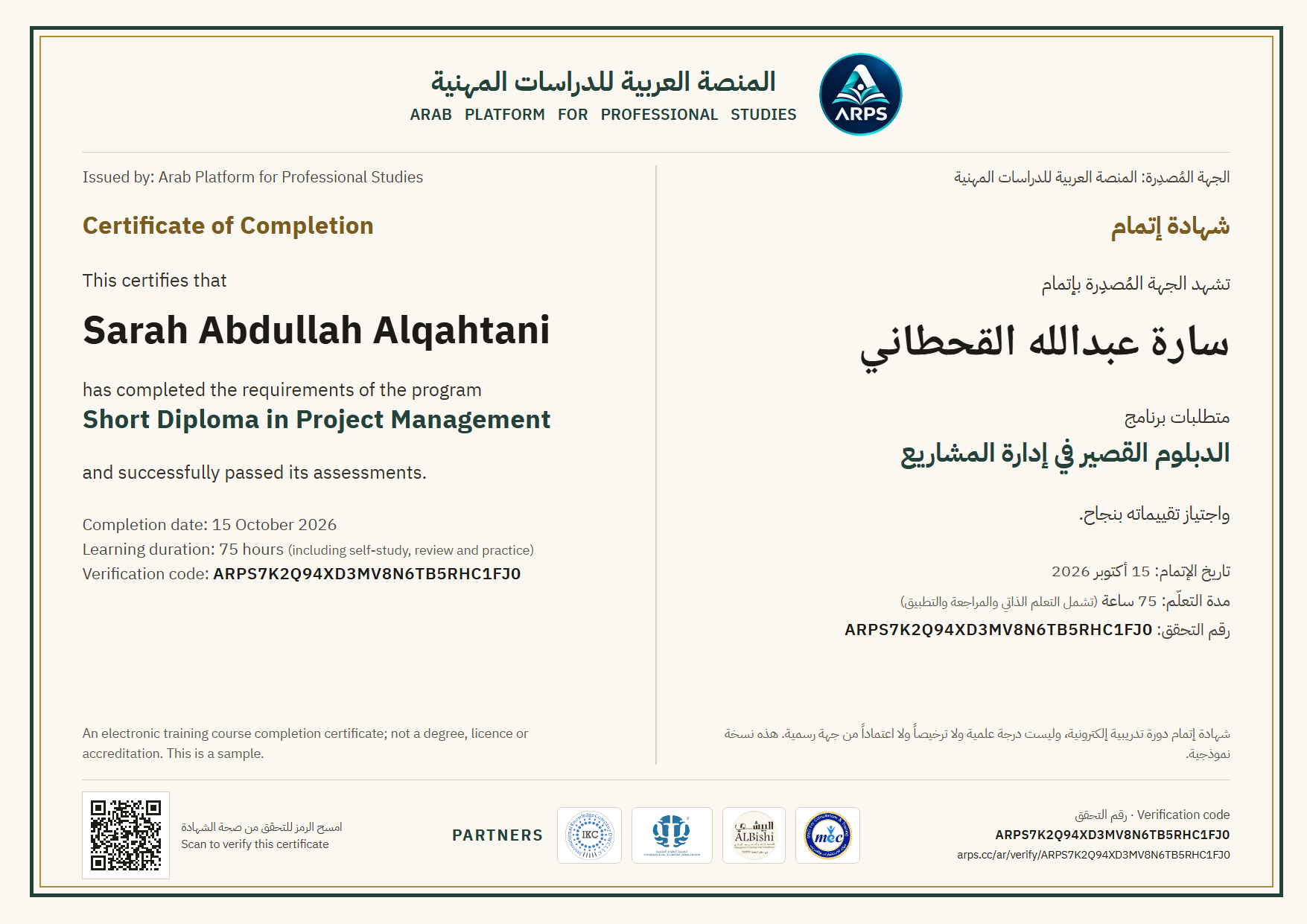
The credential confirms completion and successful assessment; it does not represent professional licensure unless explicitly and lawfully stated.

Every certificate has a public verification code. Verify a certificate

The real design with fictional details; opens in a new window.

Verification example: a real issued certificate

Program questions

Does this authorize disclosure approval or an assurance opinion?

No. It teaches evidence and calculation preparation within the specialist role; approval and assurance belong to authorized owners and practitioners.

Are the case figures actual company data?

No. Cases are fictional and labelled as such. The course shows how to document real sources and factors before use.

How is skill checked?

Self-practice has feedback, with knowledge checks and module questions. Correct choices alone do not prove workplace competence.

Does one standard apply to every organization?

No. The course explains distinct reporting methods; an authorized owner determines the reporting basis and applicable obligations.

What happens when important evidence is missing?

Record the gap and consequence, assign source, owner and date, and hold unsupported wording until an appropriate decision is made.

Is Specialist Preparation Program in Sustainability and ESG free, and do I get a certificate?

Yes. Specialist Preparation Program in Sustainability and ESG is free on ARPS: every lesson, exercise and assessment is free, the first subject is open to read without an account, and the program is available in Arabic and English. Issuing a certificate is optional; it is a training completion certificate showing you passed the program's assessments, not a university degree, a professional licence or an endorsement by an external body.

What other names is Specialist Preparation Program in Sustainability and ESG known by?

The subject of this program is also known as: ESG, Environmental Social and Governance, Corporate Sustainability. Learners usually find it by searching for: free ESG course, learn sustainability reporting online, greenhouse gas inventory basics, ESG data and disclosure, sustainability course with completion certificate.