
Data, AI, Digital, IT & Cybersecurity
Specialist Preparation Program in Business Data Analytics
A bilingual applied program for turning business questions into calculable, reviewable analysis.
Free
Professional Mini-Master in Advanced Analytics and Decision Intelligence is a free program on ARPS, the Arab Platform for Professional Studies. Build defensible analytical decisions from causal questions and forecasts through optimization and governance. The program turns advanced analytics into an integrated decision system.
Optional certificate fee 50% launch discount
$120 instead of $240
441 AED or 450 SAR
The program turns advanced analytics into an integrated decision system. You frame the question and measure, test causal effects, evaluate probabilistic forecasts, optimize under constraints and operate the decision with monitoring, escalation and retirement. Cases are fictional and require neither proprietary data nor production coding.
Learners produce reviewable decision records, assumption graphs, loss matrices, constraint models and monitoring plans.
A model can be accurate without improving a decision, and a numerical optimum can be infeasible or unfair. The program covers the full loop from evidence to action and outcome.
Relevant to analytics, operations, product and risk responsibilities. It promises neither employment nor promotion and grants no regulated professional authority.
Turn a managerial problem into an explicit decision with measures that reveal value, bias and sensitivity.
Separate association from effect and design experiments or quasi-experiments with explicit assumptions and sensitivity checks.
Evaluate out-of-sample forecasts and convert probability into action using calibration, loss and drift.
Formulate alternatives and constraints, simulate uncertainty and select robust rather than brittle optima.
Operate decisions with human accountability, traceable records, monitoring, escalation and retirement criteria.
Subjects unlock in sequence as you progress.
Concepts use scoped official and scholarly primary sources, with clear separation between supported claims and fictional teaching examples.
Scoped official and scholarly sources support named claims; citation does not imply endorsement or accreditation.
No. The work uses calculations, logic and tables; production coding is outside scope.
No. Every case and teaching quantity is fictional and labeled accordingly.
One automatically graded integrated final follows all five modules; transcript module results derive from that same final attempt.
No. It is an internal completion credential with a transcript, not a university degree or professional license.
The material is not legal or regulatory advice and must not replace accountable human review for high-impact decisions.
Each module has a standalone summary and self-checks; transcript module results are derived from that module’s questions in the same final attempt.
Yes. Professional Mini-Master in Advanced Analytics and Decision Intelligence is free on ARPS: every lesson, exercise and assessment is free, the first subject is open to read without an account, and the program is available in Arabic and English. Issuing a certificate is optional; it is a training completion certificate showing you passed the program's assessments, not a university degree, a professional licence or an endorsement by an external body.
The subject of this program is also known as: decision intelligence, advanced analytics, decision analytics. Learners usually find it by searching for: advanced analytics course, learn decision intelligence, free forecasting and optimization program, causal analysis for business decisions, online program with completion certificate.
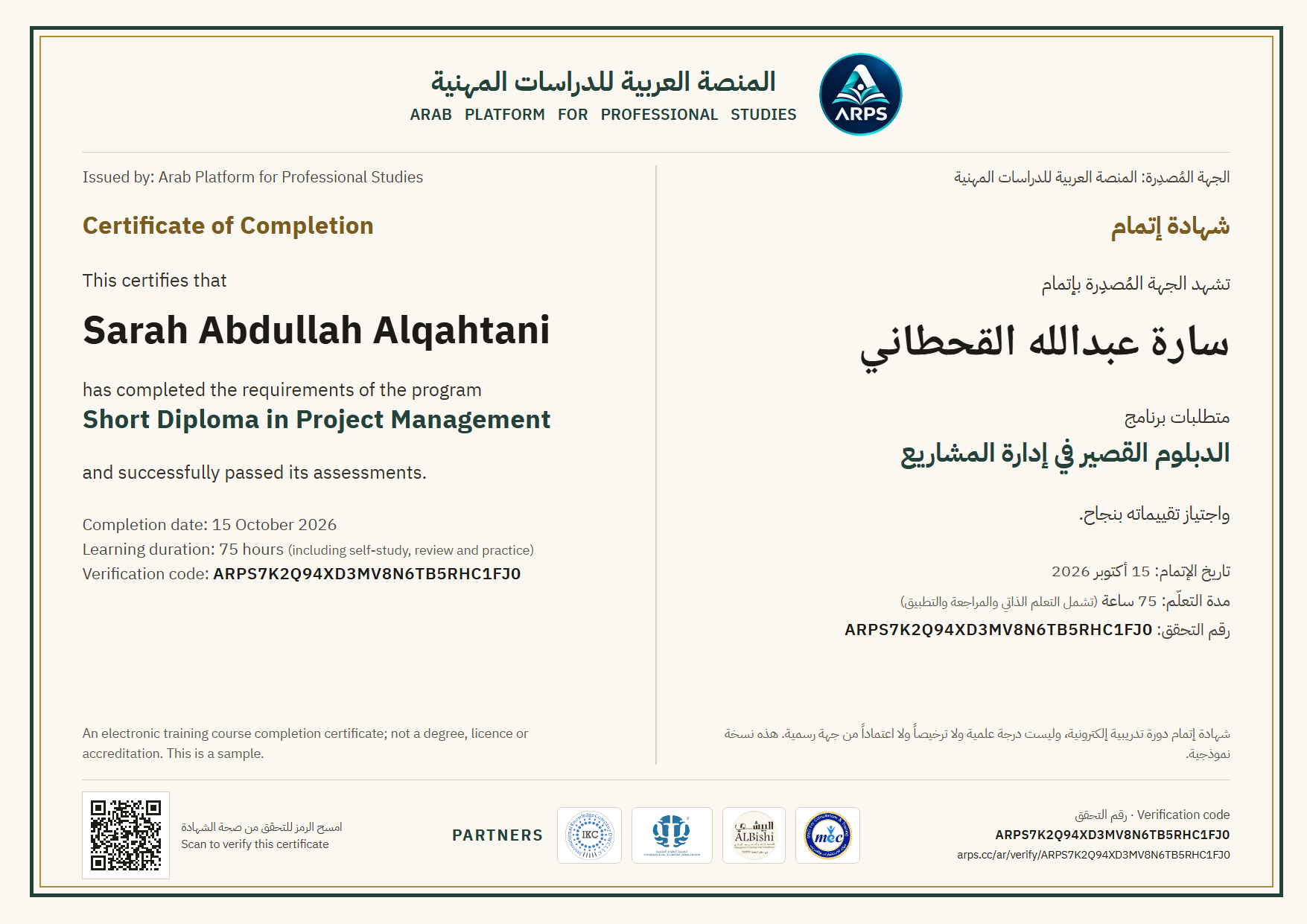
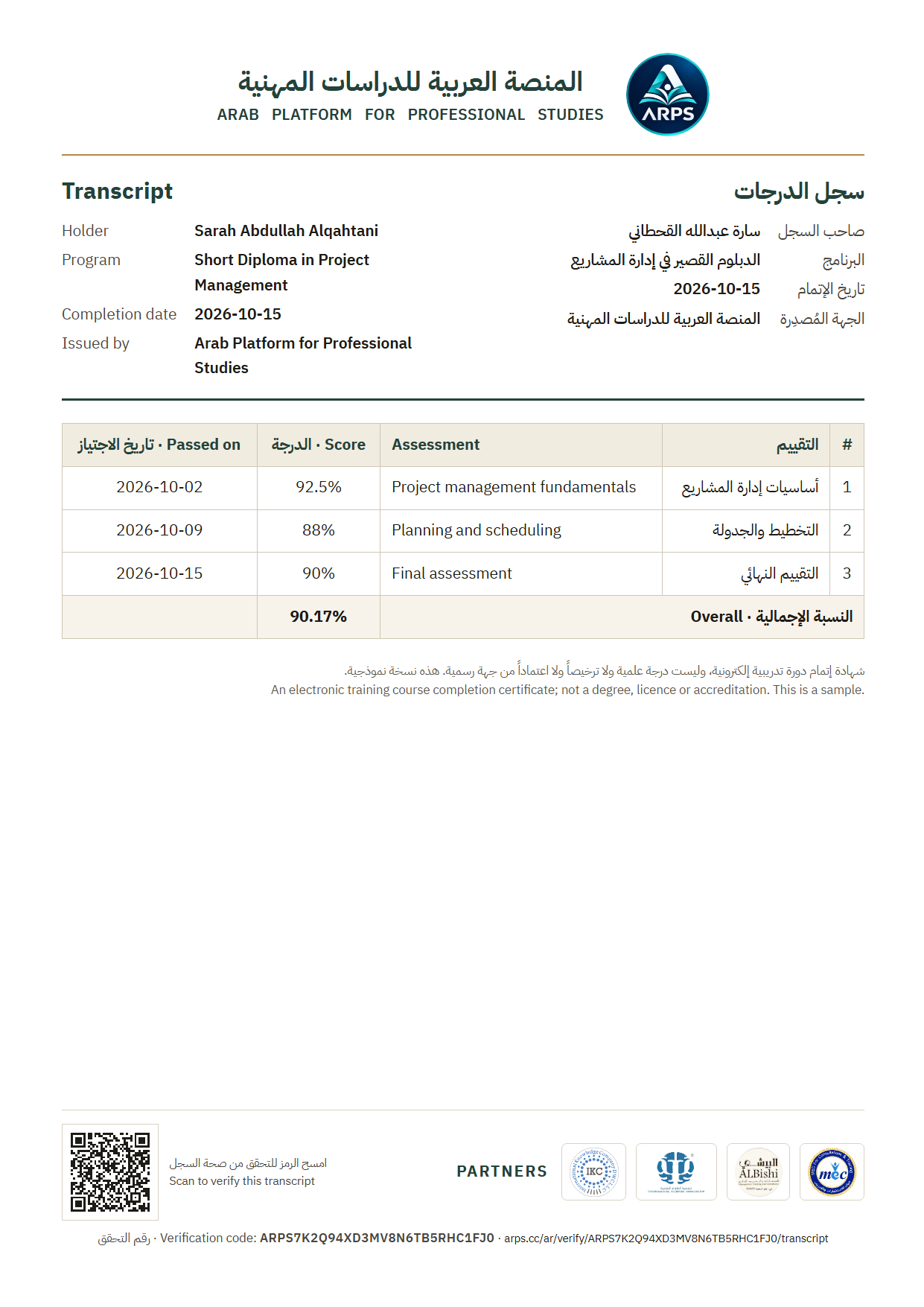
The real design with fictional details; opens in a new window.
Programs from the same field or route that may complement what you learn here.
Data, AI, Digital, IT & Cybersecurity
A bilingual applied program for turning business questions into calculable, reviewable analysis.

Data, AI, Digital, IT & Cybersecurity
A foundational short diploma that teaches how to turn a practical question into structured business data analysis: define metrics, check data quality, describe and compare, understand samples and correlation, design charts and dashboards, and communicate results without claiming more than the evidence supports.
Data, AI, Digital, IT & Cybersecurity
Develop professional judgment for a measurable enterprise data strategy and governance that operates in practice.

Data, AI, Digital, IT & Cybersecurity
Design a testable cloud security and zero-trust architecture, from resource boundaries to migration decisions.