Professional Mini-Master in AI Governance and Risk Management
Professional Mini-Master in AI Governance and Risk Management is a free program on ARPS, the Arab Platform for Professional Studies. Develop professional judgment for enterprise AI transformation, from investment selection to governance, work redesign and evidence-based scaling. The program comprises ten units and fifty lessons. Foundational units develop governance mandates, context and risk analysis, measurement, controls and monitoring.
Analyze turning organizational principles into testable decision rights and operating boundaries and justify an evidence-proportionate decision.
From lesson 1, readable now without an account: Define the governance mandate and risk appetite
Imagine an executive committee approves an AI assistant because it wants faster service. Operations later asks who may stop the assistant if harm rises. Security and customer service disagree; who resolves the disagreement? At what point does a change become a breach rather than ordinary variation? If the approval record cannot answer those questions, the organization does not merely lack another policy. It lacks an operable mandate. A governance mandate grants named people or bodies authority to make named decisions about an identified system and states what they may not exceed. Risk appetite describes the type, amount, and conditions of exposure the organization is willing to accept in pursuit of a declared benefit. Appetite does not mean risk is desirable, and it does not mean every harm can be traded for speed or revenue. Some conditions are eligibility gates: no legitimate basis for using the data, no challenge route for a consequential decision, or no person able to suspend service. A failed gate prevents the option from entering the trade-off at all. Draft the mandate around a decision, not a technology label. For example: may a reply-drafting feature be piloted for low-impact information requests for six weeks? That sentence fixes the function, population, and duration. Name four distinct authorities next. The service owner proposes operating scope. The risk owner accepts residual exposure within a stated boundary. An oversight function challenges the evidence. A pause authority suspends use when an agreed signal appears. One person may hold several roles in a small organization, but the record must expose the conflict and explain its treatment. Reserve material decisions for a higher body: expansion into a high-impact use, a new purpose, sensitive data, or a higher risk limit should not become a product-owner choice by default. State the authorization period, system version, controlling record, deputy when an authority is unavailable, and the rule for urgent action outside normal hours. NIST AI RMF is useful because governance reaches across context, measurement, and management rather than ending after an opening approval. The voluntary framework is not thereby converted into law and cannot replace applicable organizational or sector duties. Stress-test the mandate with a disagreement. An executive requests expansion, errors are rising, and two teams use different denominators. Can each participant identify the action available now, the matter that requires escalation, and the version of the limit that governs? If not, the mandate is descriptive rather than operational.
A free account saves your progress and takes you straight to lesson 1.
Program facts
Study fee
Free
subjects
10
lessons
50
Estimated time
181 hours
Content last reviewed
Access period
60 days
Study language
Arabic and English
About the program
The program comprises ten units and fifty lessons. Foundational units develop governance mandates, context and risk analysis, measurement, controls and monitoring. Extensions address data purpose, subgroup coverage, retention, withdrawal, sharing and challenges, followed by evaluation design, confidence calibration, retrieval and assurance arguments. Operational lessons cover tool authority, interrupted effects, untrusted documents, provider outages, staff skills, incident evidence and communication. Portfolio governance connects assistant effects to costs, reviewer capacity, dependencies, incentives and learning from pilots. A fictional association project brings together service boundaries, source audits, testing, controls, incident exercises, committee recommendations and monitoring and exit plans. Constructed educational data require neither model purchases nor organizational-data uploads. Decisions remain conditional on evidence, resources and authority boundaries.
Practical relevance
Apply the reasoning to a process you know: define a baseline, compare alternatives, document decision boundaries and propose a limited, reversible pilot. Learners without a suitable workplace case can use the included fictional cases. Exercises do not require buying a model or uploading organizational data.
Why this program
A small technical pilot can succeed without producing sustainable organizational value. Time saved may shift into reviewing unreliable outputs, while responsibility may be dispersed among teams with no authority to stop deployment. This program connects decisions often divided among management, technology and workforce teams. Scaling is not assumed to be the correct outcome: evidence may justify revising the scope, delaying investment or selecting a simpler solution.
Career relevance
The material relates to transformation, operations, portfolio, product and governance responsibilities. It develops judgment and cross-functional communication; it does not promise employment, promotion or financial return, or confer a regulated professional authorization.
Career paths this program serves
This program is a step on the paths of the following occupations. Open a path to see its other programs in study order.
This module develops professional judgment in governance mandate, inventory and decision rights through documented, multi-constraint decisions.
3 lessons · 6.5 hours
Define the governance mandate and risk appetite2 hours
Build and classify an AI system inventory2 hours
Allocate decision rights and accountability across the lifecycle2 hours
Subject 2
Context, Impact and Risk Analysis
This module develops professional judgment in context, impact and risk analysis through documented, multi-constraint decisions.
3 lessons · 6.5 hours
Map system context and affected parties2 hours
Analyze harm pathways and benefit claims2 hours
Estimate uncertainty and consolidate the risk record2 hours
Subject 3
Measurement, Evaluation and Assurance
This module develops professional judgment in measurement, evaluation and assurance through documented, multi-constraint decisions.
3 lessons · 6.5 hours
Design claims, metrics and an evaluation plan2 hours
Interpret subgroup performance and fairness trade-offs2 hours
Test robustness, security and generative-AI risks2 hours
Subject 4
Controls, Third Parties and Incidents
This module develops professional judgment in controls, third parties and incidents through documented, multi-constraint decisions.
3 lessons · 6.5 hours
Design controls and assess residual risk2 hours
Govern suppliers and foundation models2 hours
Operate oversight, contestability and incident response2 hours
Subject 5
Monitoring, Change and Portfolio Governance
This module develops professional judgment in monitoring, change and portfolio governance through documented, multi-constraint decisions.
3 lessons · 6.5 hours
Build post-deployment monitoring and detect drift2 hours
Control material change and revalidation2 hours
Challenge portfolio reporting and decide retirement2 hours
Subject 6
Data and Rights Governance
This module examines what changes when service data moves into another use. You assess secondary purposes and people's expectations, then check representation of groups missing from available records. Retention periods follow a defined need, and deletion is traced through retrieval and intermediate copies. You examine what evaluation reports reveal when shared with a supplier. Output-use rights are connected to their sources and limits, while an individual challenge can reveal a wider process problem. Cases provide information for comparing broad transfers with less detailed alternatives. Outputs include a purpose-review sheet, a retention and deletion map, and sharing criteria. Qualified specialists determine the applicable legal basis; you supply concrete operational facts for a specific decision.
7 lessons · 27 hours
Decide secondary data use4 hours
Assess missing population coverage4 hours
Choose a defensible retention period4 hours
Verify deletion across a processing chain4 hours
Share evaluation findings safely4 hours
Review rights in derived outputs4 hours
Handle a challenge to an automated decision4 hours
Subject 7
Advanced Evidence and Evaluation
This module moves from obtaining a test result to understanding what it establishes. Separate development data from final evaluation, then interpret confidence displayed to users. Examine the limits of a sample with no rare incidents and establish a process for adjudicating evaluator disagreement. For a retrieval assistant, distinguish finding a relevant document from locating text that supports the actual answer. Compare models on matched cases while accounting for correction and escalation effort. Finish by writing an assurance conclusion that can be tested and overturned when facts change. Outputs include a defined evaluation package, an adjudication record, a cost-and-outcome comparison, and a memorandum separating support for approval from unresolved questions. Each case adds a different diagnostic question to the final project.
7 lessons · 27 hours
Separate development and final evaluation data4 hours
Calibrate confidence displays4 hours
Sample for rare high-impact failures4 hours
Measure evaluator agreement4 hours
Evaluate retrieval and citation support4 hours
Compare models under a fixed budget4 hours
Write a falsifiable assurance conclusion4 hours
Subject 8
Tool Authority and Operational Resilience
This module addresses the transition from providing information to performing actions that affect people and systems. Define tool authority and separate understanding a request from permission to execute it. Handle an interrupted command after submission, and examine hostile instructions embedded in an external document. Design limited operation during provider failure and test employees' ability to resume manual work. Preserve incident evidence without expanding disclosure, then communicate while some facts remain unknown. Cases let you compare prompt containment with premature recovery that could repeat harm. Outputs include an authority map, a receipt-reconciliation rule, a continuity plan, an incident exercise record, and a notice that distinguishes confirmed facts from possibilities and sets the next update time.
7 lessons · 27.5 hours
Constrain an action-taking assistant4 hours
Prevent duplicate effects after interruption4 hours
Contain instructions hidden in external documents4 hours
Operate through a model-provider outage4 hours
Restore operator skill after automation4 hours
Preserve incident evidence with minimal exposure4 hours
Communicate during an unresolved incident4 hours
Subject 9
Governance Value and Portfolio Choices
This module tests the value of AI initiatives in their organizational and economic setting. Separate assistant effects from simultaneous employee training and process changes. Calculate case costs after errors and rework, then rank investments competing for the same reviewer capacity. Detect shared dependencies hidden behind different supplier names and examine incentives that suppress reporting instead of reducing failures. Assess maturity through behavior repeated under pressure, and close an unsuccessful trial while retaining useful learning. Outputs include an impact comparison, a business-case calculation, a capacity allocation decision, a concentration analysis, and a learning memorandum. Together these products help management decide what should continue, change, or stop using reasons another reviewer can examine.
7 lessons · 27.5 hours
Separate assistant effects from process improvements4 hours
Cost errors and rework4 hours
Invest under reviewer-capacity constraints4 hours
Detect concentration in a shared component4 hours
Examine incentives for error reporting4 hours
Assess maturity through repeated behavior4 hours
Close a pilot while retaining useful learning4 hours
Subject 10
Integrated Governance Case Project
The capstone combines program skills in a fictional assistant-service case with connected decision stages. Establish service boundaries and affected parties, then investigate outdated documents and delayed access revocation. Build a reproducible acceptance package and interpret conflicting results rather than selecting a convenient outcome. Compare control arrangements, costs, and operating capacity. During an incident exercise, new information changes the assessment and requires containment before recovery. Defend a recommendation against committee questions and hand over monitoring and exit arrangements. Deliverables include an evidence case, decision memorandum, incident record, and operating plan. Self-check criteria test the consistency of calculations, boundaries, and authority. The exercise provides no external accreditation or legal determination.
7 lessons · 35.5 hours
Define the project service boundary5 hours
Audit project data and dependencies5 hours
Build a reproducible project acceptance test5 hours
Choose and cost project controls5 hours
Run the project incident exercise5 hours
Defend the project recommendation5 hours
Deliver project monitoring and exit criteria5 hours
Subjects unlock in sequence as you progress.
Strengths
Enterprise trade-offs connecting value, governance and operations
Fictional exercises with feedback explaining decision reasoning
Integrated assessment and a distinct synthesis for each advanced module
Evidence basis
Concepts are grounded in scoped primary sources, including the NIST AI Risk Management Framework and OECD principles. Source guidance is distinguished from teaching assumptions and fictional numerical examples. Reading the public ISO description is not equivalent to reviewing the full standard or obtaining certification against it.
Reference organizations
NIST
OECD
Frameworks used
NIST AI Risk Management Framework — 1.0
Methodology
Concepts are grounded in scoped primary sources, including the NIST AI Risk Management Framework and OECD principles. Source guidance is distinguished from teaching assumptions and fictional numerical examples. Reading the public ISO description is not equivalent to reviewing the full standard or obtaining certification against it.
Program questions
Do I need programming experience?
Exercises do not require coding, but assume basic familiarity with data and the AI system lifecycle. You need to interpret how technical decisions affect processes, responsibilities and risks. If these concepts are new, complete foundational preparation before tackling the advanced trade-offs.
How do the modules connect?
The first five units establish mandates, context, measurement, controls and monitoring. Unit six extends data and rights decisions, seven evidence design, eight operation and response, and nine value and portfolio governance. Unit ten integrates them through a progressive governance case with practical outputs, feedback and application questions linked to every lesson.
What will I produce in the exercises?
Exercises produce defined analyses, decisions, comparisons and tests, with feedback explaining conditions and alternatives. The capstone develops a service charter, stakeholder map, data audit, test package, controls, incident exercise, committee memo and monitoring and exit plans. Data are fictional; educational outputs do not constitute actual operation or institutional approval.
How does the final assessment differ from practice?
Exercises and the capstone are open applications with criteria and guided feedback. The final uses automatically graded case questions with defined answers across ten units. Project outputs develop reviewable arguments and decisions; the program does not claim separate automated grading of a written case or authorize a real service.
Does the certificate provide external accreditation?
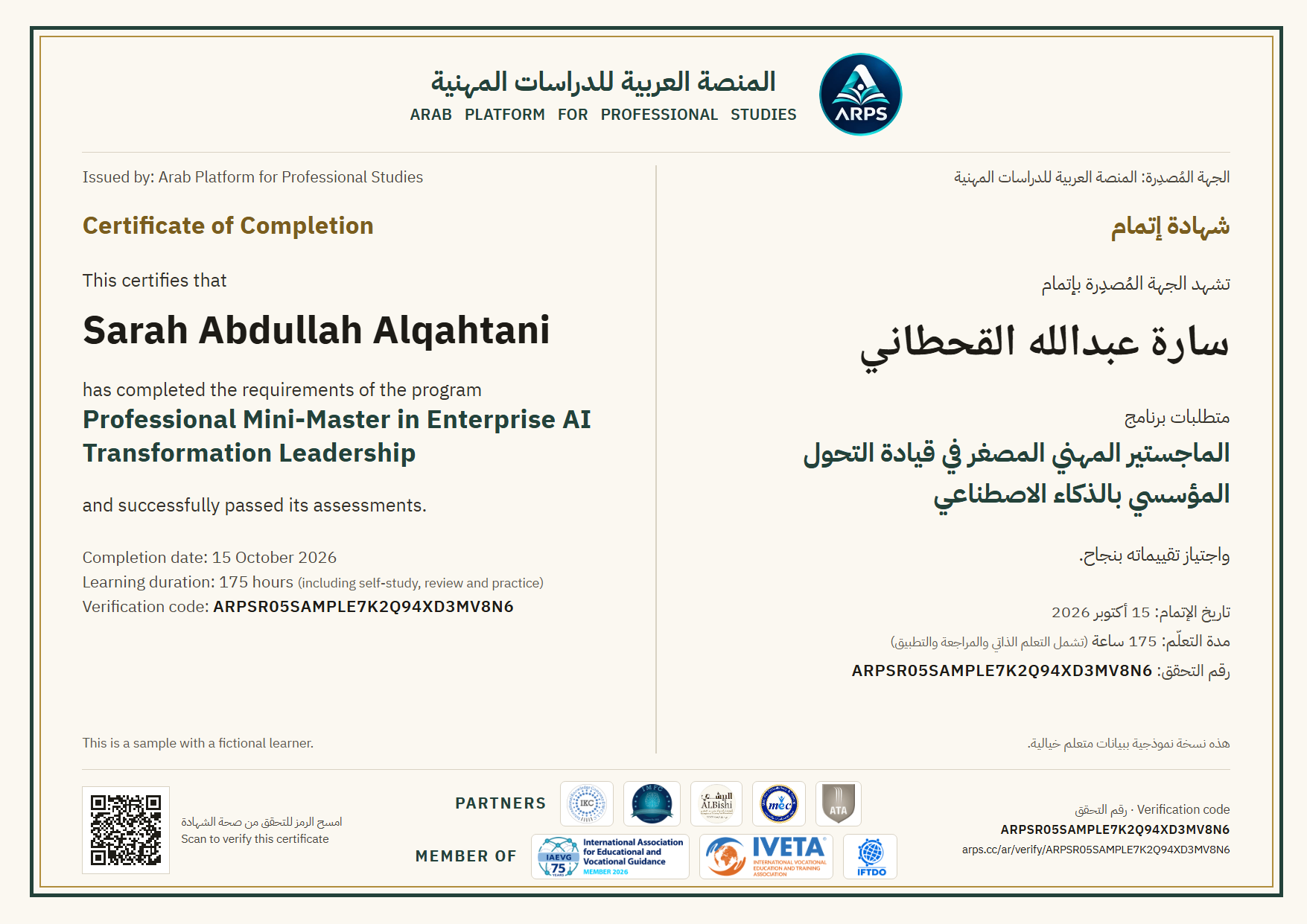
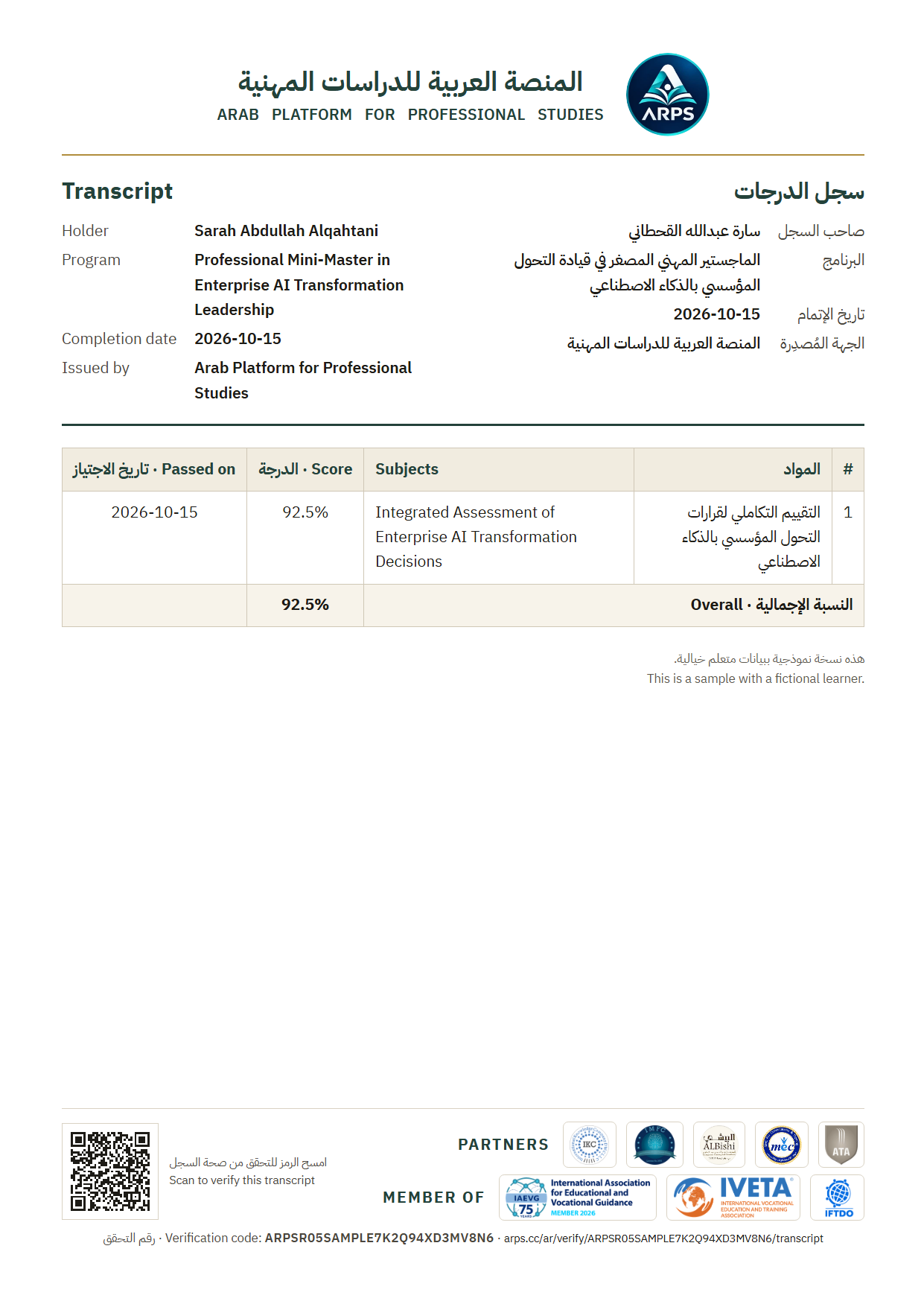
The credential records completion of the platform’s internal Professional Mini-Master route. It is not a university degree, ISO certification or legal or professional license. Learning is free and credential issuance is optional under central policy. When issued, the certificate is accompanied by a module transcript showing the ten units and the results of their questions in the accepted final attempt. These are breakdowns of the integrated assessment, not separate module examinations or grades assigned before the learner takes the assessment.
Show all (8)
Can I use workplace data?
Use fictional or appropriately de-identified information that you are authorized to use. The included data are sufficient to complete the program, and no exercise requires submitting secrets or personal information to an external service. Before applying the method at work, check data permissions, responsibilities and local constraints.
Is Professional Mini-Master in AI Governance and Risk Management free, and do I get a certificate?
Yes. Professional Mini-Master in AI Governance and Risk Management is free on ARPS: every lesson, exercise and assessment is free, the first subject is open to read without an account, and the program is available in Arabic and English. Issuing a certificate is optional and has a published fee; it is a training completion certificate showing you passed the program's assessments, recognised by most private-sector organisations in the Gulf states and most Arab countries, and it strengthens your CV; confirming that a specific organisation accepts it remains your responsibility.
What other names is Professional Mini-Master in AI Governance and Risk Management known by?
The subject of this program is also known as: AI governance, AI risk management, responsible AI governance. Learners usually find it by searching for: AI governance course, learn AI risk management, free responsible AI program, AI governance frameworks for organizations, online program with completion certificate.
A sample from a real program in this track: Professional Mini-Master in Enterprise AI Transformation Leadership. The learner, scores and dates are fictional; opens in a new window.
Independent AIGP preparation connects the four domains of the current IAPP blueprint to original bilingual lessons, decision exercises and review questions. Learners study governance, rights, development and monitoring while keeping internal assessment separate from the issuer's official exam.
An honest note: the professional mini-master is an intensive professional program; it is not an academic degree or a licence and is not equivalent to a university master's or MBA. The optional ARPS certificate is a training completion certificate showing you passed the program's assessments.