Certified Anti-Money Laundering Specialist (CAMS) Preparation is a free program on ARPS, the Arab Platform for Professional Studies. Independent bilingual CAMS preparation across the four ACAMS domains, with explanations, cases, and original questions. Across eight modules and 38 lessons, learners study financial-crime concepts, international standards, program controls, and technical tools. Each lesson includes a worked case, exercise, and feedback.
Across eight modules and 38 lessons, learners study financial-crime concepts, international standards, program controls, and technical tools. Each lesson includes a worked case, exercise, and feedback. The program has formative checks, a separate internal summative assessment, and a 20-question mini-mock weighted to the official domain percentages. It does not replicate the official ACAMS exam or guarantee eligibility or success.
Practical relevance
Across eight modules and 38 lessons, learners study financial-crime concepts, international standards, program controls, and technical tools. Each lesson includes a worked case, exercise, and feedback. The program has formative checks, a separate internal summative assessment, and a 20-question mini-mock weighted to the official domain percentages. It does not replicate the official ACAMS exam or guarantee eligibility or success.
Why this program
Independent bilingual CAMS preparation across the four ACAMS domains, with explanations, cases, and original questions.
Career relevance
Across eight modules and 38 lessons, learners study financial-crime concepts, international standards, program controls, and technical tools. Each lesson includes a worked case, exercise, and feedback. The program has formative checks, a separate internal summative assessment, and a 20-question mini-mock weighted to the official domain percentages. It does not replicate the official ACAMS exam or guarantee eligibility or success.
What you will learn
Distinguish financial-crime patterns and sector and product risks, reasoning from facts without treating a signal as proof.
Apply due diligence, beneficial ownership, and risk-based principles to customer cases.
Identify roles and jurisdictional limits of international standards, national authorities, and FIUs.
Analyze enterprise risk and design governance, independent testing, and management reporting controls.
Triage alerts and analyze investigations, escalation, reporting, evidence retention, and confidentiality.
Evaluate customer lifecycle, training, team, and privacy controls amid change and higher risk.
Test identity, screening, monitoring, and AI tools, their data quality, and operating effectiveness.
Learning outcomes (7)
Distinguish financial-crime patterns and sector and product risks, reasoning from facts without treating a signal as proof.
Apply due diligence, beneficial ownership, and risk-based principles to customer cases.
Identify roles and jurisdictional limits of international standards, national authorities, and FIUs.
Analyze enterprise risk and design governance, independent testing, and management reporting controls.
Triage alerts and analyze investigations, escalation, reporting, evidence retention, and confidentiality.
Evaluate customer lifecycle, training, team, and privacy controls amid change and higher risk.
Test identity, screening, monitoring, and AI tools, their data quality, and operating effectiveness.
Who it is for
CAMS candidates and financial-crime professionals.
Compliance and anti-money-laundering staff in banks, exchange houses, insurers, securities firms and payment service providers
Monitoring, investigations and sanctions-screening analysts, and internal audit and risk professionals who assess financial-crime controls
Staff of supervisory authorities, financial intelligence units and designated non-financial businesses seeking a structured bilingual review
Prerequisites
Basic familiarity with financial services and risk.
General understanding of how bank accounts, transfers, payments and customer onboarding work, even from an operations, branch or audit role.
Ability to read regulatory and professional texts in English, since FATF standards and many references are published in English, with terms explained in Arabic.
Readiness to analyse fictional cases involving transactions, ownership structures and reports, and to write short conclusions that others can review.
This is internal preparation and does not determine eligibility for the external examination.
What it does not offer
Those seeking guaranteed ACAMS approval or eligibility credits.
Customer controls, investigations, and coordination
Customer controls, investigations, and coordination
10 lessons · 9.5 hours
Govern committees and board information56 min
Distinguish reporting and adjacent teams56 min
Control the customer lifecycle56 min
Test control design and operation56 min
Design high-risk and internal-party controls56 min
Investigate unusual activity and draft reports56 min
Escalate, exit, and respond to authorities56 min
Balance de-risking, inclusion, and communication56 min
Train staff and coordinate AFC roles56 min
Integrate privacy, cyber, and other risk teams56 min
Subject 7
Customer data, identity, and screening
Customer data, identity, and screening
4 lessons · 3.5 hours
Select lifecycle tools and govern data56 min
Evaluate digital identity checks56 min
Configure name and sanctions screening56 min
Run periodic and event-driven refresh56 min
Subject 8
Monitoring, investigations, and technology selection
Monitoring, investigations, and technology selection
4 lessons · 4 hours
Screen payments and transfers56 min
Tune monitoring scenarios56 min
Build case evidence and network links56 min
Select and integrate AFC technology58 min
Subjects unlock in sequence as you progress.
Strengths
Original work cases with reasoned decisions.
Weighted mini-mock separate from internal assessment.
Primary sources with clear jurisdictional limits.
Evidence basis
Official ACAMS blueprint and FATF and other primary sources; confirm current official requirements before registration.
Reference organizations
ACAMS
Financial Action Task Force
Methodology
Domain objectives were mapped to instruction, cases and questions, with internal practice separated from the external credential.
How the route works
Professional Certification Preparation programs help learners prepare for a recognized external certification through structured knowledge, review, practice questions, and readiness assessments. Arab Platform for Professional Studies (ARPS) does not administer the certification owner's official exam.
Structured self-paced study aligned to the current external certification scope, with knowledge review, practice questions, readiness checks, and internal mock assessments.
Focused preparation for a specific external certification.
Content aligned to the current official exam scope when available.
Practice questions and internal readiness assessments.
Clear separation between Arab Platform for Professional Studies (ARPS) preparation and the official external exam.
Assessment
The route includes an internal assessment for Arab Platform for Professional Studies (ARPS) completion eligibility and separate mock/readiness assessments that are not the external official exam.
Assessment attempts: 2 per assessment, 7 days apart
The pass mark is announced before the program is published.
Certificate
The Arab Platform for Professional Studies (ARPS) credential confirms completion of the preparation program only; the target professional certification requires passing the external issuer's examination under its rules.
Disclaimer: Independent preparation. This program does not administer the official CAMS exam, award the CAMS credential, or claim ACAMS partnership or endorsement.
Program questions
Does this program award CAMS?
No. ACAMS awards CAMS under its external eligibility and examination rules.
Is the mini-mock an official ACAMS exam?
No. It is an original 20-question practice form weighted by domain.
Do study minutes count as official eligibility credits?
No recognized eligibility credits are claimed; check current ACAMS requirements directly.
What domains are covered?
All four A–D domains in the checked blueprint, with risk, control, and technology applications.
How is assessment organized?
Module checks, a separate internal final, and an optional mini-mock.
Do the same legal rules apply everywhere?
No. Cases are general education; verify local law and authority in each jurisdiction.
Does the mini-mock predict the official result?
No. It is a short practice sample, not the official exam length or scoring.
Which languages are available?
Lessons, cases, exercises, and questions are available in Arabic and English.
Is Certified Anti-Money Laundering Specialist (CAMS) Preparation free, and do I get a certificate?
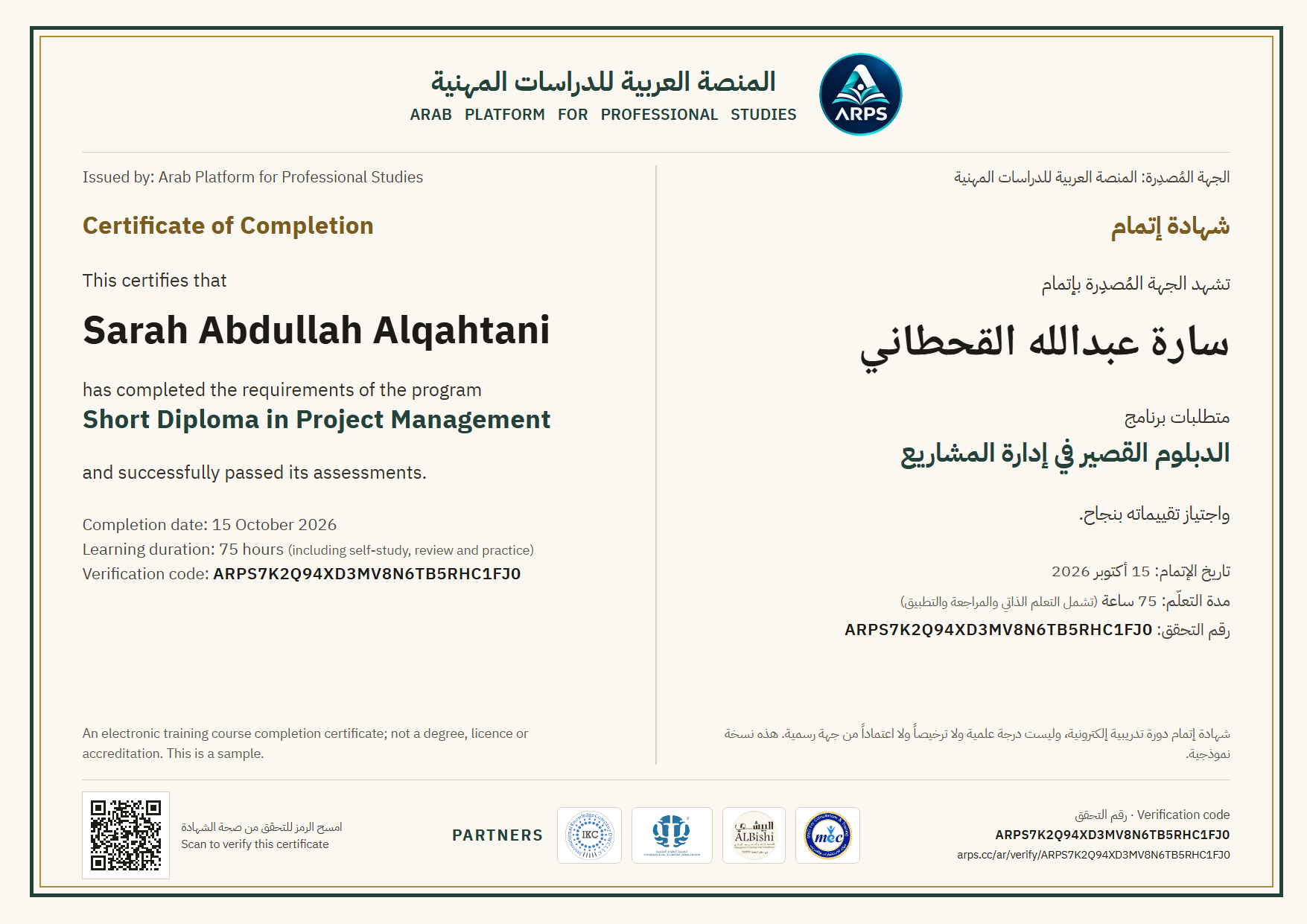
Yes. Certified Anti-Money Laundering Specialist (CAMS) Preparation is free on ARPS: every lesson, exercise and assessment is free, the first subject is open to read without an account, and the program is available in Arabic and English. Issuing a certificate is optional; it is a training completion certificate showing you passed the program's assessments, not a university degree, a professional licence or an endorsement by an external body.
What other names is Certified Anti-Money Laundering Specialist (CAMS) Preparation known by?
The subject of this program is also known as: CAMS exam prep, AML specialist exam preparation, anti-money laundering exam review. Learners usually find it by searching for: free AML course online, CAMS practice questions, learn anti-money laundering, AML compliance training, CAMS prep with completion certificate, what is CAMS certification, CAMS exam requirements, CAMS course in Arabic.
Practise reviewable compliance and financial crime case work, from source authority and customer due diligence to transaction analysis, testable controls and confidential referral within a specialist role.
Practice scoping financial-crime compliance advice, testing evidence and controls, and writing an actionable recommendation with follow-up. Cases are fictional; local legal requirements need specialist verification.
A bilingual preparation program aligned to CFA Institute’s 2026 Level I topic outline. Ten domains and forty lessons combine worked cases, separate exercises, and original practice items. It does not administer the issuer exam or guarantee a pass.