Consultant Preparation Program in Compliance and Financial Crime Prevention
Consultant Preparation Program in Compliance and Financial Crime Prevention is a free program on ARPS, the Arab Platform for Professional Studies. Practice scoping financial-crime compliance advice, testing evidence and controls, and writing an actionable recommendation with follow-up. Cases are fictional; local legal requirements need specialist verification.
The assignment begins with an apparently simple request: prove that monitoring failed. Alert totals alone cannot establish coverage, nor can an adviser replace the owner of a control decision. Learners frame a testable question, request transaction denominators and missed-case samples, and separate observed facts from hypotheses.
Five modules cover advisory scope, due diligence and beneficial ownership, monitoring and investigation effectiveness, change governance and indicators, and integrated options with an implementation recommendation. Each unit includes explanatory lessons, fictional regional cases and practical outputs with self-check feedback.
FATF standards, BCBS and OECD guidance, and the Wolfsberg industry perspective are used within their proper scope. They are not automatically local law, and a teaching case is not a real incident. Participants learn to state what is known, what remains unverified and who has decision authority.
Practical relevance
You will draft an engagement scope and evidence matrix, examine a customer and beneficial-ownership file, compare monitoring and investigation coverage, and design a change test and committee memo. Every case uses constructed data; never put real customer records or lists into these exercises.
Why this program
A team may recommend changing a monitoring rule because alerts rose while knowing little about missed transactions or investigation capacity. The program teaches you to test the hypothesis, denominator and benchmark cases, then compare options before presenting them to an authorized decision maker.
Career relevance
The program serves compliance, financial-crime risk, audit and advisory professionals who analyze controls and review recommendations. It develops decision papers with explicit evidence and limits. It confers no protected title, license, professional accreditation or employment promise.
What you will learn
Frame a decision question, scope and evidence request.
Analyze customer and ownership risks with proportionate due diligence.
Test monitoring, investigation and missed-case coverage.
Design change governance and falsifiable effectiveness indicators.
Compare options and write conditional advice with follow-up.
Learning outcomes (5)
Define advisory scope, decision questions, evidence needs and authority limits.
Analyze customer, beneficial-ownership and proportionate due-diligence risks against evidence.
Test monitoring, investigation and escalation coverage with denominators and missed cases.
Design control governance, change tests and falsifiable effectiveness indicators.
Compare options and deliver conditional advice, an implementable plan and revisable follow-up.
Who it is for
A compliance or financial-crime professional with initial experience reading customer files and alerts who wants to turn observations into disciplined advisory analysis, distinguishing evidence from interpretation and advice from a decision reserved for authorized owners.
A risk manager, auditor or consultant who works across operations, technology and legal teams and needs to compare control choices, customer effects and operational capacity while reporting verifiable findings instead of merely counting completed activities.
Prerequisites
Foundational familiarity with compliance or AML work, including customer files, alerts and escalation, and the ability to read a small transaction table and check the denominator before interpreting a percentage.
Experience writing a short professional observation and distinguishing a documented fact from a hypothesis to test, with willingness to check institutional policy and applicable law before turning a fictional exercise into a real decision.
What it does not offer
Someone seeking a formal professional credential, legal license or authority to freeze or report transactions.
Someone needing case-specific legal advice without qualified review of local rules and evidence.
This module turns a request that assumes its conclusion into a bounded mandate with an evidence scope and decision owner. Learners separate observation from explanation: more alerts can coincide with a lower alert rate, and neither figure establishes monitoring quality. They build rival hypotheses and select tests that could weaken each one, such as reconciling feeds or comparing stable cohorts. They distinguish inherent exposure from control design, demonstrated operation and residual risk, writing conditional judgments when effectiveness is unproven. Finally, they allocate limited analyst days to evidence that could change an urgent decision, defer lower-value work with a review date and set an escalation gate. The outputs are an engagement charter, evidence ledger, risk register and test plan, rather than a predetermined failure verdict or legal compliance certificate.
4 lessons · 5 hours
Scope the mandate and authority1.5 hours
Form risk hypotheses from conflicting evidence1.5 hours
Assess inherent, control and residual risk1.5 hours
Prioritise a proportionate review1.5 hours
Subject 2
Customer and beneficial ownership controls
This module moves from risk diagnosis to the institution's treatment of customers throughout a relationship. Learners compare standard, enhanced and legally permitted simplified due diligence using identity evidence, purpose and actual use rather than a customer category label. They trace a company through ownership layers to natural persons, calculate indirect shares, and test voting or appointment rights and conflicts between registers, declarations and agreements. Next they prioritise file reviews triggered by ownership, behaviour or due dates, using correct denominators for overdue and reopened work. Finally, they compare blanket refusal, unrestricted entry and controlled access that retains mandatory verification while reducing avoidable exclusion. Outputs include a route table, control graph, review queue and conditional pilot recommendation. Local legal conditions and final acceptance remain with authorised decision makers.
4 lessons · 5 hours
Design risk-based customer due diligence1.5 hours
Test beneficial ownership and control1.5 hours
Trigger lifecycle customer reviews1.5 hours
Balance integrity and financial inclusion1.5 hours
Subject 3
Monitoring, investigation and escalation
This module teaches advisers to test monitoring capability rather than count rules or alerts. Learners trace eligible source transactions and fields through detection logic to delivery into an investigation queue, using reconciliation and replay to find missing channels or inputs. They interpret alert, referral and backlog measures with the right denominators, then weigh investigation time saved by a threshold change against valuable cases it might suppress. They construct a case chronology that separates verified events from rival commercial and unexplained-flow hypotheses, naming evidence that could discriminate between them. Finally, an escalation map keeps system repair separate from case investigation and official reporting, with access restricted by role. Outputs are a coverage matrix, threshold test memo, reviewable case narrative and acknowledged handoff for a specific authorised decision.
4 lessons · 5 hours
Test monitoring scenario coverage1.5 hours
Measure alert quality and investigation load1.5 hours
Build a reviewable investigation narrative1.5 hours
Escalation decision and reporting boundary1.5 hours
Subject 4
Governance, effectiveness and change
This module asks why a known monitoring defect remains open despite policies and committees. Learners map who proposes, approves, deploys and verifies a control change, distinguishing operation, specialist oversight and independent audit under the institution's governance. They design an effectiveness test starting from production releases rather than approval forms alone, with a sample and failure rule that can expose an untested version. A balanced dashboard pairs case speed with closure quality and source-data coverage so green measures cannot conceal difficult work. Finally, learners compare old and new monitoring logic in shadow mode, challenge cases that would vanish or newly appear, and set authorised launch and rollback gates. Outputs are an accountability matrix, falsifiable test protocol, paired indicator panel and controlled change memo; advisory analysis remains separate from formal institutional approval.
4 lessons · 5 hours
Diagnose accountability and governance1.5 hours
Test control effectiveness beyond existence1.5 hours
Choose measures without perverse incentives1.5 hours
Implement monitoring changes safely1.5 hours
Subject 5
Integrated advisory recommendation and follow-up
The final module brings customer due diligence, monitoring and governance together with sanctions-screening and intermediary-integrity gaps in one actionable decision. Learners construct comparable packages covering no action, blanket restriction and targeted protection, then weigh exposure, legitimate customers, capacity and reversibility. They test whether party IDs, affected volumes or staff capacity would change their recommendation and identify a concrete new fact that could reverse it. A sequenced plan names workstream dependencies, decision owners and acceptance tests capable of rejecting a failed benchmark case rather than rewarding administrative completion. The module closes with a committee memo that separates established facts, evidence limits, conditional advice, residual risk and acknowledged follow-up. Fictional cases require advice to be updated when new evidence arrives, without treating one repaired control as proof of another or claiming legal or criminal decision authority.
4 lessons · 5 hours
Construct comparable alternatives1.5 hours
Decide under uncertainty1.5 hours
Plan implementation, ownership and verification1.5 hours
Review residual risk and present the final advice1.5 hours
Subjects unlock in sequence as you progress.
Strengths
Twenty lessons include forty exercises with defined outputs and guided feedback.
Fifty logical questions in two languages use plausible professional mistakes as distractors.
Recommendations link evidence, owners and conditions that would change advice.
Clear separation of international standards, professional guidance and local law.
Evidence basis
General principles are linked to FATF standards and guidance, bank-specific BCBS guidance with consultation status stated, the Wolfsberg industry perspective and the OECD annex on foreign bribery. Case numbers, entities and events are fictional; the sources do not endorse this program or verify its cases.
Reference organizations
FATF
BCBS
Wolfsberg Group
OECD
Methodology
Original applied instruction and fictional cases with scoped claims linked to sources.
Assessment
Assessments are aligned to program outcomes and may include module assessments, a final assessment, or a combination, with scenario-based questions where appropriate.
Assessment attempts: 2 per assessment, 7 days apart
The pass mark is announced before the program is published.
Certificate
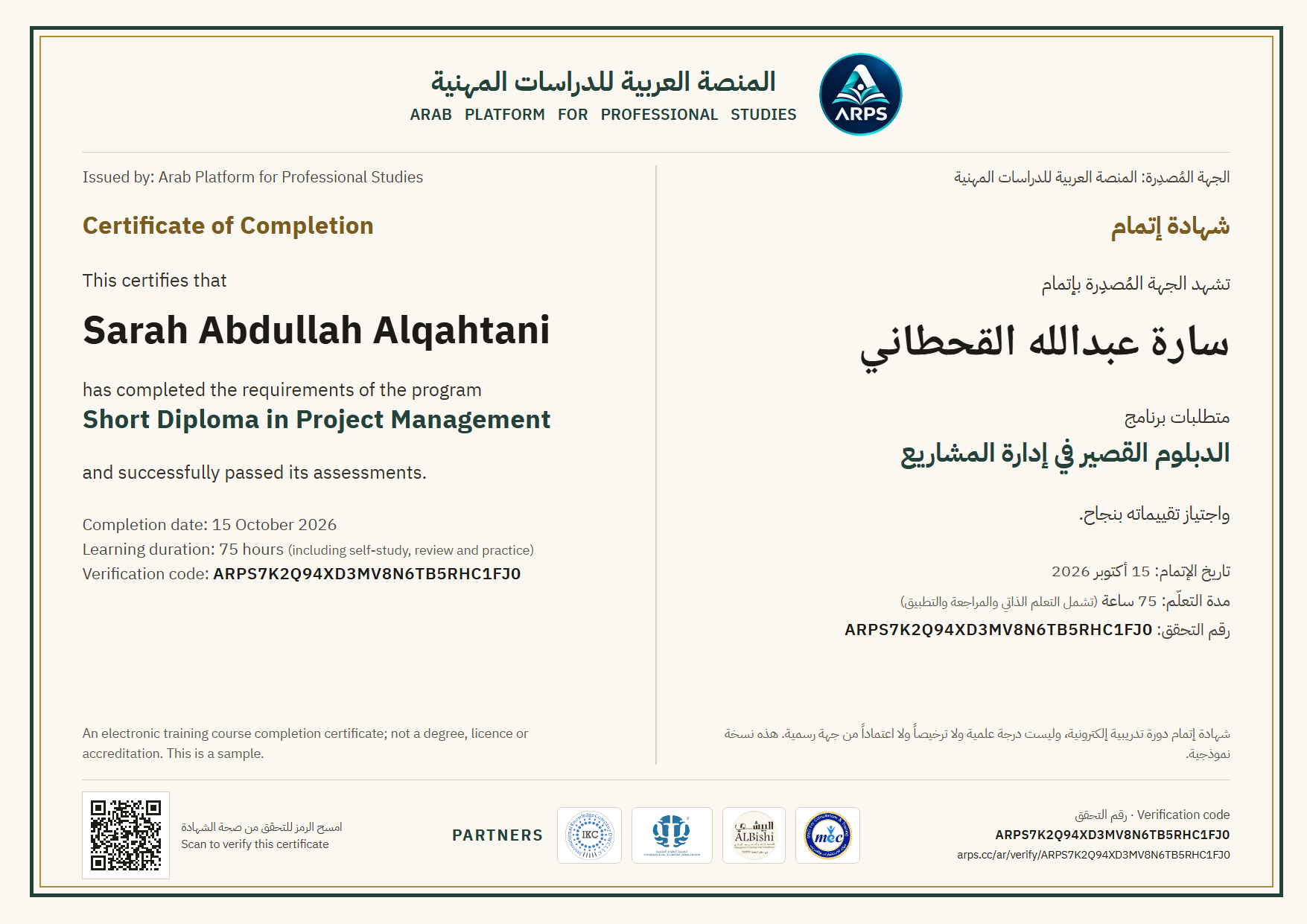
The credential confirms completion and successful assessment; it does not automatically grant a legal licence to practise as a consultant in a regulated field.
Disclaimer: Learn to analyze compliance and financial-crime risks and recommend evidence-based alternatives within role boundaries. This program grants no professional license, legal decision authority or endorsement by cited bodies. Qualified specialists must verify applicable local requirements.
Program questions
Does the program grant a license or professional accreditation?
No. It teaches analysis and advice; it grants no license, protected title or endorsement by a cited organization.
Are FATF Recommendations directly applicable local law?
No. They are international standards; verify applicable law, regulation and institutional policy for real decisions.
Do I need real customer data?
No. All exercises use constructed cases and data. Never transfer customer files into them.
Will I be authorized to freeze or report?
You learn to analyze evidence and present options. Authorized institutional functions retain legal and operational decisions.
How is monitoring effectiveness assessed?
Test coverage, missed cases, investigation quality and denominators rather than alert volume alone.
Are official credited hours available?
No official accredited hours are claimed. The displayed duration estimates reading, exercises and assessment.
Is Consultant Preparation Program in Compliance and Financial Crime Prevention free, and do I get a certificate?
Yes. Consultant Preparation Program in Compliance and Financial Crime Prevention is free on ARPS: every lesson, exercise and assessment is free, the first subject is open to read without an account, and the program is available in Arabic and English. Issuing a certificate is optional; it is a training completion certificate showing you passed the program's assessments, not a university degree, a professional licence or an endorsement by an external body.
What other names is Consultant Preparation Program in Compliance and Financial Crime Prevention known by?
The subject of this program is also known as: compliance, AML, financial crime prevention, KYC. Learners usually find it by searching for: AML compliance course, financial crime prevention training, compliance officer career, free AML course.
Practise reviewable compliance and financial crime case work, from source authority and customer due diligence to transaction analysis, testable controls and confidential referral within a specialist role.
Diagnose project delivery variance from conflicting evidence, compare feasible interventions, and write a recommendation with explicit limits, decision ownership and follow-up measures.