Consultant Preparation Program in Enterprise and Financial Risk Management
Consultant Preparation Program in Enterprise and Financial Risk Management is a free program on ARPS, the Arab Platform for Professional Studies. An advanced program in enterprise and financial risk evidence, response comparison and conditional recommendations with operational follow-up. An investment committee asks whether liquidity supports expansion.
An investment committee asks whether liquidity supports expansion. A credit dashboard shows a jump in delinquency after a system migration, while collections staff report stable cash. A consultant cannot settle that conflict by choosing the most dramatic number or colouring a risk matrix. The work starts with a defined choice, alternatives and data access. It reconciles definitions and dates, then tests credit, operating and data explanations separately.
Five modules take the learner through the work. The first establishes a consulting mandate, evidence lineage and a map of impact transmission. The second links desired growth to loss-absorption capacity, cash limits, decision rights and control effectiveness. The third analyses receivables, client concentration, currency scenarios, hedging and liquidity on payment dates. The fourth compares acceptance, reduction, transfer and avoidance, constructs coherent stress, finds the boundary-breaking point and stages implementation. The fifth produces a board decision memo, indicators with known denominators, and a 30/60/90-day verification and handover plan.
Fictional data cases have explicit assumptions, worked results and facts that would change the judgment. Lessons distinguish late payment from default and loss, accounting profit from available cash, and insurance indemnity from restoration of a disrupted service. General principles are grounded in public ISO and COSO material. IFRS 7 and Basel references are used within the scope of entities and topics to which they relate, rather than presented as universal law or professional certification. Real application requires verification of contracts, source data, local duties and decision authority.
Practical relevance
Reframe a broad request into a mandate, investigate a dashboard jump after migration, calculate peak credit exposure and a cash gap, compare a hedge or insurance policy with alternatives, and prepare a staged decision with measurable conditions. Cases are fictional and respect data and role boundaries.
Why this program
A dashboard can detect a signal yet fail to guide a decision. Enterprise and financial risks move across credit, operations, market and liquidity; one response may reduce one exposure while increasing another. The program trains you to separate fact from assumption, calculate comparable option effects and explain when evidence is insufficient for an unrestricted release. Its output is a memo and follow-up plan, not a collection of memorized terms.
Career relevance
Suitable for experienced risk, finance, audit and operations leaders advising committees or clients. It develops option analysis, inference limits and escalation. Completion grants no protected title, licence, job assurance or external body approval.
What you will learn
Define a consulting mandate with decision, alternatives, evidence and opinion limits.
Test competing explanations and link appetite to capacity and governance.
Analyse credit, market and liquidity exposures with clear definitions, dates and scenarios.
Compare responses, find stress break points and design phased implementation.
Present a board memo, monitoring indicators and a handover that can be operated.
Learning outcomes (5)
Frame a consulting mandate and evidence matrix that separates facts, assumptions and alternative explanations.
Link risk appetite to objectives, governance and decision limits, and detect design versus execution gaps.
Analyse credit, market and liquidity exposures and their operational dependencies within data limits.
Compare responses with quantitative and qualitative criteria and stress cases, then justify an actionable recommendation.
Design a board report, follow-up plan, verification indicators and escalation for residual risk.
Who it is for
Experienced risk, finance, audit or operations professionals who make enterprise-level recommendations.
Team leaders who design limits, controls or monitoring programmes and must explain trade-offs to boards and committees.
Internal or independent advisers who want an auditable method linking evidence to recommendation.
Prerequisites
Previous work with organizational data, controls or financial decisions.
Ability to read a receivables and cash-flow table, calculate a ratio and compare simple scenarios.
Willingness to verify professional authority, contracts and local obligations before applying recommendations in practice.
General familiarity with governance and internal control concepts.
What it does not offer
Anyone seeking a professional licence, accreditation or binding legal or investment opinion.
Anyone seeking a model to apply to every bank or firm without testing its own data and context.
Frame a decision, reconcile data sources and distinguish connected risk pathways.
3 lessons · 1.5 hours
From a sponsor request to a testable consulting mandate28 min
Evidence lineage and rival explanations28 min
Dependency mapping and enterprise risk statements28 min
Subject 2
Strategy, appetite and governance
Translate objectives into capacity limits and test decision rights and control effectiveness.
3 lessons · 1.5 hours
From growth objective to appetite and capacity28 min
Decision rights and governance gaps26 min
Testing control effectiveness and residual risk28 min
Subject 3
Credit, market and liquidity exposures
Analyse receivables, hedging and cash timing with bounded calculations and data limits.
3 lessons · 1.5 hours
Credit: ageing, concentration and conditional loss30 min
Market sensitivity and hedge basis28 min
Liquidity ladder and timing gaps28 min
Subject 4
Responses and stress tests
Compare treatments and coherent stress scenarios, then sequence implementation gates.
3 lessons · 1.5 hours
Comparing responses on a common basis28 min
Coherent stress and reverse stress28 min
Implementation sequencing and residual trade-offs28 min
Subject 5
Reporting, monitoring and handover
Write a board decision, design honest indicators and verify effects after handover.
3 lessons · 1.5 hours
A board memo that exposes the decision and uncertainty28 min
Risk indicators that measure without misleading28 min
Consulting handover and 30/60/90-day verification30 min
Subjects unlock in sequence as you progress.
Strengths
Conflicting-evidence cases and reproducible calculations instead of colour scores alone.
Comparisons of cash, loss, opportunity and implementation time under one decision.
Clear boundaries between general guidance and obligations applicable to a particular entity.
A handover plan with indicator owners and a route to revisit assumptions.
Evidence basis
General concepts use public material from ISO and COSO, financial disclosure examples use specific IFRS 7 passages, and credit and resilience principles use Basel Committee publications within banking scope. Teaching figures and cases are original fictional examples, not results attributed to those organizations or promises of firm performance.
Reference organizations
ISO
COSO
IFRS Foundation
Basel Committee on Banking Supervision
Frameworks used
COSO ERM — 2017 public overview
Methodology
Lessons use scoped official passages with original fictional examples not attributed to the publisher.
Assessment
Assessments are aligned to program outcomes and may include module assessments, a final assessment, or a combination, with scenario-based questions where appropriate.
Assessment attempts: 2 per assessment, 7 days apart
The pass mark is announced before the program is published.
Certificate
The credential confirms completion and successful assessment; it does not automatically grant a legal licence to practise as a consultant in a regulated field.
Disclaimer: This program teaches risk analysis and conditional recommendations; it grants no professional licence or binding investment, accounting or legal opinion.
Program questions
Does the program license me as a risk consultant?
No. It teaches and internally assesses analysis and advice skills; it grants no licence, protected title or external accreditation.
Must I upload my employer’s data?
No. Lessons include fictional cases with sufficient information. Any workplace application remains subject to access rights, confidentiality and organizational policy.
Do Basel principles apply to every company?
No. Basel Committee principles are presented in their banking and supervisory setting. Their reasoning can inform analysis where relevant without imposing bank obligations on another firm.
Are the calculations IFRS allowances?
No. Lesson loss and stress calculations are fictional comparison tools. Formal accounting estimates and disclosure require the current applicable standard, entity procedures and qualified review.
What if a case has insufficient evidence?
Separate established and untested points, compare a bounded or phased decision pending decisive evidence, and assign an owner, date and pause condition.
Why revisit a recommendation after the report?
Collections, exposure and exceptions change. The 30/60/90-day plan compares execution with assumptions and reopens the decision when a limit is crossed or a data source fails.
Is Consultant Preparation Program in Enterprise and Financial Risk Management free, and do I get a certificate?
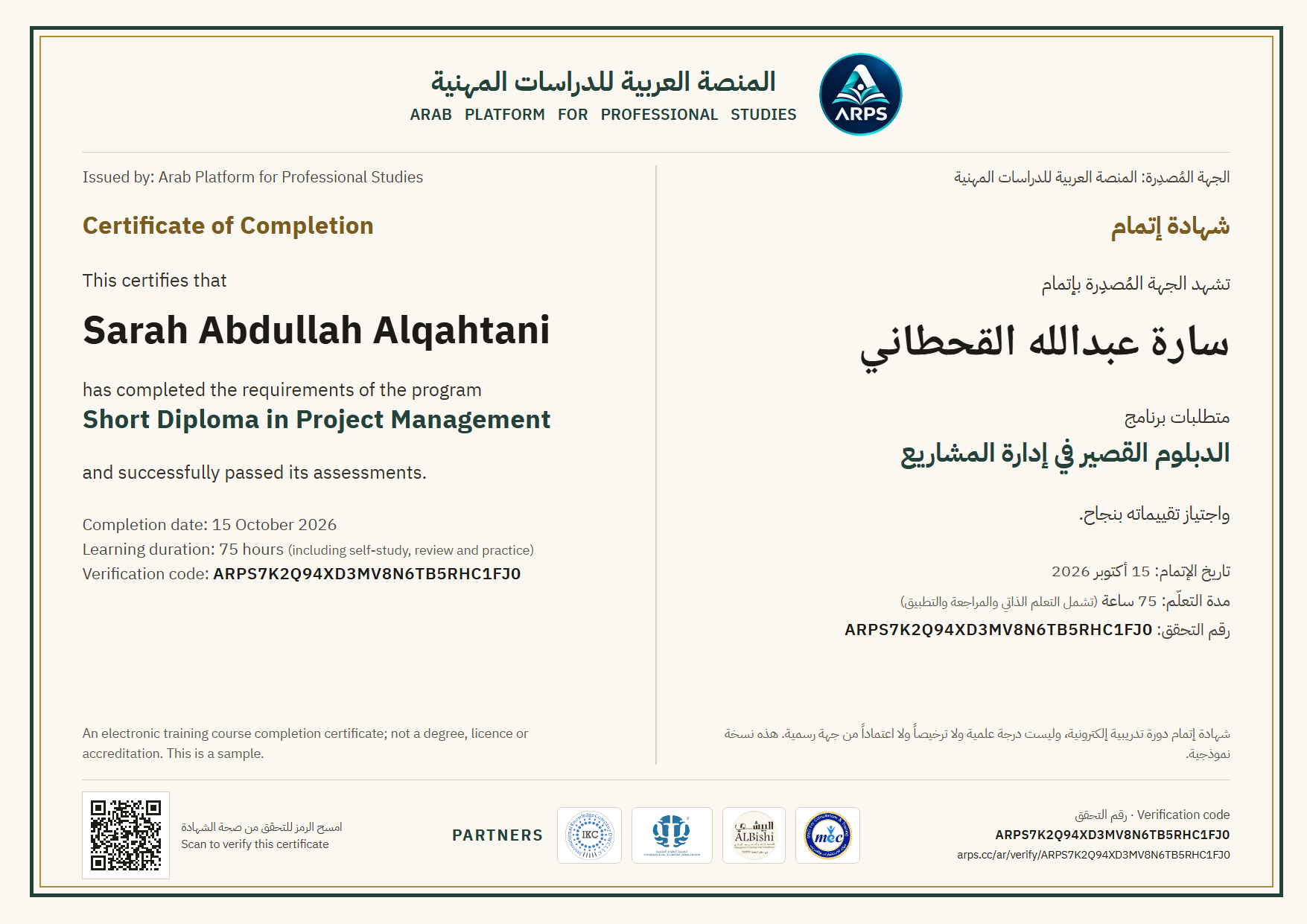
Yes. Consultant Preparation Program in Enterprise and Financial Risk Management is free on ARPS: every lesson, exercise and assessment is free, the first subject is open to read without an account, and the program is available in Arabic and English. Issuing a certificate is optional; it is a training completion certificate showing you passed the program's assessments, not a university degree, a professional licence or an endorsement by an external body.
What other names is Consultant Preparation Program in Enterprise and Financial Risk Management known by?
The subject of this program is also known as: Enterprise Risk Management, ERM, Financial Risk Management. Learners usually find it by searching for: free risk management course, learn enterprise risk management online, financial risk assessment, risk response recommendations.
An advanced professional program for risk and compliance decisions in digital enterprises. It connects appetite and treatment portfolios with scoped obligations, service resilience, control testing, product changes and automation. Learners practise turning uncertain evidence into owned decisions and review triggers.
Practice scoping financial-crime compliance advice, testing evidence and controls, and writing an actionable recommendation with follow-up. Cases are fictional; local legal requirements need specialist verification.
Practise reviewable compliance and financial crime case work, from source authority and customer due diligence to transaction analysis, testable controls and confidential referral within a specialist role.
Diagnose project delivery variance from conflicting evidence, compare feasible interventions, and write a recommendation with explicit limits, decision ownership and follow-up measures.