Consultant Preparation Program in Cybersecurity Governance and Risk
Consultant Preparation Program in Cybersecurity Governance and Risk is a free program on ARPS, the Arab Platform for Professional Studies. Advanced advisory program on cybersecurity governance, risk scenarios, treatment choices and reviewable executive decisions. An organization can have a security policy, dashboards and supplier reports yet still struggle to answer who may accept risk or whether evidence shows a control.
An organization can have a security policy, dashboards and supplier reports yet still struggle to answer who may accept risk or whether evidence shows a control working in its critical service. This program begins with a bounded engagement, decision rights, service map and dependencies. It then builds testable threat scenarios, distinguishes facts from assumptions, and estimates likelihood and impact without false precision.
Across five modules, learners compare treatments and a constrained portfolio, examine supplier concentration and exceptions, and connect policy, assurance, metrics and incident lessons to oversight. The final advisory case produces a decision memo, staged roadmap, closure evidence and follow-up. Cases are fictional and require no real organizational records.
The program teaches reasoning and documentation within an adviser’s role. It grants no license or external accreditation and does not authorize the adviser to decide for an organization. Real application requires checking applicable policy, contract, jurisdiction and qualified specialists.
Practical relevance
Fictional cloud-supplier, payment, privileged-identity and recovery cases produce scenario records, dependency maps, options matrices and monitoring cards. No sensitive records need be uploaded to outside tools.
Why this program
A red risk-register cell or published policy does not explain what changes in a business service. Learners trace an event to consequence, test conflicting evidence, compare faster or cheaper alternatives, and state what would reverse a recommendation. Investment, acceptance of residual risk, and evidence of treatment closure remain distinct.
Career relevance
For experienced security and risk professionals and internal or external advisers who present trade-offs to service owners and committees. It develops evidence review and actionable writing, without promising a protected title, job eligibility or promotion.
What you will learn
Define engagement scope, decision rights and service dependencies.
Frame a risk scenario and estimate consequence, likelihood and evidence limits.
Compare treatments, prioritize a portfolio and document delegated acceptance.
Test policy, control evidence, measures and incident lessons.
Present an executive recommendation, gated roadmap and closure card.
Learning outcomes (5)
Define an advisory mandate and decision rights and assess governance of a cyber-enabled service.
Build testable risk scenarios and assess evidence, likelihood, impact, and confidence limits.
Compare treatments, prioritize a constrained portfolio, and document residual risk.
Design policy, exceptions, assurance, and measures connecting controls to oversight decisions.
Deliver an executive recommendation, implementation roadmap, and reviewable follow-up.
Who it is for
Experienced cybersecurity and risk professionals familiar with digital services and controls.
Team leaders and advisers who develop recommendations for organizational decision makers.
Risk, compliance and internal audit managers who take part in cybersecurity decisions and need a shared language with technical teams.
Prerequisites
Prior practical experience with a digital service, security control or risk register.
Ability to read a professional case, compare evidence and justify a written choice.
Willingness to check local authority and policy in real applications.
A general grasp of risk, control and governance concepts in an organisation, without requiring advanced technical depth.
What it does not offer
Anyone seeking external professional certification or legal licensing.
Anyone expecting this course alone to deliver penetration testing or specialized legal advice.
Define mandate and decision rights, map service dependencies, test oversight and build current and target CSF outcomes.
4 lessons · 2 hours
Define the advisory mandate and decision rights32 min
Map business services and risk context32 min
Test governance accountability and oversight32 min
Build current and target CSF profiles32 min
Subject 2
Risk assessment
Build defined threat events, separate evidence from assumptions, estimate likelihood and impact, and challenge rankings.
4 lessons · 2 hours
Construct testable threat scenarios32 min
Evaluate evidence and uncertainty32 min
Estimate likelihood and consequence34 min
Calibrate and challenge risk ratings32 min
Subject 3
Response and prioritization
Compare treatment effects and costs, prioritize a constrained portfolio, examine supplier concentration and record delegated acceptance.
4 lessons · 2 hours
Compare treatment options32 min
Prioritize a constrained portfolio32 min
Assess supplier and concentration risk32 min
Document risk acceptance and escalation32 min
Subject 4
Operating governance
Make policy and exceptions operable, connect controls to outcome evidence and oversight measures, and integrate incident lessons.
4 lessons · 2 hours
Design policy and exception governance34 min
Connect controls to assurance evidence32 min
Define metrics and reporting32 min
Integrate incident lessons and resilience32 min
Subject 5
Advisory delivery
Frame an executive decision, resolve stakeholder differences, stage a gated roadmap, and hand over evidence-based follow-up.
4 lessons · 2 hours
Write an executive risk narrative34 min
Negotiate recommendations with stakeholders32 min
Build a sequenced implementation roadmap34 min
Present, hand over and monitor decisions34 min
Subjects unlock in sequence as you progress.
Strengths
Cases contain conflicting evidence and concrete reversal conditions.
Options are compared under time, budget and dependency limits.
Recommendations connect authority, closure proof and follow-up.
Complete Arabic and English instruction includes guided practice.
Evidence basis
Concept instruction uses official NIST publication pages on the CSF, risk management and supply chains with documented reading limits. Teaching cases and numbers are fictional, not empirical study findings or prescribed thresholds. Citation does not imply NIST endorsement.
Reference organizations
NIST
Frameworks used
NIST CSF — 2.0
Methodology
Lessons use documented official publication pages and original fictional advisory cases.
Assessment
Assessments are aligned to program outcomes and may include module assessments, a final assessment, or a combination, with scenario-based questions where appropriate.
Assessment attempts: 2 per assessment, 7 days apart
The pass mark is announced before the program is published.
Certificate
The credential confirms completion and successful assessment; it does not automatically grant a legal licence to practise as a consultant in a regulated field.
Disclaimer: Educational program for analyzing cybersecurity governance and risk and framing recommendations within role authority. It grants no professional license or external accreditation and does not replace delegated organizational decisions.
Program questions
Does this confer a NIST credential or advisory license?
No. External certification and licensing have separate requirements.
Must I use my organization’s records?
No. The fictional cases contain enough data for practice; do not put sensitive records into exercises.
Does the Framework prescribe one risk rating for every firm?
No. The program uses its outcomes with thresholds set and documented by an organization.
How is learning assessed?
Each lesson has a knowledge check, and modules use scenarios alongside self-check exercises and worked responses.
Does the adviser accept risk through a recommendation?
No. The adviser presents evidence and options; delegated organizational authority accepts risk.
Is Consultant Preparation Program in Cybersecurity Governance and Risk free, and do I get a certificate?
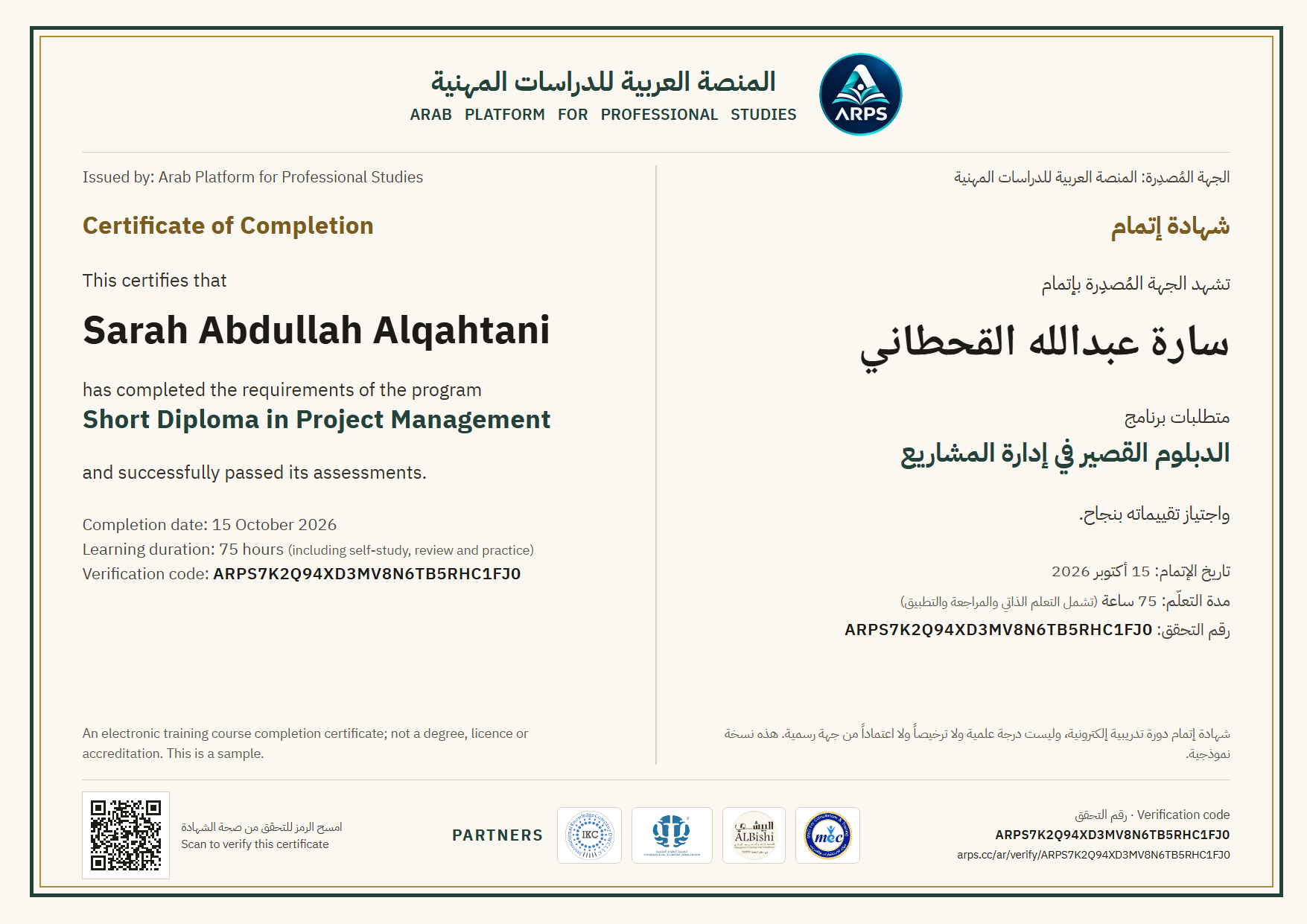
Yes. Consultant Preparation Program in Cybersecurity Governance and Risk is free on ARPS: every lesson, exercise and assessment is free, the first subject is open to read without an account, and the program is available in Arabic and English. Issuing a certificate is optional; it is a training completion certificate showing you passed the program's assessments, not a university degree, a professional licence or an endorsement by an external body.
What other names is Consultant Preparation Program in Cybersecurity Governance and Risk known by?
The subject of this program is also known as: Cybersecurity GRC, Cyber Risk Management, Cybersecurity Governance. Learners usually find it by searching for: free cybersecurity governance course, learn cyber risk management online, cyber risk scenarios, cyber risk treatment decisions.
Bilingual preparation for the four CISM domains in the ISACA outline current on 22 October 2026. Original cases and questions practice security-management decisions; this is neither ISACA's exam nor its credential.