


Safety, Emergency, Crisis & Business Continuity
Specialist Preparation Program in Business Continuity
Specialist training in disruption impact analysis, executable alternatives and verification.
Free
Professional Mini-Master in Business Continuity Design and Readiness Testing is a free program on ARPS, the Arab Platform for Professional Studies. Design a defensible service boundary and continuity strategy, test readiness and decide what the evidence supports and what remains exposed.

Optional certificate fee 50% launch discount
$120 instead of $240
441 AED or 450 SAR
Five modules move from service impact and dependencies to continuity options, activation and communication plans, safe return, controlled exercise design, repair, retest and an executive readiness decision. Fictional order and distribution cases in named Arab cities provide enough data for calculations and for distinguishing quick return from correct output. The integrated final covers all five modules and produces module results from that same attempt.
Build impact and dependency records, compare alternatives, write activation triggers, design a controlled exercise and evidence matrix, then present a conditional executive decision with repair and retest.
A continuity plan may exist without evidence that a supplier, team and data can operate a minimum service during disruption. This program links promises to dependencies, a safe trial, observations and a bounded decision.
For continuity, operational-risk, service and supplier owners who must explain a reviewable readiness decision. It develops professional judgment without conferring ISO certification or a university degree.
Continuity design starts with a service that produces a valid outcome for a beneficiary, not an inventory of systems or departments. The learner bounds booking, dispatch and settlement while separating supplier ownership from the organization’s responsibility to understand a dependency. They build impact across meaningful time points, distinguish request intake from valid confirmation, and calculate backlog and net clearance with explicit denominators. A dependency graph then tests whether apparent fallback routes share one failure point or one authorized employee. Finally, the learner reconciles an owner’s claim, register data and supplier promises by separating observation from assumption. The module yields a service charter, impact table, dependency graph and conflict ledger, each tied to a conditional priority and evidence that could change it.
This module turns service priorities into a recovery design that can be tested. The learner distinguishes an impact boundary from resource availability, first valid output and clearance of sensitive backlog, then checks what data a tested restore can actually recover without losing unresolved transactions. Manual, technical and supplier options pass validity, capacity, time and data-right gates before weighted preferences are applied. The learner tests supplier independence and authorized staffing across real shifts, calculating complete output from the bottleneck rather than adding departmental capacities. Finally, a staged funding decision specifies a trial, stop criterion, exit route and residual service gap. Lower price or faster screen startup is not presented as demonstrated recovery.
This module makes recovery strategy usable by an on-duty team. Learners calculate the last escalation time before a service impact boundary and distinguish fault detection authority from permission to change service level or accept residual risk. They build a minimum operating route requiring job authorization, valid records and worker acceptance, with a stop rule for duplicates or lost data. Customer, staff, supplier and leadership messages state verified facts, open questions and the next update without inventing a restoration time. Return then proceeds in controlled batches through manual and central record reconciliation, while old backlog is cleared at a net rate after new arrivals. The outputs are an activation, operating, communication and return plan with explicit checks and owners.
This module designs a readiness exercise from a capability hypothesis that matters to a continuity decision. A timed tabletop can test delegated approval, while isolated functional conduct measures valid output; neither result is generalized beyond observed conditions. Learners build injects with sufficient facts but no coaching, a common clock, safe branches and a stop rule protecting live operations. Observers record actions and request identifiers, calculate valid output against the intended denominator and separate fact from causal hypothesis. If exercise effects escape isolation, conduct stops and the real effect is contained; an unfinished capacity objective is unverified. A structured debrief then links each finding to an owner, targeted repair and retest instead of a generic promise to improve.
Improvement starts with a finding that separates criterion, observation and consequence from unknown cause. Duplicate orders are not evidence that a particular team caused the defect. An owner chooses a feasible corrective action by considering output validity, capacity and a dated closure criterion. A retest recreates the failure mechanism under representative release, load and permissions, comparing valid output and timing with the original requirement. The executive readiness decision names what each service demonstrated, the boundary of that evidence and any restricted operation or accepted risk under a named authority. A supplier, system or role change and an expired test window reopen the decision. The old finding remains traceable rather than being overwritten by a green status.
Subjects unlock in sequence as you progress.
Concepts use public ISO descriptions and official BCI, NIST and FEMA guidance within their scopes. Educational cases and numbers are fictional, not reports about a real organization.
Impact and dependency analysis, continuity options, controlled exercise, repair and retest.
No. It uses public source descriptions within their scope and offers internal professional learning without a conformity audit.
A linked service, impact, dependency, strategy, plan, exercise, repair and readiness-decision register.
No. Fictional cases and solved outputs require neither confidential workplace data nor production operation.
One integrated final covers all five modules; the accepted attempt yields each module result from its own questions.
No. The decision records test scope, release, load and evidence limits, and is reopened after material change.
No. They show results from module questions within the same integrated final attempt.
Yes. Professional Mini-Master in Business Continuity Design and Readiness Testing is free on ARPS: every lesson, exercise and assessment is free, the first subject is open to read without an account, and the program is available in Arabic and English. Issuing a certificate is optional; it is a training completion certificate showing you passed the program's assessments, not a university degree, a professional licence or an endorsement by an external body.
The subject of this program is also known as: business continuity, business continuity management, disaster recovery. Learners usually find it by searching for: business continuity course, business continuity planning, business continuity testing exercises, disaster recovery planning course, free business continuity course.
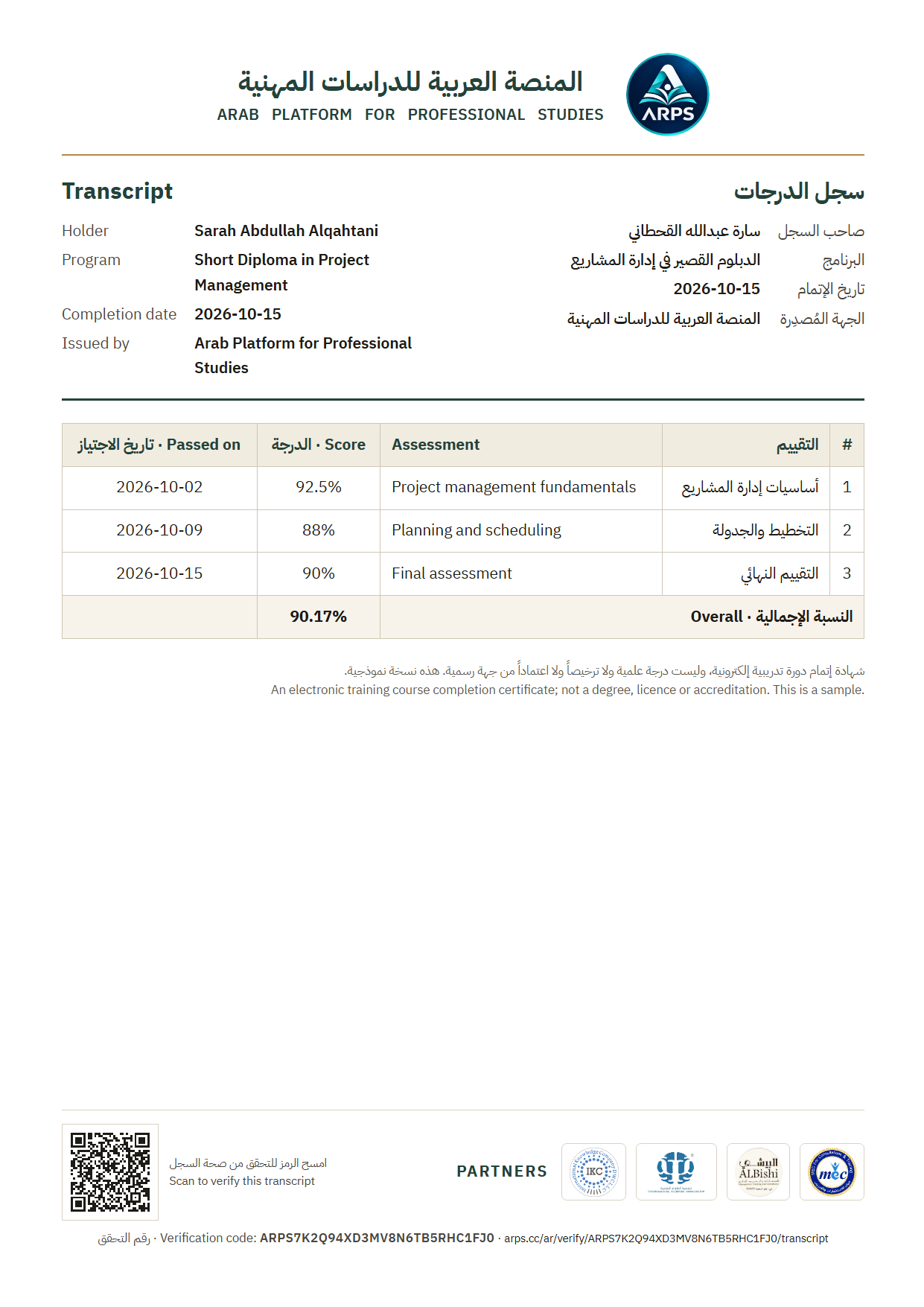
The real design with fictional details; opens in a new window.
Programs from the same field or route that may complement what you learn here.
Safety, Emergency, Crisis & Business Continuity
Specialist training in disruption impact analysis, executable alternatives and verification.

Safety, Emergency, Crisis & Business Continuity
Analyze critical service disruption, compare continuity solutions with evidence, and make testable recommendations.

Career Development, Personal Skills & Productivity
Plan a reviewable career transition using skill evidence, constraints, and application opportunities.
Entrepreneurship, Innovation & Product
Build professional judgment for technology innovation bets, from opportunity framing and evidence to a feasible portfolio, governance and rebalancing.