Professional Mini-Master in Technology Innovation and Initiative Portfolios
Professional Mini-Master in Technology Innovation and Initiative Portfolios is a free program on ARPS, the Arab Platform for Professional Studies. Build professional judgment for technology innovation bets, from opportunity framing and evidence to a feasible portfolio, governance and rebalancing. The five modules start with a measurable problem rather than a tool name.
The five modules start with a measurable problem rather than a tool name. You compare alternatives and dependencies, then design trials that separate service value from technology readiness. You select a feasible set of initiatives under budget, specialist capacity and dependency constraints. You assign decision, data and output rights and define conditions for operating a service or stopping it. Finally, you measure benefits and incremental value and defend portfolio rebalancing in a board memorandum. Training cases and numbers are fictional; methodological sources are cited with their limits. One integrated final assessment follows all five modules.
Practical relevance
Apply the tools to an initiative you are permitted to study or to the included fictional cases. Produce a problem card, evidence roadmap, initiative register and decision memo without sharing secrets or personal records.
Why this program
An initiative can top a scorecard yet be infeasible because data rights are missing or the same specialist is committed elsewhere. The program connects hypotheses with evidence, capacity, rights and realized benefits. Expansion is not presumed correct; testing, revision or stopping can be the better decision.
Career relevance
The material fits innovation, product, strategy, portfolio and transformation responsibilities for practitioners with relevant foundations. It develops decision analysis and cross-functional communication without promising employment, promotion or regulated authorization.
What you will learn
Frame a measurable technology innovation problem and compare interventions under adoption, integration and initial investment constraints.
Design a sequence of trials that separates value hypotheses from technology readiness and interprets results and limits before funding.
Construct a feasible initiative portfolio and test its ranking against capacity, dependencies and risk balance.
Design governance that assigns decision, data, output and risk rights and defines scale or stop conditions.
Evaluate benefits and economic value and justify technology portfolio rebalancing in an integrated decision memorandum.
Learning outcomes (5)
Frame a measurable technology innovation problem and compare interventions under adoption, integration and initial investment constraints.
Design a sequence of trials that separates value hypotheses from technology readiness and interprets results and limits before funding.
Construct a feasible initiative portfolio and test its ranking against capacity, dependencies and risk balance.
Design governance that assigns decision, data, output and risk rights and defines scale or stop conditions.
Evaluate benefits and economic value and justify technology portfolio rebalancing in an integrated decision memorandum.
Who it is for
Innovation, product, strategy, portfolio and transformation managers with relevant foundational experience
Project and portfolio office leaders asked to allocate budgets across competing technology initiatives.
Corporate intrapreneurs and innovation lab managers who need a disciplined method for experimenting, scaling and stopping.
Prerequisites
Practical experience with an initiative, project or technology investment decision
Ability to interpret basic performance, cost and risk measures
Management-level familiarity with present value, return and cost; no specialist finance background is needed.
Ability to write a concise decision memo that separates evidence from assumption and states what could change the recommendation.
Turn a technology proposal into a testable problem, then compare alternatives, dependencies and the first investment gate.
5 lessons · 4 hours
Frame a valuable problem and comparison baseline51 min
When does an initiative become innovation?48 min
Map the value ecosystem and dependencies48 min
Screen technology alternatives before selecting a supplier45 min
Construct an initial investment case and decision gate48 min
Subject 2
Evidence, Experimentation and Technology Readiness
Sequence hypotheses, trials and readiness evidence, separating an observed result from its interpretation before the next commitment.
5 lessons · 4 hours
Turn uncertainty into falsifiable hypotheses48 min
Design a trial that separates intervention effects from changing conditions48 min
Interpret a result without overstating certainty45 min
Assess technology readiness in its relevant environment45 min
Sequence learning and funding gates45 min
Subject 3
Portfolio Construction and Resource Allocation
Compare initiatives on consistent terms, test ranking sensitivity, and account for capacity, dependencies and correlated risk.
5 lessons · 3.5 hours
Build a comparable initiative register45 min
Select criteria and test ranking sensitivity45 min
Let capacity and dependencies shape the portfolio48 min
Balance horizons and correlated risks42 min
Stage funding and recover capacity42 min
Subject 4
Technology Initiative Governance and Scaling
Assign decision, intellectual property and risk ownership, with explicit conditions for operation, revision or stop.
5 lessons · 4 hours
Assign decision rights at a portfolio gate48 min
Set output and data rights before a partnership trial48 min
Link risk causes, signals, owners and responses45 min
Move a trial into an operable service45 min
Change course and stop responsibly42 min
Subject 5
Value Measurement and Portfolio Rebalancing
Connect initiative outputs to benefits, appraise uncertain value and rebalance the portfolio in an integrated decision memorandum.
5 lessons · 4 hours
Connect initiative outputs to verifiable benefits45 min
Appraise economic value under uncertainty48 min
Build a portfolio dashboard that explains variance45 min
Rebalance when evidence or capacity changes45 min
Defend an integrated board decision48 min
Subjects unlock in sequence as you progress.
Strengths
Connect technology trials to a feasible initiative portfolio
Worked cases and practices with decision feedback
Five advanced modules with distinct summaries and an integrated assessment
Evidence basis
Scoped primary sources include the Oslo Manual, public ISO materials, GAO guidance, PMI and the Green Book. Lessons distinguish source guidance from fictional case assumptions and figures; an ISO public description is neither the full standard nor program accreditation.
Reference organizations
OECD/Eurostat
ISO
PMI
U.S. GAO
HM Treasury
Frameworks used
Oslo Manual innovation definitions — 2018
GAO technology readiness assessment guide — 2020
Methodology
Modules connect innovation definitions, portfolio selection, trials, technology readiness and benefit appraisal while stating each source limit.
Program questions
Do I need programming experience?
Exercises require no coding, but assume basic familiarity with performance data, integration and investment decisions. Foundational preparation helps if these ideas are new.
What will I produce during the lessons?
You build a problem card, trial plan, portfolio register, funding and governance conditions, then a board memo. Fictional cases let you work without company data.
How is learning assessed?
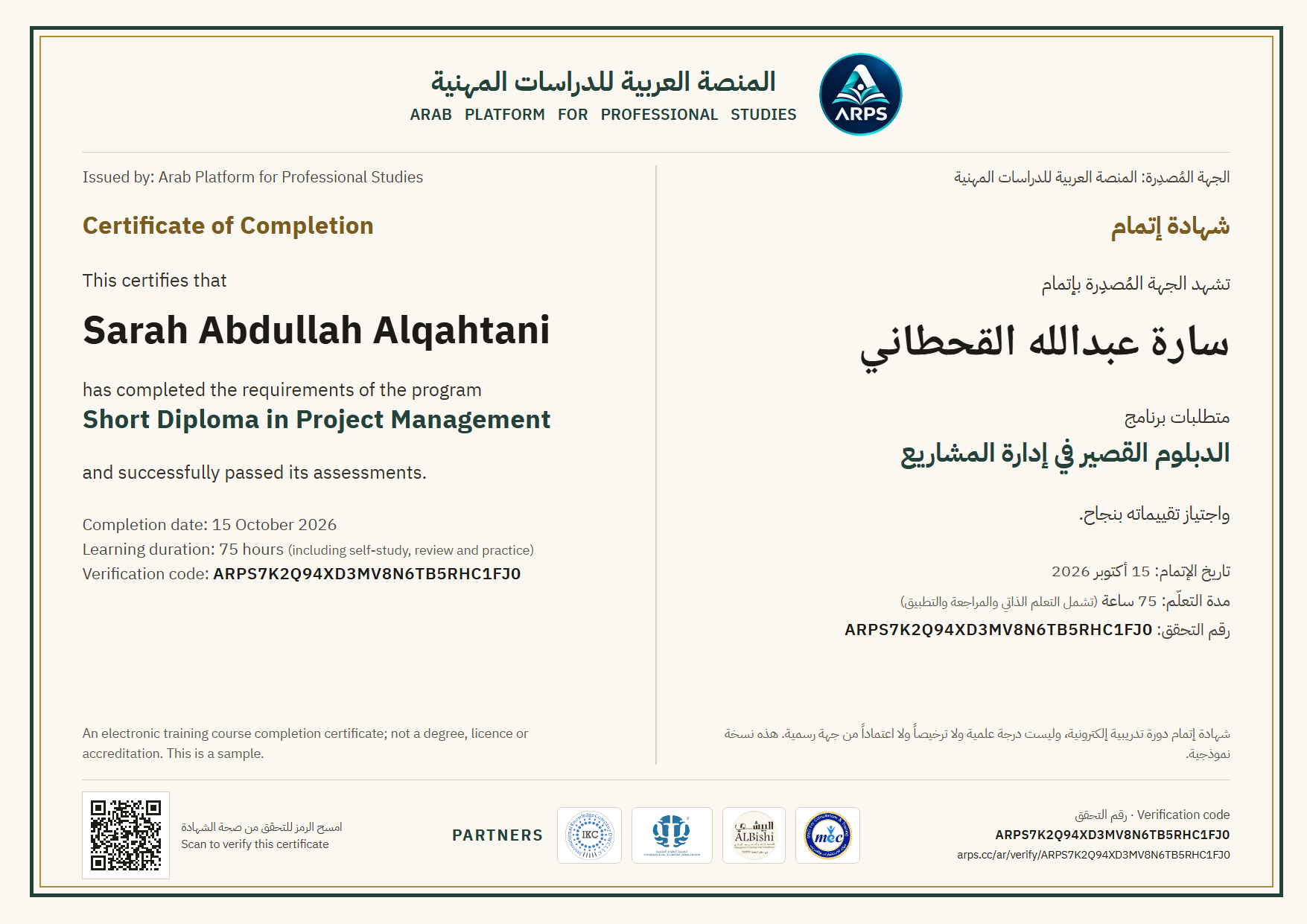
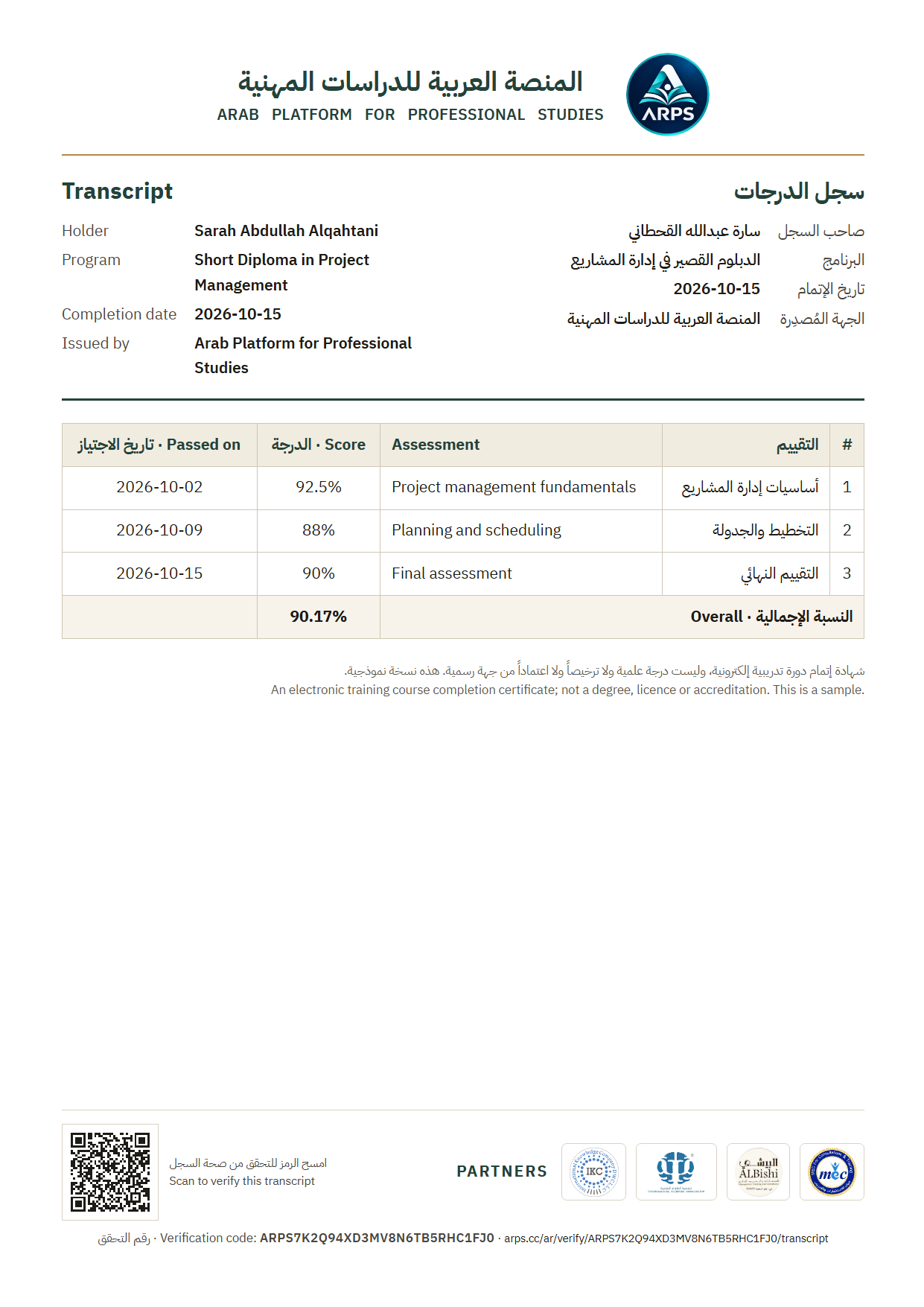
Knowledge checks appear during lessons, followed by one integrated final after all five modules. A transcript accompanying the certificate shows performance on each module's questions within the same qualifying final attempt, not separate module examinations.
Is the certificate a university degree or external accreditation?
No. It is an internal completion credential for the Professional Mini-Master route, not a university degree, standards accreditation or professional license. Availability and issuance follow central platform policy.
May I use workplace data?
The fictional cases are sufficient. When applying the method at work, use only authorized information and review rights, privacy and local constraints before any trial.
Is Professional Mini-Master in Technology Innovation and Initiative Portfolios free, and do I get a certificate?
Yes. Professional Mini-Master in Technology Innovation and Initiative Portfolios is free on ARPS: every lesson, exercise and assessment is free, the first subject is open to read without an account, and the program is available in Arabic and English. Issuing a certificate is optional; it is a training completion certificate showing you passed the program's assessments, not a university degree, a professional licence or an endorsement by an external body.
What other names is Professional Mini-Master in Technology Innovation and Initiative Portfolios known by?
The subject of this program is also known as: innovation management, innovation portfolio management, technology innovation strategy. Learners usually find it by searching for: innovation management course, learn innovation portfolio management, free technology innovation program, evaluating innovation opportunities, online program with completion certificate.
Learn the specialist tasks of innovation management, from an evidenced opportunity to a bounded experiment, decision and operating handover. Produce job aids, evidence logs, calculations and decision briefs using fictional bilingual cases.