Specialist Preparation Program in Innovation Management
Specialist Preparation Program in Innovation Management is a free program on ARPS, the Arab Platform for Professional Studies. Learn the specialist tasks of innovation management, from an evidenced opportunity to a bounded experiment, decision and operating handover. Produce job aids, evidence logs, calculations and decision briefs using fictional bilingual cases.
Begin by separating ideas and prototypes from changes made available or brought into use. Map a user journey and interpret logs and interviews without converting descriptive differences into proved causes. Write a testable opportunity with decision authority, outcome and guardrail.
Generate alternatives with distinct mechanisms and screen them by what can be learned now. Test a prototype’s meaning before live operation and manage partnership and data-sharing boundaries. Design a reversible trial, calculate rates with correct denominators, and choose revision, stopping or conditional expansion.
For operation, build a metric dictionary and transparent benefit-cost estimate. Hand states, exceptions and monitoring to a service owner, and review outcomes after launch. Finish with an integrated case connecting opportunity, options, trial, decision and handover. Teaching cases are fictional. The program grants neither professional licensure nor endorsement by a standards body.
Practical relevance
Use the tools for authorized service and initiative work: opportunity card, journey map, option matrix, trial protocol, metric dictionary and handover log. No job or measured business result is promised.
Why this program
An appealing idea or launch count does not establish innovation value. Practitioners need to separate evidence from assumption, choose informative tests, and protect service users when moving into operation.
What you will learn
Distinguish idea, prototype and implemented innovation using baseline and use evidence, and map a user journey through defined events.
Conduct neutral discovery, separate observation from inference, and write a testable opportunity brief within authority.
Generate alternatives with distinct mechanisms and screen them by evidence, uncertainty and constraint rather than false precision.
Test a prototype hypothesis with an appropriate method and manage knowledge-sharing and partnership boundaries.
Design a bounded reversible trial with denominators and guardrails and separate proposer, approver and operator roles.
Calculate trial signals without overclaiming causality and choose iterate, stop or scale using explicit conditions.
Build a balanced metric dictionary and interpret benefit and cost ranges with correct units and sensitivity.
Hand over states, exceptions and monitoring, then review post-launch outcomes with rival explanations and action owners.
Operate a traceable idea flow and refer conflicts of interest and privacy decisions to authorized owners.
Brief sponsors and operators candidly and assemble an initiative dossier from opportunity through handover.
Learning outcomes (10)
Distinguish idea, prototype and implemented innovation using baseline and use evidence, and map a user journey through defined events.
Conduct neutral discovery, separate observation from inference, and write a testable opportunity brief within authority.
Generate alternatives with distinct mechanisms and screen them by evidence, uncertainty and constraint rather than false precision.
Test a prototype hypothesis with an appropriate method and manage knowledge-sharing and partnership boundaries.
Design a bounded reversible trial with denominators and guardrails and separate proposer, approver and operator roles.
Calculate trial signals without overclaiming causality and choose iterate, stop or scale using explicit conditions.
Build a balanced metric dictionary and interpret benefit and cost ranges with correct units and sensitivity.
Hand over states, exceptions and monitoring, then review post-launch outcomes with rival explanations and action owners.
Operate a traceable idea flow and refer conflicts of interest and privacy decisions to authorized owners.
Brief sponsors and operators candidly and assemble an initiative dossier from opportunity through handover.
Who it is for
This program serves staff in public services, nonprofit initiatives and internal teams who frame and test an innovation opportunity within a defined assignment.
It suits improvement coordinators, early career user researchers and operations analysts with initial practical experience who need evidence, trial and handover tools.
It does not suit someone seeking professional licensure, clinical training, or automatic authority to invest, contract, or access personal records.
Prerequisites
Read a simple service log with counts, periods and event types, and distinguish observations from assumptions before interpreting results.
Calculate a rate from a named numerator and denominator; organize short interview notes or a user journey in a basic table.
Know who owns service and data decisions at work. Professional licensure and experience managing an entire innovation portfolio are unnecessary.
Begin with the difference between an unused proposal and a change made available or brought into use. Name the baseline, comparison unit and implementation scope before describing novelty. A room-booking sketch proves no benefit; sending a message to a subset supports bounded availability but not fewer calls. Map the visitor path from finding a room to confirmation, separating observed acts from explanations. Calendar opens cannot stand for uniqu
4 lessons · 2 hours
Distinguish ideas, innovation and problems34 min
Map the user journey and pain points34 min
Conduct neutral discovery and synthesize evidence34 min
Write a testable opportunity brief32 min
Subject 2
Generate and screen alternatives
Generate options by asking how each could work: clarify wording, show the approval step or provide a nondigital channel, rather than listing three button colors. For each, write a hypothesis and an observation that could disconfirm it. Screening separates evidence of value, ease of a small test, and potential harm or exclusion; decimal scores do not remove unknowns. Match a prototype to the question: paper can test meaning but not mail delivery,
4 lessons · 2.5 hours
Generate options from constraints34 min
Screen ideas for value and feasibility34 min
Test prototype assumptions34 min
Manage knowledge and partner boundaries34 min
Subject 3
Run the initiative and learn by experiment
A bounded experiment connects a hypothesis to treatment, comparison, unit, guardrail, stop rule and restoration path. When display time or staff help differs across paths, an observed gap remains descriptive until alternatives are examined. Record who approves, operates and stops; paper-prototype permission does not authorize live sends. In the worked case, 48 valid requests from 100 starters and 66 from 120 mean 48% and 55%, a seven-percentage-p
4 lessons · 2.5 hours
Design a reversible small experiment34 min
Assign roles and maintain a decision log34 min
Interpret experiment signals34 min
Decide iterate, stop or scale34 min
Subject 4
Measure value and hand over operations
A useful metric answers a decision question and defines numerator, denominator, period and source. Idea and send counts measure activity; valid completion, confirmation time and correction requests track outcomes and side effects. Do not present 66 valid among 78 submissions as if it were 66 of 120 starters: they are 84.6% and 55% for different questions. Estimate value and cost as ranges with assumptions; freed staff time is possible capacity, n
4 lessons · 2.5 hours
Build balanced activity and outcome measures34 min
Estimate benefit, cost and uncertainty34 min
Handover to operational owner34 min
Review after launch and correct course34 min
Subject 5
Integrated professional practice
An idea flow needs status, owner, decision reason and feedback, not an inbox that merely counts. Preserve both contributors to similar ideas and do not rank by title alone. Disclose an evaluator’s interest in a supplier and refer participation and criterion review to an unaffected authority. Test alert logic on synthetic cases before seeking real visitor records; privacy and contract decisions exceed the specialist’s authority. Give a sponsor a c
4 lessons · 2.5 hours
Operate a traceable idea flow34 min
Handle conflicts and privacy32 min
Communicate with sponsor and operations32 min
Integrate opportunity through handover1 hours
Subjects unlock in sequence as you progress.
Strengths
Evidence and defined denominators before outcome claims
Reversible trials with guardrails and authority boundaries
Operating handover with states, exceptions and owners
Evidence basis
General definitions draw on the Oslo Manual and recorded primary sources. Public ISO pages support only their broad scope; this program claims neither clause coverage nor issuer endorsement. Cases and figures are authored for teaching.
Methodology
An appealing idea or launch count does not establish innovation value. Practitioners need to separate evidence from assumption, choose informative tests, and protect service users when moving into operation.
Assessment
Assessments follow the program blueprint and may use module assessments, a final assessment, or a combination, under the approved attempt policy.
Assessment attempts: 2 per assessment, 7 days apart
The pass mark is announced before the program is published.
Certificate
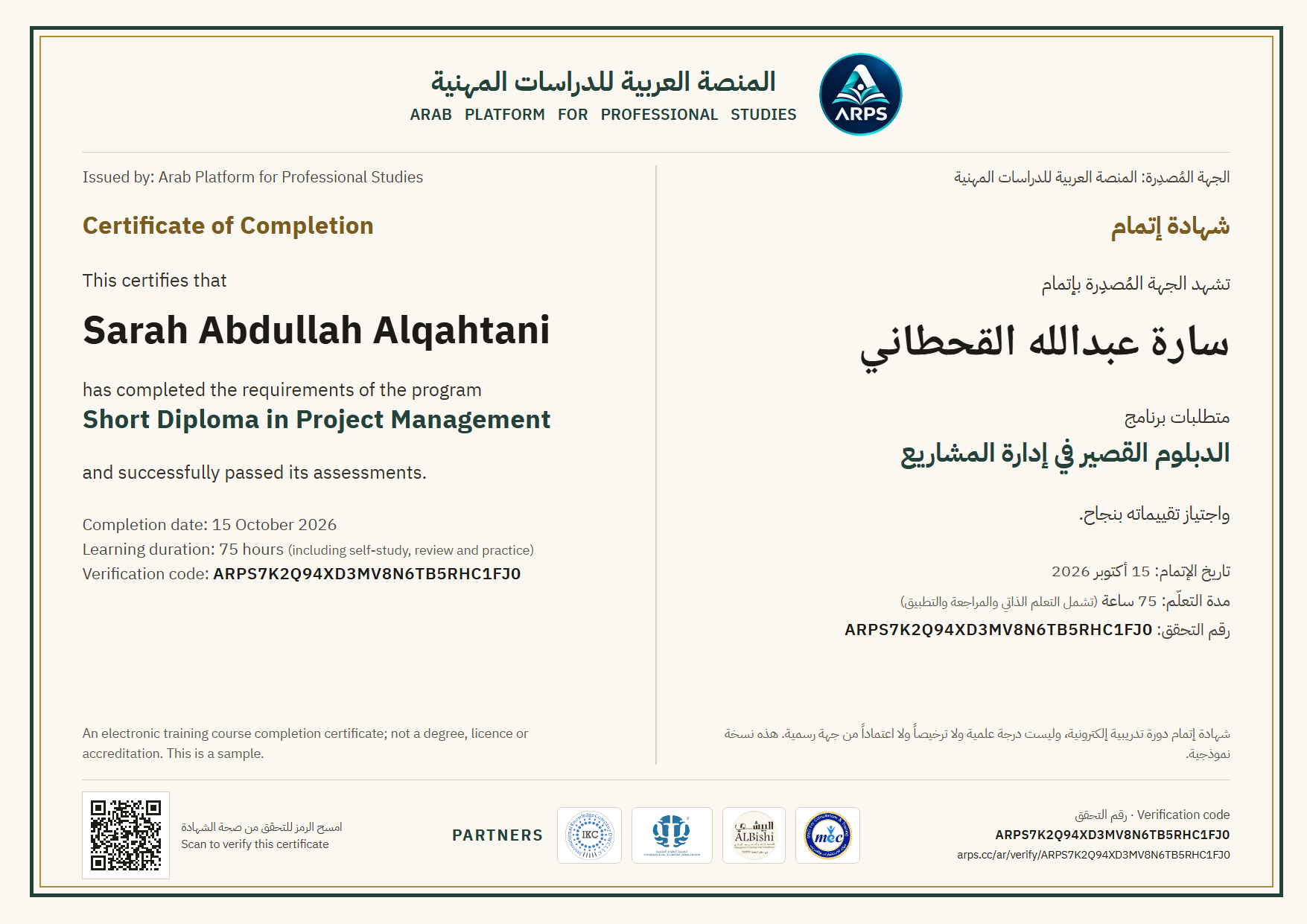
The credential confirms completion and successful assessment; it does not represent professional licensure unless explicitly and lawfully stated.
The specialist reports evidence, limits and a recommendation; the authorized service owner decides on expansion after reviewing risk and resources.
Do I need real workplace data?
No. Lessons use fictional records; applying methods at work remains subject to organizational permission.
Does it teach full innovation-portfolio management?
It follows one initiative through execution and handover; resource allocation across a portfolio belongs to its owner.
How is practical skill assessed?
Lessons have self-check tasks and formative checks, followed by a banked summative for each module.
Are official learning hours accredited?
Official hours remain unset. Reading, practice and assessment minutes are editorial workload estimates, not external credit.
How are trial rates compared?
Use the same eligible population and time window, disclose exclusions, and check whether workload moved to another channel.
Is Specialist Preparation Program in Innovation Management free, and do I get a certificate?
Yes. Specialist Preparation Program in Innovation Management is free on ARPS: every lesson, exercise and assessment is free, the first subject is open to read without an account, and the program is available in Arabic and English. Issuing a certificate is optional; it is a training completion certificate showing you passed the program's assessments, not a university degree, a professional licence or an endorsement by an external body.
What other names is Specialist Preparation Program in Innovation Management known by?
The subject of this program is also known as: innovation management, corporate innovation, innovation strategy, design thinking. Learners usually find it by searching for: innovation management course, innovation management course online, innovation management course free, corporate innovation training, design thinking course.
Learn to diagnose ambiguous service problems, compare design options and write evidence-based advisory recommendations with clear limits, from research through testing and monitoring.