

Safety, Emergency, Crisis & Business Continuity
Specialist Preparation Program in Business Continuity
Specialist training in disruption impact analysis, executable alternatives and verification.
Free
Specialist Preparation Program in Risk Assessment and Preparedness is a free program on ARPS, the Arab Platform for Professional Studies. Learn to frame, analyze and evaluate risks, then prepare controls and readiness for a bounded service. Fictional data lead to a risk register, continuity card, exercise and documented corrective action within a specialist role.

Optional certificate fee 50% launch discount
$90 instead of $180
331 AED or 338 SAR
Begin by defining a service, objective and decision criterion, then separate the event, consequence, evidence and assumption. Select an assessment technique suited to the data and calculate indicators with explicit numerators and denominators. Compare treatments and record the control, owner and remaining exposure without inventing certainty. Translate findings into service impact, dependencies and failure points, then write a safe activation trigger and fallback. Design an exercise, measure observed performance, record a gap, and retest the correction. Finally combine risk and readiness evidence in an owner briefing and monitoring indicators. Cases and numbers are fictional teaching material. Study does not grant authority to accept risk, activate a plan or claim standards conformity; authorized decision owners must review real local conditions.
Produce cards and registers that can inform review of a real service after replacing fictional numbers with verified data and obtaining the decision owner’s approval. Learn to show what missing evidence changes and when testing or escalation is justified.
A risk register may look complete even when the rate uses the wrong denominator or a control has never been tested. The program connects assessment to readiness evidence and exercise results so a specialist can present a bounded, reviewable decision.
The module begins by defining a service, objective and decision owner before opening a risk register.
This module makes technique selection precede numbers that could create false precision.
This module moves from ranking risk to an action that changes a specific driver or effect.
This module derives preparedness requirements from a defined service's disruption impact over time rather than a vague promise of rapid return.
This module teaches exercise design around a specific decision rather than a general presentation of a plan.
The final module joins specialist work into a reviewable decision.
Subjects unlock in sequence as you progress.
Teaching draws on public descriptions and primary materials in the listed references. Numerical case thresholds are fictional training criteria, not standards or legal limits; naming a source does not imply its endorsement of this program.
A risk register may look complete even when the rate uses the wrong denominator or a control has never been tested. The program connects assessment to readiness evidence and exercise results so a specialist can present a bounded, reviewable decision.
Assessments follow the program blueprint and may use module assessments, a final assessment, or a combination, under the approved attempt policy.
Assessment attempts: 2 per assessment, 7 days apart
The pass mark is announced before the program is published.
The credential confirms completion and successful assessment; it does not represent professional licensure unless explicitly and lawfully stated.
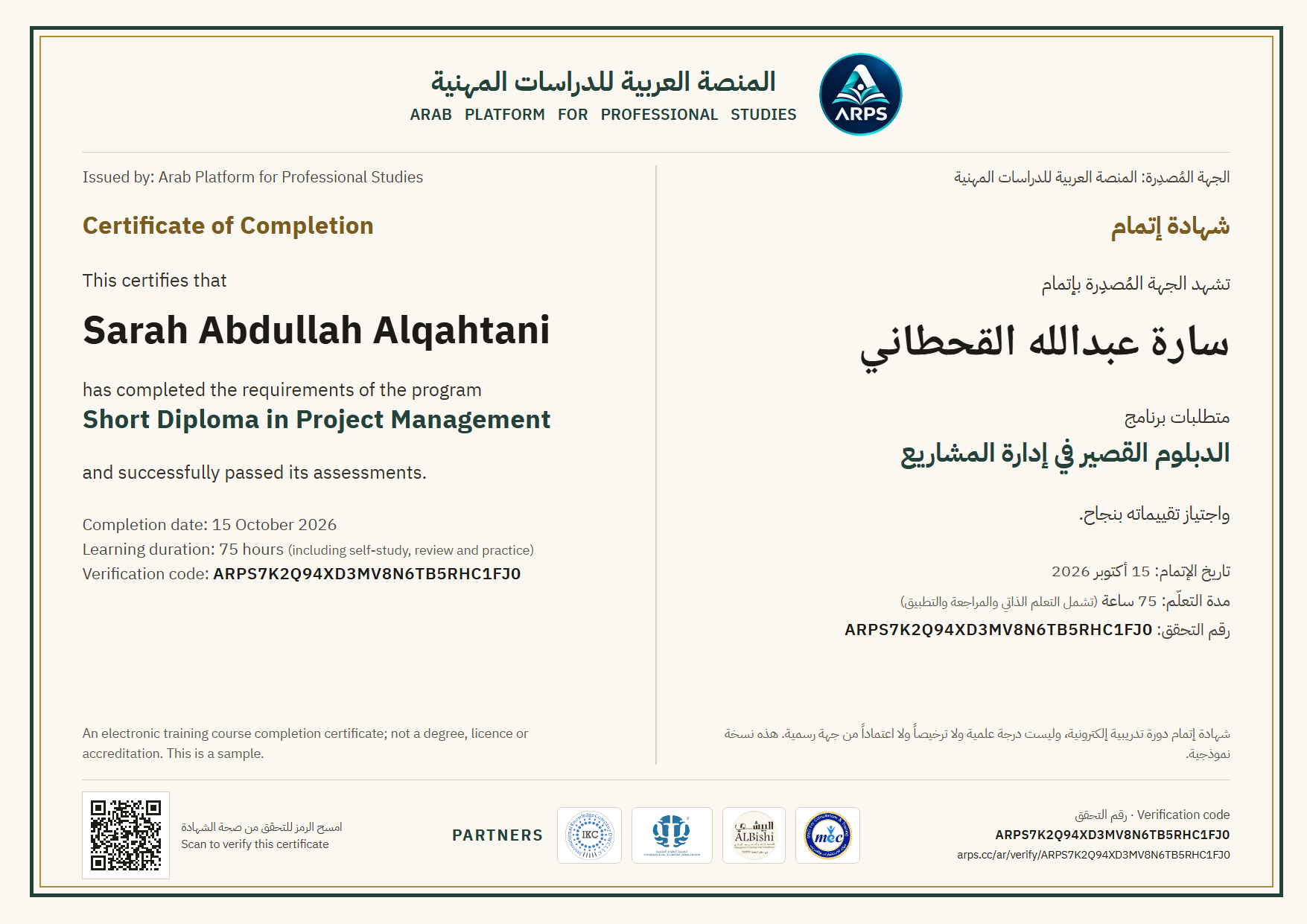
Every certificate has a public verification code. Verify a certificate
The real design with fictional details; opens in a new window.
No. They are explained fictional criteria; review local criteria before real use.
No. You prepare evidence and recommendations; authorized owners accept risk and activate plans.
Through observed exercise performance against defined objectives and timing, followed by gap tracking and retest.
No. The fictional inputs support all exercises; transfer the method only with local permission.
No. This scope uses public descriptions and primary links without reproducing restricted clauses.
Practice produces a card or register with a worked answer; assessment tests decisions on other facts.
Yes. Specialist Preparation Program in Risk Assessment and Preparedness is free on ARPS: every lesson, exercise and assessment is free, the first subject is open to read without an account, and the program is available in Arabic and English. Issuing a certificate is optional; it is a training completion certificate showing you passed the program's assessments, not a university degree, a professional licence or an endorsement by an external body.
The subject of this program is also known as: risk assessment, risk management, emergency preparedness, risk analysis. Learners usually find it by searching for: risk assessment course, risk assessment course online, risk assessment course free with certificate, emergency preparedness training, how to become a risk analyst.
Programs from the same field or route that may complement what you learn here.
Safety, Emergency, Crisis & Business Continuity
Specialist training in disruption impact analysis, executable alternatives and verification.

Safety, Emergency, Crisis & Business Continuity
Analyze critical service disruption, compare continuity solutions with evidence, and make testable recommendations.

Safety, Emergency, Crisis & Business Continuity
Independent preparation for the NEBOSH 2025 International General Certificate specification and GIC1/GIC2, from management-scenario reasoning to a practical risk assessment and action plan.

Data, AI, Digital, IT & Cybersecurity
Turn software requirements into checkable acceptance conditions and reproducible tests. Record execution and defects, then write an evidence bounded release recommendation. The program covers design, risk, accessibility, authorization, performance and automation.