Specialist Preparation Program in Project Management
Specialist Preparation Program in Project Management is a free program on ARPS, the Arab Platform for Professional Studies. An applied program for specialists who create and inspect project-management artifacts from authorization through closure, using execution, calculation and escalation cases within clear authority boundaries.
The program moves practitioners from terminology to inspectable work products: a charter, stakeholder register, requirements and acceptance criteria, WBS, schedule network, estimate, risk register, performance measurement, change request and closure pack.
Five units contain 20 lessons. Every lesson includes a worked case, specialist lab and exercise with feedback. Cases are fictional and context-neutral; completion does not grant approval authority, field experience or eligibility for an external certification.
Practical relevance
Each unit produces tools that can be adapted to real work after fictional data is replaced with authorized evidence and organizational policies and decision rights are applied.
Why this program
A common gap is not the absence of a form but the missing connection between record, evidence and decision. The program develops the ability to build and inspect that connection and escalate beyond delegated authority.
Career relevance
Useful for project coordinators, control specialists, PMO staff and initiative teams who prepare records, analysis and decision follow-up. It does not promise employment, promotion or regulated professional eligibility.
What you will learn
Turn an authorized project assignment into a concise charter, value map, constraints and traceable decisions.
Analyze stakeholders and select a predictive, adaptive or hybrid approach, justifying its fit to context.
Translate requirements into acceptance criteria, scope boundaries and a deliverable-oriented work breakdown structure.
Build a linked schedule and transparent estimate, checking critical path, assumptions, reserves and baselines.
Coordinate work, resources and suppliers through explicit responsibilities, interfaces and reviewable records.
Design quality controls, communications and reports that connect status to evidence and a required decision rather than narrating activity.
Maintain an actionable risk register linking responses to triggers, owners, reserves and escalation limits.
Measure performance, forecast outcomes and distinguish useful variance from misleading indicators within available data quality.
Operate integrated issue and change control that protects configuration, baselines and decision authority.
Validate delivery, transfer ownership, close obligations and preserve learning, then integrate controls to stabilize a troubled project.
Learning outcomes (10)
Turn an authorized project assignment into a concise charter, value map, constraints and traceable decisions.
Analyze stakeholders and select a predictive, adaptive or hybrid approach, justifying its fit to context.
Translate requirements into acceptance criteria, scope boundaries and a deliverable-oriented work breakdown structure.
Build a linked schedule and transparent estimate, checking critical path, assumptions, reserves and baselines.
Coordinate work, resources and suppliers through explicit responsibilities, interfaces and reviewable records.
Design quality controls, communications and reports that connect status to evidence and a required decision rather than narrating activity.
Maintain an actionable risk register linking responses to triggers, owners, reserves and escalation limits.
Measure performance, forecast outcomes and distinguish useful variance from misleading indicators within available data quality.
Operate integrated issue and change control that protects configuration, baselines and decision authority.
Validate delivery, transfer ownership, close obligations and preserve learning, then integrate controls to stabilize a troubled project.
Who it is for
Project coordinators and project support or control specialists.
PMO and improvement-team members who prepare project evidence and decisions.
Practitioners moving from foundation knowledge into responsibility for records and analysis.
Staff asked to prepare a project charter, schedule or risk register who want reviewable evidence that a decision maker can rely on.
Prerequisites
Introductory knowledge of a project life cycle or general experience in a project team.
Ability to read tables and perform simple percentage calculations; no specific scheduling application is required.
Willingness to apply the exercises to a real or hypothetical work project using only authorized data, and to set aside regular study time within the 30-day access window.
What it does not offer
Not PMP exam preparation and not aligned to an external issuer blueprint.
Does not grant financial, contractual or legal authority or establish field experience or software proficiency.
Turn an idea into a controlled assignment, identify influence and impact, select a delivery approach and establish decision authority.
4 lessons · 3 hours
Project charter and outcome map42 min
Stakeholder analysis and engagement plan42 min
Selecting and tailoring the delivery approach40 min
Governance, decision map and value42 min
Subject 2
Requirements, scope, schedule and estimating
Turn needs into acceptable scope, decompose work, link activities and build checkable estimates and baselines.
4 lessons · 3 hours
Requirements, acceptance criteria and scope boundaries44 min
Work breakdown structure and work packages44 min
Schedule network, critical path and constraints54 min
Estimating, reserves and the cost baseline50 min
Subject 3
Execution, suppliers, quality and communication
Run work through clear ownership, supplier interfaces, quality controls and decision-oriented reporting.
4 lessons · 2.5 hours
Work authorization and resource coordination42 min
Procurement and supplier interfaces40 min
Quality planning and control40 min
Decision-oriented reporting and communication42 min
Subject 4
Risk, performance, issues and change
Turn uncertainty and variance into records, responses, forecasts and integrated change decisions that preserve the baseline.
4 lessons · 3 hours
Risk register, responses and triggers42 min
Measurement design and status-data quality40 min
Earned value and forecasting48 min
Issues, integrated change and configuration50 min
Subject 5
Validation, transition, closure and recovery
Connect acceptance to transition, closure of obligations and learning, then integrate specialist tools in a recovery case.
4 lessons · 3 hours
Roles, ethics and escalation boundaries42 min
Collaboration and operational conflict management42 min
Tailoring and hybrid integration points40 min
Validation, transition, closure and recovery48 min
Subjects unlock in sequence as you progress.
Strengths
Twenty specialist labs, each producing an artifact, inspection and escalation boundary.
Calculations, networks and change cases use stated data and assumptions.
Sixty bilingual logical question groups with learning checks separate from module assessments.
Five integrated summaries connect records, decisions and dependencies.
Evidence basis
The program uses professional and official project-management sources with original instructional wording and fictional cases. Citation does not imply endorsement or partnership, and a publication description is not represented as access to a protected full text.
Reference organizations
Association for Project Management (APM)
Project Management Institute (PMI)
BCcampus
National Institute of Standards and Technology (NIST)
Frameworks used
Agile Manifesto principles — original software context explicitly identified — 2001 principles, public HTML
Scrum — definition and empirical foundations; not all agile practice — November 2020
NIST AI RMF — public overview of voluntary risk management only — AI RMF 1.0; revision activity noted, no replacement inferred
Methodology
Instruction connects explanation with work artifacts, cases, exercises and assessment. Review is assisted internal self-review, not external endorsement or a learner study.
How the route works
Specialist Preparation Programs are focused pathways that build applied knowledge and role-specific capabilities without automatically conferring professional licensure or the right to practise a regulated profession.
Structured self-paced study using focused modules, examples, scenarios, exercises, knowledge checks, and assessments that measure application of knowledge.
Focused development of role-specific knowledge and tasks.
Strong connection between concepts and practical scenarios.
A shorter, more focused pathway than a comprehensive diploma.
Clear professional boundaries in regulated fields.
Assessment
Assessments follow the program blueprint and may use module assessments, a final assessment, or a combination, under the approved attempt policy.
Assessment attempts: 2 per assessment, 7 days apart
The pass mark is announced before the program is published.
Certificate
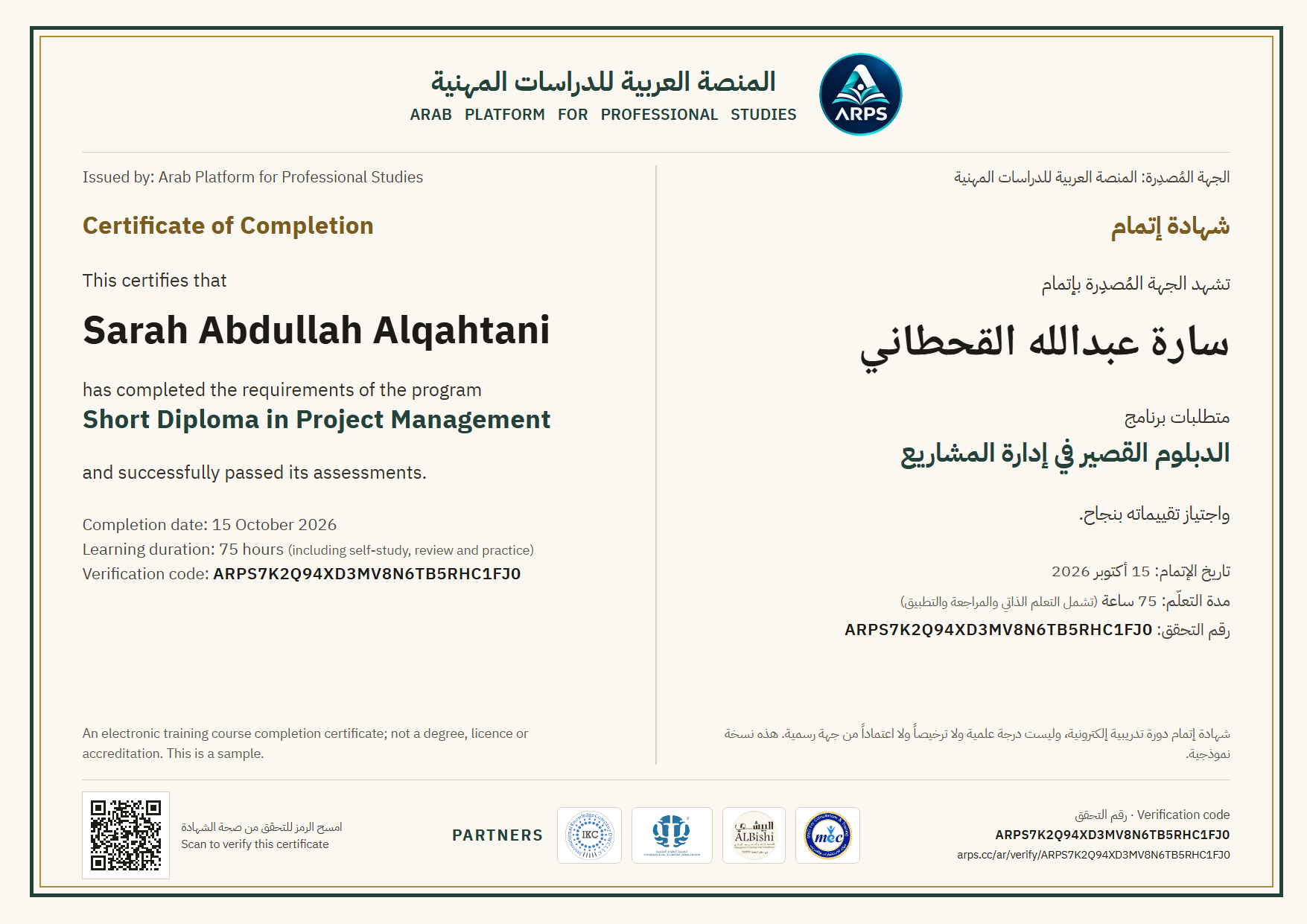
The credential confirms completion and successful assessment; it does not represent professional licensure unless explicitly and lawfully stated.
No. It assesses internal specialist tasks and claims neither exam alignment nor external eligibility.
Do I need scheduling software?
No. Networks and calculations use lesson data. Proficiency in a specialist application requires separate hands-on training.
Can I use the templates directly?
Transfer their logic and fields, then apply your organization's policies, decision rights and data sources. Do not transfer fictional case figures.
How does it differ from the foundation diploma?
It assumes an initial foundation and emphasizes producing, inspecting, correcting and escalating work artifacts rather than only explaining concepts.
Does it authorize me to approve changes?
No. You learn to prepare change analysis and update dependencies after a decision; approval remains with the named authority.
How is skill assessed?
Through exercises with outputs and criteria, applied questions, and a module assessment that draws one distinct item from each lesson.
Is Specialist Preparation Program in Project Management free, and do I get a certificate?
Yes. Specialist Preparation Program in Project Management is free on ARPS: every lesson, exercise and assessment is free, the first subject is open to read without an account, and the program is available in Arabic and English. Issuing a certificate is optional; it is a training completion certificate showing you passed the program's assessments, not a university degree, a professional licence or an endorsement by an external body.
What other names is Specialist Preparation Program in Project Management known by?
The subject of this program is also known as: project management, PM, project planning, project coordination. Learners usually find it by searching for: free project management course, learn project management online, project planning and scheduling, project scope and risk management, project management course with completion certificate.
Diagnose project delivery variance from conflicting evidence, compare feasible interventions, and write a recommendation with explicit limits, decision ownership and follow-up measures.
Bilingual preparation for project-management decisions and the PMP exam. The design starts with PMI’s official outline and combines people, planning, delivery and business-environment decisions with calculations and explained practice. This is independent preparation, not PMI’s exam or the PMP credential.