Certified Information Privacy Manager (CIPM) Preparation
Certified Information Privacy Manager (CIPM) Preparation is a free program on ARPS, the Arab Platform for Professional Studies. Independent CIPM preparation across the six domains of the IAPP privacy program management blueprint. Six modules and thirty lessons move from building a privacy framework and governing it through assessment, protection, sustainment and response.
Important notice: Independent preparation for an external credential. Arab Platform for Professional Studies (ARPS) does not administer the IAPP exam, award CIPM, or claim IAPP endorsement.
Apply the decision in map personal information and define program scope, recording assumptions, evidence and scope limits.
From lesson 1, readable now without an account: Map personal information and define program scope
The scope of a privacy program begins with what the organization actually does with personal information. The skill in this lesson is to produce an initial map connecting source, purpose, decision owner, processor, retention point and onward flow. Domain I.A of the current CIPM Body of Knowledge calls for identifying sources, types and uses of personal information; understanding the business model, operating environment and risk appetite; and choosing a governance model, team structure and internal partners. These tasks depend on one another. Accountability for an undiscovered flow is unlikely to work.
A free account saves your progress and takes you straight to lesson 1.
Program facts
Study fee
Free
subjects
6
lessons
30
Estimated time
75 hours
Content last reviewed
Access period
30 days
Study language
Arabic and English
About the program
Six modules and thirty lessons move from building a privacy framework and governing it through assessment, protection, sustainment and response. Each lesson applies a decision to a hypothetical case, then provides an exercise with feedback and original questions. An internal final assessment and readiness mock distributed across all six domains follow. IAPP controls its separate examination and certification.
Practical relevance
Exercises produce scope maps, accountability decisions, risk assessments, monitoring records and response plans.
Why this program
Connects the CIPM blueprint to defensible, documented operating decisions and shows how teams turn policy into accountable evidence and verification.
Career relevance
Useful to privacy program managers and candidates linking governance and controls to team accountability.
Career paths this program serves
This program is a step on the paths of the following occupations. Open a path to see its other programs in study order.
Applying the Six Domains to Integrated Operational Cases
Learning outcomes (30)
Apply the decision in map personal information and define program scope, recording assumptions, evidence and scope limits.
Apply the decision in choose a privacy governance model, recording assumptions, evidence and scope limits.
Apply the decision in communicate privacy vision by role, recording assumptions, evidence and scope limits.
Apply the decision in scope rules and ai-related privacy risks, recording assumptions, evidence and scope limits.
Apply the decision in translate governance into lifecycle policies, recording assumptions, evidence and scope limits.
Apply the decision in assign decisions, execution and escalation, recording assumptions, evidence and scope limits.
Apply the decision in specify metrics and monitoring controls, recording assumptions, evidence and scope limits.
Apply the decision in train roles and maintain change awareness, recording assumptions, evidence and scope limits.
Apply the decision in inventory flows and establish a risk baseline, recording assumptions, evidence and scope limits.
Apply the decision in assess processors and transfer decisions, recording assumptions, evidence and scope limits.
Apply the decision in evaluate physical and technical controls, recording assumptions, evidence and scope limits.
Apply the decision in perform privacy due diligence in a transaction, recording assumptions, evidence and scope limits.
Apply the decision in classify data and test access controls, recording assumptions, evidence and scope limits.
Apply the decision in build privacy into product development, recording assumptions, evidence and scope limits.
Apply the decision in decide on secondary data use, recording assumptions, evidence and scope limits.
Apply the decision in verify safeguards and reduced-linkage controls, recording assumptions, evidence and scope limits.
Apply the decision in interpret performance measures against program goals, recording assumptions, evidence and scope limits.
Apply the decision in audit controls and close findings, recording assumptions, evidence and scope limits.
Apply the decision in select assessments and verify risk treatment, recording assumptions, evidence and scope limits.
Apply the decision in triage and fulfill privacy requests, recording assumptions, evidence and scope limits.
Apply the decision in contain and assess a privacy incident, recording assumptions, evidence and scope limits.
Apply the decision in revise and test the response plan, recording assumptions, evidence and scope limits.
Reassess residual privacy risk after an acquisition using documented controls and reviewable evidence.
Coordinate incident communications and decision records using verified facts and review triggers.
Produce an evidence-backed working file for build a privacy framework for a franchise network, including alternatives and decision limits.
Produce an evidence-backed working file for fund privacy services and allocate operational capacity, including alternatives and decision limits.
Produce an evidence-backed working file for reconcile processing records and field lineage, including alternatives and decision limits.
Produce an evidence-backed working file for separate linkage keys from a research environment, including alternatives and decision limits.
Produce an evidence-backed working file for design assurance samples that reveal operational drift, including alternatives and decision limits.
Produce an evidence-backed working file for coordinate a rights request with an incident evidence hold, including alternatives and decision limits.
Who it is for
CIPM candidates, new privacy program managers, and governance, compliance or product professionals who want to review all six current blueprint domains and justify decisions to teams. The original questions diagnose readiness and are not official IAPP items. It suits people coordinating teams and keeping auditable decision records.
Prerequisites
Learners benefit from basic familiarity with personal-data flows in an organization and the difference between a business objective and evidence of implementation. The program explains operational terms before using them in cases; no country-specific legal expertise or memorized legislation is assumed.
This module starts with actual processing: sources, fields, purposes, recipients and decision owners. Learners turn a conflict between staff description and system configuration into a confidence-graded flow map and verification questions. They compare centralized, distributed and federated governance against workload and review capacity, then design different messages and actions for product, support and procurement. Access to procedures and actual use are measured with relevant denominators. Finally, learners separate facts that may make territorial or sectoral rules relevant from legal conclusions requiring authoritative text and qualified review. An AI service is treated as a data flow with purpose, supplier and retention questions. Fictional cases do not establish compliance or confer the IAPP credential.
5 lessons · 11 hours
Map personal information and define program scope40 min
Choose a privacy governance model44 min
Communicate privacy vision by role38 min
Scope rules and AI-related privacy risks44 min
Build a privacy framework for a franchise network8 hours
Subject 2
Establishing Program Governance
The module turns vision into workable policies for collection, retention, disposal, requests and incidents. Learners identify retention start events, documented holds and supplier execution receipts instead of relying on ticket closure. They assign detection, execution, approval and verification across security, product, procurement, privacy and deputies, separating urgent containment from notice decisions. A metric is specified with numerator, denominator, period, source and intended decision; records are tested rather than trusting a “closed” status. Role-based training for employees and contractors uses simulation and subsequent work evidence. The fictional numbers teach calculation and inference limits. They do not impose a universal legal response period or replace the applicable source.
5 lessons · 11 hours
Translate governance into lifecycle policies44 min
Assign decisions, execution and escalation44 min
Specify metrics and monitoring controls46 min
Train roles and maintain change awareness38 min
Fund privacy services and allocate operational capacity8 hours
Subject 3
Assessing Data and Third Parties
Learners map one processing activity from collection through transfers, copies and disposal, comparing observed operation with a dated criterion. They distinguish a contracted supplier from a live technical connection, test field necessity, and consider aggregates and small-cell linkage. They examine export rights, departed accounts, deletion failures by record and backup locations rather than extending a primary-region assumption. In an acquisition they limit pre-close access and decide which post-close records stay separate or integrate after tested control alignment. Each case produces a gap, owner and closure test. Missing evidence remains unresolved; it is neither proof of safety nor an automatic finding of legal violation.
5 lessons · 11 hours
Inventory flows and establish a risk baseline44 min
Assess processors and transfer decisions44 min
Evaluate physical and technical controls42 min
Perform privacy due diligence in a transaction46 min
Reconcile processing records and field lineage8 hours
Subject 4
Protecting Personal Data During Use
Learners connect classification to task-based read, export, edit and delete rights, testing accounts and API keys rather than trusting a label or encryption alone. A new feature moves from purpose, alternatives and collection minimization to negative tests in production configuration, such as blocking a supplier event after withdrawal. For secondary use, learners separate original and new purposes and compare rates with proper denominators without claiming causation. They verify alignment among policy, agreement, transmitted file and deletion receipt. Tokens are not treated as anonymity when a mapping table or contextual fields can relink a person. The output is a conditional release decision supported by control evidence and explicit residual risk.
5 lessons · 11 hours
Classify data and test access controls42 min
Build privacy into product development42 min
Decide on secondary data use44 min
Verify safeguards and reduced-linkage controls44 min
Separate linkage keys from a research environment8 hours
Subject 5
Sustaining Privacy Program Performance
This module uses balanced measures: coverage of pre-release change assessment, evidence-backed remedy closure, and time critical work remains ownerless. Learners do not equate more completed forms with overall program success or count fines that never happened as verified savings. They formulate an audit question, criterion, sample and timing finding for supplier transfer, then distinguish gate repair from tested effectiveness. They select impact, transfer, interest or technology assessments according to a change and applicable rule and reopen only affected analysis. Cases end with a follow-up decision, owner, closure evidence and inference limit that separates sample from population and synthetic testing from production impact. The fourth lesson reopens changed acquisition-risk assumptions, separates a separation plan from operating proof, and holds directory merging until sensitive roles are retested.
5 lessons · 11 hours
Interpret performance measures against program goals42 min
Audit controls and close findings42 min
Select assessments and verify risk treatment44 min
Reassess residual risk after an acquisition38 min
Design assurance samples that reveal operational drift8 hours
Subject 6
Responding to Requests and Incidents
Learners split one person's message into phone correction, stopping offers and access to bookings, each with identity check, owner and separate receipt. They review a shared record to avoid disclosing another person's details and do not claim supplier update before evidence. In a public-file event they isolate the link, preserve logs and keep request counts distinct from people and completed copies. A verified downloaded-version hash changes the impact assessment without an invented notice period. Finally they measure detection and containment separately and test publishing denial, alerting and a deputy in a fresh exercise. A successful future safeguard does not erase the impact of a copy already downloaded. The fourth lesson adds a time-ordered communication record distinguishing download requests, completed copies and unique people, with an owner for each proof and an update condition.
5 lessons · 11 hours
Triage and fulfill privacy requests44 min
Contain and assess a privacy incident42 min
Revise and test the response plan46 min
Coordinate incident communication and decision records36 min
Coordinate a rights request with an incident evidence hold8 hours
Subjects unlock in sequence as you progress.
Strengths
Coverage of all six IAPP blueprint domains
Worked cases and exercises with evidence and limits
Original rationale for every question option
Evidence basis
Scope follows IAPP blueprint version 4.2.0, with NIST and EDPB guidance used only within their stated limits.
Reference organizations
IAPP
NIST
EDPB
Frameworks used
IAPP CIPM Body of Knowledge and Exam Blueprint — 4.2.0
Methodology
Mapped six domains to original lessons, cases and questions within source limits.
How the route works
Professional Certification Preparation programs help learners prepare for a recognized external certification through structured knowledge, review, practice questions, and readiness assessments. Arab Platform for Professional Studies (ARPS) does not administer the certification owner's official exam.
Structured self-paced study aligned to the current external certification scope, with knowledge review, practice questions, readiness checks, and internal mock assessments.
Focused preparation for a specific external certification.
Content aligned to the current official exam scope when available.
Practice questions and internal readiness assessments.
Clear separation between Arab Platform for Professional Studies (ARPS) preparation and the official external exam.
Assessment
The route includes an internal assessment for Arab Platform for Professional Studies (ARPS) completion eligibility and separate mock/readiness assessments that are not the external official exam.
Assessment attempts: 2 per assessment, 7 days apart
The pass mark is announced before the program is published.
Certificate
The Arab Platform for Professional Studies (ARPS) credential confirms completion of the preparation program only; the target professional certification requires passing the external issuer's examination under its rules.
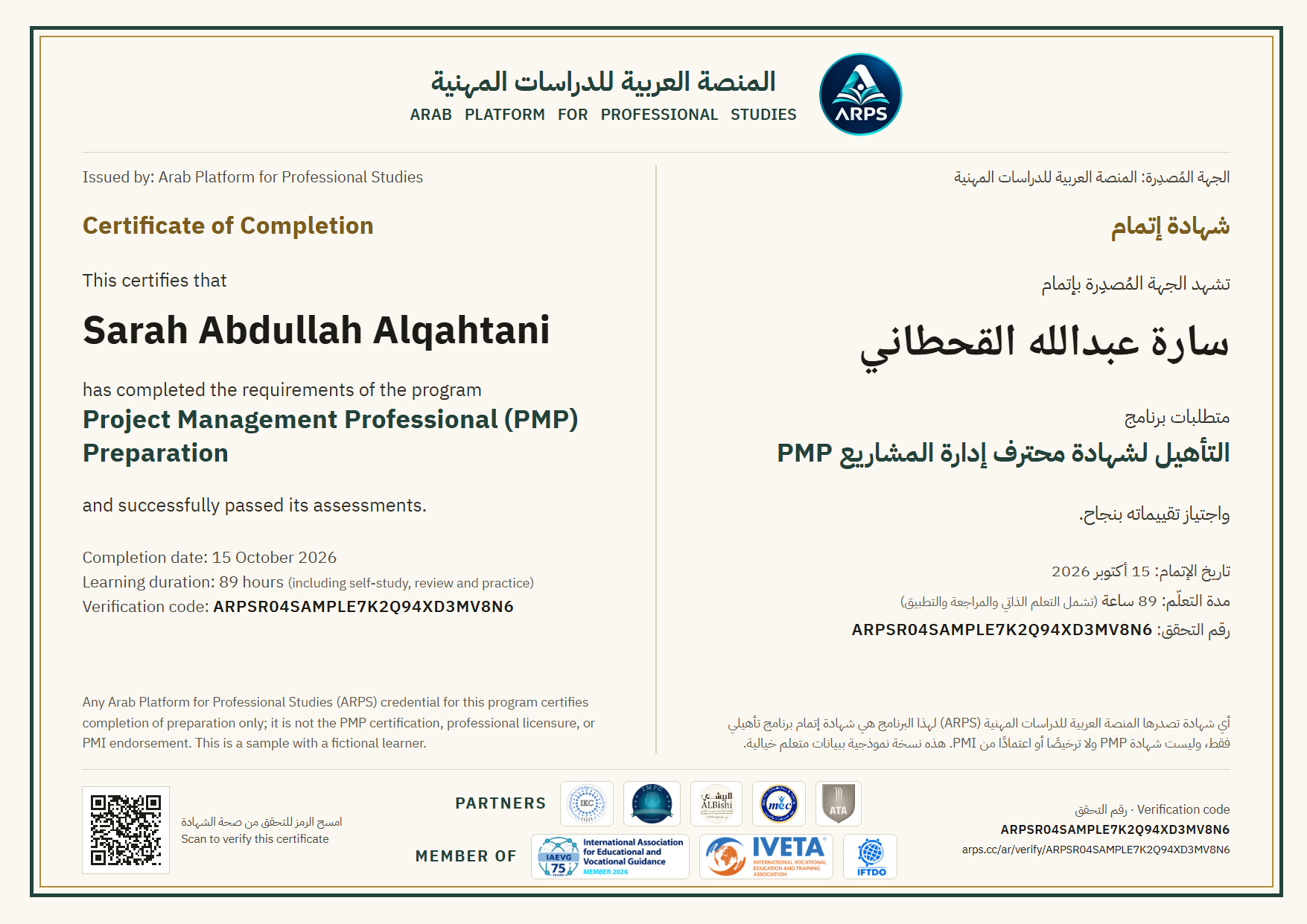
A sample from a real program in this track: Project Management Professional (PMP) Preparation. The learner, scores and dates are fictional; opens in a new window.
Disclaimer: Any platform completion credential is separate from the official IAPP certification.
Program questions
Is this the official CIPM certification?
No. This is independent preparation; IAPP owns its exam and credential.
Which blueprint is covered?
IAPP CIPM blueprint version 4.2.0, effective 1 September 2025, subject to a publication recheck.
Do the cases replace legal advice?
No. Cases are hypothetical; actual obligations depend on facts and jurisdiction.
Are mock questions official?
No. They are original compact practice items, not the official exam.
What do exercises produce?
Scope, accountability, assessment, control and response decisions with evidence and reasons.
Show all (8)
Is exercise feedback included?
Yes. Each lesson has a worked case and an exercise with comparable feedback.
Is Certified Information Privacy Manager (CIPM) Preparation free, and do I get a certificate?
Yes. Certified Information Privacy Manager (CIPM) Preparation is free on ARPS: every lesson, exercise and assessment is free, the first subject is open to read without an account, and the program is available in Arabic and English. Issuing a certificate is optional and has a published fee; it is a training completion certificate showing you passed the program's assessments, recognised by most private-sector organisations in the Gulf states and most Arab countries, and it strengthens your CV; confirming that a specific organisation accepts it remains your responsibility.
What other names is Certified Information Privacy Manager (CIPM) Preparation known by?
The subject of this program is also known as: CIPM, Certified Information Privacy Manager, privacy program management, data privacy management. Learners usually find it by searching for: CIPM exam prep, CIPM exam syllabus, CIPM exam eligibility, CIPM practice questions, privacy program management course, what is CIPM certification, CIPM course in Arabic, CIPM prep online free.
Independent AIGP preparation connects the four domains of the current IAPP blueprint to original bilingual lessons, decision exercises and review questions. Learners study governance, rights, development and monitoring while keeping internal assessment separate from the issuer's official exam.
An honest note: we prepare you for the exam; we do not award the certification. Only the body that owns a certification awards it, once you meet its requirements and pass its official exam, and you register and pay for the exam with that body. The optional ARPS certificate is a training completion certificate recognised by most private-sector organisations in the Gulf states and most Arab countries, and it strengthens your CV alongside the certification.