Certified Information Systems Auditor (CISA) Preparation
Certified Information Systems Auditor (CISA) Preparation is a free program on ARPS, the Arab Platform for Professional Studies. Bilingual CISA preparation mapped to the current ISACA outline, with worked audit cases, original questions, and clear official-exam boundaries. The program covers five domains in the CISA outline effective August 2024 through ten modules and thirty-six lessons.
Important notice: Independent preparation. Arab Platform for Professional Studies (ARPS) does not administer the official CISA exam, award CISA, or claim ISACA endorsement.
Distinguish engagement standards from professional conduct, identify a self-review threat, and choose a safeguard for an objective conclusion
From lesson 1, readable now without an account: Audit standards, ethics and independence
An information systems audit should not begin with “Which control shall I test?” before its audience, scope, and decision authority are clear. An assurance engagement gathers evidence, compares it with stated criteria, and gives a conclusion limited to the work performed. Three layers matter. Professional standards govern how the engagement is planned, performed, documented, and reported. A code of ethics governs the auditor's conduct, interests, and handling of confidential information. The organization's procedure defines a control expected in that environment. Breaching a local procedure may become an audit finding without automatically being a breach of a professional standard. Equally, a technically sound control test does not resolve an auditor's conflict of interest.
A free account saves your progress and takes you straight to lesson 1.
Program facts
Study fee
Free
subjects
10
lessons
36
Estimated time
81 hours
Content last reviewed
Access period
30 days
Study language
Arabic and English
About the program
The program covers five domains in the CISA outline effective August 2024 through ten modules and thirty-six lessons. It moves from audit standards, planning, and evidence to governance, development, operations, resilience, and security. Learners practice interpreting a log, sample, or control test and stating what evidence does and does not establish. The internal assessment and short readiness sample are neither the ISACA exam nor its credential. Twelve lessons include extended practical laboratories. Two timed local-practice forms each contain sixty questions over ninety minutes.
Practical relevance
Lessons use migration, logs, access control, backup, and incident cases, each with a worked outcome, inference boundary, and exercise.
Why this program
Audit questions ask for a defensible decision when facts are incomplete or evidence conflicts. Cases therefore make the denominator, timing, owner, and consequence visible before choosing an action.
Career relevance
Suited to audit, control, and technology-risk practitioners seeking a systematic CISA domain review without an eligibility or pass guarantee.
Career paths this program serves
This program is a step on the paths of the following occupations. Open a path to see its other programs in study order.
Plan an information systems audit and bound its conclusions
3 lessons · 1.5 hours
Audit standards, ethics and independence24 min
Engagement types and risk-based planning5.5 hours
Control design and audit criteria24 min
Subject 2
Audit execution and reporting
Collect and analyze audit evidence, then report findings
4 lessons · 1.5 hours
Engagement management and sampling5.5 hours
Evidence collection and data analytics22 min
Findings, communication and follow-up22 min
Audit quality assurance22 min
Subject 3
IT governance and risk
Connect IT governance with business goals, risk, and data
4 lessons · 1.5 hours
Strategy and governance structures22 min
Policies, compliance and control ownership22 min
Enterprise architecture and risk management22 min
Privacy, data governance and classification5.5 hours
Subject 4
IT management and measurement
Evaluate IT resources, vendors, and performance measures
3 lessons · 1.5 hours
Resources and projects22 min
Vendors and supply chain5.5 hours
Performance, risk indicators and quality22 min
Subject 5
Systems acquisition and development
Test acquisition feasibility and development controls
3 lessons · 1.5 hours
Business case and feasibility22 min
Development methods and project governance22 min
Controls throughout the lifecycle5.5 hours
Subject 6
Implementation readiness and migration
Assess implementation, migration, and postlaunch outcomes
3 lessons · 1.5 hours
Readiness and acceptance testing22 min
Release, conversion and deployment5.5 hours
Post-implementation review22 min
Subject 7
IT operations and service management
Trace assets, operations, interfaces, and service levels
5 lessons · 2 hours
Components and asset lifecycle22 min
Scheduling, interfaces and end-user computing5.5 hours
Capacity, availability and user support22 min
Incidents, problems and change22 min
Logs, service levels and databases5.5 hours
Subject 8
Business resilience and recovery
Measure business impact, recovery, and data restoration
3 lessons · 1.5 hours
Business impact analysis22 min
Backups and restoration testing5.5 hours
Continuity and disaster recovery plans22 min
Subject 9
Information asset protection
Test identity, encryption, physical protection, and awareness
5 lessons · 2 hours
Security program and physical controls22 min
Identity and privileged access5.5 hours
Networks, cryptography and cloud5.5 hours
Endpoints, wireless and data loss prevention22 min
Awareness, threats and vulnerabilities22 min
Subject 10
Security testing and response
Connect security testing and response with evidence and improvement
3 lessons · 1 hours
Security testing and monitoring22 min
Incident response and digital evidence5.5 hours
Emerging technology and improvement22 min
Subjects unlock in sequence as you progress.
Strengths
Explicit mapping of all forty-three official tasks to applied lessons.
Worked cases show inputs, calculation, decision, and inference limits.
Separate learning, internal assessment, and unofficial short readiness question pools.
Evidence basis
The plan uses ISACA’s official outline; primary public sources support instruction while fictional cases remain distinct from published facts.
Reference organizations
ISACA
Frameworks used
CISA Exam Content Outline — effective August 2024
Methodology
All forty-three tasks were mapped to lessons and cases; learning, summative, and readiness pools are distinct.
How the route works
Professional Certification Preparation programs help learners prepare for a recognized external certification through structured knowledge, review, practice questions, and readiness assessments. Arab Platform for Professional Studies (ARPS) does not administer the certification owner's official exam.
Structured self-paced study aligned to the current external certification scope, with knowledge review, practice questions, readiness checks, and internal mock assessments.
Focused preparation for a specific external certification.
Content aligned to the current official exam scope when available.
Practice questions and internal readiness assessments.
Clear separation between Arab Platform for Professional Studies (ARPS) preparation and the official external exam.
Assessment
The route includes an internal assessment for Arab Platform for Professional Studies (ARPS) completion eligibility and separate mock/readiness assessments that are not the external official exam.
Assessment attempts: 2 per assessment, 7 days apart
The pass mark is announced before the program is published.
Certificate
The Arab Platform for Professional Studies (ARPS) credential confirms completion of the preparation program only; the target professional certification requires passing the external issuer's examination under its rules.
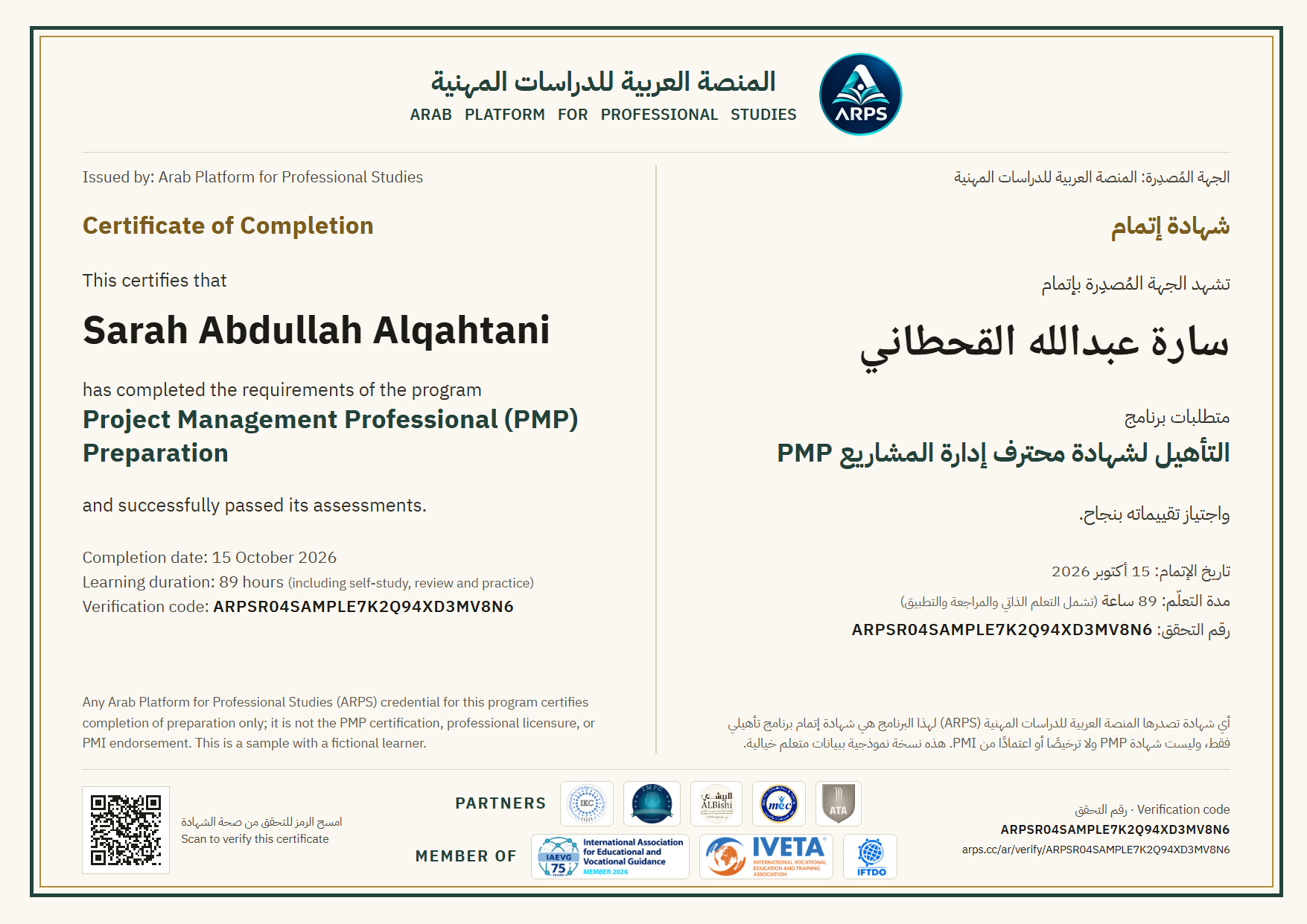
A sample from a real program in this track: Project Management Professional (PMP) Preparation. The learner, scores and dates are fictional; opens in a new window.
Disclaimer: Any internal credential confirms preparation completion only; it is neither CISA nor ISACA endorsement.
Program questions
Is this the official CISA exam?
No. ISACA alone administers the exam and awards the credential. This is independent preparation with original items.
Which outline is covered?
It covers the current five-domain outline using the designated source registry verified by the source-review team on14 November2026. Consult issuer instructions before your exam.
How do timed mocks differ from the short sample?
Each timed practice form has sixty questions, ninety minutes and domain quotas. The ten-item sample remains for quick review. These local practice forms do not reproduce the official150-item exam length or predict a pass.
How should I use the internal assessment result?
Review missed topics and option explanations. It is an internal result, not an ISACA pass prediction.
Do study minutes count as recognized hours?
Minutes are an editorial estimate of learner work; this program does not claim ISACA-recognized training hours.
Show all (7)
Is Certified Information Systems Auditor (CISA) Preparation free, and do I get a certificate?
Yes. Certified Information Systems Auditor (CISA) Preparation is free on ARPS: every lesson, exercise and assessment is free, the first subject is open to read without an account, and the program is available in Arabic and English. Issuing a certificate is optional and has a published fee; it is a training completion certificate showing you passed the program's assessments, recognised by most private-sector organisations in the Gulf states and most Arab countries, and it strengthens your CV; confirming that a specific organisation accepts it remains your responsibility.
What other names is Certified Information Systems Auditor (CISA) Preparation known by?
The subject of this program is also known as: CISA exam prep, IS auditor exam preparation, CISA exam review. Learners usually find it by searching for: free CISA exam prep, IT audit course online, CISA practice questions, information systems audit training, CISA prep with completion certificate, what is CISA certification, CISA exam requirements, CISA course in Arabic.
Independent AIGP preparation connects the four domains of the current IAPP blueprint to original bilingual lessons, decision exercises and review questions. Learners study governance, rights, development and monitoring while keeping internal assessment separate from the issuer's official exam.
An honest note: we prepare you for the exam; we do not award the certification. Only the body that owns a certification awards it, once you meet its requirements and pass its official exam, and you register and pay for the exam with that body. The optional ARPS certificate is a training completion certificate recognised by most private-sector organisations in the Gulf states and most Arab countries, and it strengthens your CV alongside the certification.