

Environment, Sustainability, Energy, Agriculture & Food Systems
Consultant Preparation Program in Sustainability and ESG
An advanced professional program for ESG diagnosis, option comparison, and implementable, reviewable recommendations.
Free
Consultant Preparation Program in Circular Economy and Resource Management is a free program on ARPS, the Arab Platform for Professional Studies. Learn to analyze resource flows, compare circular alternatives, and make evidence-based advisory recommendations using material balances, equal-service comparisons, costs, risks and a measurable pilot plan.

Optional certificate fee 50% launch discount
$90 instead of $180
331 AED or 338 SAR
Good advice starts by defining what the client must decide: buy a new asset, improve its return, or prevent surplus before it arises. This program works through fictional cases with complete inputs. You build flow balances and compare prevention, repair, recovery and performance-service options. You define functional units and impact boundaries, distinguish measured operation from supplier assumptions, and test whether a recommendation reverses when lifetime, demand or return cost changes. Analysis becomes a decision memo naming safety and service gates, evidence owners and a short trial with stop and scale criteria. Primary sources support concepts and methods; teaching numbers do not describe any city or local law. The program develops advisory reasoning within role boundaries. It grants no professional license or product conformity certificate.
Cases cover returnable crates, food surplus, repairable equipment and supplier claims. Each asks for a defined calculation, denominator check and decision with limits and verification action. Learners repeatedly revise a decision memo when demand, returns or safety evidence changes rather than freezing a plan that cannot be questioned.
Advisory work differs from executing a single sorting or measurement task: it must interpret conflicting evidence and compare options affecting materials, water, service and cost. Lessons connect calculations to decisions that another party can reproduce and ask what new fact would reverse the recommendation before scale-up.
The program suits professionals who lead resource-improvement decisions in operations, procurement, services and public organizations and need supported recommendations rather than isolated recycling rates. It helps them discuss service life, cost and evidence with suppliers, safety staff and finance colleagues, without assuming legal or engineering authority they do not hold.
This module begins with the client decision and the boundary of a resource system before calculating a circularity percentage. Learners reconcile crate stock across dispatch, return, damage, outstanding assets and confirmed loss. They then define an equal service unit for comparing single-use and durable packaging without changing the denominator. Actor mapping identifies who owns an asset, generates evidence and authorizes a decision when warehouse, carrier and customer records conflict. Worked cases show how duplicate identifiers or different cut-off times can create false balances and how verified loss changes the investigation. Practice produces a flow table, evidence-gap register and auditable responsibility map. Fictional case values are not local statistics or sufficient grounds for purchasing without demand, lifespan and alternative-cost evidence.
The module distinguishes preventing surplus, extending asset life and recovering residual material. A food-service case tests lower preparation against demand service and food safety instead of calling transferred surplus prevention. A pump case compares cleaning, repair and component recovery by observed yield, service life and cost while isolating units that cannot be handled safely. Learners then map organic and technical streams and calculate what a processor accepted and rejected without confusing shipment with final recycling. Exercises deliver denominator-correct tables, bounded pilot decisions, stop conditions and follow-up checks. The cases show why the largest processed tonnage is not necessarily the best outcome when purchases rise, service worsens or rejected material disappears from measurement.
Learners build an impact comparison around equivalent service and a disclosed life-cycle boundary, rather than the weights of two objects with different lives. They calculate new material and washing water and explain why kilograms, litres and kilometres cannot be added without an appropriate impact model. A repair-versus-new case tests production burden, operating energy, feasible lifespan and a break-even service count; a rebound case separates per-use efficiency from total consumption as demand changes. Finally, learners use multi-criteria analysis while keeping hard safety and water gates separate from negotiable weights, then rerun rankings under changed priorities. Outputs are a bounded inventory, sensitivity table and decision record naming the strongest alternative and missing evidence. Screening is not represented as a complete life-cycle assessment or universal environmental verdict.
This module turns alternatives into executable commitments and trials. Learners compare ownership and subscription over equal service and time, testing uncertain resale value, use caps and downtime. They draft a procurement requirement with testable function, safety gate, representative sample, operating-life evidence and take-back records instead of relying on a ‘circular product’ label. In a reverse-logistics pilot, they calculate on-time serviceable returns for a numbered cohort and distinguish average collection cost from cost of an additional successful return. They assign every source record an owner and set stop and exit conditions for safety or data failure. Outputs are a bounded cost comparison, supplier acceptance table and reversible pilot plan. Client-specific legal and accounting judgments remain with appropriate specialists.
The final module separates visible circular activity from proven outcomes. Learners define indicator numerators, denominators, cohorts, periods and owners, distinguishing a device’s restart from sustained service and a shipment to a processor from usable output. They audit supplier recycled-content and waste-reduction claims when the service denominator changes, recording supported, conditional and unverified statements without delaying urgent containment of a possible safety risk. An integrative fictional food-and-packaging case becomes a phased memo respecting budget, service and water gates while avoiding the addition of food and packaging savings as one misleading number. The final output is a recommendation with a contingency option, review measures, accountable decision owners and an explicit stop or revision trigger when new evidence arrives.
Subjects unlock in sequence as you progress.
Lessons use accessible primary overviews from ISO, UNEP and Ellen MacArthur Foundation, and bounded US EPA guidance. They do not attribute unavailable detailed clauses to paid ISO standards or present fictional city examples as local facts.
Primary sources support only inspected overview scope and method; numerical teaching cases are fictional with explicit limits.
Assessments are aligned to program outcomes and may include module assessments, a final assessment, or a combination, with scenario-based questions where appropriate.
Assessment attempts: 2 per assessment, 7 days apart
The pass mark is announced before the program is published.
The credential confirms completion and successful assessment; it does not automatically grant a legal licence to practise as a consultant in a regulated field.
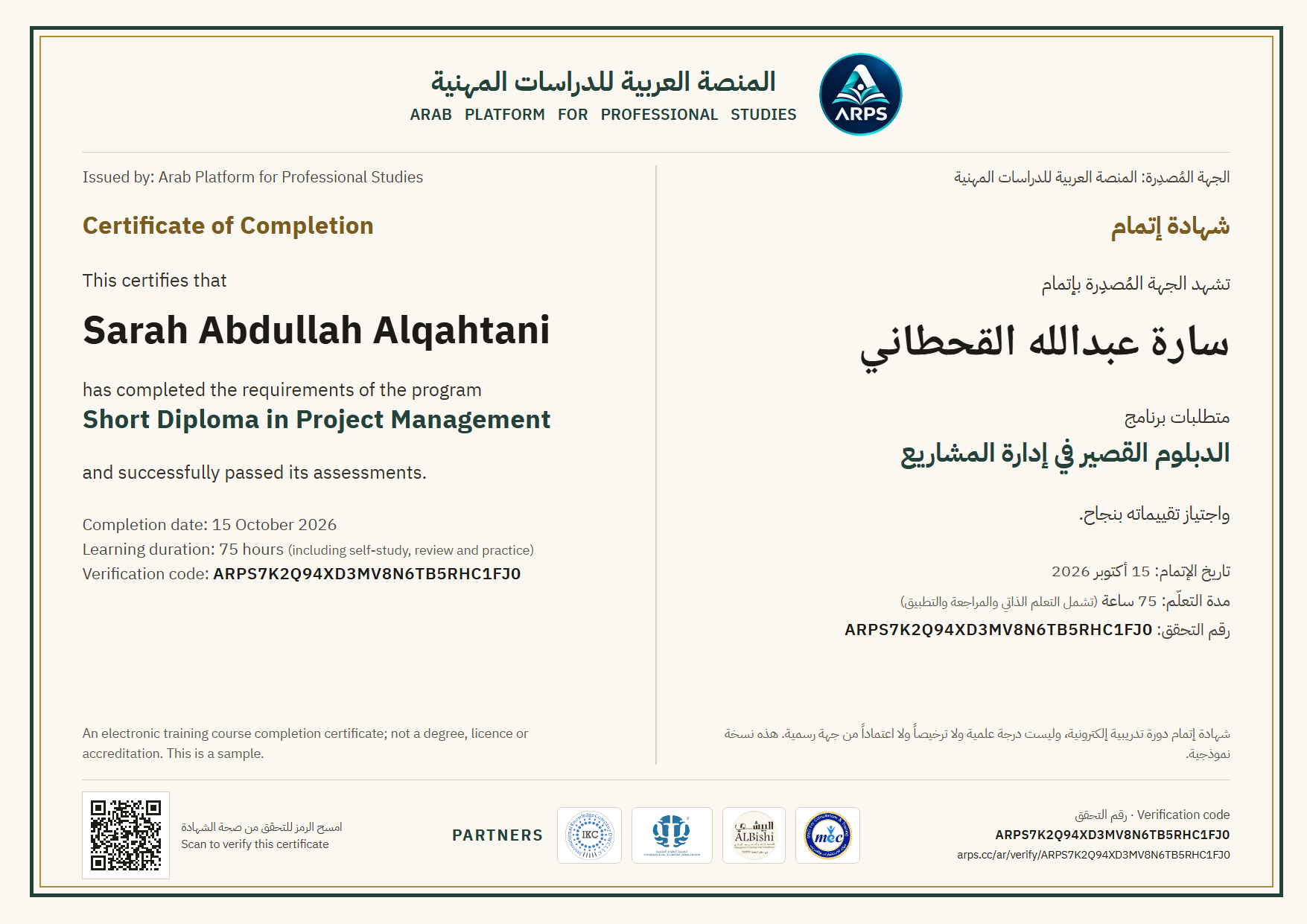
Every certificate has a public verification code. Verify a certificate
The real design with fictional details; opens in a new window.
Verification example: a real issued certificate
Disclaimer: This educational program develops evidence-bounded circular-economy and resource-management advice. It grants no professional license or conformity certificate; fictional cases establish no local law or city performance.
No. It teaches analytical and advisory skills; licensing and conformity are separate matters for competent bodies.
No. Cities are fictional settings and teaching figures assert nothing about their markets or laws.
You learn functional units, boundaries and data gaps; total footprint is not inferred from material mass alone.
No. Lessons distinguish transfer, acceptance and final output and request evidence at each step.
Each has inputs, an observable output and a worked solution or correction criterion; assessments test case decisions.
You record the gap, test decision sensitivity or run a bounded pilot instead of inventing a number.
Yes. Consultant Preparation Program in Circular Economy and Resource Management is free on ARPS: every lesson, exercise and assessment is free, the first subject is open to read without an account, and the program is available in Arabic and English. Issuing a certificate is optional; it is a training completion certificate showing you passed the program's assessments, not a university degree, a professional licence or an endorsement by an external body.
The subject of this program is also known as: circular economy, resource management, resource efficiency, circular business models. Learners usually find it by searching for: circular economy course free, circular economy principles, circular economy model, circular economy and sustainability, circular economy consultant.
Programs from the same field or route that may complement what you learn here.
Environment, Sustainability, Energy, Agriculture & Food Systems
An advanced professional program for ESG diagnosis, option comparison, and implementable, reviewable recommendations.

Environment, Sustainability, Energy, Agriculture & Food Systems
Prepare traceable sustainability and ESG workpapers: identify topics, control data, build a GHG inventory and test disclosure before handoff.

Environment, Sustainability, Energy, Agriculture & Food Systems
Prepare agricultural enterprise budgets, compare marketing channels, measure risk effects and select bounded investment and operating options using explicit evidence and decision limits.

Finance, Accounting, Banking, Insurance & Compliance
An advanced program in enterprise and financial risk evidence, response comparison and conditional recommendations with operational follow-up.