Microsoft Azure Data Fundamentals (DP-900) Preparation
Microsoft Azure Data Fundamentals (DP-900) Preparation is a free program on ARPS, the Arab Platform for Professional Studies. Independent DP-900 preparation covering core data concepts, Azure relational and non-relational services, and analytics. Four modules and twenty-four lessons connect data concepts with Azure relational, non-relational and analytical services. Retained sound examples are extended through practical outputs that can be checked.
Important notice: Independent preparation. Arab Platform for Professional Studies (ARPS) does not administer the Microsoft exam, award Microsoft Azure Data Fundamentals certification, or claim Microsoft endorsement.
Classify a record by its actual structure and identify what is needed to extract its fields without confusing file type and data store
From lesson 1, readable now without an account: Representing data: structure is not a file extension
The core data concepts domain asks you to distinguish structured, semi-structured, and unstructured data. Start with the record the application must process, rather than the name of a cloud service. Structured data follows a relatively stable schema: known fields, a type for each value, and rows whose constraints can be checked. Appointment records with appointment_id, patient_id, slot, and status fit that description if every row follows those fields, even when they arrive as a CSV file. A comma does not make content structured by itself. A CSV cell can contain free text or nested JSON, and files in one feed can have different columns. Ask which fields software may rely on and which constraints can be enforced before selecting a database.
A free account saves your progress and takes you straight to lesson 1.
Program facts
Study fee
Free
subjects
4
lessons
24
Estimated time
56.5 hours
Content last reviewed
Access period
30 days
Study language
Arabic and English
About the program
Four modules and twenty-four lessons connect data concepts with Azure relational, non-relational and analytical services. Retained sound examples are extended through practical outputs that can be checked. Every lesson has three exercises with separate feedback. Two timed internal mocks each contain forty original questions in sixty minutes. Microsoft’s blueprint defines certification scope; these training forms remain independent of the official examination.
Classify a record by its actual structure and identify what is needed to extract its fields without confusing file type and data store
Compare file, object and database storage from reading, update and query patterns
Separate event recording from aggregation by counting unit and freshness requirement
Assign a data incident among database administrator, data engineer and analyst with escalation boundaries
Compare CSV, JSON and column-oriented files by structure, validation and read pattern
Trace a record from source to report and assign quality checks to the responsible roles
Decompose a repeating order table into related entities and prevent update and deletion anomalies
Interpret SELECT, JOIN, GROUP BY and row changes, and distinguish tables, views and indexes
Compare Azure SQL Database, Managed Instance and SQL Server on an Azure VM by compatibility, control and operations
Match a PostgreSQL or MySQL requirement to its managed Azure service without assuming SQL Server compatibility
Design a junction table with composite key and constraints, then check join effects on counts and sums
Interpret filtered aggregation and distinguish the roles of table, view, index and procedure
Choose object storage or a managed file share from access pattern and bound a raw-size calculation
Choose PartitionKey and RowKey for non-relational metadata and explain query limits
Assess a distributed document store and choose a partition key aligned with customer queries
Match a data model or existing client to a Cosmos DB API without treating APIs as interchangeable
Balance access frequency, retrieval delay and retention policy when selecting a Blob tier
Design a document and partition key for a read pattern, separating API compatibility from identical behavior
Trace ingestion, transformation, storage and analysis while preserving grain and source quality
Distinguish the platforms' capabilities and match processing and BI layers to real needs without exclusivity claims
Choose batch or stream from decision latency and place ingestion, processing and alerting services
Set model grain and measure, then choose a comparison or trend visual without misleading denominators
Define fact and dimension grains and reconcile counts and values from ingestion to report
Design a model relationship and a measure with the right denominator, then choose a visual that preserves context
Who it is for
DP-900 candidates seeking structured coverage of current Microsoft domains with original cases and questions.
New analysts and application developers connecting business questions to storage and processing choices.
Team members considering Azure migration who need to distinguish file, object, relational and document workloads, discuss report freshness, and challenge a dashboard denominator before any production deployment decision.
Prerequisites
Basic familiarity with files, tables, rows, columns and simple percentages. The first lesson reviews these before service selection.
Azure administration, advanced SQL and a paid subscription are not required for these reading and decision cases.
If these terms are new, first calculate one numerator-over-denominator rate and read a small CSV row and JSON document. Use each exercise feedback block to check your interpretation before moving on.
What it does not offer
General Azure administration or AZ-900 preparation.
Advanced PL-300 implementation or awarding a Microsoft credential.
Start with the question the data must answer, not a file extension. Compare regular CSV columns with JSON documents whose keys may vary, and with images or audio that require extraction before their content can be counted. Separate interchange formats from object storage and an operational database: retaining proof images differs from updating an order state or preventing a double sale. Concurrent state changes indicate a transactional workload; grouping history by month or category indicates analytical work. In the extended case, trace record counts from source to pipeline, model and visual. The first count divergence identifies where to investigate; blaming the chart alone is insufficient. Distinguish the roles that verify source data, repair transformations and agree on metric meaning. Exercises classify records, calculate a rate and reconcile a pipeline, while explicitly marking what cannot be inferred from unindexed scans or incomplete fields.
6 lessons · 13 hours
Representing data: structure is not a file extension2 hours
From files to a store that fits the query2 hours
Distinguishing transactions from analysis2 hours
Who owns which decision in the data chain?2 hours
Read file formats before choosing a store2 hours
Data quality and lineage across roles2 hours
Subject 2
Relational data on Azure
Build a small relational model from customer orders. Repeating a customer's current address on every order causes update anomalies; separating Customer from Order with stable keys reduces that risk while the policy for a historical delivery address remains a separate decision. In SQL, read SELECT, JOIN and GROUP BY, distinguishing order rows from distinct customers after a join. Work a two-row result and see how a separate INSERT would change one city's total. Compare Azure SQL Database for a new app seeking less server management, Managed Instance for a demonstrated instance-level compatibility need, and SQL Server on a virtual machine when broader control justifies more operations. The word SQL does not make PostgreSQL and MySQL interchangeable with SQL Server; engine behavior and migration dependencies still need checking. Exercises produce a key map, a query with expected rows, and a service-choice matrix with its assumptions.
6 lessons · 13 hours
Keys, relationships and normalization2 hours
Reading SQL and basic database objects2 hours
Choosing among Azure SQL options2 hours
Open-source relational engines on Azure2 hours
Resolve many-to-many relationships without multiplying measures2 hours
Choose SQL objects for the question and update pattern2 hours
Subject 3
Non-relational data on Azure
Compare non-relational options by access interface rather than a NoSQL label. Invoice images retrieved as whole objects suggest Blob, whereas a legacy app requiring a shared file path across servers suggests Azure Files. Table Storage entities use partition and row keys; known-key retrieval fits, but this is not a promise of relational joins. For Cosmos DB documents, inspect the partition key against traffic: uniqueness alone does not prevent a hotspot when one value receives most requests. Finally, distinguish Cosmos DB APIs by the existing application's data model; a MongoDB-like interface does not guarantee identical queries or migration behavior. Worked cases state the read and write unit, then test traffic distribution, consistency and query form rather than selecting storage from JSON syntax or a file extension. Exercises produce an access matrix, a key design and a migration boundary note.
6 lessons · 13 hours
Blob and Files: same content, different access pattern2 hours
Azure Table: designing keys from query patterns2 hours
Cosmos DB: workload fit and partition key2 hours
Cosmos DB APIs and the meaning of compatibility2 hours
Blob tiers and the lifecycle of retrievable copies2 hours
From document query to Cosmos partition and API choice2 hours
Subject 4
Analytics on Azure
Trace a reporting question from source to presentation. Identify ingestion, transformations that clean or derive fields, analytical storage, then model and visual. Reconcile row counts between stages: filling a missing value does not insert a row, and a report filter can reduce what is displayed without changing the model. Distinguish batch work that tolerates stated delay from a streaming requirement that receives and processes events continuously, assigning Event Hubs and Stream Analytics roles only where needed. Compare Fabric and Azure Databricks by workload, tooling and integration rather than claiming either universally replaces the other. In Power BI, choose trend, comparison or composition views from the question and show denominators beside rates. Exercises deliver a pipeline map, count reconciliation, freshness decision and a verifiable visual specification.
6 lessons · 13 hours
From source to analytical store2 hours
Fabric and Databricks in a large analytics workload2 hours
Batch or stream: time is part of the decision2 hours
Power BI: model, measure and fitting visual2 hours
From source batch to a reconcilable analytical model2 hours
Interpret a Power BI measure under filters2 hours
Subjects unlock in sequence as you progress.
Strengths
DP-900 blueprint coverage through specific data cases
Worked applications with checked results
Original questions with reasons for each option
Evidence basis
Scope follows Microsoft’s study guide effective 21 July 2026; service explanations use current documentation and an independent normalization source.
Reference organizations
Microsoft
Frameworks used
DP-900 study guide — Skills measured as of 2026-07-21
Methodology
Mapped blueprint skills to original lessons, cases and questions while checking each service boundary.
How the route works
Professional Certification Preparation programs help learners prepare for a recognized external certification through structured knowledge, review, practice questions, and readiness assessments. Arab Platform for Professional Studies (ARPS) does not administer the certification owner's official exam.
Structured self-paced study aligned to the current external certification scope, with knowledge review, practice questions, readiness checks, and internal mock assessments.
Focused preparation for a specific external certification.
Content aligned to the current official exam scope when available.
Practice questions and internal readiness assessments.
Clear separation between Arab Platform for Professional Studies (ARPS) preparation and the official external exam.
Assessment
The route includes an internal assessment for Arab Platform for Professional Studies (ARPS) completion eligibility and separate mock/readiness assessments that are not the external official exam.
Assessment attempts: 2 per assessment, 7 days apart
The pass mark is announced before the program is published.
Certificate
The Arab Platform for Professional Studies (ARPS) credential confirms completion of the preparation program only; the target professional certification requires passing the external issuer's examination under its rules.
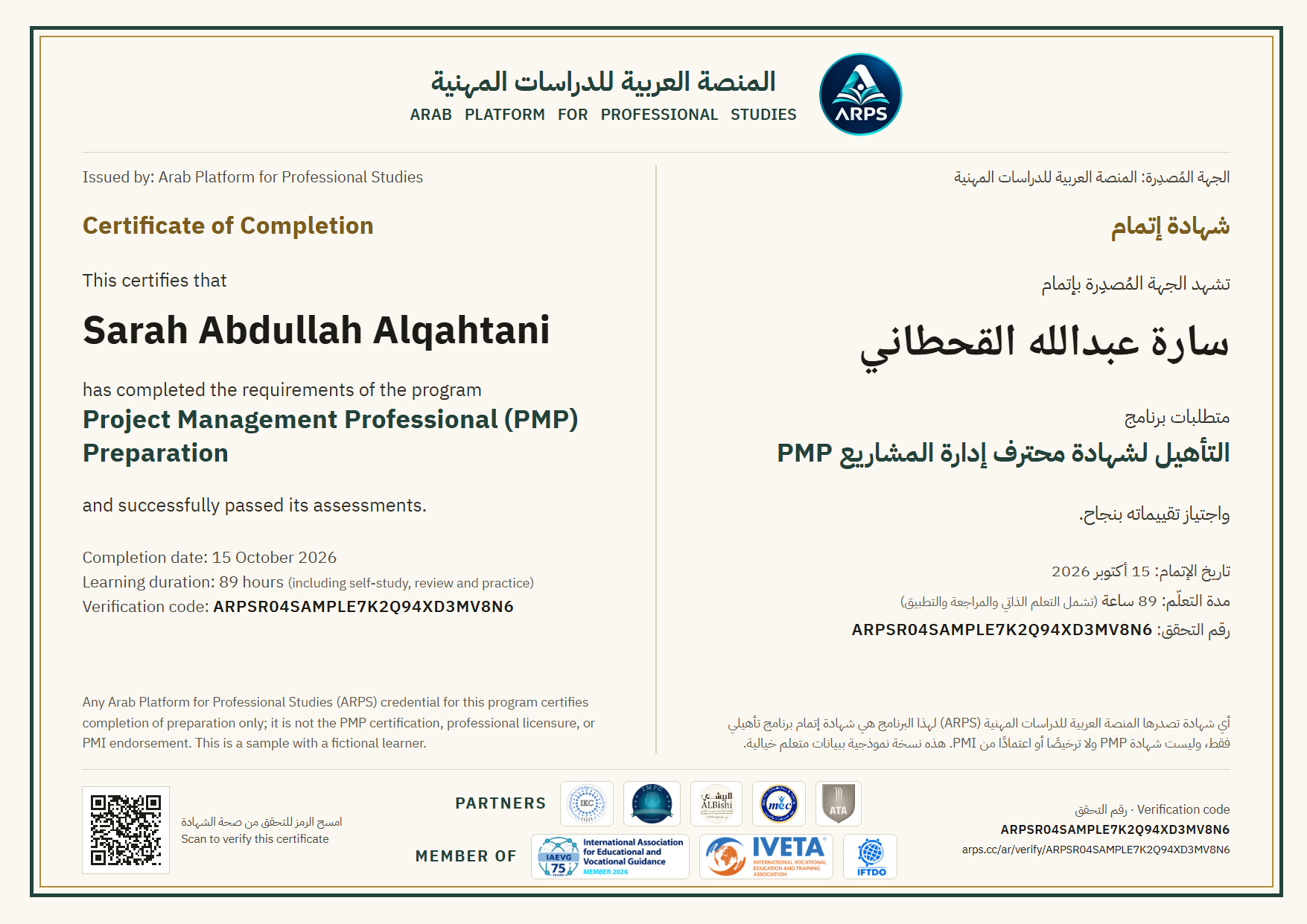
A sample from a real program in this track: Project Management Professional (PMP) Preparation. The learner, scores and dates are fictional; opens in a new window.
Disclaimer: Any platform completion credential is separate from Microsoft certification.
Program questions
Is this the official Microsoft certification?
No. This is independent preparation; Microsoft controls its official exam and certification.
Which blueprint does this cover?
The DP-900 skills measured from 21 July 2026, subject to source review when revised.
Do I need an Azure subscription?
No, not for the reading, decision exercises or assessments in this material.
Are official exam items copied?
No. Practice and mock questions are original, and their result is not a Microsoft exam result.
How do I choose a service for a case?
State read, update, consistency and freshness needs first, then compare the relevant service behavior.
Show all (8)
Are there worked examples?
Yes. Each lesson includes a worked example and three exercises with separate feedback, followed by explanatory questions.
Is Microsoft Azure Data Fundamentals (DP-900) Preparation free, and do I get a certificate?
Yes. Microsoft Azure Data Fundamentals (DP-900) Preparation is free on ARPS: every lesson, exercise and assessment is free, the first subject is open to read without an account, and the program is available in Arabic and English. Issuing a certificate is optional and has a published fee; it is a training completion certificate showing you passed the program's assessments, recognised by most private-sector organisations in the Gulf states and most Arab countries, and it strengthens your CV; confirming that a specific organisation accepts it remains your responsibility.
What other names is Microsoft Azure Data Fundamentals (DP-900) Preparation known by?
The subject of this program is also known as: DP-900, Azure Data Fundamentals, Microsoft Azure Data Fundamentals. Learners usually find it by searching for: DP-900 exam prep, microsoft azure data fundamentals dp 900 exam prep, DP-900 practice test prep, DP-900 study guide, free DP-900 exam prep, what is DP-900 certification, DP-900 exam requirements, DP-900 course in Arabic.
Independent AIGP preparation connects the four domains of the current IAPP blueprint to original bilingual lessons, decision exercises and review questions. Learners study governance, rights, development and monitoring while keeping internal assessment separate from the issuer's official exam.
An honest note: we prepare you for the exam; we do not award the certification. Only the body that owns a certification awards it, once you meet its requirements and pass its official exam, and you register and pay for the exam with that body. The optional ARPS certificate is a training completion certificate recognised by most private-sector organisations in the Gulf states and most Arab countries, and it strengthens your CV alongside the certification.