

Human, Psychology, Counseling & Family Studies
Professional Specialization in Family Guidance
Learn defined tasks in educational family guidance: intake, scope, safe dialogue, a reviewable trial, and referral when a need exceeds the role.
Free
Specialist Preparation Program in Non-Clinical Counseling Studies is a free program on ARPS, the Arab Platform for Professional Studies. An applied non-clinical counseling-studies program about remit, supportive meetings, collaborative practical planning, safeguarding and referral, documentation and closure. It does not teach diagnosis or treatment or confer a professional license.

Optional certificate fee 50% launch discount
$90 instead of $180
331 AED or 338 SAR
The program starts with service boundaries, consent and information safeguards, then moves to listening, understanding the request and constructing a practical plan owned by the person seeking support. Lessons include solved fictional scenarios and exercises with review criteria. Learners practice recognizing when referral or urgent safety procedures take priority over further discussion. The fourth module focuses on safeguarding and safe referral. Possible harm is taken seriously without clinical diagnosis; emergency response follows applicable local authorities and organizational protocols. The final module teaches factual notes, service indicators and responsible handoff without treating administrative progress as proof of clinical recovery. This is a globally accessible educational resource, not authorization to practice a regulated profession. Local law, role authorization, supervision and operational training must be verified before offering actual services.
Learners draft a role card, consent script, intake record, options map, next-step plan, safety/referral decision, follow-up note and handoff record. All exercise data are fictional.
Helping work becomes unsafe when listening turns into unqualified therapy, facilitators promise outcomes they cannot control, or notes become speculative diagnoses. The program supplies auditable decisions, referral boundaries and concise documentation.
Use fictional decision cases for Scope of service and ethical governance with explicit remit and output.
Use fictional decision cases for Helping interaction and needs formulation with explicit remit and output.
Use fictional decision cases for Collaborative non-clinical support planning with explicit remit and output.
Use fictional decision cases for Safety, safeguarding and referral with explicit remit and output.
Use fictional decision cases for Documentation, evaluation and responsible closure with explicit remit and output.
Subjects unlock in sequence as you progress.
Primary references include WHO, UNICEF, IASC and IFRC. Each is used only within its relevant scope and does not constitute local law, endorsement or formal program accreditation.
Progressive skills, worked cases and feedback-supported practice followed by module assessment.
Assessments follow the program blueprint and may use module assessments, a final assessment, or a combination, under the approved attempt policy.
Assessment attempts: 2 per assessment, 7 days apart
The pass mark is announced before the program is published.
The credential confirms completion and successful assessment; it does not represent professional licensure unless explicitly and lawfully stated.
Every certificate has a public verification code. Verify a certificate
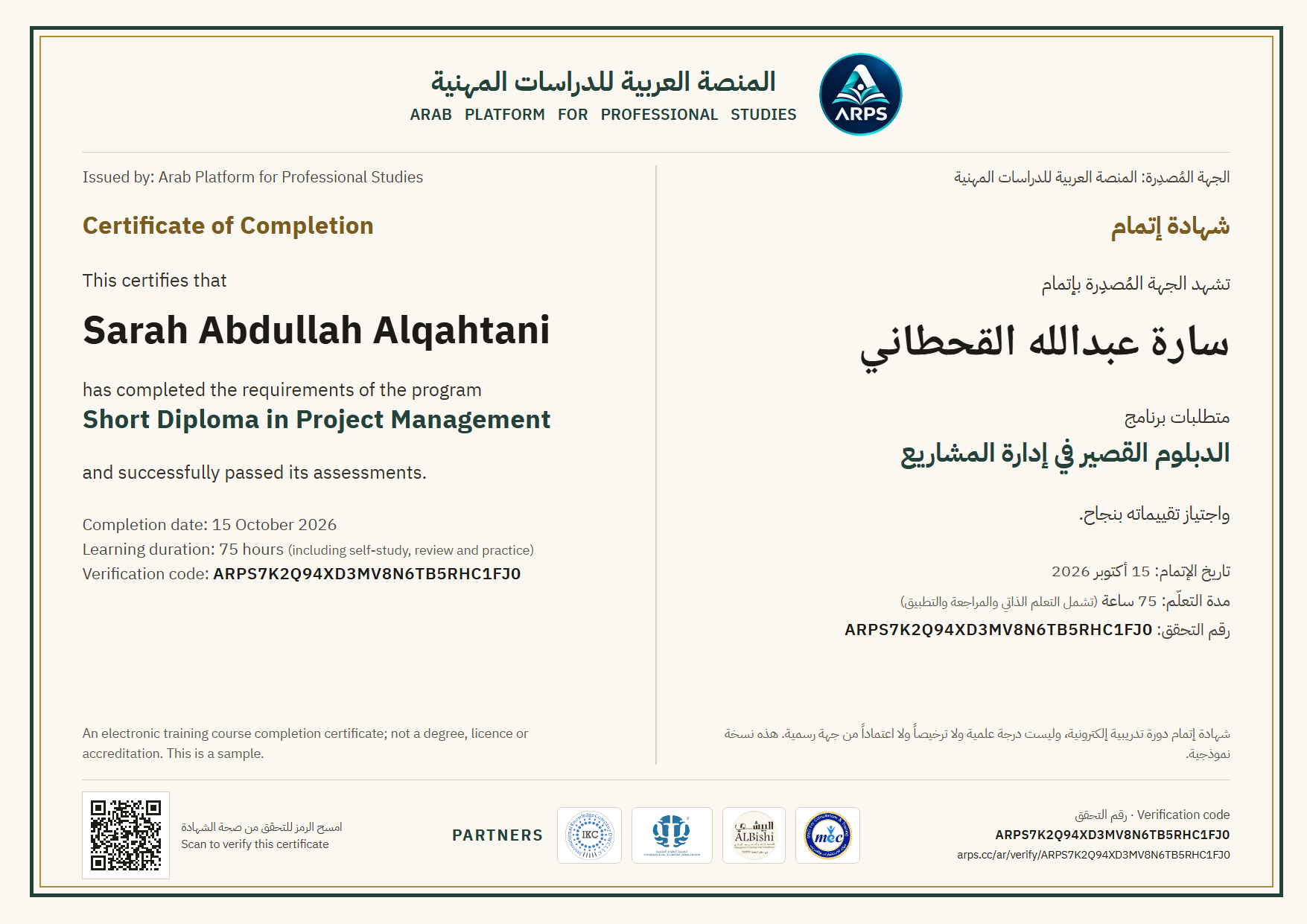
The real design with fictional details; opens in a new window.
No. It teaches the organization of non-clinical practical support and referral limits, not diagnosis, psychotherapy or medication.
The fictional examples are suitable for study. Live use requires actual institutional authorization and applicable safeguards.
Follow local emergency/safety and authorized escalation procedures rather than trying to perform clinical risk assessment within a learning exercise.
Each module has a short knowledge check and a module assessment drawing original scenarios separate from the practice exercises.
No. Sources do not confer institutional accreditation, licensure or legally protected professional titles.
Yes. Specialist Preparation Program in Non-Clinical Counseling Studies is free on ARPS: every lesson, exercise and assessment is free, the first subject is open to read without an account, and the program is available in Arabic and English. Issuing a certificate is optional; it is a training completion certificate showing you passed the program's assessments, not a university degree, a professional licence or an endorsement by an external body.
The subject of this program is also known as: non-clinical counseling, supportive counseling studies, counseling skills. Learners usually find it by searching for: free non-clinical counseling course, learn supportive counseling skills online, active listening skills course, when to refer to a specialist, counseling studies with completion certificate.
Programs from the same field or route that may complement what you learn here.
Human, Psychology, Counseling & Family Studies
Learn defined tasks in educational family guidance: intake, scope, safe dialogue, a reviewable trial, and referral when a need exceeds the role.

Human, Psychology, Counseling & Family Studies
Learn a bounded non-clinical support workflow: check safety and choice, listen, identify practical needs, and connect a person with an appropriate service. Work through fictional cases with decisions, referrals, minimal records, and follow-up. The program keeps diagnosis, therapy, and unverified promises outside the worker role.

Human, Psychology, Counseling & Family Studies
Learn to analyze family requests, compare support options and develop a reasoned recommendation that can be followed up. Family and service cases apply clear boundaries for consent, privacy, referral and clinical practice.

Human, Psychology, Counseling & Family Studies
Analyze coaching and professional-development cases with conflicting evidence. Design a bounded agreement, observable experiment, and recommendation. Balance client and sponsor goals, distinguish individual from system constraints, and evaluate change without claiming a license or unwarranted causation.