

Human, Psychology, Counseling & Family Studies
Professional Specialization in Family Guidance
Learn defined tasks in educational family guidance: intake, scope, safe dialogue, a reviewable trial, and referral when a need exceeds the role.
Free
Professional Specialization in Non-Clinical Psychosocial Support is a free program on ARPS, the Arab Platform for Professional Studies. Learn a bounded non-clinical support workflow: check safety and choice, listen, identify practical needs, and connect a person with an appropriate service. Work through fictional cases with decisions, referrals, minimal records, and follow-up.

Optional certificate fee 50% launch discount
$90 instead of $180
331 AED or 338 SAR
The program starts with a helper’s boundaries: notice safety, listen without forced retelling, and identify practical needs. Learners check consent before sharing data, build verified referrals, and practise optional individual and community support. They then audit a record, hand over a task with an owner and deadline, and revisit a decision when facts change. Cases are fictional; real action follows local organizational procedures. The program grants no authority to diagnose, treat, or practise independently under a professional licence.
Exercises produce decision cards, a support map, a referral record, an optional group plan, an audit table, and a changing-case timeline. Complete fictional inputs allow practice without disclosing any real person’s story.
Workers need small, explainable decisions rather than broad reassurance. The program connects observation, listening, and linking with consent and verified action. It teaches the difference between offering an option and confirming service access, so learners can see when supervision or referral is needed.
Non-clinical support begins by understanding the person's actual request, not assigning a diagnosis. This module teaches a worker to explain the role, check setting safety and urgent needs, then distinguish supportive listening, practical information and qualified referral. Specific consent matters: a person may permit sharing a name to request an appointment while withholding their story, or choose paper rather than a message to a shared phone. The worker therefore keeps a minimal record that separates the person's account, observation and unverified service details. A stated imminent danger changes the priority to the approved local response protocol; an unanswered call is not a successful handover. Learners practise these choices through decision cards, call scripts and escalation cases while diagnosis and treatment remain outside the role.
This module turns role boundaries into psychological first aid during a short encounter. The worker prepares the setting and service information, looks for safety and visible needs, then listens for the priority the person chooses without demanding a painful story. Learners practise an open question and a reflection that invites correction, while respecting silence or refusal to talk and keeping practical help available. A useful link is a checked option, not a promised result: offering a number does not prove a call connected, and calling does not prove a service accepted someone. When needs compete, a table exposes timing, availability, access barriers and a fallback. The applied work includes a repaired conversation, a look-listen-link plan and a family priority table with a defined service window.
This module turns a service directory into a decision map usable today. An address is not enough: service type, eligibility, hours, capacity and actual access need separate checks, with a source and time for each claim and a fallback when contact fails. Learners then practise supported referral, offering a joint call or information the person can use independently and asking what may be shared before sending a name or request. The status record distinguishes an offer, a sent request, service receipt, an appointment and attendance. Follow-up needs an agreed purpose, safe channel and time, while a refusal of non-urgent contact is respected. Applied cases compare conflicting service cards, respond to an unauthorized request for more detail, and count distinct evidence levels across five fictional referrals.
Support changes when a child is separated or a barrier in the setting or language prevents access. The worker learns to keep a child in a safe place, use age-appropriate words and avoid handing them to an adult whose role has not been verified through the authorized protection route. For accessibility, learners distinguish reaching reception from reaching the actual appointment and ask for the person's preferred communication method rather than imposing a companion as interpreter or disclosing the request to them. In grief, a worker assumes no single emotional pattern or religious practice, offering a practical step, call or qualified service according to the person's choice. Applied cases test child-protection handover, an access card and dialogue that respects privacy and silence.
This module extends support from one contact to a chosen social network and a bounded group activity. Learners map whom a person wants to contact, for what purpose and through which safe channel; family closeness does not guarantee safe contact, and a call plan does not prove a response. They also design a practical information meeting with explicit rules for privacy and choice, without requiring painful stories or promising secrecy among participants that a facilitator cannot control. Limited feedback then informs a design adjustment: attendance has a real denominator, an observed difference is kept separate from a possible cause, and recognizable small-group comments are protected. Outputs are maps, session plans and test decisions, not diagnosis or treatment claims.
This module brings the earlier skills into work that can be handed over and reviewed. The learner first checks worker capacity after a difficult contact: can the next task be done attentively, who owns open follow-up, and what support is needed? Critical tasks are transferred with acknowledgement before a break, and supervision is sought without identifying a recipient in a general channel. The learner then audits three records, separating consent, an option offered, referral acceptance, and service access. A disclosure is contained, an overstatement corrected, and an owner and deadline assigned. In a final case, information changes between contacts, requiring a fresh safety decision and current consent. The worker closes only the part their organization owns and respects a request for no routine follow-up while retaining an urgent protection route.
Subjects unlock in sequence as you progress.
The route draws on WHO psychological first aid guidance, the IFRC PFA guide, the IASC MHPSS framework, and UNICEF community guidance. These sources support principles and role boundaries; they do not establish that any particular local service is available.
Sequenced fictional cases, bounded decisions, worked outputs, and limit checks for each skill.
Assessments follow the program blueprint and may use module assessments, a final assessment, or a combination, under the approved attempt policy.
Assessment attempts: 2 per assessment, 7 days apart
The pass mark is announced before the program is published.
The credential confirms completion and successful assessment; it does not represent professional licensure unless explicitly and lawfully stated.
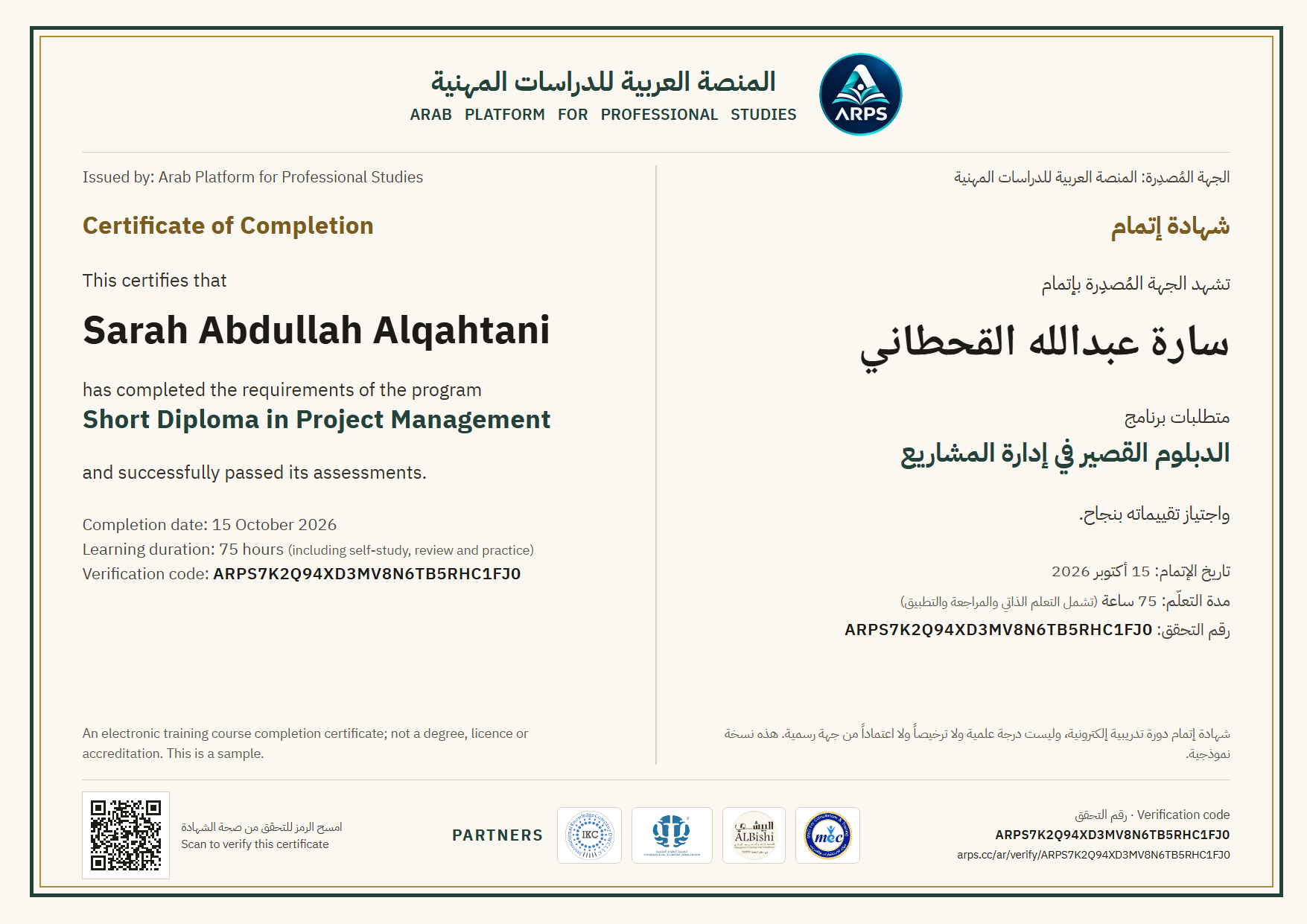
Every certificate has a public verification code. Verify a certificate
The real design with fictional details; opens in a new window.
No. It teaches non-clinical help within an organizational role, supervision, and local referral route.
No. All cases are fictional and complete for practice.
After checking need, safe channel, and appropriate consent under organizational policy; urgent danger follows its agreed route.
Separate offering, person consent, service acceptance, and actual access; record only what evidence supports.
No. Participation is optional and needs clear privacy and safety boundaries.
No. Learning completion is neither professional licensure nor clinical competence.
Yes. Professional Specialization in Non-Clinical Psychosocial Support is free on ARPS: every lesson, exercise and assessment is free, the first subject is open to read without an account, and the program is available in Arabic and English. Issuing a certificate is optional; it is a training completion certificate showing you passed the program's assessments, not a university degree, a professional licence or an endorsement by an external body.
The subject of this program is also known as: psychosocial support, psychological first aid, non-clinical mental health support. Learners usually find it by searching for: psychosocial support course, psychological first aid course, psychosocial support training, psychosocial support for children, free psychosocial support course.
Programs from the same field or route that may complement what you learn here.
Human, Psychology, Counseling & Family Studies
Learn defined tasks in educational family guidance: intake, scope, safe dialogue, a reviewable trial, and referral when a need exceeds the role.

Human, Psychology, Counseling & Family Studies
An applied non-clinical counseling-studies program about remit, supportive meetings, collaborative practical planning, safeguarding and referral, documentation and closure. It does not teach diagnosis or treatment or confer a professional license.

Human, Psychology, Counseling & Family Studies
Learn to analyze family requests, compare support options and develop a reasoned recommendation that can be followed up. Family and service cases apply clear boundaries for consent, privacy, referral and clinical practice.

Human, Psychology, Counseling & Family Studies
Analyze coaching and professional-development cases with conflicting evidence. Design a bounded agreement, observable experiment, and recommendation. Balance client and sponsor goals, distinguish individual from system constraints, and evaluate change without claiming a license or unwarranted causation.