Professional Specialization in Nutrition Education and Healthy Lifestyle
Professional Specialization in Nutrition Education and Healthy Lifestyle is a free program on ARPS, the Arab Platform for Professional Studies. Learn to design nutrition and lifestyle education that leads to a checkable practical decision, from label reading and feasible meals to learner comprehension. Fictional cases keep a clear boundary between general education and individual treatment.
Build a non-diagnostic learner profile from stated food access, routine, language and task, then adapt an educational example without imposing a meal plan.
From lesson 1, readable now without an account: The boundary between nutrition education and referral
Nutrition education helps people understand food choices and use general information in daily decisions. Begin with the decision the learner wants to make after a session: comparing products, making a familiar meal more varied, or interpreting a serving size. An educator can teach a comparison method and explore barriers. Diagnosing a deficiency, calculating an individual's needs in illness, or changing a therapeutic diet or medicine requires clinical history, findings, assessment and professional authority. Discussing the decision in a group workshop does not turn it into general advice.
Use a four-field request card. First record the person's question in their own words rather than adding an interpretation. Second, identify what a general source actually supports. You can explain adequacy, balance, moderation and diversity, while recognizing that practical choices vary with age, activity, accessible foods and customs. Third, record information whose absence prevents an individual conclusion. The person may mention a diagnosis, treatment, pregnancy, symptoms, allergy or restriction. Fourth, choose an action: teach a general skill, seek only clarification needed for the education task, or refer to an authorized professional. Referral prevents population guidance from becoming an unsuitable personal intervention.
Do not use a list of diseases as an automatic diagnostic rule. If someone says, “I take medicine and my doctor told me to watch my food,” the sentence cannot establish that person's sodium or potassium allowance. You may show where sodium is found on a label, while leaving its interpretation against the care plan to the treating team. If someone describes difficulty swallowing or a severe reaction after food, continuing a meal-choice exercise may overlook an urgent safety issue. Follow the setting's referral and emergency procedure. This program does not prescribe treatment for those symptoms.
Set the source boundary before composing a message. WHO population dietary guidance is not a prescription for one person. An FDA example explains the US label and does not make its format universal. For another country, consult its current food-based guide and official labeling rules before printing local figures. When these have not been checked, teach observation of available fields and explain that definitions differ. Useful education does not require inventing a local rule.
A respectful response acknowledges the question, states a limit and offers a useful route: “Your question about a meal that fits your treatment matters. This session lacks the information needed to set your therapeutic plan. I can show you how to inspect ingredients and serving size, and you can ask the professional responsible for your care about an appropriate amount.” Avoid both “this meal is safe for everyone” and a frightening refusal without help. Ask the learner to explain in their own words the difference between reading a label and making a treatment decision. Teach-back checks how clearly you communicated; it is not medical clearance.
A free account saves your progress and takes you straight to lesson 1.
Program facts
Study fee
Free
subjects
9
lessons
46
Estimated time
56.5 hours
Content last reviewed
Access period
30 days
Study language
Arabic and English
About the program
Begin by identifying what an educator can teach and what requires referral, then assess learner context without collecting unnecessary health details. Explain dietary-pattern principles, servings, sugars, sodium and fibre. Compare products on a common basis while considering cost, storage and culture. Practise shopping, safe preparation, eating away from home and checking popular claims.
Next, help a learner choose a small behavior experiment, record opportunities without stigma and revise a plan when work, sleep or access changes. Make usable bilingual material and facilitate disagreement without exposing private information. Then assemble an applied session, measure delivery and learning with clear denominators, and review sources, referral and updates before handoff. Later units apply these skills to food decisions under changing information and to education operations and result interpretation, ending with a shift-meal education improvement capstone. This is not a clinical licence, treatment promise or external certification.
Practical relevance
Use the tools in community workshops, workplaces or general education materials: request triage cards, label comparisons, action plans, teach-back questions and revision logs. Cases are fictional; transfer to a real organization requires local guidance and authority review.
Why this program
General food advice can fail when transferred to an individual without context, or when a label becomes a treatment prescription. This program connects primary information to an education task, a justified decision and inference limits, with access, privacy and safety built into delivery.
What you will learn
Classify education requests, assess learner context, write observable outcomes and check comprehension without clinical overreach.
Explain dietary pattern principles and make fair, bounded comparisons of food groups, labels, sugar, sodium, fibre, cost and access.
Plan feasible shopping, food safety and away-from-home choices while checking unsupported nutrition claims.
Negotiate a bounded behavior experiment, monitor it respectfully, interpret activity guidance, and revise plans under changing routines.
Design and test accessible bilingual group instruction while managing disagreement and adapting examples to learners.
Show all (7)
Measure education delivery and learning, limit causal claims, manage safety and source updates, and hand off an integrated project.
Make practical food decisions when quantities, costs and information change, run education delivery and interpret its results fairly, then complete a shift-meal education improvement project.
Learning outcomes (6)
Classify education requests, assess learner context, write observable outcomes and check comprehension without clinical overreach.
Explain dietary pattern principles and make fair, bounded comparisons of food groups, labels, sugar, sodium, fibre, cost and access.
Plan feasible shopping, food safety and away-from-home choices while checking unsupported nutrition claims.
Negotiate a bounded behavior experiment, monitor it respectfully, interpret activity guidance, and revise plans under changing routines.
Design and test accessible bilingual group instruction while managing disagreement and adapting examples to learners.
Measure education delivery and learning, limit causal claims, manage safety and source updates, and hand off an integrated project.
Who it is for
Practitioners offering general nutrition education who want stronger session design and application
Professionals in related roles needing decision tools within their authority
Staff in community, school or workplace health programs who deliver group education sessions.
Developers of bilingual awareness materials who want clear, practical messages without therapeutic claims.
Prerequisites
Ability to read simple quantities, portions and workshop instructions; clinical authorization is not required to study, while clinical practice is outside scope.
Willingness to distinguish general nutrition education from individual therapeutic advice and to refer cases that need specialist professional assessment.
Time set aside for regular study and for applying the exercises to fictional cases within the access window.
Classify education requests, assess learner context, write observable outcomes and check comprehension without clinical overreach.
4 lessons · 1.5 hours
The boundary between nutrition education and referral8 min
Assessing learner context and access32 min
Writing measurable education outcomes30 min
Teach-back and equitable communication6 min
Subject 2
Healthy dietary patterns and food literacy
Explain dietary pattern principles and make fair, bounded comparisons of food groups, labels, sugar, sodium, fibre, cost and access.
7 lessons · 3 hours
Adequacy, balance, moderation and diversity32 min
Food groups, portions and flexible meal patterns32 min
Reading labels and comparing packaged foods30 min
Affordable and culturally usable food choices30 min
Free, added and total sugars30 min
Distinguishing sodium from salt in education6 min
Teaching food fibre through food and labels6 min
Subject 3
Education for practical food decisions
Plan feasible shopping, food safety and away-from-home choices while checking unsupported nutrition claims.
4 lessons · 1.5 hours
Planning and shopping under constraints32 min
Teaching food preparation and safety32 min
Meals away from home and social occasions8 min
Checking misleading nutrition claims8 min
Subject 4
Lifestyle behavior change
Negotiate a bounded behavior experiment, monitor it respectfully, interpret activity guidance, and revise plans under changing routines.
5 lessons · 58 min
Choosing a behavior target and readiness for change8 min
Self-monitoring without stigma6 min
Physical-activity and sedentary-time education30 min
Integrating sleep, stress and routine8 min
Revising a plan after a lapse6 min
Subject 5
Facilitation and adaptation
Design and test accessible bilingual group instruction while managing disagreement and adapting examples to learners.
5 lessons · 56 min
Designing a group education session6 min
Making usable bilingual learning material6 min
Facilitating disagreement in an education session6 min
Adapting education across life stages and access needs8 min
Testing material usability before delivery30 min
Subject 6
Evaluation and quality assurance
Measure education delivery and learning, limit causal claims, manage safety and source updates, and hand off an integrated project.
6 lessons · 40 min
Measuring delivery and learning6 min
Interpreting change without causal overclaim6 min
Referral, incident and source-review logs6 min
An integrated education project8 min
Auditing an education program before delivery6 min
Handing off a program and running an update cycle8 min
Subject 7
Food decisions under changing information
Examines food decisions when quantities, cost, information or equipment change: recipe yield and serving size, shopping with waste and changing prices, comparing cafeteria options with missing data, adapting a cooking activity, and negotiating improvements to the work meal environment.
5 lessons · 14 hours
Recipe yield and serving size3 hours
Shopping with waste and changing prices3 hours
Comparing cafeteria options with missing data3 hours
Adapting a cooking activity when equipment changes3 hours
Negotiating changes to the work meal environment3 hours
Subject 8
Education operations and interpretation
Builds reliable delivery and fair interpretation of results: one activity in person and remotely, training a replacement facilitator for critical decisions, calculating the cost of reaching a learner, and interpreting results with unequal attendance.
4 lessons · 11 hours
Delivering one activity in person and remotely3 hours
Training a replacement facilitator for critical decisions3 hours
Calculating the cost of reaching a learner3 hours
Interpreting results with unequal attendance3 hours
Subject 9
Shift meal education improvement capstone
A capstone that simulates improving shift-meal education: a project brief from conflicting voices, a data and source pack, a teaching pack with a transfer task, simulated delivery and incident response, then pilot analysis, defence and handover of a usable edition.
6 lessons · 17 hours
Building a project brief from conflicting voices3 hours
Preparing the project data and source pack3 hours
Building a teaching pack and transfer task3 hours
Simulating delivery and incident response3 hours
Analysing a pilot and choosing a revision3 hours
Defending the project and handing over a usable edition3 hours
Subjects unlock in sequence as you progress.
Strengths
Clear separation of general education and therapeutic referral
Worked label, cost and storage decisions
Every lesson linked to practice, measurement and source upkeep
Evidence basis
General rules draw on primary pages from WHO, FAO, FDA, AHRQ and CDC with relevant country, age and date limits named. Training cases and figures are fictional. Mention of an institution does not imply program endorsement or accreditation.
Methodology
A teachable decision is followed by explanation, worked case, practice and measurement, with source and clinical boundary checks.
Assessment
Assessments follow the program blueprint and may use module assessments, a final assessment, or a combination, under the approved attempt policy.
Assessment attempts: 2 per assessment, 7 days apart
The pass mark is announced before the program is published.
Certificate
The credential confirms completion and successful assessment; it does not represent professional licensure unless explicitly and lawfully stated.
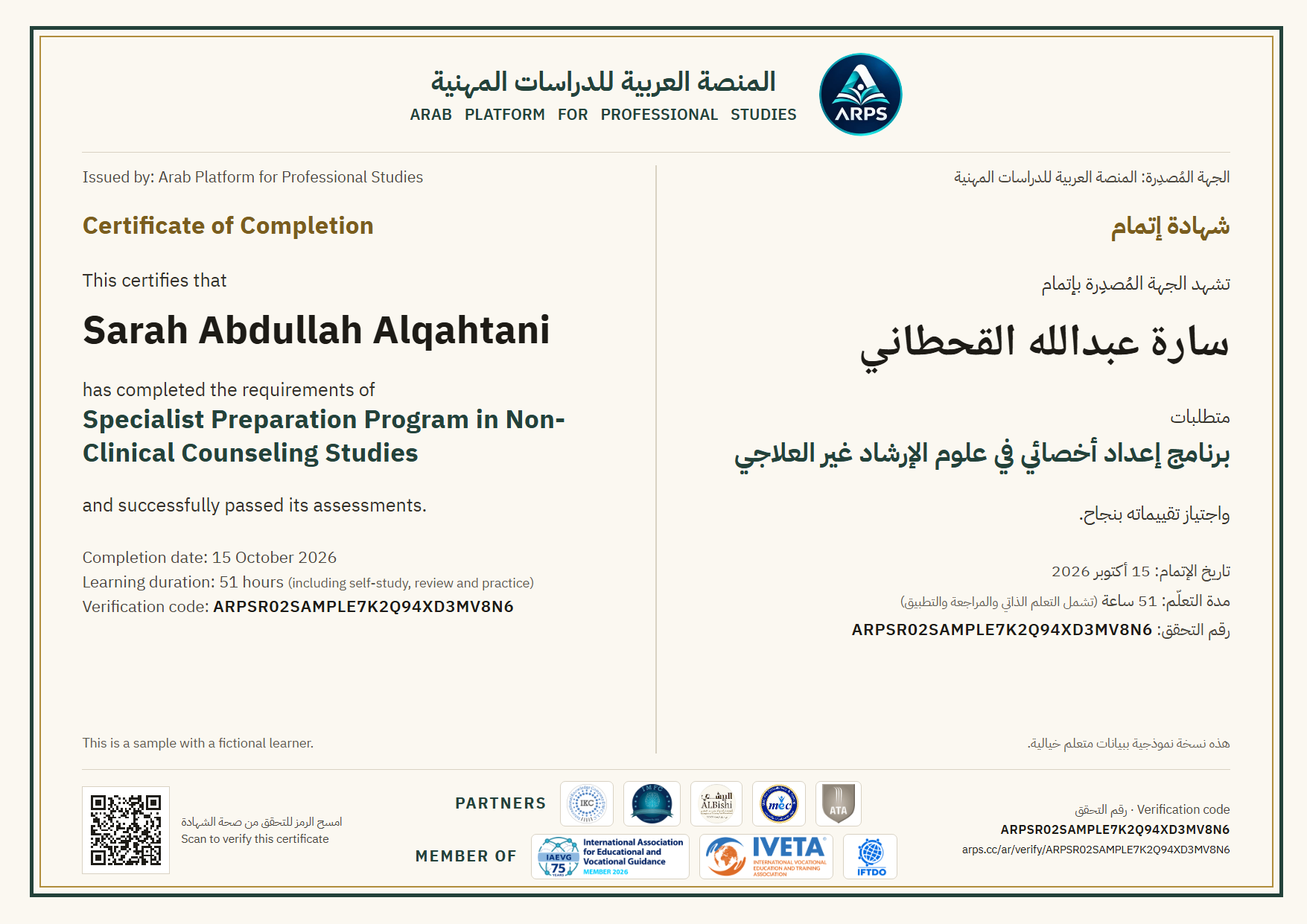
A sample from a real program in this track: Specialist Preparation Program in Non-Clinical Counseling Studies. The learner, scores and dates are fictional; opens in a new window.
No. It develops general education, facilitation and comparison skills. Individual prescriptions, diagnosis and treatment changes remain with authorized professionals under local rules.
Do I need participants’ health records?
Exercises use fictional cases and labels. Collect only information necessary for an educational task under the host policy; do not demand diagnoses or weight in a group.
Do the figures apply in every country?
Population sources and the US label context are named where used. Check current national food guidance and labeling rules before local deployment.
How can I check understanding?
Ask for a new application or an explanation in the learner’s own words, then inspect operation, decision and inference limit. Attendance or a yes answer is not skill evidence.
Are clinical outcomes proven for this course?
The course makes no clinical trial or disease-risk reduction claim. It teaches bounded delivery and learning measurement and the difference between observation and causality.
Show all (8)
How do practice and tests differ?
Lesson exercises are self-checked with solutions or criteria. Short knowledge checks and automated module assessments use new cases; choices alone do not prove live job performance.
Is Professional Specialization in Nutrition Education and Healthy Lifestyle free, and do I get a certificate?
Yes. Professional Specialization in Nutrition Education and Healthy Lifestyle is free on ARPS: every lesson, exercise and assessment is free, the first subject is open to read without an account, and the program is available in Arabic and English. Issuing a certificate is optional and has a published fee; it is a training completion certificate showing you passed the program's assessments, recognised by most private-sector organisations in the Gulf states and most Arab countries, and it strengthens your CV; confirming that a specific organisation accepts it remains your responsibility.
What other names is Professional Specialization in Nutrition Education and Healthy Lifestyle known by?
The subject of this program is also known as: Nutrition Education, Healthy Lifestyle Education, Nutrition Awareness. Learners usually find it by searching for: free nutrition education course, learn to read food labels, designing nutrition education sessions, healthy lifestyle course online.
A foundational diploma on foods, nutrients, dietary patterns, labels, food safety and everyday behaviour, taught as general education that can transfer across cultures without prescribing individualized therapeutic diets.
6 subjects
25 lessons
56 hours
Free
Specialist Preparation Programs
Public Health, Nutrition, Wellbeing & Healthcare Management
Learn to frame a health policy question, appraise evidence, analyze financing, cost and equity, and write a conditional recommendation with a monitoring plan. Hypothetical numerical cases support auditable decision tools while keeping inference and professional authority within clear limits.
7 subjects
30 lessons
49.5 hours
Free
Professional Certification Preparation
Public Health, Nutrition, Wellbeing & Healthcare Management
Bilingual review of the published CPHQ task outline through original instruction, fictional quality and safety cases, worked exercises and a limited readiness assessment. NAHQ/HQCC owns the official examination and credential.
Turn software requirements into checkable acceptance conditions and reproducible tests. Record execution and defects, then write an evidence bounded release recommendation. The program covers design, risk, accessibility, authorization, performance and automation.
10 subjects
40 lessons
53.5 hours
Free
Next step: a professional certification or a mini-master
Programs in the same domain that prepare you for an international certification exam or form a professional mini-master, also free.