Certified Professional in Healthcare Quality (CPHQ) Preparation
Certified Professional in Healthcare Quality (CPHQ) Preparation is a free program on ARPS, the Arab Platform for Professional Studies. Bilingual review of the published CPHQ task outline through original instruction, fictional quality and safety cases, worked exercises and a limited readiness assessment. NAHQ/HQCC owns the official examination and credential.
Important notice: Independent preparation. This program does not administer the official CPHQ exam, award CPHQ or claim NAHQ/HQCC endorsement.
Distinguish the seven domains and their scored item counts from the internal learning path and issuer policies.
Turn a bounded work-history record into readiness gaps tied to an official task and performance evidence, without inferring eligibility or a predicted pass.
Rank improvement opportunities by harm, alignment and readiness and revisit the decision when weights change.
From lesson 1, readable now without an account: From the CPHQ outline to a testable gap map
A quality practitioner who says, ‘I work in patient safety, so I am ready for CPHQ,’ is confusing broad experience with the specific coverage tested by the examination. The Healthcare Quality Certification Commission (HQCC), NAHQ's certifying arm, publishes the examination task outline. The version checked on 23 October 2026 has seven domains and 125 scored items in total: Quality Leadership and Integration 19, Performance and Process Improvement 27, Population Health and Care Transitions 11, Health Data Analytics 26, Patient Safety 18, Quality Review and Accountability 16, and Regulatory and Accreditation 8. These are published exam item counts, not minutes of our course or pass rates. The outline appears in the 2026 international candidate handbook; a candidate should check the issuer again before applying in case a later edition replaces it.
A free account saves your progress and takes you straight to lesson 1.
Program facts
Study fee
Free
subjects
10
lessons
34
Estimated time
77.5 hours
Content last reviewed
Access period
30 days
Study language
Arabic and English
About the program
Ten modules and 34 lessons connect leadership, process improvement, population health, data analytics, patient safety, accountability and external evaluation, then apply them in laboratories on leadership and improvement design, populations and data, and safety and accountability across service boundaries. Each lesson introduces a decision, a data-rich worked case with limits, and an exercise with reviewable feedback. Program questions are original; learning checks, internal assessment and limited readiness practice are neither the issuer’s item bank nor its examination.
Practical relevance
Lessons use fictional organizations and cases in several cities to practice denominators, transitions, safety and accreditation without attributing invented data to a real site. Transfer the method only after checking local definitions and authority.
Why this program
Working in quality does not automatically show that a candidate can choose a valid denominator or decide from conflicting evidence. This program connects outline tasks to calculations and verifiable applications and teaches when an active case needs protection before system analysis proceeds.
Career relevance
For quality practitioners organizing professional review and testing judgment in leadership, measurement and safety. The program grants no issuer eligibility or license and promises no pass or career outcome.
Career paths this program serves
This program is a step on the paths of the following occupations. Open a path to see its other programs in study order.
Turn CPHQ outline tasks into evidenced readiness gaps without inferring eligibility.
Rank quality opportunities and build a reviewable charter and governance decision.
Select a change test and cause or risk tool, then monitor adoption.
Define a population and examine a care transition without causal overreach.
Design measures and interpret rates, time series and stratified comparisons.
Show all (10)
Protect an active safety case, investigate the system and test a barrier.
Audit evidenced performance and comprehension, and connect external requirements to live evidence.
Build a feasible improvement portfolio and redesign a results handoff across shifts.
Trace access losses in affected populations and audit a comparison dashboard with changing denominators.
Test device safeguards before procurement and trace a contracted service from request to result.
Learning outcomes (34)
Distinguish the seven domains and their scored item counts from the internal learning path and issuer policies.
Rank improvement opportunities by harm, alignment and readiness and revisit the decision when weights change.
Write a charter linking delayed results to an outcome measure, balancing measure and spread authority.
Interpret reporting and staff-experience signals without equating count with harm, and design safe feedback.
Map referral rework and calculate timely booking and form completeness with a fixed denominator.
Test a small change with a falsifiable PDSA prediction, separating immediate harm response from the next cycle.
Distinguish defect frequency from failure-mode severity and choose Pareto or FMEA for the question.
Compare adoption, outcome and balancing measures across two sites before spread.
Define comparison populations and calculate an appointment gap without inferring transport causality from margins.
Separate population outreach delivery, reach and completion while retaining excluded people’s unknown outcomes.
Check care-transition elements on the same case and assign follow-up ownership for a pending result.
Compare readmission events per discharge and examine changing risk mix and call reach.
Design a fall measure dictionary and validate unique events and complete patient-days before display.
Calculate and distinguish fall event count, exposure-based rate and unique-person proportion.
Interpret a run-chart signal within its sampling frame and design collection across other shifts.
Compare two services overall and by risk stratum after aligning outcome definitions.
Protect a suspect case first, preserve event evidence and separate facts from causal hypotheses.
Measure initial wrong selection despite later interception and test a stronger identifier barrier across shifts.
Sequence an unacknowledged result and write a conditional cause tested by routing and backup checks.
Prioritize prospective failure modes without lowering detection difficulty before alert performance is observed.
Classify audit performance, exceptions, missing evidence and late exclusions with a fixed eligible denominator.
Triangulate documented instruction delivery, respondent understanding and version differences while protecting review confidentiality.
Separate urgent clinical response, data disclosure containment and a current-rule-based reporting decision.
Calculate a fictional quality-contract threshold and verify exclusions and visit timing before payment judgment.
Compare external evaluation options by scope, eligibility, evidence and resources without claiming accreditation.
Link a result acknowledgment rule to its edition, timed log, shift owner and live performance test.
Distinguish correction of an expired record from sustained proof of night-shift expiry alerts.
Trace a result through sending, acknowledgment and contact and test a system gap before readiness judgment.
Build a feasible improvement portfolio within available resources and examine ranking sensitivity and decision authority.
Redesign a results handoff across shifts and test delay, rework and exceptions using explicit operational data.
Trace access losses across follow-up stages and select a targeted response using correct denominators and outcome limits.
Audit a comparison between services and calculate the effects of case mix, missingness and reviewer agreement before drawing a bounded conclusion.
Design safe simulated-use tests of a fictional device's safeguards and distinguish lower risk scores from actual prevention or detection evidence.
Trace a contracted service across organizational boundaries and reconcile fictional requirements with operational, outcome and corrective-action evidence.
Who it is for
For candidates seeking structured review before CPHQ and practitioners in quality, patient safety, performance improvement, data coordination or accreditation who need to explain decisions rather than memorize terms. It also supports members of multidisciplinary teams who must communicate calculations and limits. All cases are educational; learners should consult their own organization’s policies and the credential owner before applying a real clinical or regulatory decision.
Prerequisites
This program suits learners familiar with a healthcare or quality workflow who can read a simple table and calculate a percentage, or who want to refresh those skills before the lessons. Enrollment here does not verify a job title or formal experience. Any external examination application conditions belong to the credential owner and should be checked against its current source, not inferred from platform study progress.
What it does not offer
Awarding CPHQ or providing a full-length official-equivalent simulation.
Replacing authorized clinical or local legal decisions.
Quality leadership begins with the issuer’s CPHQ task outline, then turns each task into performance evidence and a review gap without promising eligibility or a pass.
4 lessons · 2.5 hours
From the CPHQ outline to a testable gap map32 min
Prioritizing improvement opportunities against strategy32 min
From a selected opportunity to an accountable plan34 min
Reading safety culture and engaging stakeholders32 min
Subject 2
Performance and Process Improvement
Bound an improvement process from referral decision to patient notification and show the rework loop when incomplete requests return.
4 lessons · 2.5 hours
Defining an improvement opportunity and its process boundary32 min
Choosing an improvement method and running a small test34 min
Choosing a cause, frequency or prospective-risk tool32 min
Leading change and evaluating its sustainment32 min
Subject 3
Population Health and Care Transitions
A population definition decides who belongs in the denominator before interpreting a group gap.
4 lessons · 2.5 hours
Defining a population and reading differences fairly32 min
Designing a population prevention and follow-up intervention32 min
Finding information gaps at a care transition32 min
Evaluating a care transition without premature causal claims32 min
Subject 4
Health Data Analytics
Build a measure dictionary naming unique events, exposure days, period and source for each field, then check duplicate events and missing days before publishing a dashboard.
4 lessons · 2.5 hours
Designing a decision-ready measure and data set32 min
Distinguishing proportions, rates and suitable denominators32 min
Choosing a sample, display and time-series interpretation32 min
Comparing and reporting results with uncertainty34 min
Subject 5
Patient Safety and Event Learning
Patient safety starts with protecting an active case: authorized staff stop use of a suspect item, clinicians assess exposure, then the team preserves records and learns from the system.
4 lessons · 2.5 hours
Safety signals: protect first, then learn32 min
Human factors and system safeguards32 min
Reviewing an event and choosing a verifiable action34 min
Assessing a new pathway's risk and safety activity32 min
Subject 6
Quality Review and Accountability
Fair accountability keeps audit classes separate: evidenced performance, a documented clinical exception pending validation, missing evidence and a late exclusion without a prior rule.
4 lessons · 2.5 hours
Auditing a clinical pathway with its exceptions32 min
Triangulating documentation, practitioner performance and patient experience32 min
Protecting quality records and checking reporting duties32 min
Evaluating a payment-linked quality initiative32 min
Subject 7
Regulatory and Accreditation Review
Select external evaluation by the current body’s service scope, site eligibility, evidence and resources; an internal imaging gap or a broad accreditation offer does not confer eligibility.
4 lessons · 2.5 hours
Selecting external evaluation for the service scope32 min
From a current requirement to live compliance evidence32 min
Correcting a compliance gap and verifying it stays closed32 min
Survey readiness through a case-to-system tracer32 min
Subject 8
Leadership decisions and improvement design
This unit moves from ranking a single proposal to building a portfolio the organization can actually deliver. Compare value with role-specific capacity, examine weight sensitivity, conflicts and dependencies, and then redesign a fictional results pathway across shifts. Distinguish sending, acknowledgment and completed follow-up. Resource, queue and rework tables reveal where time is consumed, while tests cover absent recipients and downtime. The outputs are a funding memo and an operating plan with explicit review conditions. Exercises combine calculation, artifact construction and critique, each with independent worked feedback identifying evidence and remaining information needs. Cases and numerical thresholds are educational assumptions; current care responses remain with authorized professionals.
2 lessons · 17.5 hours
Allocating quality resources across competing projects9 hours
Redesigning a results pathway across shifts9 hours
Subject 9
Population and data laboratories
This unit examines what overall percentages hide when access opportunities and denominators differ. Trace a fictional discharge cohort from eligibility through invitation, receipt and completion, selecting responses matched to time, transport or understanding barriers. Keep unknown outcomes and less visible groups present, and examine consequences for other populations' capacity. Audit a comparison dashboard through category rates, reference weights, missingness bounds and a reviewer agreement table. Distinguish percentage points from relative change, targets from control limits and event time from recording time. Outputs include an access plan, comparison memo and operational and leadership views. Every calculation retains its units and denominator, and every interpretation states assumptions before becoming an expansion recommendation.
2 lessons · 17.5 hours
Following populations hidden by the average9 hours
Auditing a comparison dashboard with changing denominators9 hours
Subject 10
Safety and accountability across service boundaries
This unit connects safety and accountability to observable work across device and service boundaries. Design fictional-device simulations covering retained identifiers, source absence and bypasses, interpreting detection, false alerts and limited-test evidence. Compare safeguards and write acquisition conditions tied to version, context and results. Then trace a contracted laboratory service from request through issue, acknowledgment and follow-up, checking document scope, clocks, exceptions and financial incentives. Separate case correction from cause-focused change and target verification to actual impacts. Outputs are an acquisition recommendation, tracer report and testable corrective plan. Cases preserve privacy and role boundaries while distinguishing supported conclusions from claims pending suitable sources or tests.
2 lessons · 17.5 hours
Testing safety controls before procuring a device9 hours
Tracing a contracted service from request to result9 hours
Subjects unlock in sequence as you progress.
Strengths
Outline tasks linked to instruction, cases and original questions.
Auditable denominator calculations and bounded solutions.
Clear separation between immediate protection and system learning.
Evidence basis
The NAHQ/HQCC outline and candidate handbook are paired with primary professional, safety and measurement resources; source access and version limits are logged.
Reference organizations
NAHQ/HQCC
Institute for Healthcare Improvement
Frameworks used
CPHQ examination outline — 2024 official outline corroborated by indexed 2026.5 handbook
Methodology
Published tasks are linked to instruction, worked cases, exercises and questions, separating issuer decisions from internal preparation.
How the route works
Professional Certification Preparation programs help learners prepare for a recognized external certification through structured knowledge, review, practice questions, and readiness assessments. Arab Platform for Professional Studies (ARPS) does not administer the certification owner's official exam.
Structured self-paced study aligned to the current external certification scope, with knowledge review, practice questions, readiness checks, and internal mock assessments.
Focused preparation for a specific external certification.
Content aligned to the current official exam scope when available.
Practice questions and internal readiness assessments.
Clear separation between Arab Platform for Professional Studies (ARPS) preparation and the official external exam.
Assessment
The route includes an internal assessment for Arab Platform for Professional Studies (ARPS) completion eligibility and separate mock/readiness assessments that are not the external official exam.
Assessment attempts: 2 per assessment, 7 days apart
The pass mark is announced before the program is published.
Certificate
The Arab Platform for Professional Studies (ARPS) credential confirms completion of the preparation program only; the target professional certification requires passing the external issuer's examination under its rules.
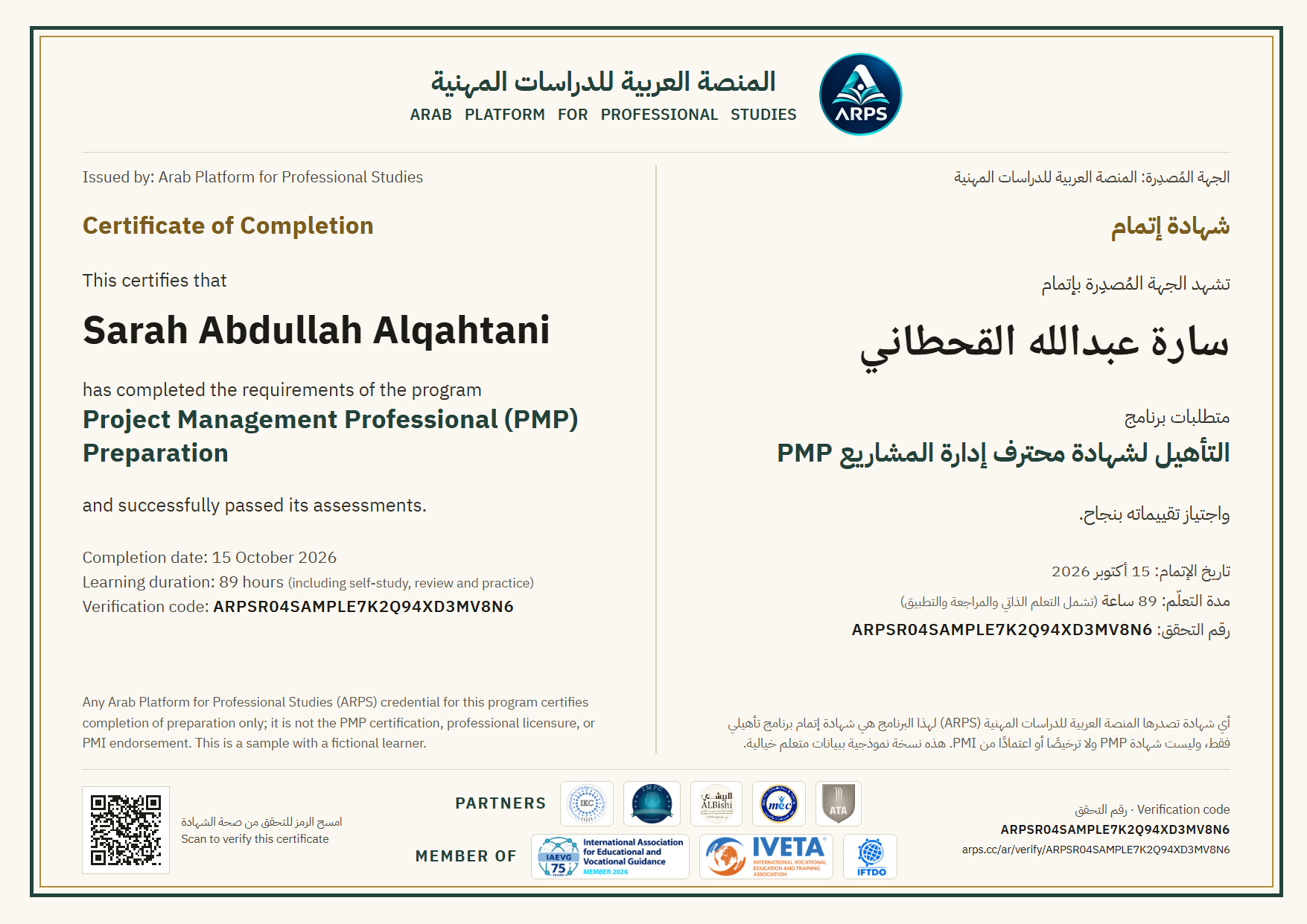
A sample from a real program in this track: Project Management Professional (PMP) Preparation. The learner, scores and dates are fictional; opens in a new window.
Disclaimer: Any platform completion credential is not CPHQ, professional licensure or NAHQ/HQCC accreditation.
Program questions
Does study here award CPHQ?
No. NAHQ/HQCC owns the official CPHQ exam and credential; these assessments are original internal material.
Is the readiness mock equivalent to the official examination?
It is a limited diagnostic of decisions, not a match to the issuer’s full item count or exam conditions and not a pass prediction.
How can I check the outline version?
The issuer-source check date is recorded; check the current issuer edition again when applying.
Does the internal result approve a CPHQ application?
No. A platform result describes performance on its original questions only; issuer application and examination decisions remain with NAHQ/HQCC.
How should I use the fictional cases?
Calculate the denominator, next action and limit, then compare the feedback. Check your own organization’s rules before any real action.
Show all (7)
Is Certified Professional in Healthcare Quality (CPHQ) Preparation free, and do I get a certificate?
Yes. Certified Professional in Healthcare Quality (CPHQ) Preparation is free on ARPS: every lesson, exercise and assessment is free, the first subject is open to read without an account, and the program is available in Arabic and English. Issuing a certificate is optional and has a published fee; it is a training completion certificate showing you passed the program's assessments, recognised by most private-sector organisations in the Gulf states and most Arab countries, and it strengthens your CV; confirming that a specific organisation accepts it remains your responsibility.
What other names is Certified Professional in Healthcare Quality (CPHQ) Preparation known by?
The subject of this program is also known as: CPHQ, Certified Professional in Healthcare Quality, healthcare quality, healthcare quality management. Learners usually find it by searching for: CPHQ exam prep, CPHQ exam 2026 preparation, CPHQ practice questions, CPHQ exam preparation free, healthcare quality course, what is CPHQ certification, CPHQ exam requirements, CPHQ course in Arabic.
Learn to design nutrition and lifestyle education that leads to a checkable practical decision, from label reading and feasible meals to learner comprehension. Fictional cases keep a clear boundary between general education and individual treatment.
A bilingual preparation program aligned to CFA Institute’s 2026 Level I topic outline. Ten domains and forty lessons combine worked cases, separate exercises, and original practice items. It does not administer the issuer exam or guarantee a pass.
An honest note: we prepare you for the exam; we do not award the certification. Only the body that owns a certification awards it, once you meet its requirements and pass its official exam, and you register and pay for the exam with that body. The optional ARPS certificate is a training completion certificate recognised by most private-sector organisations in the Gulf states and most Arab countries, and it strengthens your CV alongside the certification.