Professional Mini-Master in Administrative Leadership of Care Quality and Patient Safety
Professional Mini-Master in Administrative Leadership of Care Quality and Patient Safety is a free program on ARPS, the Arab Platform for Professional Studies. Lead service quality and patient safety administratively, from responsibility-transfer analysis to measurable change and operational handover. Nine modules and fifty lessons cover service-quality governance, incident learning, measurement, change testing and sustainment, then equity and user experience, operational.
Apply where a service begins and a risk signal gets lost to a service case with evidence and decision limits.
From lesson 1, readable now without an account: Where a service begins and a risk signal gets lost
Imagine an outpatient unit promising that a result will reach the responsible team within a day. The results team, however, believes that its follow-up duty begins only when a clinician opens the message. A risk signal can disappear in the space between those promises. A quality manager cannot decide the person's diagnosis or treatment from this description. The manager can examine who owns the transfer, what demonstrates completion, and what happens when completion cannot be demonstrated. We begin with the boundary of a service system. Here a system means the linked work, people, data, tools and decisions that deliver a defined service, rather than a department name on an organization chart. A map that starts at the clinic door and ends when the person leaves may omit consequential work after the visit, including delivery of results or resolution of a pending referral. Set the start and end from the service promise and its associated risk, then trace accountability across organizational boundaries. A useful map makes a handoff testable. An exhaustive diagram that hides the decision point is less useful to a manager.
A free account saves your progress and takes you straight to lesson 1.
Program facts
Study fee
Free
subjects
9
lessons
50
Estimated time
136 hours
Content last reviewed
Access period
60 days
Study language
Arabic and English
About the program
Nine modules and fifty lessons cover service-quality governance, incident learning, measurement, change testing and sustainment, then equity and user experience, operational resilience, executive judgment and an integrated capstone. Synthetic cases and decision exercises retain explicit evidence limits. Learners estimate resources, specify procurement conditions and board mandates, then build an administrative-case portfolio with baseline, two tests, review, deputy-tested handover, defense and follow-up. Training results retain declared origins, while medical and legal judgments remain with authorized specialists.
Practical relevance
Build a ninety-day administrative improvement plan: define a failure, protect open cases, test a bounded mechanism, disclose data limits, escalate dependencies beyond your authority and demonstrate ownership transfer. The capstone extends application into source reconciliation, two mechanism tests, capacity review, deputy handover and follow-up decisions with explicit ownership.
Why this program
A dashboard can look reassuring while a request remains without valid acknowledgement or an aggregate rate hides night-shift burden. This program connects process analysis, responsible reporting, outcome/process/balancing measures and a justified choice to spread, adapt or pause a change.
Career relevance
For quality, risk and operations managers in care settings with foundational experience. It develops transferable administrative judgment, not a professional license, university degree or job promise.
Career paths this program serves
This program is a step on the paths of the following occupations. Open a path to see its other programs in study order.
Govern service quality and responsibility transfer within clear professional boundaries.
Lead incident response and systems learning while verifying repair without prejudging individual accountability.
Build outcome, process and balancing measures and interpret signals and source limits for decisions.
Design and run bounded change tests and decide whether to adopt, adapt, retest or stop.
Justify resource trade-offs, escalate residual risk and transfer a sustainable administrative improvement plan.
Show all (9)
Evaluate access barriers and user experience, designing administrative responses that protect fairness and follow-up ownership.
Analyze compensating work, alerts and disruption, testing operating recovery that preserves cases and capacity.
Justify resource, procurement and effect-review decisions using bounded evidence and traceable executive mandates.
Build an administrative capstone from case selection and baseline through testing, review, deputy handover, defense and follow-up.
Learning outcomes (9)
Govern service quality and responsibility transfer within clear professional boundaries.
Lead incident response and systems learning while verifying repair without prejudging individual accountability.
Build outcome, process and balancing measures and interpret signals and source limits for decisions.
Design and run bounded change tests and decide whether to adopt, adapt, retest or stop.
Justify resource trade-offs, escalate residual risk and transfer a sustainable administrative improvement plan.
Evaluate access barriers and user experience, designing administrative responses that protect fairness and follow-up ownership.
Analyze compensating work, alerts and disruption, testing operating recovery that preserves cases and capacity.
Justify resource, procurement and effect-review decisions using bounded evidence and traceable executive mandates.
Build an administrative capstone from case selection and baseline through testing, review, deputy handover, defense and follow-up.
Who it is for
For quality, risk and operations managers, service-pathway leads and supervisors responsible for request handoffs and follow-up in care settings. It suits professionals with foundational experience who want to lead incident analysis, build measures, test change and transfer an operational control. It is not designed for clinical diagnosis or treatment training, professional licensure or a university degree.
Prerequisites
Foundational experience in health-service operations, care quality or risk management, including familiarity with referrals, follow-up and responsibility transfers between teams. Clinical practice and treatment experience are not required.
Ability to read a simple measure's numerator and denominator, compare work records, describe an operational failure and propose escalation. Learners should be ready to discuss fictional cases and write an administrative improvement plan that states evidence and privacy limits.
Governing service quality and safety: apply decisions with evidence and clear limits.
5 lessons · 4.5 hours
Where a service begins and a risk signal gets lost57 min
Who decides and who escalates when a handoff fails?54 min
A risk register that separates signals from harm54 min
Choosing an improvement portfolio under capacity limits54 min
A governance charter that turns meetings into decisions54 min
Subject 2
Incident response and organizational learning
Incident response and organizational learning: apply decisions with evidence and clear limits.
5 lessons · 4.5 hours
The first minutes: contain the signal and preserve facts54 min
Triage incident signals without claiming certainty54 min
Reconstructing an event and testing explanations54 min
From incident explanation to an action that interrupts failure54 min
Closing the learning loop and verifying effect54 min
Subject 3
Measurement and signal detection
Measurement and signal detection: apply decisions with evidence and clear limits.
5 lessons · 4.5 hours
Specify a measure before plotting it54 min
Three measures to understand one change51 min
Reading change over time without a causal leap54 min
Reveal service differences without exposing people54 min
A measurement review that ends in a testable decision54 min
Subject 4
Testing change and responsible implementation
Testing change and responsible implementation: apply decisions with evidence and clear limits.
5 lessons · 4.5 hours
From a safety aim to a falsifiable change theory57 min
A small test that learns before it spreads57 min
What did the test actually teach?57 min
Moving a tested change into shift work57 min
Deciding to adopt, adapt, retest or stop54 min
Subject 5
Integrated leadership and sustainment
Integrated leadership and sustainment: apply decisions with evidence and clear limits.
5 lessons · 4.5 hours
Balancing safety, access and resources54 min
Learning climate, reporting and fair accountability54 min
Escalating residual risk and communicating with governance54 min
Ownership transfer and drift monitoring54 min
An integrated ninety-day safety improvement plan57 min
Subject 6
Equity and patient experience when service stalls
This module extends service quality to people whose journey stalled before access, distinguishing respondents from experiences missing in measurement. Learners define a bounded learning sample and examine an administrative task across language, interface and channel. They review request age, holds and queue exits while leaving clinical priority with qualified professionals. Follow-up separates message delivery, recipient response and completed action. Service recovery uses feasible promises within delegated authority. The final lesson gives service users a clear design question, protects case privacy and records how contributions affect decisions. Exercises produce coverage maps, tested messages, review rules and traceable decisions without generalizing a small sample or hiding unfinished work behind a reassuring indicator.
6 lessons · 21 hours
Hearing people who never reached the service3.5 hours
Analyzing language barriers in an administrative request3.5 hours
Reviewing fairness in a waiting list3.5 hours
Designing follow-up contact that reaches its owner3.5 hours
Separating service recovery from a treatment promise3.5 hours
Including a service-user representative in improvement3.5 hours
Subject 7
Operational resilience across people and technology
This module examines operational resilience through the work that keeps pathways functioning when formal processes or tools are incomplete. Learners distinguish useful compensating functions from methods needing repair or authorization. They reduce duplicate alerts while protecting detection and response, then design recovery separating older work, outage-period requests and new intake. Absence exercises test knowledge, access, authority and capacity. Interface review follows user expectations through action and recovery. Finally, learners examine successful pressure days without treating exceptional conditions as universal practice. Exercises produce function records, tests and handover cases while preserving specialist decision boundaries and distinguishing restored screens from restored service obligations.
6 lessons · 21 hours
Revealing hidden work that keeps a pathway running3.5 hours
Protecting decisions from alert overload3.5 hours
Managing a backlog after an outage3.5 hours
Testing the absence of a critical role3.5 hours
Checking an interface change before use3.5 hours
Learning from a day that succeeded under pressure3.5 hours
Subject 8
Executive judgment across resources and evidence
This module connects executive judgment with evidence sources and resource limits. Learners estimate effort while separating released capacity from realized cash, then examine conflicting measures that may encourage superficial closure. They read targeted audits without unsupported extrapolation and translate supplier promises into testable acceptance and exit conditions. Rival evidence about case mix or timing definitions prompts bounded review preserving decision history and valid work. The module ends with a board memo containing genuine alternatives, explicit authority, ownership, resources and start and review conditions. Exercises use declared synthetic cases, retaining medical, legal and contractual judgments with authorized specialists. The outcome is a decision independent roles can understand, execute and trace to its supporting evidence.
6 lessons · 21 hours
Building a reviewable operating cost estimate3.5 hours
Resolving conflicting measures before rewarding performance3.5 hours
Reading a limited-sample audit report3.5 hours
Defining conditions for buying a technical solution3.5 hours
Reopening a decision when rival evidence appears3.5 hours
Writing a board decision with a clear mandate3.5 hours
Subject 9
Capstone: handing over a learning service system
The capstone builds a connected administrative-service portfolio from selection through follow-up. Learners choose an eligible case, make bounded commitments and protect referred or deferred issues. They reconcile baseline sources and missingness, then design two mechanism-led tests with predictions and execution records. Midpoint review continues valid components while repairing or stopping faulty ones within capacity. A deputy tests handover by resuming unfamiliar work. Defense retains claim lineage, limitations and review origins. Final follow-up separates service drift from measurement change and assigns maintenance, monitoring and reconsideration events. Applications use declared synthetic information when authorized fieldwork is unavailable. Specialist decisions and official acceptance remain with their authorized roles.
7 lessons · 32 hours
Choosing a capstone case and its commitment4.5 hours
Building a baseline dossier and tracing input quality4.5 hours
Designing two tests that distinguish rival explanations4.5 hours
Leading a midpoint project review4.5 hours
Preparing a handover pack tested by a deputy4.5 hours
Defending results and their limits professionally4.5 hours
Reporting follow-up after handover4.5 hours
Subjects unlock in sequence as you progress.
Strengths
Connected decisions across governance, analysis, measurement and implementation.
Clear separation of operational evidence from unmeasured clinical effects.
A ninety-day plan with review gates and proven ownership transfer.
Evidence basis
Concepts draw on scoped primary sources from WHO, AHRQ and IHI. Teaching cases and numbers are fictional and are neither study findings nor treatment recommendations.
Reference organizations
WHO
AHRQ
IHI
Methodology
The material combines incident learning, workflow analysis, improvement measures and PDSA tests while distinguishing source principles from fictional case decisions.
Program questions
Does this award a license or university master's degree?
No. Professional Mini-Master is an internal program title with an optional completion credential, not an academic degree or professional license.
Does it require clinical practice?
No. It addresses service pathways, measurement and escalation and refers diagnosis and treatment to professionals.
What practical output will I make?
An administrative improvement plan and capstone portfolio covering case selection, baseline, two tests, review, deputy handover, defense and follow-up. Use declared synthetic cases when authorized fieldwork is unavailable.
How is learning assessed?
Applied lesson checks and an integrated assessment cover all nine modules, alongside exercises and an administrative capstone portfolio retaining evidence, decisions and limitations.
How should personal data be used?
Examples are fictional. Use authorized institutional channels and do not enter real personal data in open exercises.
Show all (8)
How long is access?
The nominal period is thirty days and the route access window is sixty days; official learning hours remain unspecified.
Is Professional Mini-Master in Administrative Leadership of Care Quality and Patient Safety free, and do I get a certificate?
Yes. Professional Mini-Master in Administrative Leadership of Care Quality and Patient Safety is free on ARPS: every lesson, exercise and assessment is free, the first subject is open to read without an account, and the program is available in Arabic and English. Issuing a certificate is optional and has a published fee; it is a training completion certificate showing you passed the program's assessments, recognised by most private-sector organisations in the Gulf states and most Arab countries, and it strengthens your CV; confirming that a specific organisation accepts it remains your responsibility.
What other names is Professional Mini-Master in Administrative Leadership of Care Quality and Patient Safety known by?
The subject of this program is also known as: patient safety, healthcare quality, quality and patient safety, healthcare quality leadership. Learners usually find it by searching for: patient safety course online, patient safety courses online free, healthcare quality management course, quality improvement in healthcare, patient safety leadership.
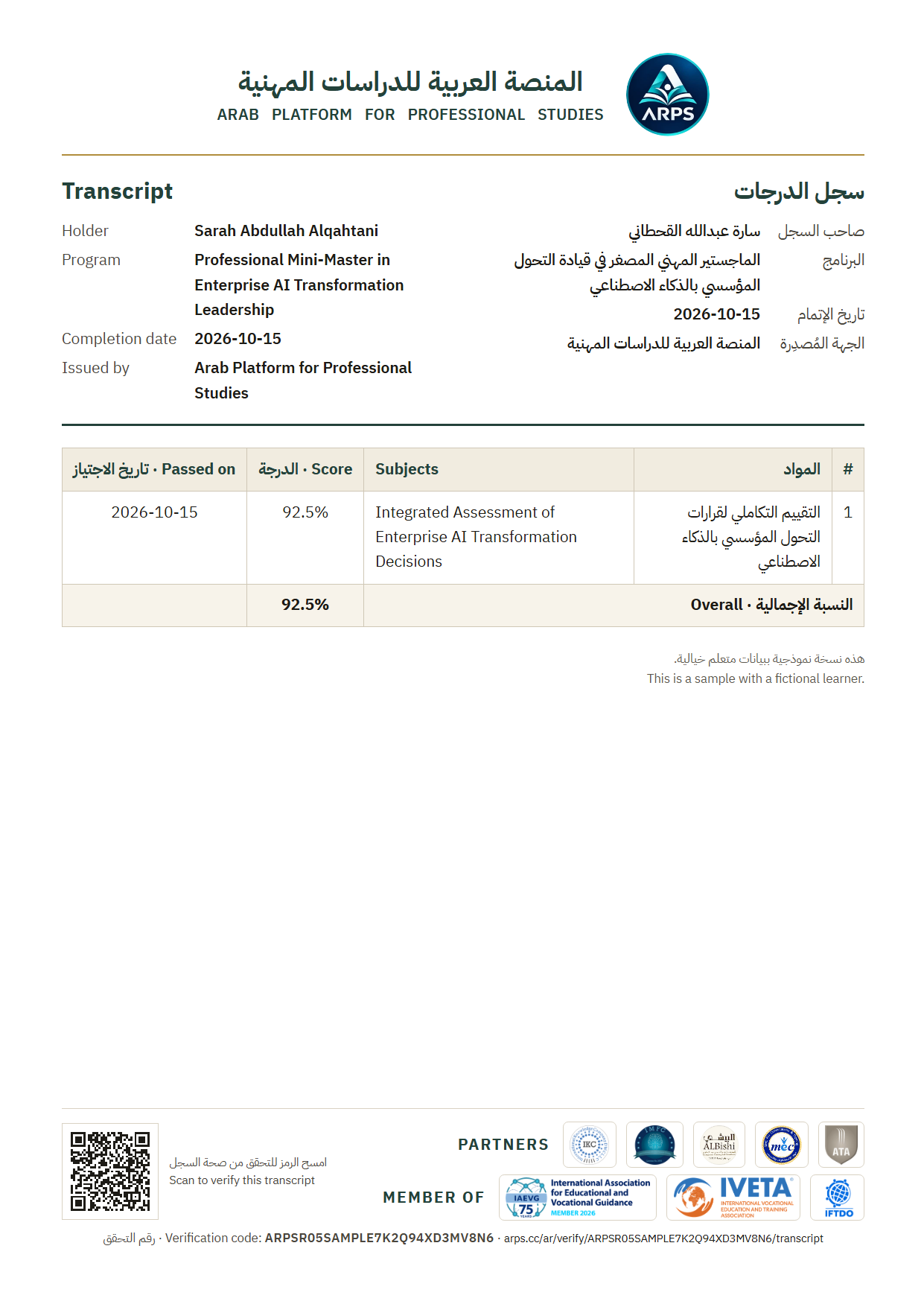
A sample from a real program in this track: Professional Mini-Master in Enterprise AI Transformation Leadership. The learner, scores and dates are fictional; opens in a new window.
Bilingual review of the published CPHQ task outline through original instruction, fictional quality and safety cases, worked exercises and a limited readiness assessment. NAHQ/HQCC owns the official examination and credential.
10 subjects
34 lessons
77.5 hours
Free
Professional Mini-Master
Public Health, Nutrition, Wellbeing & Healthcare Management
Learn to design nutrition and lifestyle education that leads to a checkable practical decision, from label reading and feasible meals to learner comprehension. Fictional cases keep a clear boundary between general education and individual treatment.
An honest note: the professional mini-master is an intensive professional program; it is not an academic degree or a licence and is not equivalent to a university master's or MBA. The optional ARPS certificate is a training completion certificate showing you passed the program's assessments.