Professional Mini-Master in Applied Social Research and Impact Evaluation
Professional Mini-Master in Applied Social Research and Impact Evaluation is a free program on ARPS, the Arab Platform for Professional Studies. Design responsible applied social research and impact evaluation, from the decision question and theory of change to comparison, measurement, analysis and reporting.
Separate a decision question, descriptive question and causal question
From lesson 1, readable now without an account: Separate a decision question, descriptive question and causal question
An evaluation team receives a brief: “Two hundred forty young people attended mentoring and their confidence in job search rose. Demonstrate the program’s impact.” The first move is to name the decision. Is the sponsor deciding whether to continue delivery, expand to more sites, or repair referral and attendance? Each decision asks for different evidence. Session completion and absence can inform delivery. Whether mentoring caused a change in confidence is a causal question. Post-program counts alone cannot answer it.
A free account saves your progress and takes you straight to lesson 1.
Program facts
Study fee
Free
subjects
10
lessons
50
Estimated time
166 hours
Content last reviewed
Access period
60 days
Study language
Arabic and English
About the program
The program follows one evaluation project through ten advanced modules. Begin with the decision an organization needs, distinguish description from a causal question and build a theory of change. Test evaluability before promising an effect estimate. Choose an estimand and comparison while examining selection, attrition and spillover. Specify indicators, a sample, field quality controls and proportionate consent and protection. Interpret quantitative and qualitative findings with uncertainty, then complete an integrated protocol and a recommendation that says what is known and unresolved. Later modules deepen comparison design, longitudinal measurement, decision economics and process explanation before a licensing-service capstone. Training cases set in Arab cities are fictional; their figures are not real local data.
Practical relevance
You produce a question and estimand card, theory of change, design matrix, indicator specifications, quality and ethics plan, limitations report and decision recommendation. Apply the templates to a familiar initiative only after replacing fictional figures with verified data and securing suitable permissions.
Why this program
A social service indicator may rise after delivery without showing what would have happened in its absence. Conversely, demanding impossible certainty can halt useful learning. This program trains a proportionate choice of question, design and claim for the decision, ethical constraints and available data. It also teaches what to do when a causal comparison is not credible.
Career relevance
The skills support social research, program management and evaluation roles in public, nonprofit and research organizations. The final product can help review an internal protocol or discuss evidence with a funder and analyst. It does not confer professional licensure or external academic accreditation.
Career paths this program serves
This program is a step on the paths of the following occupations. Open a path to see its other programs in study order.
Frame an evaluation question, theory of change and decision-linked evaluability judgment.
Select a comparison and estimand while checking design assumptions and bias threats.
Specify indicators, a sample, field quality, consent and participant protection.
Interpret quantitative and qualitative results with uncertainty and transfer limits.
Defend an integrated protocol and transparent scale, test or redesign recommendation.
Show all (10)
Design comparisons for multicomponent interventions, including factorial, phased and weighted observational designs.
Audit linkage, panel follow-up, mode changes and indicator validity while protecting disclosure.
Compare incremental costs, timing, distribution and the value of further information under explicit assumptions.
Test process and contribution explanations and synthesize studies with different measures.
Produce a licensing-service evaluation dossier and update the decision when evidence is corrected.
Learning outcomes (10)
Frame an applied social evaluation question, theory of change and criteria matrix, then issue a conditional evaluability judgment.
Select a defensible comparison and impact estimand while checking allocation, threshold, trend, attrition and spillover assumptions.
Specify valid indicators, a sample and a data quality plan with proportionate consent, privacy and participant protection.
Interpret quantitative and qualitative results, uncertainty, mechanisms and transfer without exceeding the design's support.
Defend an integrated evaluation protocol and transparent decision recommendation documenting governance, cost, equity and limits.
Design comparisons of service offers, exposure timing and components, examining time-series and observational weighting assumptions.
Audit linkage, follow-up, mode changes and indicator validity, reporting results with disclosure protection.
Compare incremental costs, timing, distribution, information value and persistence under explicit assumptions and sensitivity.
Test process, context, implementation and contribution explanations, synthesizing studies with rival and comparability checks.
Produce a licensing-service procurement dossier and follow-on protocol, revising decisions after denominator correction while preserving lineage and inferential limits.
Who it is for
This program is for social research and program leads, evaluation practitioners and analysts in public, nonprofit and research organizations who have foundational experience with data collection or service delivery. It suits people reviewing an impact claim, planning a new evaluation or making a recommendation to a funder. Exercises require comfort with denominators, percentages, tables and ethical limits, but no particular statistical software experience.
Prerequisites
You should know how to frame a basic research question, read a simple table, calculate a percentage and distinguish a person from a record or event. Experience in a social program or field study makes the cases easier to use. The lessons explain comparisons and estimands, but cannot replace institutional specialist review for work involving children, sensitive data, local law or real service decisions.
Frame the decision question, theory of change, criteria and evaluability.
4 lessons · 9.5 hours
Separate a decision question, descriptive question and causal question2.5 hours
Draw an intervention logic with assumptions and rival explanations2.5 hours
Set evaluation criteria, stakeholders and distributional questions2.5 hours
Test evaluability and issue a go, redesign or defer recommendation2.5 hours
Subject 2
Comparison design and impact identification
Choose an estimand and comparison, testing allocation, attrition and spillover.
4 lessons · 9.5 hours
Define treatment, eligible population, estimand and counterfactual2.5 hours
Assess random assignment feasibility and contamination2.5 hours
Compare quasi-experimental designs and assumptions2.5 hours
Plan sensitivity to selection, attrition and interference2.5 hours
Subject 3
Measurement, sampling, data and ethics
Specify indicators, sampling, data quality, consent and proportionate protection.
4 lessons · 9 hours
Operationalize constructs with validity and comparability checks2.5 hours
Construct sampling frame and reason about precision2.5 hours
Build field quality controls and missingness response2.5 hours
Apply proportionate consent, privacy and safeguarding2.5 hours
Subject 4
Mixed-method analysis and interpretation
Interpret quantitative and qualitative results with uncertainty and transfer limits.
4 lessons · 9.5 hours
Pre-specify estimands, missing data and subgroup analysis2.5 hours
Calculate and interpret a bounded impact estimate2.5 hours
Triangulate qualitative accounts with quantitative findings2.5 hours
Evaluate heterogeneity, mechanisms and external validity2.5 hours
Subject 5
Evaluation governance, reporting and decision
Complete an integrated protocol and a transparent, reviewable recommendation.
4 lessons · 9.5 hours
Contract governance, independence and protocol changes2.5 hours
Synthesize evidence using fit-for-purpose criteria2.5 hours
Write transparent limitations and communicate to audiences2.5 hours
Assemble and defend the integrated impact protocol2.5 hours
Subject 6
Comparisons for multicomponent interventions
Learners separate encouragement from receipt, test interactions in factorial designs, evaluate phased rollouts, examine interrupted time series and build weighted observational comparisons.
5 lessons · 16 hours
Separate encouragement from receipt3 hours
Test interaction in a factorial design3 hours
Evaluate a phased rollout with varying timing3 hours
Examine an interrupted service time series3 hours
Construct a weighted observational comparison3 hours
Subject 7
Longitudinal measurement and record quality
Learners audit record linkage, manage a three-wave household panel, separate survey-mode effects, validate proxies and release small tables while protecting identity.
5 lessons · 16 hours
Balance record linkage errors3 hours
Manage a household panel across three waves3 hours
Separate survey mode from outcome change3 hours
Validate a proxy against a reference measure3 hours
Release small tables while protecting identity3 hours
Subject 8
Decision economics under uncertainty
Learners calculate incremental outcome costs, align cost and benefit timing, make equity tradeoffs explicit, value further information and test persistence after support ends.
5 lessons · 16 hours
Calculate cost per additional outcome3 hours
Align cost horizons and benefit timing3 hours
Make efficiency equity tradeoffs explicit3 hours
Estimate the value of additional information3 hours
Test persistence after support ends3 hours
Subject 9
Process explanation and conflicting evidence
Learners trace causal processes, link context to mechanism, measure fidelity and adaptation, build contribution claims and synthesize studies with different measures.
5 lessons · 16 hours
Trace a causal process in a critical case3 hours
Link context mechanism and outcome3 hours
Measure fidelity and useful adaptation3 hours
Build a challengeable contribution claim3 hours
Synthesize studies with different measures3 hours
Subject 10
Capstone: evaluate an integrated licensing service
A capstone evaluating a fictional licensing-support service, from framing and trial design to reproducible analysis, costing, a decision dossier and responses to panel challenges.
10 lessons · 32.5 hours
Frame a licensing service procurement decision3.5 hours
Map journeys and competing outcomes3.5 hours
Design a component trial in licensing centers3.5 hours
Prepare a data dictionary and linkage audit3.5 hours
Plan follow-up of withdrawn applicants3.5 hours
Analyze trial outcomes reproducibly3 hours
Explain differential effects on small firms3.5 hours
Cost expansion including applicant burden3.5 hours
Prepare a decision dossier and follow-on test3.5 hours
Respond to panel challenges and update the decision3.5 hours
Subjects unlock in sequence as you progress.
Strengths
One connected protocol links questions, design, measurement and decision
Worked exercises reveal how denominators, loss and spillover alter conclusions
Parallel Arabic and English outputs with explicit claim boundaries
Evidence basis
Methods draw on primary material from the World Bank, OECD DAC, UNICEF, DIME and AAPOR. These sources support general methods; they do not verify the training numbers or accredit this program.
Reference organizations
World Bank
OECD DAC
UNICEF
World Bank DIME
AAPOR
Frameworks used
OECD DAC evaluation criteria — 2019
Methodology
Decision-led design, explicit assumptions, mixed evidence and claim boundaries.
Program questions
Is this an academic master's degree?
No. Professional Mini-Master is the name of an internal learning route. Completion, when earned under platform policy, is neither a university degree nor a practice license or external accreditation. The transcript reports module results from the same qualifying final attempt.
Will I calculate a causal effect for every initiative?
You will learn when a comparison can support an effect estimate and when the result remains descriptive. Some cases lack the data or allocation rule for a causal claim. A clear judgment and next-round data or design plan is then the professional output.
Do I need statistical software?
The lessons require no particular software. They use rates, tables and interpretable uncertainty intervals and ask you to explain assumptions. Applying a protocol to real data may require analysis software and specialist review according to its design and data sensitivity.
How does assessment work?
An automated integrated assessment follows all ten modules and draws questions across their topics. Each attempt has its own result. The route allows at most two attempts with a seven-day wait between them. Lesson checks are for practice and are not separate module credentials.
How long do study and access last?
The nominal route is thirty days with a sixty-day access window. Displayed minutes are an editorial estimate for reading, practice and assessment in one language path, not officially calibrated learning hours.
Show all (8)
Can I cite the Arab city cases as local statistics?
No. Cases set in named Arab cities are fictional training scenarios, not local facts or law. Verify real data, context and permissions for an actual project.
Is Professional Mini-Master in Applied Social Research and Impact Evaluation free, and do I get a certificate?
Yes. Professional Mini-Master in Applied Social Research and Impact Evaluation is free on ARPS: every lesson, exercise and assessment is free, the first subject is open to read without an account, and the program is available in Arabic and English. Issuing a certificate is optional and has a published fee; it is a training completion certificate showing you passed the program's assessments, recognised by most private-sector organisations in the Gulf states and most Arab countries, and it strengthens your CV; confirming that a specific organisation accepts it remains your responsibility.
What other names is Professional Mini-Master in Applied Social Research and Impact Evaluation known by?
The subject of this program is also known as: impact evaluation, social research, monitoring and evaluation. Learners usually find it by searching for: impact evaluation course, social research methods course, monitoring and evaluation course, social impact measurement, free impact evaluation course.
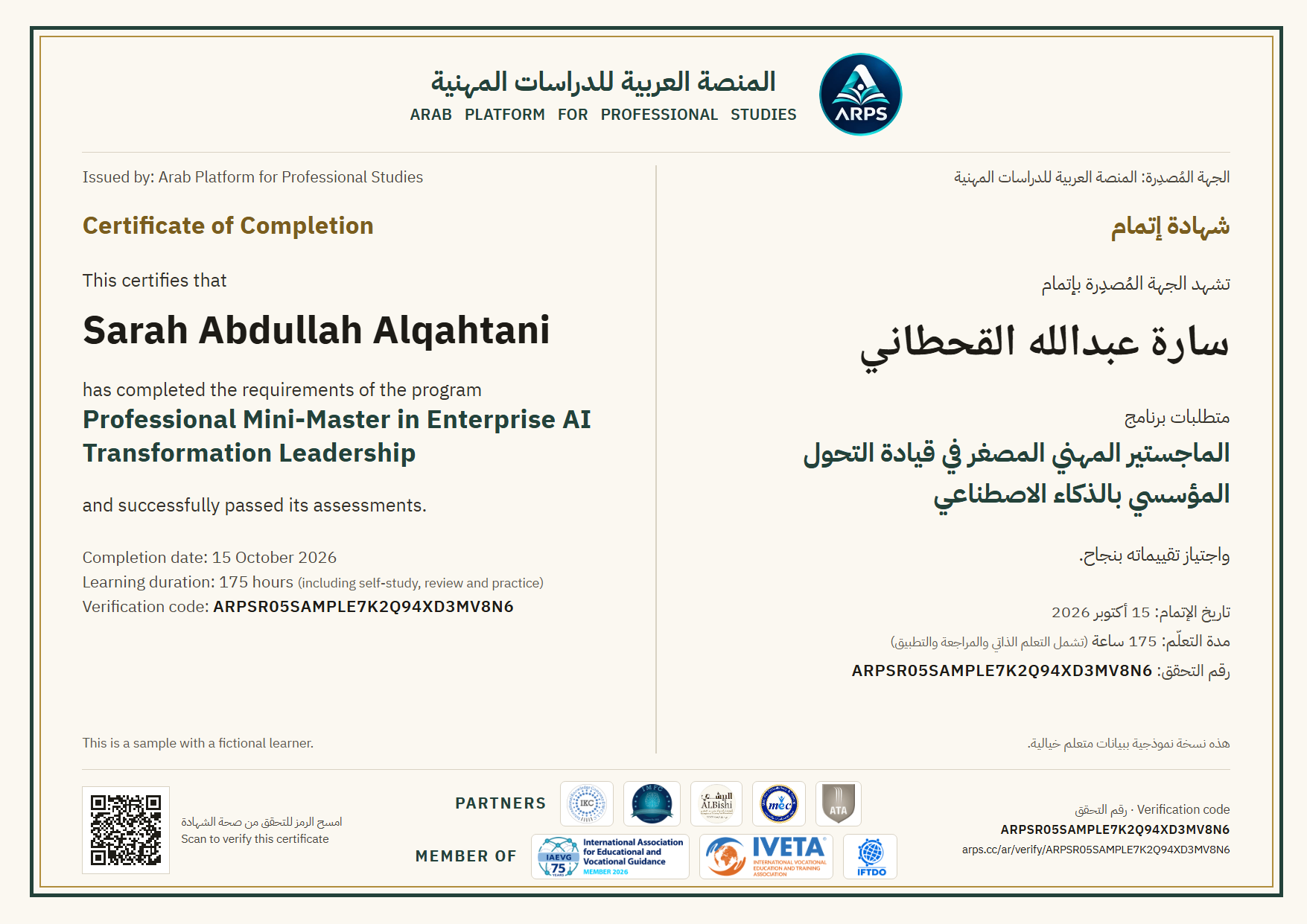
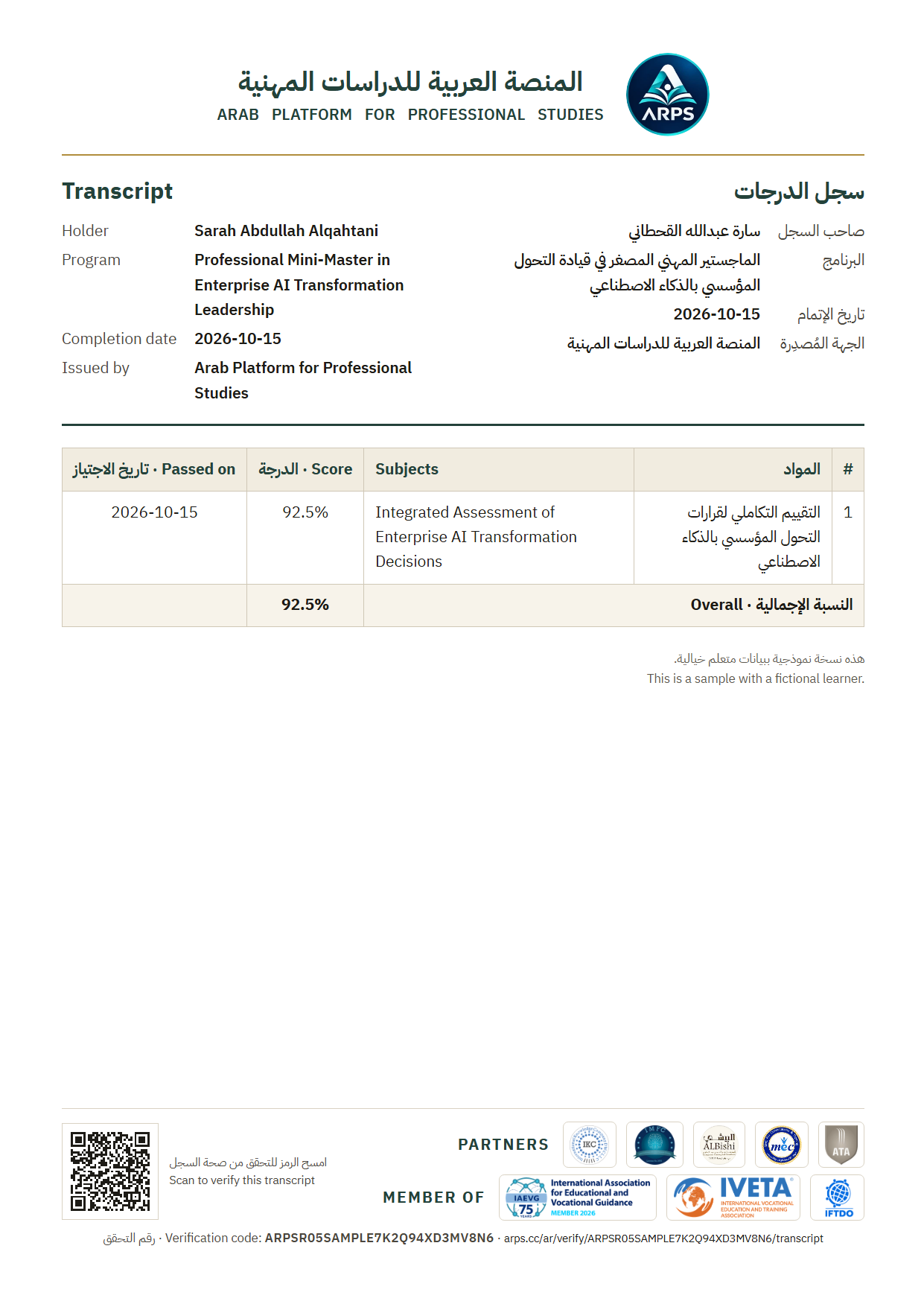
A sample from a real program in this track: Professional Mini-Master in Enterprise AI Transformation Leadership. The learner, scores and dates are fictional; opens in a new window.
Learn to diagnose social protection gaps, weigh evidence and alternatives, and write conditional, implementable recommendations within an advisory role.
8 subjects
36 lessons
68.5 hours
Free
Professional Mini-Master
Career Development, Personal Skills & Productivity
An honest note: the professional mini-master is an intensive professional program; it is not an academic degree or a licence and is not equivalent to a university master's or MBA. The optional ARPS certificate is a training completion certificate showing you passed the program's assessments.