Professional Mini-Master in Design of Non-Clinical Wellbeing Programs
Professional Mini-Master in Design of Non-Clinical Wellbeing Programs is a free program on ARPS, the Arab Platform for Professional Studies. Design a nonclinical preventive wellbeing program from a bounded work need to a responsible implementation and evaluation decision. Fifty lessons across eleven units move from a work need to package selection, participation, measurement and provider accountability.
Separate workload and survey participation signals from any individual's condition, then frame an organization-level problem with a clear intervention boundary.
From lesson 1, readable now without an account: Frame an organizational need without diagnosing people
Imagine that you commission a wellbeing program for an organization with shift workers. A chart shows that the average response to an energy question fell over recent weeks. It would be easy to say that employees have a mental disorder and purchase stress-management training. Neither conclusion follows. A self-reported feeling over a stated period is not a diagnosis, and an average does not reveal who changed or why. The mix of respondents, season of work, or wording of the question may have changed. Professional design starts with the organization's decision: which working conditions can be improved, for whom, and on what evidence? Whether any individual needs clinical assessment belongs outside the program designer's role. State the operating boundary at the outset: the proposed program is preventive and educational at organization level. It offers a separate route to qualified local services when needed and does not screen, diagnose, or treat people.
A free account saves your progress and takes you straight to lesson 1.
Program facts
Study fee
Free
subjects
11
lessons
50
Estimated time
143.5 hours
Content last reviewed
Access period
60 days
Study language
Arabic and English
About the program
Fifty lessons across eleven units move from a work need to package selection, participation, measurement and provider accountability. Listening, work design, evidence analysis, purchasing and sustained learning lead into an integrated capstone. Fictional cases and independently corrected practice accompany learning checks and one integrated final. Teaching separates observed results from causal explanation, resource estimates from expenditure, and a review candidate from authorized acceptance. The output is a reviewable decision dossier covering need, selection, safety, information, capacity, measurement and knowledge limits. The scope remains preventive, organizational and educational, with clinical and specialist matters directed to appropriate roles rather than promised unmeasured effects.
Practical relevance
Practice defining a problem with correct denominators, drawing a causal model, setting referral and privacy boundaries, staging a feasible pilot, and reading subgroup differences and missing data before scaling. Each lesson gives inputs, an observable output and an independent correction.
Why this program
A wellbeing initiative can become an attractive workshop that leaves a work risk intact, or a survey that appears to diagnose people. This program makes the boundary between need, intervention and result testable. It helps designers compare work redesign with education and qualified support. Each module contributes to one decision file rather than a disconnected list of activities.
Career relevance
For workplace HR and wellbeing leads and institutional community program designers who must justify funding, delivery and measurement to an accountable group. The skill is planning and reviewing preventive programs. The title is neither a clinical license nor an academic master's degree.
Career paths this program serves
This program is a step on the paths of the following occupations. Open a path to see its other programs in study order.
Define a bounded organizational preventive need, its population and measurement denominator with an equitable participation map.
Build a testable theory of change and choose an accessible, equitable organizational and educational package.
Design facilitator limits, safe referral, and data and incident governance without diagnosis or treatment.
Stage a feasible pilot, measure reach and fidelity, and control adaptations while preserving mechanism and safety.
Interpret outcomes, disparities, missingness and cost to justify conditional continuation, adaptation or stopping.
Learning outcomes (5)
Define a bounded organizational preventive need, its population and measurement denominator with an equitable participation map.
Build a testable theory of change and choose an accessible, equitable organizational and educational package.
Design facilitator limits, safe referral, and data and incident governance without diagnosis or treatment.
Stage a feasible pilot, measure reach and fidelity, and control adaptations while preserving mechanism and safety.
Interpret outcomes, disparities, missingness and cost to justify conditional continuation, adaptation or stopping.
Who it is for
Workplace human resources and wellbeing leaders, institutional community program leads and preventive intervention designers with foundational experience managing an activity or team. The program suits people who can coordinate with operations, safety and data stewards and want an equitable, voluntary offer across shifts and access groups. It does not qualify anyone to diagnose or treat individuals.
Prerequisites
Initial practice planning an activity or improving an organizational procedure, plus ability to interpret a simple rate with a numerator and denominator and to document a decision. Clinical training is not assumed. Learners should be ready to define their role limits and seek a qualified professional review when an individual needs care.
It helps to know how to gather optional worker feedback without exposing identities and to distinguish operational logs from self-report wellbeing data before working through the cases.
A wellbeing program begins with a modifiable work condition, not a survey mean treated as diagnosis.
3 lessons · 8 hours
Frame an organizational need without diagnosing people2.5 hours
Design participation and representation without coercion3 hours
Turn a need into an objective and commissioning gates3 hours
Subject 2
Theory of change and intervention selection
A theory of change names the population, modifiable mechanism, activities, near outcomes and assumptions that could fail.
3 lessons · 8.5 hours
Build a theory of change that can be challenged3 hours
Compare organizational change, education and targeted support3 hours
Specify intervention dose, fair access and delivery effects3 hours
Subject 3
Safety, referral and governance
A non-clinical program protects participants by defining the facilitator's role before a session: general education and respectful listening without diagnosis, treatment or a promise of absolute secrecy.
3 lessons · 8.5 hours
Define facilitator boundaries, competence and supervision3 hours
Design a safe route for disclosures and referral3 hours
Govern minimum data and safety incidents3 hours
Subject 4
Implementation, quality and adaptation
Implementation begins with observable readiness gates: operations authority, a stable baseline, real team capacity, shift access and an available safety route.
3 lessons · 8.5 hours
Turn the design into a stoppable operational pilot3 hours
Read reach, dose and implementation quality3 hours
Control local adaptations while preserving the mechanism3 hours
Subject 5
Evaluation and integrated decision
Evaluation starts by defining a measure, denominator and review time before seeing results.
3 lessons · 8.5 hours
Choose outcome measures and an interpretable comparison3 hours
Interpret subgroup differences, missingness and unintended harm3 hours
Integrated governance decision: continue, adapt or stop3 hours
Subject 6
Listening and validating need
This unit develops a needs dossier whose decisions can be traced from work accounts to priority selection. It starts with neutral interviews revealing events rather than confirming an earlier explanation, then codes accounts while retaining contrary cases. Learners map help seeking through disclosure, choice and dignity, and weigh two needs competing for a limited budget. The final lesson audits claims, denominators and unresolved information. Outputs are concrete working tools: an interview guide, coding rule, journey map, priority note and audit trail. Fictional examples are not attributed to real organizations. Each stage separates evidence-established knowledge from assumptions used in a decision.
5 lessons · 15.5 hours
Interview workers without leading answers3 hours
Code work accounts and explain disagreement3 hours
Map a dignified help-seeking journey3 hours
Prioritize two needs within one budget3 hours
Audit needs evidence before commissioning3 hours
Subject 7
Design work across different settings
This unit applies work design across settings with different communication, handover and role-cover needs. Learners create a hybrid-work communication agreement, repair responsibility transfer between teams and test what makes a break usable during service. They examine concentrated emotional demands and the role of authority and support, then design volunteer duties around competence, confirmed availability and supervision. Practice uses explicit fictional operating decisions and counts rather than worker diagnoses. Outputs include a communication agreement, handover model, cover arrangement, demand-allocation review and volunteer-role plan. Solution quality depends on feasibility without silently transferring burden to colleagues or service users.
5 lessons · 15.5 hours
Protect contact boundaries in hybrid work3 hours
Repair handovers between two teams3 hours
Design breaks that can actually be taken3 hours
Distribute emotional demands in public-facing work3 hours
Include volunteers without treating them as employees3 hours
Subject 8
Analyze evidence and interpret figures
This unit connects record quality with decision quality. Learners clean event logs while separating units from movements and unknowns from zero, then interpret indicators over time alongside denominators and channel availability. They examine site comparisons through definitions, coverage and request mix, and test choice sensitivity to uncertain cost, reach and capacity. The final lesson separates observed description, causal interpretation and conditional recommendation. Practice produces a traceable log, time-monitoring page, comparison note, scenario table and bilingual executive conclusion. Numerical cases are fictional teaching examples and conclusions remain limited to what was measured. Reports should carry their definitions and limitations to new decision makers.
5 lessons · 15.5 hours
Clean an event log before calculating rates3 hours
Read a time series alongside changing demand3 hours
Build a fair comparison between two sites3 hours
Test a decision against cost and reach uncertainty3 hours
Write conclusions that separate evidence and claims3 hours
Subject 9
Select and hold providers accountable
This unit makes provider selection a reviewable sequence of decisions. Learners specify outputs, dependencies and acceptance tests in a proposal request, then inspect a delivery sample through behavioral evidence and explicit limits. They map information between supplier and organization, separating delivery needs from managerial decision needs. They examine interests and combined roles, proposing proportionate management and review with traceable origin. The final lesson plans exit while protecting commitments, responsibilities and information when a service becomes unsuitable. Outputs include a purchasing specification, observation sheet, information map, interest-management plan and transition plan. Legal and financial judgments and actual notices remain with authorized organizational owners. Fictional cases test operating reasoning rather than establish universal contracting rules.
5 lessons · 15.5 hours
Write a request for a defined service output3 hours
Inspect a sample session before contracting3 hours
Separate provider data from management decisions3 hours
Manage conflicts of interest in evaluation3 hours
Plan an exit from an unsuitable service3 hours
Subject 10
Sustain learning and accountability
This unit develops learning that continues after an initiative starts. Learners handle objections through worker voice, response and decision, then examine whether delivery consumes operating reserve or transfers burden to nonparticipants. They renew one facilitator skill through observation, correction and trial, and transfer a pilot between sites by preserving function while testing adaptations. The final lesson updates the program when priorities change while protecting commitments and measurement meaning. Outputs are an objection pathway, capacity analysis, development cycle, transfer plan and update note. Each step has a question, resource, owner and evidence, with conclusions limited to actual testing. The aim is a program that learns from work and closes decisions responsibly rather than remaining in endless improvement or nominal expansion.
5 lessons · 15.5 hours
Handle objections while protecting worker voice3 hours
Read the effect on reserve capacity3 hours
Refresh facilitator skill through observation3 hours
Transfer a pilot responsibly to another site3 hours
Update a program when priorities change3 hours
Subject 11
Capstone: an accountable design dossier
This capstone develops an integrated design dossier for fictional Al Nada. Learners define a bounded commission and roles, triangulate needs and test an acceptance package’s logic. They prepare safety and referral, information flow, capacity and resources, then fix a measurement protocol before interpreting conflicting teaching results. They finish by defending a conditional recommendation and handing over a linked candidate with observations and a next-learning plan. All case figures are constructed and labeled rather than actual institutional implementation or approval. Practical tasks produce components reused in later lessons, checking relationships among need, choice, authority, resources and measurement. Completion means a reviewer can trace decisions and inspect limits, while final acceptance remains with the authorized role.
10 lessons · 31 hours
Define the capstone commission and boundaries3 hours
Build a triangulated needs dossier3 hours
Stress-test the chosen package logic3 hours
Prepare the project safety and referral dossier3 hours
Review the project data flow3 hours
Build a delivery schedule with real capacity3 hours
Write a prospective measurement protocol3 hours
Analyze conflicting fictional results3 hours
Defend a recommendation to a challenging board3 hours
Hand over the dossier and next learning cycle3 hours
Subjects unlock in sequence as you progress.
Strengths
One decision path from need to governance and evaluation
Fictional practice with independent solutions and explicit denominators
One integrated final spanning eleven units, with a learning check for every lesson
Evidence basis
Teaching uses scoped WHO, ILO/WHO and NICE workplace guidance, CDC evaluation methods and complex-intervention principles. Self-report wellbeing data have stated limits. All teaching cases and numbers are invented; they are not results reported by those organizations.
Reference organizations
WHO
ILO
NICE
CDC
MRC
Frameworks used
CDC Program Evaluation Framework — 2024
MRC complex interventions framework — 2021
Methodology
Compare need, mechanism, delivery and outcome while protecting participants and inference limits.
Program questions
Does the program diagnose or treat people?
No. It designs organizational prevention and education, with facilitator limits and locally verified qualified referral when needed.
What is the final applied output?
A decision memo joining need, theory of change, safety, delivery, measurement and cost to justify conditional continuation, adaptation or stopping.
Does a survey score prove impact?
No. The lessons check denominator, coverage, comparison and rival explanations before causal attribution.
Are the cases specific to a country?
Named regional cases are fictional. Any real referral route must be verified locally before use.
How is equitable reach examined?
The program separates eligible, invited, started and completed groups and examines access barriers while protecting privacy.
Show all (8)
Is the title a clinical or academic credential?
No. Professional Mini-Master is an internal learning-program title, not an academic master's degree or practice license.
Is Professional Mini-Master in Design of Non-Clinical Wellbeing Programs free, and do I get a certificate?
Yes. Professional Mini-Master in Design of Non-Clinical Wellbeing Programs is free on ARPS: every lesson, exercise and assessment is free, the first subject is open to read without an account, and the program is available in Arabic and English. Issuing a certificate is optional and has a published fee; it is a training completion certificate showing you passed the program's assessments, recognised by most private-sector organisations in the Gulf states and most Arab countries, and it strengthens your CV; confirming that a specific organisation accepts it remains your responsibility.
What other names is Professional Mini-Master in Design of Non-Clinical Wellbeing Programs known by?
The subject of this program is also known as: wellbeing programs, workplace wellbeing, employee wellness, wellbeing program design. Learners usually find it by searching for: workplace wellbeing programs, wellbeing program manager, employee wellbeing strategy, wellbeing program design course, workplace wellbeing course free.
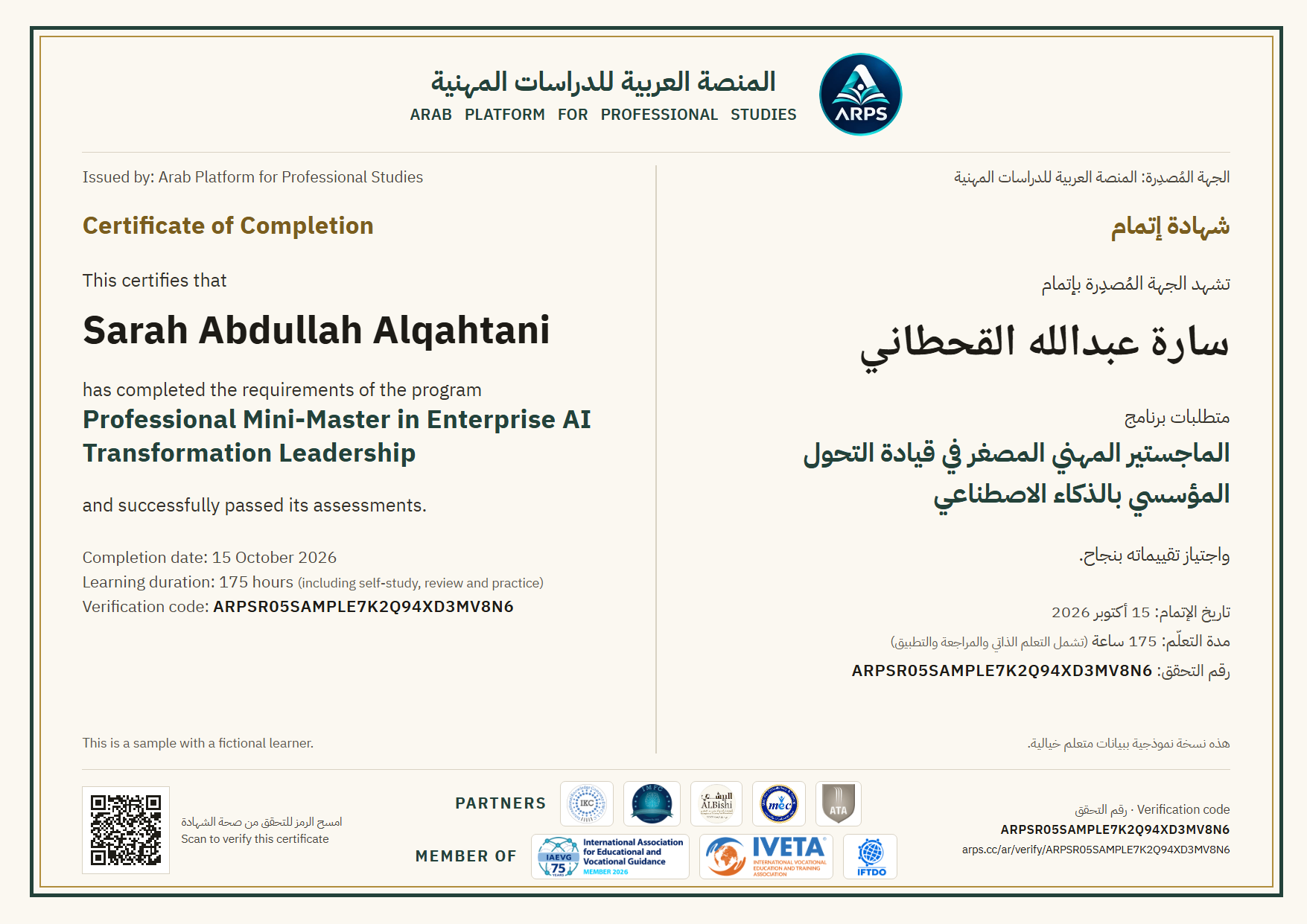
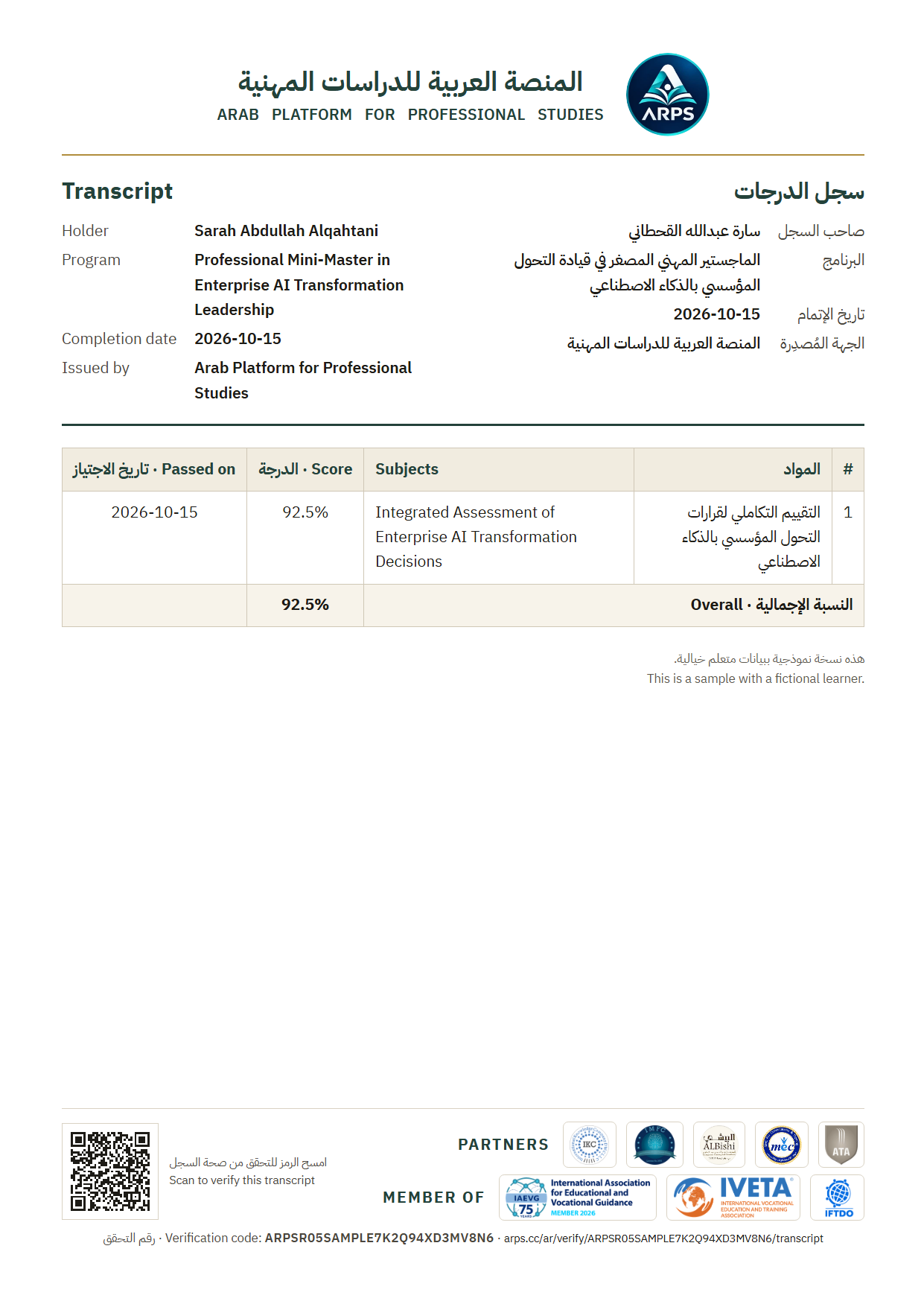
A sample from a real program in this track: Professional Mini-Master in Enterprise AI Transformation Leadership. The learner, scores and dates are fictional; opens in a new window.
A foundational, applied diploma connecting psychological wellbeing with self-awareness, stress management, sleep, movement, relationships, communication, problem-solving, decision-making and sustainable habits. It is non-therapeutic and does not use self-ratings to diagnose disorders.
An honest note: the professional mini-master is an intensive professional program; it is not an academic degree or a licence and is not equivalent to a university master's or MBA. The optional ARPS certificate is a training completion certificate showing you passed the program's assessments.