Professional Mini-Master in Development Initiative Design and Economic Impact
Professional Mini-Master in Development Initiative Design and Economic Impact is a free program on ARPS, the Arab Platform for Professional Studies. Design a testable development initiative, appraise its economic value and impact limits, and defend a funding or adaptation decision.
Apply define the outcome, population, and baseline to a development case, explaining inputs and decision limits.
From lesson 1, readable now without an account: Define the outcome, population, and baseline
An initiative may begin with an appealing ambition such as ‘improve young people's job prospects.’ That phrase tells the design team neither whom the intervention will reach nor what change will count as success. Before selecting training or finance, write the decision question: among eligible young people in a defined area, did the share obtaining sustained paid work within six months increase relative to what would have happened without the initiative? The final clause does not assume that every improvement was caused by the initiative; it identifies the outcome, population, period, and alternative. Keep this outcome separate from activity outputs. Registrations or training hours may show service reach, but neither is a job obtained by a learner. If a team is rewarded only for registrations, it may select easy-to-enroll people and neglect those who need more support. An outcome card therefore pairs a reach measure with an outcome measure and a protective measure, and explains the proposed link among them.
A free account saves your progress and takes you straight to lesson 1.
Program facts
Study fee
Free
subjects
9
lessons
50
Estimated time
180.5 hours
Content last reviewed
Access period
60 days
Study language
Arabic and English
About the program
Study fifty lessons across nine modules, progressing from initiative diagnosis and economic appraisal to advanced impact designs and uncertainty modeling. Complete seven linked outputs for a fictional rural production-service center: mandate, market, resources, evaluation, pilot, finance, and defense. Cases distinguish evidence, assumptions, and authorized decisions. Exercises require calculations, protocols, or reviewable memoranda. The integrated foundations assessment remains, supplemented by lesson-specific checks for every new lesson. Figures are instructional rather than field results. Learning effort is estimated from reading, practice, and assessment without claiming officially accredited hours.
Practical relevance
Apply the reasoning to an initiative you know once its data and context are appropriate, or work entirely with the included fictional cases. The pathway requires neither uploading identifiable beneficiary data nor buying outside tools.
Why this program
An initiative can appear beneficial before its real alternative, sustainability cost, or uneven effects have been considered. Outcomes can also rise after a program without the program causing the rise. This course connects intervention choice with economic appraisal, impact design, and conditional delivery so a committee can distinguish evidence from assumptions.
Career relevance
The material supports work in local development, program design, policy analysis, and economic and social evaluation. It develops the ability to prepare and challenge a decision brief. It does not promise employment, promotion, professional licensing, or a university degree.
Career paths this program serves
This program is a step on the paths of the following occupations. Open a path to see its other programs in study order.
Diagnose a development problem and define its population, baseline, intervention alternatives, and testable theory of change.
Build an incremental economic appraisal of costs, benefits, present value, distribution, and measurement limits.
Test decision sensitivity, scenarios, cost-effectiveness, liquidity, and reversible financing gates.
Design an impact evaluation with a credible comparison, explicit estimand, data and assumption checks, and participant safeguards.
Integrate impact, cost, and implementation evidence in a conditional brief to adapt, pause, or scale.
Apply local demand diagnosis, advanced impact designs and modeling under uncertainty in a decision file for a rural production-service center.
Learning outcomes (5)
Diagnose a development problem and define its population, baseline, intervention alternatives, and testable theory of change.
Build an incremental economic appraisal of costs, benefits, present value, distribution, and measurement limits.
Test decision sensitivity, scenarios, cost-effectiveness, liquidity, and reversible financing gates.
Design an impact evaluation with a credible comparison, explicit estimand, data and assumption checks, and participant safeguards.
Integrate impact, cost, and implementation evidence in a conditional brief to adapt, pause, or scale.
Who it is for
Local development and social program managers, economic policy analysts, and monitoring and evaluation staff who contribute to decisions under limited resources. The course also fits public and nonprofit practitioners who need to connect initiative logic with cost and impact appraisal. It assumes related foundational experience and comfort reading simple tables and percentages.
Prerequisites
Initial experience planning a project, analyzing a policy, or monitoring a program, plus familiarity with percentages, tables, and direct cost. Having faced a target-population or alternative-service question helps, but prior impact-evaluation work is not required. Lessons introduce advanced terms when needed and walk through calculations using bounded fictional cases.
Appraise incremental resources, benefits, present value, and distribution.
5 lessons · 8.5 hours
Appraisal perspective, horizon, and counterfactual1.5 hours
Inventory incremental resource costs1.5 hours
Value benefits without double-counting1.5 hours
Net present value and alternative choice1.5 hours
Distributional incidence and affordability1.5 hours
Subject 3
Uncertainty, Choice, and Financing
Test scenarios, break-even, and liquidity before another funding gate.
5 lessons · 8.5 hours
Sensitivity and break-even thresholds1.5 hours
Coherent scenarios and decision triggers1.5 hours
Cost-effectiveness when monetization is weak1.5 hours
Financing plan and cash sustainability1.5 hours
Staged investment and reversible gates1.5 hours
Subject 4
Impact Evaluation and Data Design
Design an impact comparison and inspect assumptions, attrition, and safeguards.
5 lessons · 8.5 hours
Estimand and comparison population1.5 hours
Choose a credible comparison design1.5 hours
Calculate difference-in-differences and inspect assumptions1.5 hours
Sampling, measurement, and participant safeguards1.5 hours
Heterogeneity and implementation evidence1.5 hours
Subject 5
Implementation, Learning, and Decision Brief
Join implementation, impact, and cost in a conditional decision brief.
5 lessons · 8.5 hours
Delivery governance and contracting controls1.5 hours
Delivery milestones and leading indicators1.5 hours
Decide to adapt, pause, or scale1.5 hours
Integrate causal and economic evidence without overclaiming1.5 hours
Defend the feasibility and impact brief1.5 hours
Subject 6
Local demand and market diagnosis
Diagnosing effective demand and the local economy before buying capacity and choosing projects.
6 lessons · 19.5 hours
Estimate effective demand for a development service3.5 hours
Separate new jobs from displaced activity3.5 hours
Locate services using travel time3.5 hours
Diagnose value-chain constraints before producer support3.5 hours
Read regional differences in scale cost3.5 hours
Prioritize projects with explicit trade-offs3.5 hours
Subject 7
Feasible advanced impact designs
Feasible advanced impact designs for a defined decision, population and resource envelope.
6 lessons · 19.5 hours
Assign clusters while managing spillovers3.5 hours
Use an eligibility cutoff carefully3.5 hours
Estimate receipt effects with noncompliance3.5 hours
Examine effects over multiple periods3.5 hours
Plan sample size from the decision3.5 hours
Specify analysis before seeing results3.5 hours
Subject 8
Economic modeling under uncertainty
Economic models with inspectable units, paths and assumptions under uncertainty.
6 lessons · 20 hours
Distinguish constant and current prices3.5 hours
Account for residual value and closure3.5 hours
Convert outcomes into benefit-years3.5 hours
Combine correlated risks in one model3.5 hours
Value additional information3.5 hours
Choose a portfolio with shared resources3.5 hours
Subject 9
Capstone: a rural production service center
A capstone preparing a decision file for a fictional rural production-service center through seven linked outputs.
7 lessons · 49.5 hours
Define the capstone decision and mandate7 hours
Build the market and partner evidence file7 hours
Build the capstone resource and cash model7 hours
Design an income and displacement evaluation7 hours
Run a pilot and define progression rules7 hours
Write a financing brief under disagreement7 hours
Defend the brief and hand over monitoring7 hours
Subjects unlock in sequence as you progress.
Strengths
One path from problem diagnosis to an economic and causal decision brief.
Numerical exercises with feedback on denominators, assumptions, and sensitivity.
Impact comparison and benefit distribution with explicit limits on scaling.
Evidence basis
Economic appraisal methods draw on Asian Development Bank and World Bank guidance; evaluation and comparison principles draw on OECD, the World Bank impact evaluation reference, and the Magenta Book. Teaching-case numbers are fictional, not universal thresholds or published findings.
Reference organizations
Asian Development Bank
OECD
World Bank
Methodology
Economic appraisal methods draw on Asian Development Bank and World Bank guidance; evaluation and comparison principles draw on OECD, the World Bank impact evaluation reference, and the Magenta Book. Teaching-case numbers are fictional, not universal thresholds or published findings.
Program questions
What practical output will I produce?
You develop a feasibility and impact brief in stages: population, outcome and alternative; resource and benefit calculations; scenarios and liquidity; comparison protocol; and a conditional staged decision. Model feedback shows how to check the figures and inference limits.
Are the case numbers real outcomes?
No. Locations and numbers are labeled hypothetical for instruction and do not describe an actual city or agency. Sources support the methods, not the invented figures.
Do I need statistical software?
No. A calculator and simple tables suffice. The task is to interpret denominators and assumptions and choose a credible comparison, not to code or fit an advanced model.
How does the final differ from exercises?
Exercises are open practice with self-check solutions. The integrated final has twenty automatically graded scenario questions across five modules, and the qualifying attempt follows the central passing policy.
What accompanies the optional certificate?
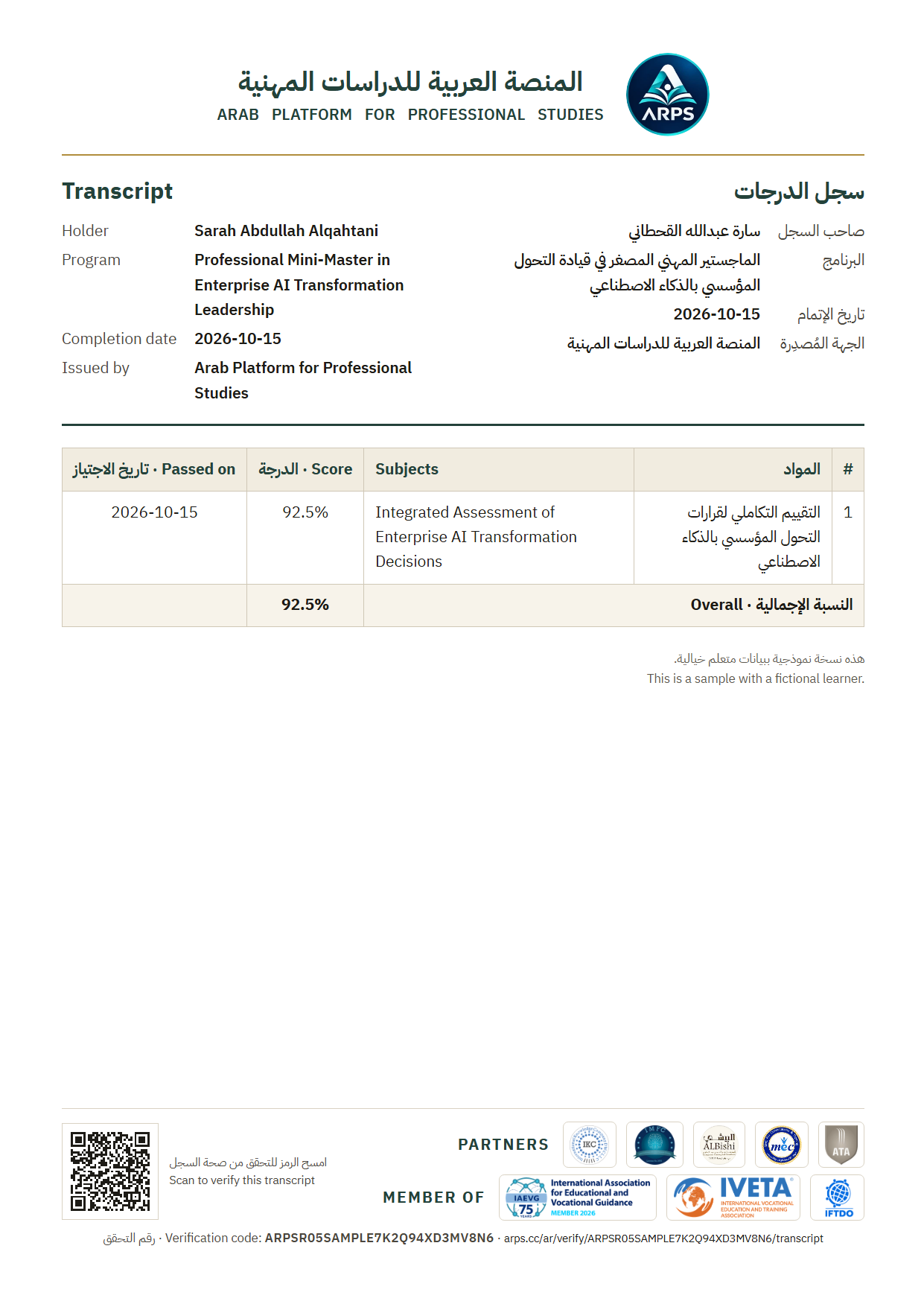
A module transcript accompanies certificate issuance under central policy. It reports five module results derived only from their questions in the same designated integrated-final attempt, not separate module examinations or invented learner grades.
Show all (8)
Does this give personal financial advice?
No. It concerns institutional appraisal of development initiative resources and benefits. It is neither individual investment advice nor a guaranteed return or external professional accreditation.
Is Professional Mini-Master in Development Initiative Design and Economic Impact free, and do I get a certificate?
Yes. Professional Mini-Master in Development Initiative Design and Economic Impact is free on ARPS: every lesson, exercise and assessment is free, the first subject is open to read without an account, and the program is available in Arabic and English. Issuing a certificate is optional and has a published fee; it is a training completion certificate showing you passed the program's assessments, recognised by most private-sector organisations in the Gulf states and most Arab countries, and it strengthens your CV; confirming that a specific organisation accepts it remains your responsibility.
What other names is Professional Mini-Master in Development Initiative Design and Economic Impact known by?
The subject of this program is also known as: impact evaluation, economic impact assessment, development program design, monitoring and evaluation. Learners usually find it by searching for: impact evaluation course online, impact assessment courses online, economic impact analysis, monitoring and evaluation course, development project design.
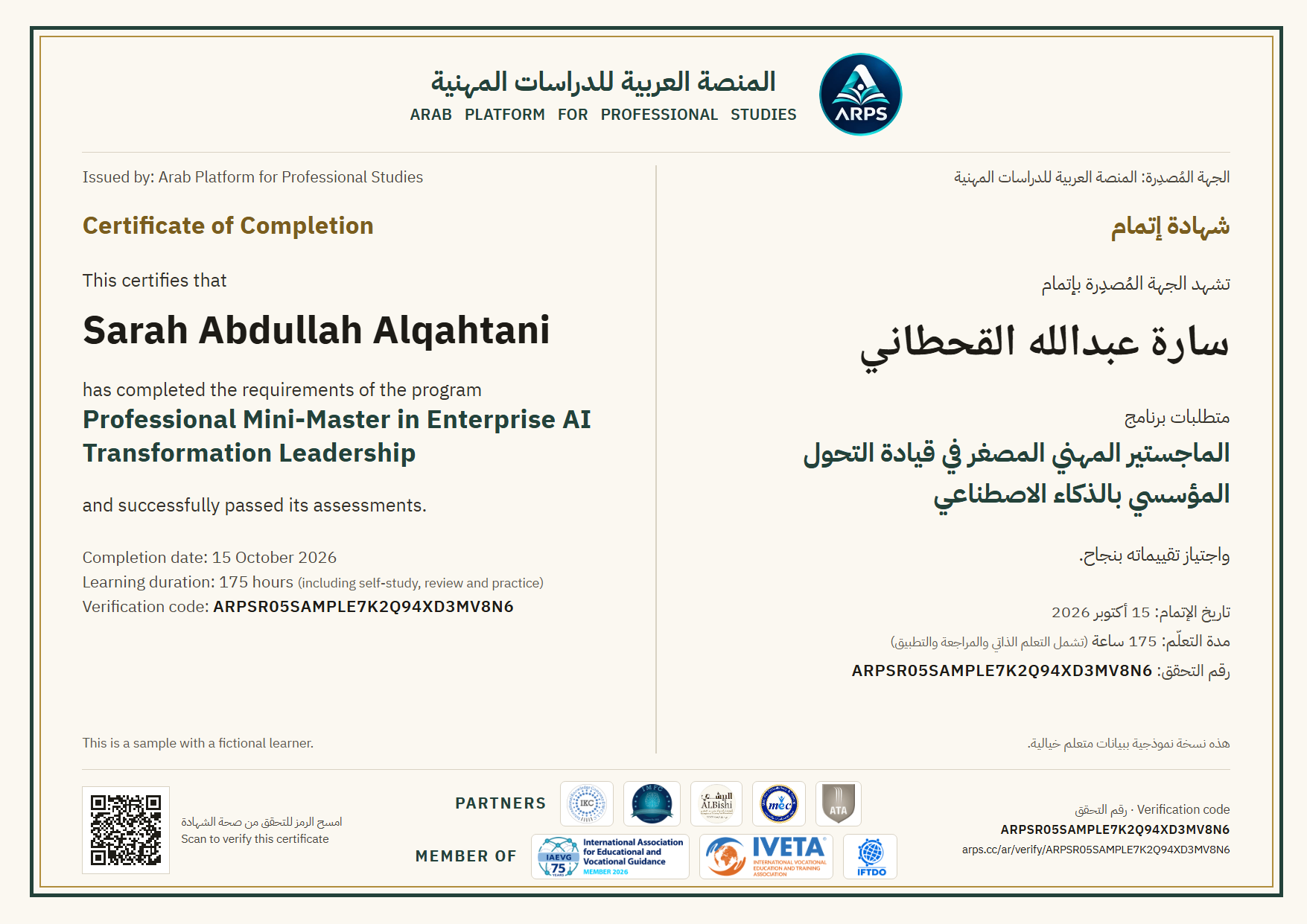
A sample from a real program in this track: Professional Mini-Master in Enterprise AI Transformation Leadership. The learner, scores and dates are fictional; opens in a new window.
Learn to prepare a political economy advisory brief that separates stated goals from decision authority, distributes costs and benefits, and turns bounded evidence into options that can be reviewed.
10 subjects
44 lessons
79.5 hours
Free
Professional Mini-Master
Career Development, Personal Skills & Productivity
An honest note: the professional mini-master is an intensive professional program; it is not an academic degree or a licence and is not equivalent to a university master's or MBA. The optional ARPS certificate is a training completion certificate showing you passed the program's assessments.