Short Diploma in Change and Organizational Transformation
Short Diploma in Change and Organizational Transformation is a free program on ARPS, the Arab Platform for Professional Studies. A short diploma linking diagnosis of a change problem to intervention design, participation, adoption and evaluation. Seven subjects follow the full cycle, then cross-team change and a capstone, through fictional regional cases, calculation and decision exercises, with a separate subject assessment.
Important notice: Independent education; not a university degree, professional licence or endorsement by cited organizations.
Classify the change and define its boundary and justify the decision using case evidence.
From lesson 1, readable now without an account: Separating a symptom from the change problem
An operations manager receives a message: “Rework has risen; we need a new system immediately.” The observation deserves attention, but the proposed system is a decision made before diagnosis. Rework is a **symptom**. It might result from incomplete intake, a changed definition of completion, uneven workloads, or a software defect. A useful change problem states what is happening, to whom, over which period, by which measure, and what remains unknown. That description gives the team a basis for choosing an intervention instead of committing to the most visible solution.
A free account saves your progress and takes you straight to lesson 1.
Program facts
Study fee
Free
subjects
7
lessons
28
Estimated time
68.5 hours
Content last reviewed
Access period
60 days
Study language
Arabic and English
About the program
When service quality slips, the first proposed answer may be a new system or a broad announcement. This diploma teaches learners to separate the presenting symptom from possible causes and test whether a change in process, data or authority fits the problem. A case for action uses a defined baseline, benefits and uncertainty. Impact mapping then follows both people who perform a task and those who depend on its output.
The first five subjects cover diagnosis, impact and readiness, participation and support, implementation governance and measurement, then benefit evaluation and sustainability. A sixth subject applies the cycle to cross-team changes, and a capstone joins them in a shared lending service. Learners produce rate tables, handoff maps, adoption cards, decision logs and an evaluation memo. All regional cases and numbers are fictional teaching devices, not claims about local laws or practices. The completion credential is educational and does not represent a licence or endorsement from cited organizations.
Practical relevance
The reasoning can be applied to a small service or internal procedure: inspect denominators, test handoffs, assign exception ownership, and compare correct use with service results. A real decision still needs the organization's own authority, evidence and constraints; fictional case figures are not transferable benchmarks.
Why this program
A change can look complete when training has been attended or a tool has launched, while actual work and service outcomes remain untested. The program reconnects decisions to reviewable evidence: what changed, for whom, whether it is used correctly and what side effects a headline average might conceal.
Career relevance
The content supports people contributing to improvement initiatives and internal transformation. It gives a shared language for baseline, impact, communication, adoption and evaluation. It does not promise employment, promotion, salary, professional eligibility or certification by an external body.
Career paths this program serves
This program is a step on the paths of the following occupations. Open a path to see its other programs in study order.
Form a testable change problem and case for action with explicit assumptions.
Define intervention boundaries, impacted groups and handoff dependencies.
Design participation, communication and task-specific support without equating training with performance.
Govern a trial with decision ownership and conditions to expand, slow or revert.
Evaluate adoption, results and side effects, then plan sustained operational ownership.
Show all (7)
Manage change across team boundaries: knowledge transfer, shared working language, incentive repair and external-partner coordination.
Deliver a shared lending service project from charter and custody reconciliation to a continuation decision.
Learning outcomes (28)
Separate the presenting symptom from a testable change problem.
Classify the change and define its boundary.
Build a credible case for action.
Frame a measurable future state.
Map affected groups by task and degree of impact.
Diagnose readiness without treating opinion as fact.
Assess cumulative change and constraints.
Choose diagnostic interventions.
Define sponsor and manager responsibilities.
Design participation with a real feedback loop.
Tailor change communication.
Interpret resistance as diagnostic data.
Sequence a staged rollout and fallback.
Turn training into demonstrated ability.
Track adoption distinctly from activity.
Resolve implementation barriers and exceptions.
Evaluate outcomes against baseline and alternative explanations.
Embed new practice in operating controls.
Learn from unintended effects.
Integrate the complete change cycle.
Make and justify a decision about preserving practical knowledge when an expert leaves
Make and justify a decision about reconciling working language after combining teams
Make and justify a decision about repairing an incentive that hides unfinished work
Make and justify a decision about coordinating change with an external partner
Make and justify a decision about lending project charter and option appraisal
Make and justify a decision about reconciling custody balances before merging records
Make and justify a decision about simulating a service day and assistance route
Make and justify a decision about continuation review using a benefits and handover record
Who it is for
Team leads, initiative coordinators, operations and people professionals involved in changing a service or internal procedure. Managers of small units can use the cases to discuss impacts with data, technology and service teams.
This applied foundation suits learners who can interpret a simple table in public or private services. It does not serve advanced researchers or specialists seeking licensed practice or a country-specific regulatory manual.
Prerequisites
No prior change credential is required. You should read a simple workflow, identify task owners and downstream users, and calculate basic percentages with a consistent denominator and period.
Exercises require short tables and decision notes in Arabic or English. All fictional case data are supplied; no specialist software or access to confidential workplace information is needed.
What it does not offer
Not preparation for an external professional certification or a substitute for field experience leading a transformation.
Does not prescribe local law, sector thresholds or an organization-wide mandatory methodology.
Diagnose a change problem with a consistent baseline, then define boundaries, the case for action and a measurable future state.
4 lessons · 9 hours
Separating a symptom from the change problem1.5 hours
Change type and boundary1.5 hours
Building a credible case for action1.5 hours
Defining a measurable future state3 hours
Subject 2
Diagnosing impact and readiness
Map effects on tasks, decisions and group handoffs, then test readiness, barriers and change saturation before launch.
4 lessons · 9 hours
Mapping impact by task1.5 hours
Assessing readiness with conflicting evidence1.5 hours
Cumulative change and capacity1.5 hours
Choosing diagnostic methods without damaging trust3 hours
Subject 3
Leading participation and communication
Design task-specific participation, communication and support; use employee voice to test understanding, ability and evidenced responses.
4 lessons · 9 hours
Sponsor, manager and decision rights1.5 hours
Participation that can influence design1.5 hours
Communication tailored to decision and work1.5 hours
Interpreting objections before responding3 hours
Subject 4
Implementing transition and adoption
Plan a controlled rollout with acceptance and recovery rules; monitor correct use and service outcomes before expanding.
4 lessons · 9 hours
Staged rollout and fallback1.5 hours
Training that demonstrates ability1.5 hours
Measuring adoption rather than activity1.5 hours
Triage of implementation barriers3 hours
Subject 5
Measuring impact and sustaining transformation
Compare outcomes with a defensible baseline, separate intervention effects from case-mix changes, and assign sustained ownership.
4 lessons · 9 hours
Evaluating outcomes and causal limits1.5 hours
Embedding practice in operations1.5 hours
Detecting unintended effects1.5 hours
An integrated change decision with evidence and limits3 hours
Subject 6
Changes across team boundaries
The sixth subject handles changes that cross team boundaries: preserving practical knowledge when an expert leaves, reconciling working language after teams combine, repairing an incentive that hides unfinished work, and coordinating change with an external partner.
4 lessons · 13 hours
Preserving practical knowledge when an expert leaves3 hours
Reconciling working language after combining teams3 hours
Repairing an incentive that hides unfinished work3 hours
Coordinating change with an external partner3 hours
Subject 7
Shared lending service capstone
The capstone applies the change cycle to a shared lending service, from charter, option appraisal and custody-balance reconciliation to a service-day simulation and a continuation review.
4 lessons · 13 hours
Lending project charter and option appraisal3 hours
Reconciling custody balances before merging records3 hours
Simulating a service day and assistance route3 hours
Continuation review using a benefits and handover record3 hours
Subjects unlock in sequence as you progress.
Strengths
Cases connect diagnosis, impact, adoption, execution and evaluation decisions.
Rates use explicit denominators and guardrails separate activity from outcomes.
Exercises produce reviewable work and each subject has a separate assessment under route policy.
Fictional regional settings demonstrate transfer while stating the limits of each case.
Evidence basis
Concepts are grounded in source-owner pages from CIPD, Prosci and Kotter, government evaluation guidance and OECD analysis. All instructional cases and calculations are original and fictional. Citations do not imply endorsement.
Reference organizations
CIPD
Prosci
Kotter
Methodology
Diagnosis, impact mapping and evaluation use source-owner pages; cases are fictional.
How the route works
Short Diplomas are relatively comprehensive learning pathways that cover a major subject through five connected learning subjects and structured assessments, with a diploma transcript available with the credential.
Self-paced sequential study. Content unlocks progressively and each subject combines reading, examples, exercises, knowledge checks, and assessment.
Build integrated knowledge in a major subject.
Study through five clear, connected learning subjects.
Complete a defined assessment for each subject.
Receive a diploma transcript showing subjects and results when the credential is issued.
Assessment
Each Short Diploma contains five subjects, each with an approved assessment. A sixth final exam is not required when the five assessments adequately cover the learning outcomes.
Assessment attempts: 2 per assessment, 7 days apart
The pass mark is announced before the program is published.
Certificate
Successful completion makes the learner eligible for the Short Diploma certificate and Diploma Transcript under the credential policy.
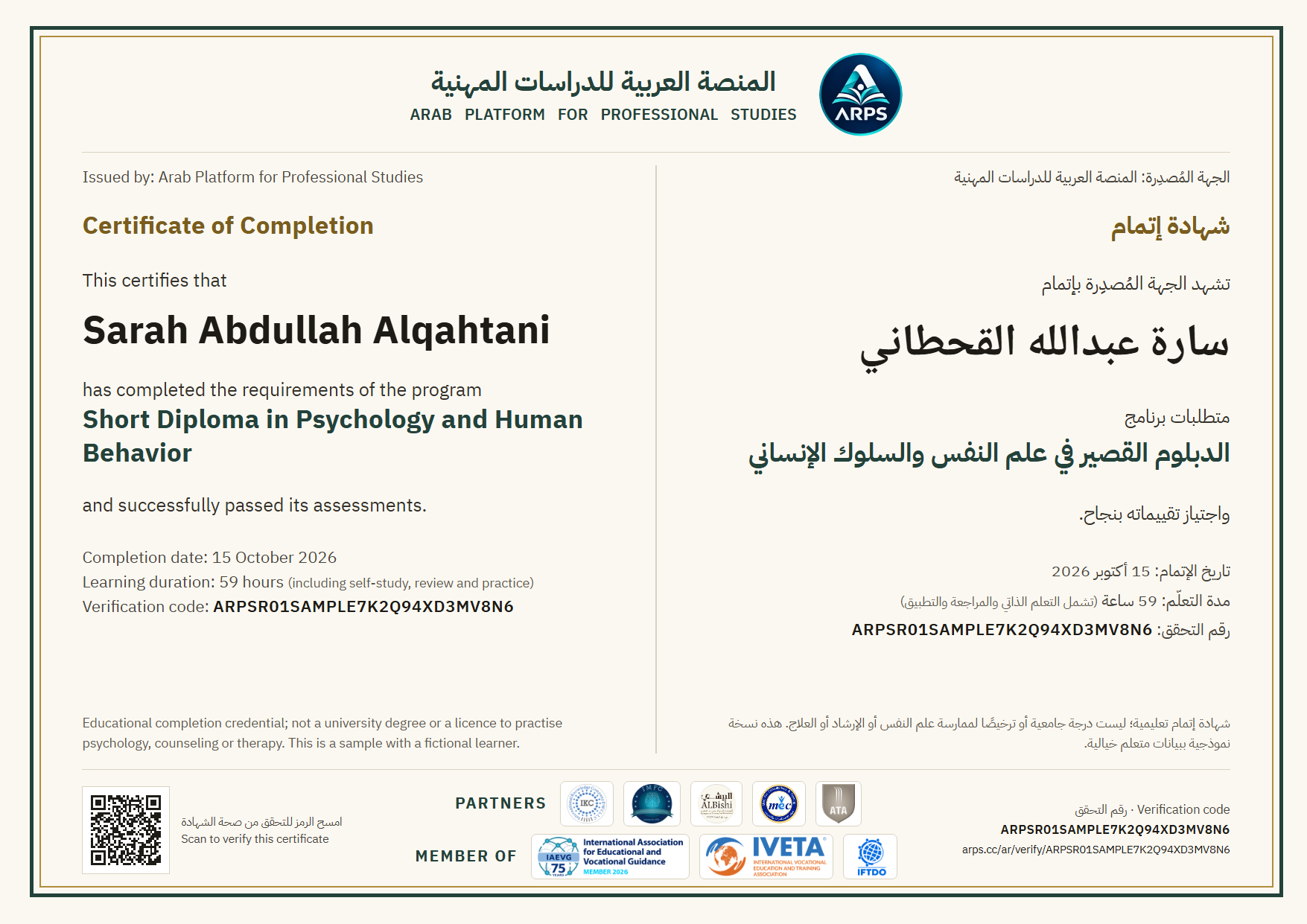
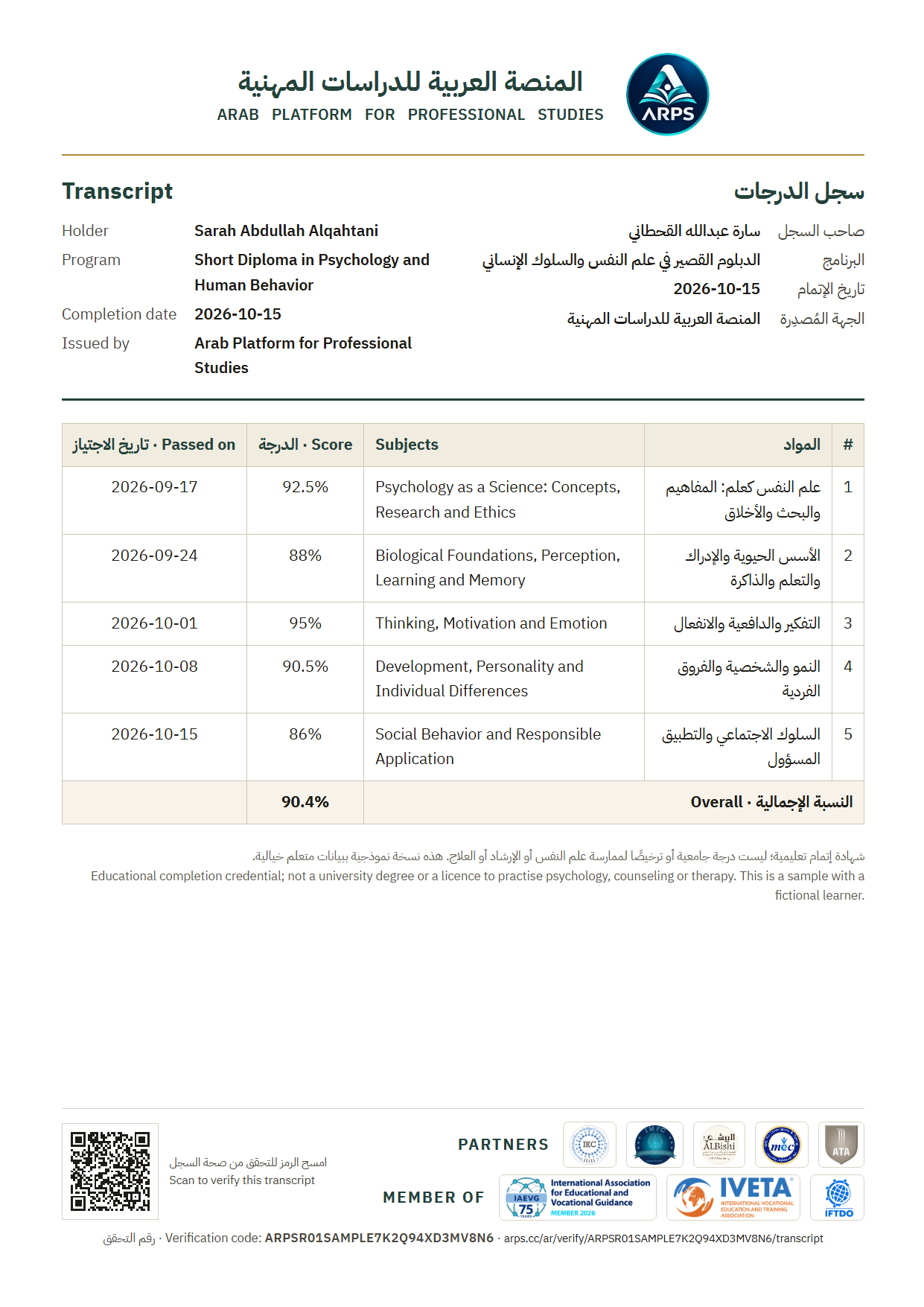
A sample from a real program in this track: Short Diploma in Psychology and Human Behavior. The learner, scores and dates are fictional; opens in a new window.
Disclaimer: Training completion, not a university degree or professional licence.
Program questions
Do I need a live transformation project?
No. Each exercise supplies enough fictional data. Transfer the reasoning to your workplace only after checking your authority and evidence.
Does the program prescribe one mandatory model?
It uses concepts from several sources and selects tools according to the problem and its boundaries rather than claiming a universal sequence.
Does training completion prove adoption?
No. Lessons separate attendance, correct use and actual service results, each with its own denominator.
How are staff objections handled?
The learner examines what staff voice reveals about tasks, authority and workload, then assigns an owner and date to the response or design change.
Are case figures local averages?
No. Cities and figures are fictional teaching examples, not statistics or decision rules for a real location.
Show all (10)
Can one rate establish trial success?
No. Correct use is read alongside service outcomes, processing time and the mix of cases.
What if harm rises after launch?
The program covers conditions for slowing, reversal and redesign, with a decision owner and review evidence.
Does assessment establish field experience?
It assesses reasoning about the taught cases. Field experience requires separate work in a real context.
Is Short Diploma in Change and Organizational Transformation free, and do I get a certificate?
Yes. Short Diploma in Change and Organizational Transformation is free on ARPS: every lesson, exercise and assessment is free, the first subject is open to read without an account, and the program is available in Arabic and English. Issuing a certificate is optional and has a published fee; it is a training completion certificate showing you passed the program's assessments, recognised by most private-sector organisations in the Gulf states and most Arab countries, and it strengthens your CV; confirming that a specific organisation accepts it remains your responsibility.
What other names is Short Diploma in Change and Organizational Transformation known by?
The subject of this program is also known as: change management, organizational transformation, organizational change, change leadership. Learners usually find it by searching for: change management courses online, change management courses free, organizational change management course, organizational transformation course, how to become a change manager.
Learn to lead the people and organizational changes involved in enterprise AI adoption, from diagnosing an opportunity to piloting, scaling and measuring results.
A foundational, applied diploma on turning scattered information into justified strategic choices and then into execution, measurement, and learning. It covers external and internal analysis, advantage and trade-offs, portfolio choices, execution, and measurement while teaching the limits of tools such as PESTEL, SWOT, Five Forces, BCG, and the Balanced Scorecard.
A foundational applied diploma that connects modern management as one system: objectives and planning, organization and leadership, operations and data, control and decision-making, then change, innovation and responsible technology use.
A practical foundation that connects leadership with building a team able to understand purpose, distribute responsibility, speak up, work through conflict, make decisions and review performance. It avoids deterministic personality typing and focuses on observable behaviors that can be adapted to context.