Professional Mini-Master in Leading Change and Enterprise AI Adoption
Professional Mini-Master in Leading Change and Enterprise AI Adoption is a free program on ARPS, the Arab Platform for Professional Studies. Learn to lead the people and organizational changes involved in enterprise AI adoption, from diagnosing an opportunity to piloting, scaling and measuring results.
Frame a comparable work problem and test an AI use case against a non-AI improvement while protecting quality.
From lesson 1, readable now without an account: Distinguish a task opportunity from tool hype
A customer service director says, “We need an AI assistant immediately; our competitors have one.” That statement names a means, not the work to be changed or the outcome worth paying for. Start with a unit of work: one customer request from receipt to a correct closure on which the customer can rely. If the delay is an approval queue rather than drafting a reply, a writing assistant will not remove the bottleneck. Describe the current task before choosing a tool. Who receives the request? Which information must the agent find? Where does the case wait? Who may close it? Which exceptions require a human decision? The workflow map is useful only if it locates a changeable step and a way to observe its effect.
A free account saves your progress and takes you straight to lesson 1.
Program facts
Study fee
Free
subjects
6
lessons
50
Estimated time
161.5 hours
Content last reviewed
Access period
60 days
Study language
Arabic and English
About the program
This professional mini-master focuses on the human and organizational decisions that determine whether AI actually improves work. Five core modules start with a defined task, baseline and non-AI alternative, then develop sponsorship, authority, communication and skills. You design a bounded pilot with review and stop rules and sequence rollout waves while managing vendors, local adaptation and incentives. Finally, you combine adoption, outcome, harm and cost signals into a defensible enterprise decision. Every module includes fictional cases, exercises with guided answers and an integrated summary, and a sixth capstone module builds a connected project dossier for a multi-branch service. The final assessment tests decisions spanning all six modules.
Practical relevance
You can apply the method to a workflow you know without sharing workplace data. Define the start and end of a request, map a review point, compare two alternatives and specify a stop rule and small pilot. The included fictional cases contain enough data for the exercises. No system purchase or submission of personal data to an external service is required.
Why this program
Widespread tool use can conceal added reviewer work, errors concentrated in a small group or dependence on a supplier that is difficult to leave. Announcing change, delivering generic training or reporting logins alone will not resolve these problems. The program teaches you to identify who is affected, who can halt use and what evidence supports scaling or correction. It distinguishes poor communication, lack of ability, operational barriers and justified objections, and compares AI investment with a simpler process repair when appropriate.
Career relevance
The material suits operations, product, transformation, HR and governance managers involved in changing workflows across teams. It develops accountable decisions and communication with stakeholders. It does not promise employment, promotion or financial return and does not confer a regulated professional authority or university degree.
Career paths this program serves
This program is a step on the paths of the following occupations. Open a path to see its other programs in study order.
Diagnose a task, baseline and stakeholder incentives, selecting an AI pilot against a non-AI alternative.
Allocate sponsorship, decision and escalation authority, and role skills in a clear operating agreement.
Design a bounded pilot with review instructions, harm monitoring and a gate for wider use.
Sequence rollout waves while managing vendors, local adaptation, incentives and subgroup effects.
Interpret adoption and outcome evidence with causal caution and present a reversible integrated board decision.
Integrate the charter, influence map, pilot protocol, team proficiency, rollout scenario and impact estimate in a project dossier defended before a board challenge.
Learning outcomes (5)
Diagnose an AI adoption opportunity in a defined workflow and compare it with a non-AI alternative using outcomes, risk and a baseline.
Design sponsorship, decision rights, communication, governance and skills in an actionable operating agreement.
Design a bounded pilot, build applied capability, monitor harms and make an evidence-conditioned scale decision.
Sequence rollout waves and manage vendors, local adaptation, incentives and impacts on workers and affected groups.
Interpret adoption and outcome measures with causal caution, correct drift, transfer ownership and present an integrated enterprise decision.
Who it is for
Transformation, operations, product, HR and governance managers with foundational experience improving a workflow or leading a team.
Department leaders asked to pilot AI tools in their teams who need decisions grounded in evidence rather than enthusiasm.
Risk and compliance officers who help set controls for AI use and review its effects on employees and customers.
Prerequisites
Prior experience managing and improving a project, team or workflow involving multiple parties.
Ability to interpret simple rates, baselines, alternative costs and risks.
Basic familiarity with AI-assisted work; model programming is not required.
Willingness to apply the exercises to a real workflow or a hypothetical case, using only authorized data.
We turned a demand to “use AI” into a defined job, outcome, guardrail, and non-AI alternative. The workflow map locates the suggestion, source of truth, and human authority; it also exposes waiting time that faster draft
9 lessons · 24 hours
Distinguish a task opportunity from tool hype1 hours
Map workflow and human boundaries1 hours
Establish a baseline and variation1 hours
Analyze affected groups and incentives1 hours
Select use cases under constraints1 hours
Observe invisible work4.5 hours
Estimate task variety and transfer limits4.5 hours
Decision reversibility and the cost of waiting4.5 hours
Diagnose access barriers to AI-assisted work4.5 hours
Subject 2
Designing change and decision rights
Enterprise AI adoption changes work decisions, not just a screen. A leadership coalition assigns an owner for service outcomes, a verifier for data use, an approver for external release, and immediate stop authority. Exp
8 lessons · 19.5 hours
Build sponsorship and decision rights1 hours
Explain the change and handle objections1 hours
Design risk-proportionate governance1 hours
Plan role skills and work transition1 hours
Negotiate an operating agreement1 hours
Build psychological safety for reporting4.5 hours
Manage competing change initiatives4.5 hours
Negotiate changing work roles4.5 hours
Subject 3
Piloting workflows and building capability
A good pilot reduces uncertainty that matters to a decision. It compares a defined task with a realistic alternative, stating hypothesis, denominator, outcome, guardrail and stop rule before results appear. Work instruct
9 lessons · 24 hours
Design a bounded pilot1 hours
Build work instructions and output review1 hours
Build proficiency through practice1 hours
Monitor incidents during a pilot1 hours
Decide whether a pilot may scale1 hours
Prevent comparison contamination4.5 hours
Test automation overreliance4.5 hours
Build a challenge set for rare cases4.5 hours
Rehearse manual fallback4.5 hours
Subject 4
Scaling responsibly and managing dependence
Scaling transfers a tested workflow into settings with different volume, context, and support. Deployment waves account for error impact, source readiness, review and support capacity, and shared failure tests. Vendor de
8 lessons · 19.5 hours
Design deployment waves1 hours
Manage vendors and technical dependence1 hours
Set guardrails while allowing local adaptation1 hours
Align incentives and behavior signals1 hours
Respond to resistance and harms at scale1 hours
Respond to unauthorized AI use4.5 hours
Transfer practice after a team merger4.5 hours
Retire an initiative that no longer adds value4.5 hours
Subject 5
Measuring, correcting and sustaining adoption
Adoption measurement separates eligible opportunity, use, correct decision and outcome, declaring denominators, windows and limits. A before/after comparison describes change; attributing it to the assistant needs a real
8 lessons · 19.5 hours
Build an adoption and outcomes scorecard1 hours
Interpret outcome evidence cautiously1 hours
Run post-deployment review and correction1 hours
Sustain capability and hand off ownership1 hours
Make an integrated enterprise decision1 hours
Triangulate interviews and usage records4.5 hours
Account for opportunity cost4.5 hours
Detect gaming of adoption measures4.5 hours
Subject 6
Leading change in a multi-branch service project
The capstone builds a connected charter-to-board dossier applying context, authority, experimentation, proficiency, rollout and impact accounting.
8 lessons · 37 hours
Project dossier: charter for a struggling service4.5 hours
Project dossier: influence and capacity map4.5 hours
Project dossier: data and decision conditions4.5 hours
Project dossier: integrated pilot protocol4.5 hours
Project dossier: demonstrate team proficiency4.5 hours
Project dossier: rollout and exit scenario4.5 hours
Project dossier: impact and uncertainty4.5 hours
Project dossier: board challenge hearing4.5 hours
Subjects unlock in sequence as you progress.
Strengths
Progressive cases link worker behavior and decision rights to actual work outcomes.
Solved fictional exercises test trade-offs, measurement and limits of transfer.
A distinct summary for every module and an integrated final covering all fifty lessons.
Evidence basis
The concepts draw on scoped primary sources: the voluntary NIST AI RMF and its functions, the NIST Generative AI Profile, OECD AI principles and discussion of skills, and the Prosci ADKAR change lens. These sources support concepts. The figures, cases and decision thresholds in the lessons are original teaching examples, not findings or accreditation conditions of those organizations.
Reference organizations
NIST
Prosci
OECD
Frameworks used
NIST AI Risk Management Framework — 1.0
Prosci ADKAR — current public methodology
OECD AI Principles — 2024 update
Methodology
Fictional cases connect stakeholder and workflow analysis with bounded experimentation and outcome and harm measurement; lessons distinguish source frameworks from the organization’s designed decision.
Program questions
Do I need to have programmed an AI model?
No, provided you have experience changing a process or leading a team and can interpret basic indicators and data. Exercises ask who reviews tool output, when use should stop and what indicates real value. If you have never managed a workflow or interpreted a rate, start with foundational preparation.
How do the six modules connect?
The first diagnoses the work opportunity, the second establishes sponsorship and authority, and the third designs a pilot and safety boundaries. The fourth manages rollout waves, vendors and incentives. The fifth interprets evidence, drift and sustainability in an integrated board decision. The sixth combines these steps in a project dossier that ends with a board challenge hearing. Each module ends with a summary after its lessons.
What will I do in the exercises?
You will compare a non-AI repair with a tool, map task handoffs, review pilot evidence and an incident, choose a rollout wave and interpret a results scorecard. The lessons provide fictional scenarios, the necessary facts and explained answers. Real organizational data are not required.
How does the final assessment work?
The system selects fifty automatically scored case questions, one per lesson, from a bilingual bank. They test applied decisions across all six modules, with explanations after submission. Lesson exercises support practice and are not separate credential pass tests.
What are the certificate and transcript?
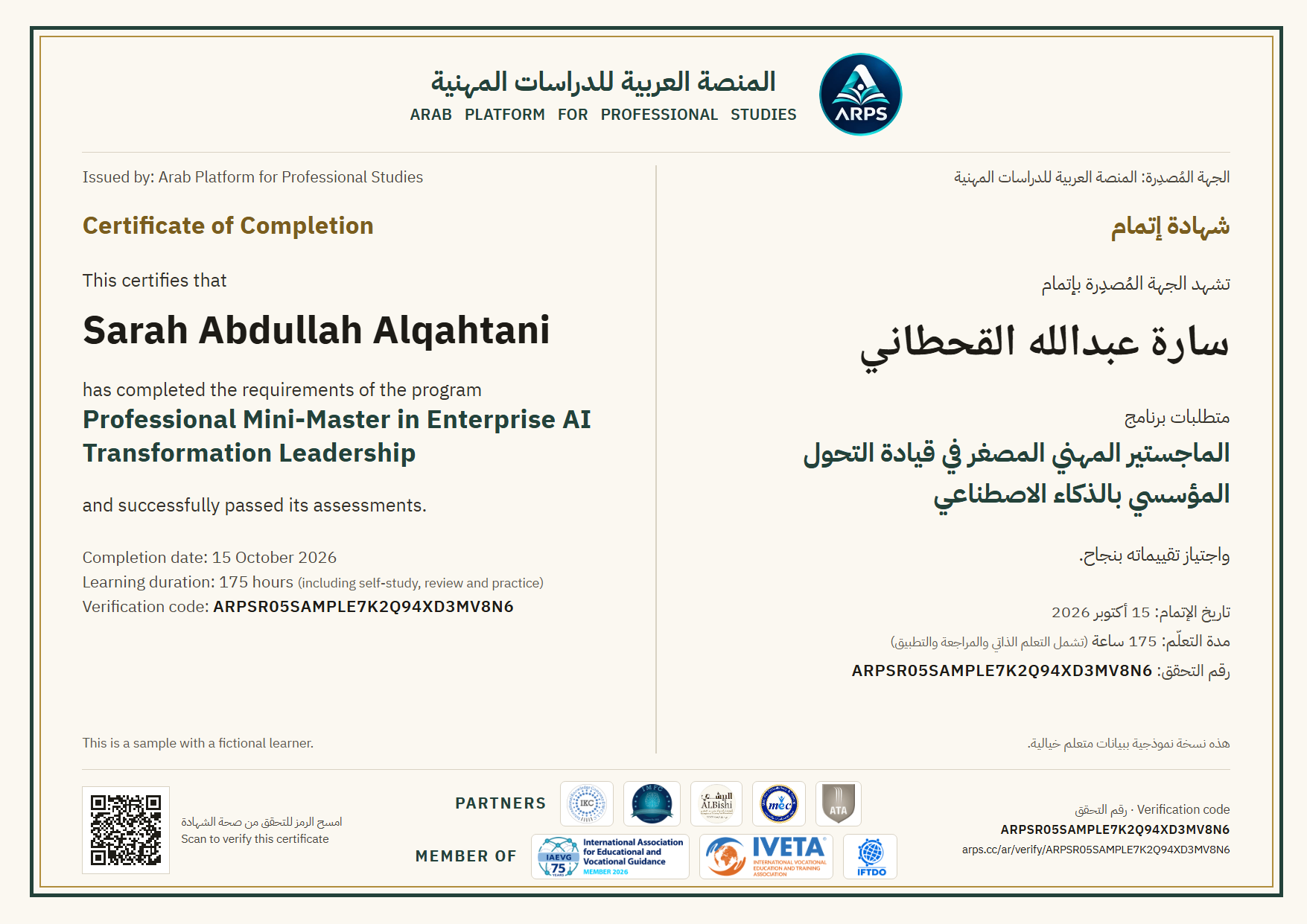
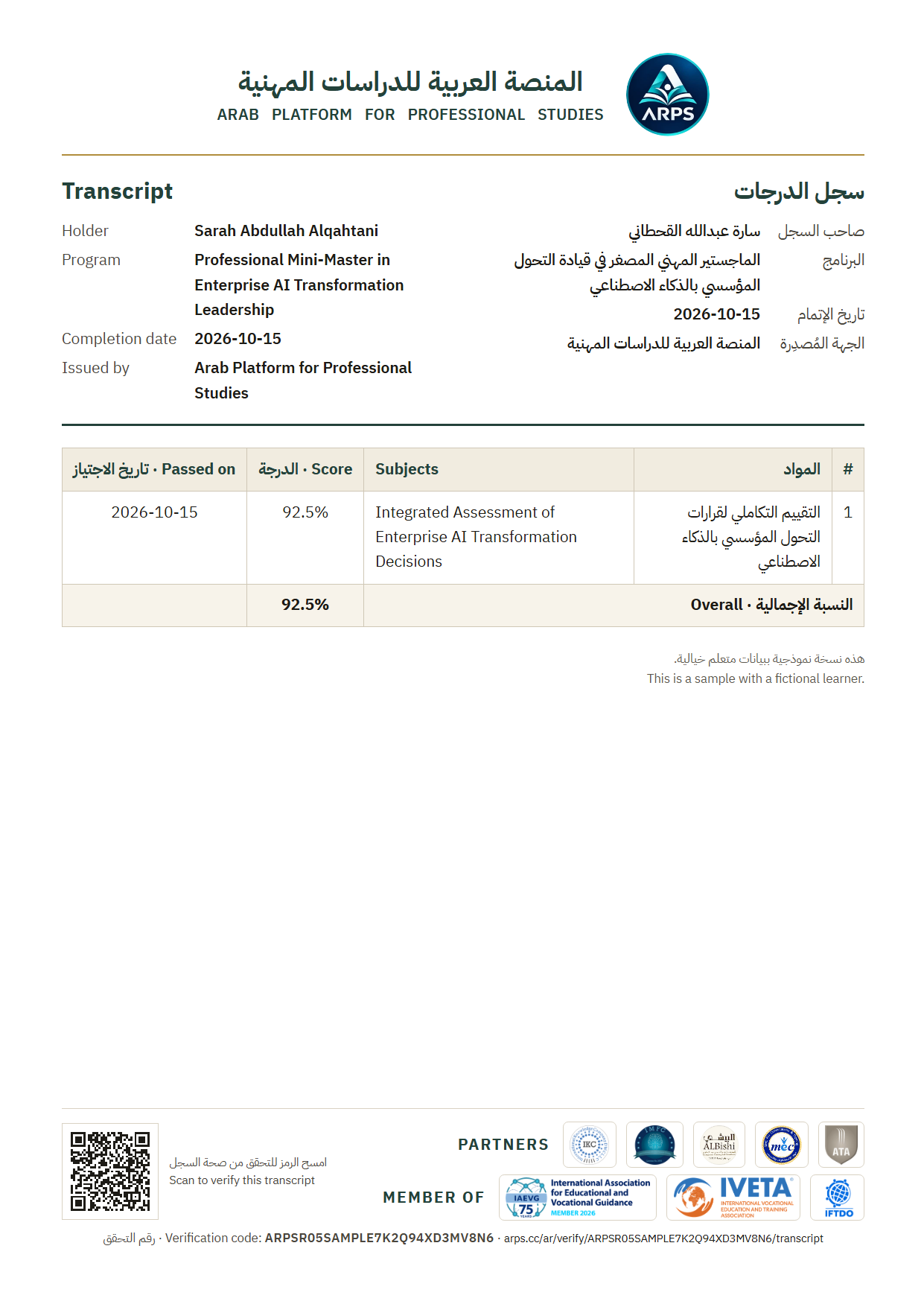
This is an internal professional mini-master completion certificate, not a university degree or external accreditation. Study access is free; certificate issue is optional under platform settings. Its transcript shows six module results derived from the same qualifying integrated-final attempt, not from separate module exams or a mix of attempts.
Show all (8)
May I use workplace files for practice?
The fictional cases are sufficient. If you apply the method at work, use only data your organization authorizes, and establish access permissions, incident reporting and stop authority before entering personal or confidential data into an external tool.
Is Professional Mini-Master in Leading Change and Enterprise AI Adoption free, and do I get a certificate?
Yes. Professional Mini-Master in Leading Change and Enterprise AI Adoption is free on ARPS: every lesson, exercise and assessment is free, the first subject is open to read without an account, and the program is available in Arabic and English. Issuing a certificate is optional and has a published fee; it is a training completion certificate showing you passed the program's assessments, recognised by most private-sector organisations in the Gulf states and most Arab countries, and it strengthens your CV; confirming that a specific organisation accepts it remains your responsibility.
What other names is Professional Mini-Master in Leading Change and Enterprise AI Adoption known by?
The subject of this program is also known as: change management, enterprise AI adoption, change leadership. Learners usually find it by searching for: change management course, learn to lead AI adoption, free change leadership program, scaling AI pilots in organizations, online program with completion certificate.
A sample from a real program in this track: Professional Mini-Master in Enterprise AI Transformation Leadership. The learner, scores and dates are fictional; opens in a new window.
A short diploma linking diagnosis of a change problem to intervention design, participation, adoption and evaluation. Seven subjects follow the full cycle, then cross-team change and a capstone, through fictional regional cases, calculation and decision exercises, with a separate subject assessment.
Learn to turn a management request into a bounded consulting assignment, plan evidence, diagnose causes, compare options and hand over a testable recommendation. Fictional cases supply the information needed for practice without access to a real client’s files.
7 subjects
30 lessons
50 hours
Free
Professional Mini-Master
Career Development, Personal Skills & Productivity
An honest note: the professional mini-master is an intensive professional program; it is not an academic degree or a licence and is not equivalent to a university master's or MBA. The optional ARPS certificate is a training completion certificate showing you passed the program's assessments.