
Specialist Preparation Program in Management Consulting

Specialist Preparation Program in Management Consulting is a free program on ARPS, the Arab Platform for Professional Studies. Learn to turn a management request into a bounded consulting assignment, plan evidence, diagnose causes, compare options and hand over a testable recommendation. Fictional cases supply the information needed for practice without access to a real client’s files.

Consultant figurine presenting at an standing screen to a client team, a paper process model on the table and coffee cups: cover of the ARPS program Specialist Preparation Program in Management Consulting Studying is completely free
Estimated time
50 hours
subjects
7
lessons
30
Study language
Arabic and English

Certificate issuance fee

$90

331 AED or 338 SAR

After you pay the certificate fee, you can print the certificate and transcript in both Arabic and English, or in English only.

Start the first subject now Fees by route

What you will learn in the first 10 minutes

The opening lessons of the first subject, with the reading time set for each. Approximate total time in minutes: 9

  1. Turning a request into a consulting question 9 min read
    • Convert an ambiguous sponsor request into a bounded decision question and acceptance test. Use the problem statement and scope card to produce a scoping brief and verify sponsor and process owner can agree on metric, population, decision and exclusions.

From lesson 1, readable now without an account: Turning a request into a consulting question

The service director says, “We are slow because the team is too small; recommend four new hires.” The request sounds precise because it contains a number. Yet what is slow: first response, resolution, or delivery? An average may also conceal a narrow tail of long cases. If a specialist starts by costing four hires, the analysis has already accepted a cause that has not been tested. The first consulting skill is to turn the sponsor’s preferred answer into a decision question: “What is driving the rise in ticket resolution time, and which intervention can reduce it within cost and quality limits?” That question leaves staffing open as one possible explanation.

An assignment is an agreement about what to examine, produce, and deliver to whom. It is not open authority to change the client’s operations. ISO 20700:2017 is presented by ISO as guidance on the delivery of management consultancy services. It is neither a licence conferred by this course nor a universal law. The ICMCI competence framework places understanding the client business and stakeholders in a consultant’s capability. We use those sources to orient scope practice, while the specific card below is an instructional tool of this course; we do not attribute its fields to a full standard we have not reviewed. Distinguish the client organization, the sponsor requesting the work, the decision maker, and people who will live with the outcome. One person can fill more than one role, and their interests can still differ.

Start with the decision, not with whatever data is easy to obtain. Ask what decision the report will inform: hiring, a workflow pilot, a change in priorities, or a decision to leave the process alone. Ask what would make the decision acceptable: a resolution-time threshold, a cost ceiling, and a quality floor. If the sponsor lacks final authority, record who can approve the decision. Define the unit being measured. A “closed ticket” is not the same as a customer or an email. State the start and end timestamps, period, and case types. Two figures with the same label may be incomparable when their denominators or boundaries differ.

A useful scope card separates five things. First, state the observed problem in testable language rather than assigning blame. Second, write the decision question and plausible alternatives without choosing among them. Third, name the organizational and time boundaries: which sites, ticket classes and dates. Fourth, specify outputs that serve the decision: a metric definition, a traceable data table, an options comparison and a recommendation with assumptions. Fifth, state authority and exclusions: who may grant record access, how customer data will be protected, and which steps require separate approval, such as reading sensitive messages, changing a service policy or hiring. “A report” alone is hard to accept or reject. “Compare three interventions on resolution time, cost and quality risk” has a usable acceptance test.

Consider a fictional company with two service centers. It closed 1,200 tickets last quarter, with a median opening-to-closure time of 2.1 days. This quarter it closed 1,440 tickets and the reported median rose to 3.0 days. The director says headcount was unchanged and asks for four hires. Operations says the reopened share rose from 8% to 15% after a classification change. A data steward says some tickets were administratively closed and reopened under new identifiers. The evidence conflicts. Higher volume could strain capacity, rework could consume time, and identifier changes could corrupt the comparison. None of those observations alone proves that hiring or classification is the cause.

My initial scope card states that the decision is to select a first action to reduce resolution time without raising reopen rates or exceeding a client-defined budget. The examination covers routine tickets at both centers over the two quarters, while separating urgent cases and cases whose identifiers changed. Resolution runs from the first valid opening to a stable closure after a follow-up window agreed with the process owner; first-response time is tracked separately. Inputs include ticket records, old and new classification rules, rosters and a privacy-protected sample of reopened cases. The output compares a capacity explanation, a rework explanation and a measurement-error explanation before proposing testable interventions. The assignment does not authorize hiring or viewing sensitive content without permission.

Test the card with the decision maker and the data owner. The decision maker may say, “I need the staffing decision this week.” A rapid brief can offer a conditional estimate, but the reopen and identifier issues make a categorical cause claim unsound unless a sample can separate them. Offer a sequence: in two days, check the metric definition and 30 tickets spread across sites and periods; then decide whether the data permit a comparison of capacity with rework. Thirty is a fictional initial check size, not a statistically guaranteed sample. If access fails, narrow the scope and lower the confidence of the conclusion rather than inventing an answer.

“What happened?”, “why?”, and “what should we do?” are different questions. A median of 3.0 rather than 2.1 days describes a change; it does not establish a cause. Case mix and the closure definition might explain part of it. Only after validating the measure should the specialist test competing mechanisms. Only then does a comparison among staffing, classification improvement and workload allocation become useful. The starting card need not list every analysis one could perform. It needs a chain that ties each piece of work to a decision. Record stopping and escalation points as well: no legitimate access to records, unresolved disagreement over the metric, or a request to use individual employee data for an appraisal outside scope. Those are authority issues, not arithmetic problems.

Review the card with two counterfactual questions. If corrected identifiers show no rise in resolution time, would hiring four people still follow from this assignment? If the answer is “yes regardless of evidence,” the client is commissioning an implementation study of an already chosen option, not an open diagnosis. That can be a valid assignment if stated honestly. Second, if the rise is real, does the card collect enough evidence to distinguish capacity from rework? Without rosters, reopened cases and case mix, it does not. These tests prevent the engagement from producing slides that merely restate the sponsor’s opening belief.

Read the full lesson free
Start free

A free account saves your progress and takes you straight to lesson 1.

Program facts

Study fee
Free
subjects
7
lessons
30
Estimated time
50 hours
Content last reviewed
Access period
30 days
Study language
Arabic and English

About the program

The program begins with the difference between the sponsor’s preferred remedy and the decision question. Hiring or changing suppliers is a hypothesis, not a diagnosis. Define the scope, metric, population, period and decision authority before requesting records. Practice planning interviews and data access, and assess changes to an engagement without silently expanding the mandate. For diagnosis, map workflow and compare logs, interviews and measures using consistent definitions. Detect changes in channel, denominator or identifiers. Keep observation separate from interpretation and from a hypothesis requiring a test. Build alternatives tied to observed causes. Use declared criteria and weights, test the sensitivity of the ranking, and write a decision brief stating what could change the recommendation. Finally, design a bounded pilot with a comparison, quality guardrail and stop rule. Read intended and unintended effects before recommending expansion. Record acceptance of each deliverable, unresolved evidence and the next decision owner. This is practical preparation for specialist tasks; it conveys no professional licence or guaranteed business result. The client organization makes operational and investment decisions after reviewing its own evidence and context.

Practical relevance

Produce a scope card, evidence matrix, process map, options appraisal, decision brief, pilot charter and handover record. Each tool is applied to a fictional case with explicit limits. Transfer to an organization requires appropriate authority and relevant data.

Why this program

A consultant may receive a ready-made solution request before the cause is established. This program connects decision framing, evidence appraisal, cause-linked alternatives and implementation checks so a recommendation can be examined and challenged.

Career paths this program serves

This program is a step on the paths of the following occupations. Open a path to see its other programs in study order.

What you will learn

  • Frame an assignment around a decision, metric, scope and authority limit.
  • Map stakeholders and identify who owns data access and change approval.
  • Plan deliverables and handle a scope expansion through an explicit decision.
  • Select records and interviews with a defined population, period and denominator.
  • Separate waiting, capacity and rework while weighing conflicting evidence.
Show all (11)
  • Compare cause-linked options with declared weights and sensitivity checks.
  • Write a decision brief with evidence, objection, request and limits.
  • Design a pilot, read intended and side effects, and hand over follow-up owners.
  • Define records before cleaning, observe and time work, compare like service groups and judge when evidence is sufficient.
  • Prepare change for use through option costing and break-even, linking outputs to benefits, assigning owners and planning risk responses.
  • Complete an integrated consulting capstone on a registration service, from charter to pilot, handover and defense of the decision.
Learning outcomes (30)
  1. Convert an ambiguous sponsor request into a bounded decision question and acceptance test. Use the problem statement and scope card to produce a scoping brief and verify sponsor and process owner can agree on metric, population, decision and exclusions.
  2. Map sponsor, recipient, process owner and affected staff with authority and communication needs. Use the influence-impact map and decision-rights table to produce a interview and sign-off map and verify each requested action has an accountable client authority.
  3. Translate scope into an assignment plan with deliverables, evidence access, risks and change control. Use the engagement work plan to produce a assignment charter and verify dependencies and acceptance are testable.
  4. Design a minimally sufficient evidence plan and sample across records and interviews. Use the evidence matrix to produce a collection protocol and verify source, period, denominator and access are explicit.
  5. Map a process and separate volume, capacity, wait and rework mechanisms. Use the flow map and simple throughput calculations to produce a diagnostic exhibit and verify reconcile totals and missing timestamps.
  6. Triangulate conflicting evidence and grade confidence without turning association into cause. Use the evidence ledger to produce a qualified diagnosis and verify alternative explanation and missing evidence are visible.
  7. Generate options that address tested mechanisms and state constraints. Use the mechanism-option map to produce a shortlist and verify each option links to a cause and operational owner.
  8. Compare options using explicit criteria, uncertain estimates and sensitivity. Use the weighted decision matrix to produce a trade-off table and verify weights sum to one and a sensitivity case is shown.
  9. Communicate a recommendation with claim, evidence, objection and decision request. Use the decision brief to produce a one-page recommendation and verify objection and uncertainty remain visible.
  10. Translate recommendation into a controlled pilot and responsibility map. Use the pilot charter and RACI to produce a pilot plan and verify owner, baseline, guardrail and rollback trigger exist.
  11. Measure outcome against baseline and guardrails while considering rival explanations. Use the measurement sheet to produce a pilot readout and verify denominators and comparison windows match.
  12. Close assignment with accepted deliverables, unresolved issues and learning transfer. Use the handover checklist to produce a closure memo and verify client acceptance and residual owner are explicit.
  13. Define records before cleaning through a worked decision and two checkable outputs.
  14. Observe work and record time through a worked decision and two checkable outputs.
  15. Compare like service groups through a worked decision and two checkable outputs.
  16. Schedule arrivals around demand peaks through a worked decision and two checkable outputs.
  17. Code interviews and examine disagreement through a worked decision and two checkable outputs.
  18. Decide when evidence is sufficient through a worked decision and two checkable outputs.
  19. Cost options and find break-even through a worked decision and two checkable outputs.
  20. Connect outputs to measurable benefits through a worked decision and two checkable outputs.
  21. Facilitate a disputed options workshop through a worked decision and two checkable outputs.
  22. Assign work and cover absent owners through a worked decision and two checkable outputs.
  23. Support learning in the workflow through a worked decision and two checkable outputs.
  24. Prepare actionable risk responses through a worked decision and two checkable outputs.
  25. Capstone brief: learner registration through a worked decision and two checkable outputs.
  26. Clean registration records and diagnose stalls through a worked decision and two checkable outputs.
  27. Appraise registration options and workload through a worked decision and two checkable outputs.
  28. Specify a staged registration pilot through a worked decision and two checkable outputs.
  29. Read pilot data and revisit the decision through a worked decision and two checkable outputs.
  30. Hand over and defend the capstone through a worked decision and two checkable outputs.

Who it is for

  • For people in process improvement, performance analysis, project management or decision support in service and operational organizations who want to perform defined consulting tasks under an authorized decision maker. It also suits an early-career specialist needing practical tools for scope, evidence, options and pilots.
  • It is not professional licensure or authority to change contracts or staffing. Real implementation requires sector knowledge and organizational approval.

Prerequisites

  • Read a simple work table, identify a period and rate denominator, and distinguish observation from assumption. These skills support the service, invoice and workflow cases. The course teaches the consulting tools themselves; prior consulting practice is unnecessary.
  • You should be able to summarize a work problem and ask its owner a clarifying question. No real client data or paid analysis software is needed; exercises supply the figures.

Curriculum

  1. Subject 1 Open for free

    Consulting assignment and boundaries

    Frame the assignment question, scope, authority and deliverable acceptance. Distinguish a sponsor’s preferred remedy from an established cause, and handle scope changes through an explicit decision.

    3 lessons · 2.5 hours
    1. Turning a request into a consulting question 52 min
    2. Mapping stakeholders and decision authority 52 min
    3. Planning scope and handling change 54 min
  2. Subject 2

    Evidence gathering and performance diagnosis

    Select evidence and map workflow, distinguishing waiting, capacity and rework. Compare records and interviews under consistent definitions, and state sample limits in the diagnosis.

    3 lessons · 2.5 hours
    1. Designing an evidence plan 54 min
    2. Mapping the process and measuring flow 54 min
    3. Weighing conflicting evidence 54 min
  3. Subject 3

    Options and recommendation

    Link options to mechanisms, compare explicit criteria and weights, and test sensitivity. Write a recommendation preserving evidence, objections and the decision request.

    3 lessons · 2.5 hours
    1. Building options from causes 52 min
    2. Comparing options and testing sensitivity 50 min
    3. Writing a decision brief 54 min
  4. Subject 4

    Implementation, measurement and closure

    Design a bounded pilot and monitoring rules, then read implementation, outcomes and harm together. Separate deliverable acceptance from rollout authority and hand over measurement responsibilities.

    3 lessons · 2.5 hours
    1. Designing a controlled pilot 52 min
    2. Measuring outcomes and unintended effects 52 min
    3. Closing and handing over the assignment 54 min
  5. Subject 5

    Decision diagnosis tools

    Define record identity, design observation and compare case mix. Build arrival-capacity tables, code interviews and select information capable of changing the next action.

    6 lessons · 11.5 hours
    1. Define records before cleaning 2 hours
    2. Observe work and record time 2 hours
    3. Compare like service groups 2 hours
    4. Schedule arrivals around demand peaks 2 hours
    5. Code interviews and examine disagreement 2 hours
    6. Decide when evidence is sufficient 2 hours
  6. Subject 6

    Preparing change for use

    Calculate option costs and break-even, and connect outputs to benefits. Prepare workshops, responsibilities, performance practice and risk responses within real authority and resource limits.

    6 lessons · 11.5 hours
    1. Cost options and find break-even 2 hours
    2. Connect outputs to measurable benefits 2 hours
    3. Facilitate a disputed options workshop 2 hours
    4. Assign work and cover absent owners 2 hours
    5. Support learning in the workflow 2 hours
    6. Prepare actionable risk responses 2 hours
  7. Subject 7

    Integrated consulting capstone

    Build a fictional training center’s registration portfolio from charter to handover. Reconcile data, appraise options, design a pilot and defend a recommendation conditional on outcomes and harm.

    6 lessons · 11.5 hours
    1. Capstone brief: learner registration 2 hours
    2. Clean registration records and diagnose stalls 2 hours
    3. Appraise registration options and workload 2 hours
    4. Specify a staged registration pilot 2 hours
    5. Read pilot data and revisit the decision 2 hours
    6. Hand over and defend the capstone 2 hours

Subjects unlock in sequence as you progress.

Strengths

  • Link the decision question to scope and authority before diagnosis
  • Distinguish conflicting evidence, definition changes and causal claims
  • Compare conditional options, pilot within limits and hand over a reviewable decision

Evidence basis

Concepts draw on primary pages and documents with stated access limits. Teaching cases and numbers are original and fictional. Mentioning ISO, ICMCI, CIPD or a government guide does not imply that any of them endorsed this course.

Methodology

A consultant may receive a ready-made solution request before the cause is established. This program connects decision framing, evidence appraisal, cause-linked alternatives and implementation checks so a recommendation can be examined and challenged.

Assessment

Assessments follow the program blueprint and may use module assessments, a final assessment, or a combination, under the approved attempt policy.

Assessment attempts: 2 per assessment, 7 days apart

The pass mark is announced before the program is published.

Certificate

The credential confirms completion and successful assessment; it does not represent professional licensure unless explicitly and lawfully stated.

Every certificate has a public verification code. Verify a certificate

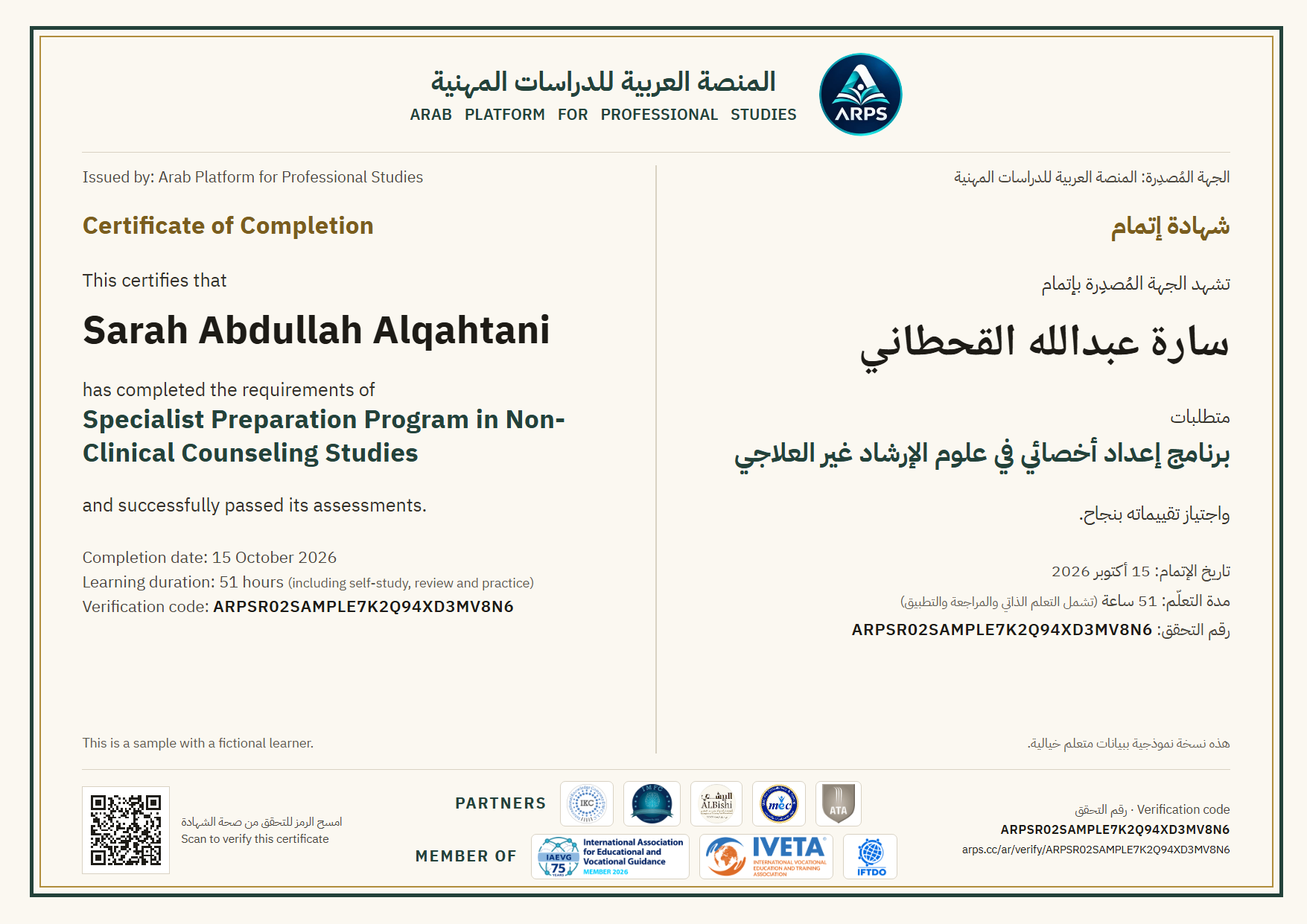
A sample from a real program in this track: Specialist Preparation Program in Non-Clinical Counseling Studies. The learner, scores and dates are fictional; opens in a new window.

Verification example: a real issued certificate

Program questions

Do I need prior consulting experience?

Experience with a work problem and simple tables is enough. The program explains assignment and diagnosis tools step by step, then asks you to use them in fictional cases.

Does this make me a certified management consultant?

No. It prepares defined specialist tasks and confers neither professional licensure nor accreditation by organizations named in the references.

Can I change client processes during an exercise?

Exercises are fictional. In real work, a specialist submits a recommendation and bounded trial to an authorized decision maker; no process or data access changes without permission.

Are the case numbers research data?

No. They are authored for calculations, option appraisal and limits of inference, and do not establish performance of an organization or sector.

What if an interview conflicts with a system report?

Record the source, definition and date of each observation; check records, sampling and identifiers before favoring an explanation. Module two teaches a test that could overturn a hypothesis.

Show all (8)
How do exercises differ from assessments?

Exercises are ungraded self-practice with detailed feedback. Lessons have knowledge checks, followed by a summative assessment for each module and an integrative final assessment. Automated selection measures judgment on supplied facts, not live engagement proficiency.

Is Specialist Preparation Program in Management Consulting free, and do I get a certificate?

Yes. Specialist Preparation Program in Management Consulting is free on ARPS: every lesson, exercise and assessment is free, the first subject is open to read without an account, and the program is available in Arabic and English. Issuing a certificate is optional and has a published fee; it is a training completion certificate showing you passed the program's assessments, recognised by most private-sector organisations in the Gulf states and most Arab countries, and it strengthens your CV; confirming that a specific organisation accepts it remains your responsibility.

What other names is Specialist Preparation Program in Management Consulting known by?

The subject of this program is also known as: management consulting, business consulting, management consultant, consulting skills. Learners usually find it by searching for: management consulting courses, management consulting courses free, management consulting courses online, how to become a management consultant, consulting skills training.

Professionals in this domain

Connect with certified consultants, trainers, coaches and specialists in the same domain across the ARPS communities.