Short Diploma in Digital and Knowledge Economy is a free program on ARPS, the Arab Platform for Professional Studies. This diploma examines how value forms in digital and knowledge economies and how to measure it without confusing access with task completion or transaction value with intermediary revenue.
Important notice: Independent education with a completion credential on meeting requirements; no professional licence or accreditation.
Separate digital sector output from digital inputs used across sectors without double counting.
From lesson 1, readable now without an account: Set the boundary before counting activity
Classify a service change as digitisation of material, digital use within a process, or a broader transformation in value delivery. Then calculate an indicator whose unit and denominator are stated.
A free account saves your progress and takes you straight to lesson 1.
Program facts
Study fee
Free
subjects
7
lessons
25
Estimated time
58.5 hours
Content last reviewed
Access period
60 days
Study language
Arabic and English
About the program
This diploma examines how value forms in digital and knowledge economies and how to measure it without confusing access with task completion or transaction value with intermediary revenue. Learners move from indicator boundaries, data quality and knowledge transfer to platform economics, transformation outcomes, inclusion and sustainability trade-offs, followed by applied operating labs and a capstone investment and handover decision. Each subject uses labelled fictional figures and exercises that produce a table or decision memo with a separate worked solution. Training cases are not real market statistics. Completion does not confer a licence, professional authorisation or accredited learning hours.
Practical relevance
Learners build indicator sheets, calculations and pilot memos from supplied cases, stating what evidence cannot establish.
Why this program
The diploma links measurement, data, markets and interventions in a decision that can be tested rather than merely describing technology.
Career relevance
The diploma serves learners and early-career professionals who analyse digital services or markets, including education, service and small-enterprise staff needing a shared language for value, data and inclusion. It is useful for someone reviewing a proposed tool or platform without specialist econometrics or legal training. It does not prepare a person to issue binding regulatory opinions, practise competition law or claim professional authorisation; those tasks require expertise and local evidence.
Career paths this program serves
This program is a step on the paths of the following occupations. Open a path to see its other programs in study order.
Define digital activity and calculate bounded indicators with correct denominators.
Check data quality, knowledge transfer, purpose and rights.
Estimate platform fees, booking contribution, matching and competition limits.
Measure baselines and valid productivity, and test inclusive service routes.
Compare investments and environmental scope in a reviewable decision brief.
Operate indicators, services and platform tests in applied labs, then defend a staged purchase decision at handover.
Learning outcomes (5)
Interpret a small indicator table and defend a measurement boundary.
Select a knowledge and data governance design from competing evidence.
Choose a channel using a supplied cost and participation case.
Evaluate a transformation pilot using supplied baseline and follow-up observations.
Write and select defensible decisions in a cross-subject case.
Who it is for
The diploma serves learners and early-career professionals who analyse digital services or markets, including education, service and small-enterprise staff needing a shared language for value, data and inclusion. It is useful for someone reviewing a proposed tool or platform without specialist econometrics or legal training. It does not prepare a person to issue binding regulatory opinions, practise competition law or claim professional authorisation; those tasks require expertise and local evidence.
Prerequisites
No advanced economics, programming or licensed professional status is required. Learners should be able to read a simple table, calculate a percentage with a calculator if needed, and distinguish a count from its denominator. They should be willing to follow a hypothetical case and write a short reason for a choice. Cases and exercises are text based; uploading workplace data or using an external commercial service is not required.
What it does not offer
This program does not award a practice credential or licence or provide local legal determinations.
The first subject establishes a precise language for measuring digital activity. Learners distinguish digitising a paper record from changing a service workflow and from wider transformation effects, then define unit, numerator and denominator before calculating a rate. They separate digital products and inputs from ordering and delivery methods, avoiding a total that double counts overlapping flows. A small dashboard differentiates household access, individual use and success among task attempts while checking data sources and periods. The subject ends with a barrier matrix covering devices, language, skill and service design. Learners produce a classification table, bounded indicators and a testable intervention hypothesis without generalising from a handful of comments.
4 lessons · 7 hours
Set the boundary before counting activity2 hours
Product, transaction and input2 hours
Access, use and quality2 hours
Diagnose inclusion barriers1.5 hours
Subject 2
Knowledge, data and skills
The second subject explains why collecting data and storing documents alone do not create an effective knowledge economy. Learners distinguish raw observations, contextual information, codified guidance and experience needing practice and feedback. They inspect participant records for duplication, missing outcomes and inconsistent completion definitions, then report a defensible range rather than converting unknown cases into failure. A task-based skills matrix tests finding a resource and checking its reuse terms on a new case, separating learning from tool defects. Finally, learners design sharing layers for methods, aggregates and person-level records, reviewing re-identification, purpose and rights. Outputs include a knowledge-flow map, quality register, transfer test and reviewable access decision.
4 lessons · 7 hours
How knowledge moves through work2 hours
Data quality before reuse1.5 hours
Skills gaps and a learning loop1.5 hours
Sharing knowledge within its limits1.5 hours
Subject 3
Platforms and digital markets
The third subject treats platforms as markets connecting distinct groups, not apps judged by registered accounts alone. Learners map each side's value and separate cross-side participation effects from lower average operating cost as fixed expense is spread over transactions. They calculate intermediary revenue, booking contribution and the acquisition cost of a new cohort while stating what repeat use and cancellations remain unknown. Marketplace liquidity is examined through searches leading to suitable bookings. Learners then distinguish one seller's channel dependence from whole-market share or a legal finding. A final channel comparison uses different demand assumptions for platform, direct and cooperative routes, including unpriced work. Outputs are a contribution worksheet, switching matrix and bounded channel trial.
4 lessons · 7 hours
Two sides of a market and network effects1.5 hours
Transaction economics and market liquidity2 hours
Switching costs and contestability1.5 hours
Choosing a sales channel2 hours
Subject 4
Transformation, productivity and inclusion
The fourth subject moves from proposing technology to testing a service problem and the effect of a response. Learners set a baseline for decision time, repeat contact and request types, and trial a simpler process change before adopting a new system. Productivity is calculated as first-pass valid requests per staff hour, not every closed ticket, and the change in a tool team is compared cautiously with another team. Learners map a user journey requiring different devices or human assistance and distinguish successful attempts from unique people helped. A pilot scorecard closes the subject with adoption, task-completion, scale-up threshold and a safety signal requiring escalation. Outputs include a problem charter, bounded impact table, inclusion test and pilot decision.
4 lessons · 7 hours
Baseline before buying a tool1.5 hours
Productivity and output quality1.5 hours
Designing an inclusive service1.5 hours
A pilot scorecard1.5 hours
Subject 5
Sustainability, policy and integrated decision
The fifth subject brings economic, knowledge and environmental evidence into a responsible choice. Learners set a device lifecycle boundary from materials and manufacture through use and end of life, separating mechanical operation from fitness for the required task. They balance shareable learning-resource descriptions and exchange between two systems against learner-progress privacy and reuse rights, without treating a broad recommendation as local legal permission. A sensitivity table tests three demand levels and the cost of an assisted route, calculating break-even from declared assumptions without invented probabilities. Finally, learners write a decision brief containing a baseline, alternatives, success measures, pause trigger, missing evidence and review owner. Neither environmental nor financial outcomes are claimed without measurement.
4 lessons · 7 hours
Technology lifecycle and its footprint1.5 hours
Policy goals and limits of generalisation1.5 hours
Sensitivity and uncertainty1.5 hours
An integrated, reviewable decision2 hours
Subject 6
Operating digital value laboratories
The sixth subject applies measurement in operating laboratories: tracing indicator lineage and correcting releases, keeping a service running and reconciling offline work, and testing how platform ranking affects user choice.
3 lessons · 10 hours
Indicator lineage and release corrections3.5 hours
Service continuity and offline reconciliation3.5 hours
Testing platform ranking and choice3.5 hours
Subject 7
Investment decision and operational handover project
The capstone assembles the evidence into a staged purchase file with testable acceptance limits, followed by a handover rehearsal in which the decision is challenged before approval.
2 lessons · 11.5 hours
A staged purchase with testable acceptance limits6 hours
Handover rehearsal and decision challenge6 hours
Subjects unlock in sequence as you progress.
Strengths
Fictional numerical cases with explicit calculations and inference limits.
Independent exercises producing reviewable tables and decision briefs.
Clear separation of intermediary revenue, market value and fixed cost.
Task completion and inclusion tested beyond account counts.
Environmental and financial trade-offs with missing evidence disclosed.
Evidence basis
General concepts draw on publisher pages from OECD, ITU, the World Bank, UNESCO and UNCTAD; case figures are fictional teaching data.
Reference organizations
OECD
ITU
World Bank
UNESCO
UNCTAD
Methodology
Lessons define measures and denominators, work fictional cases and disclose inference limits.
How the route works
Short Diplomas are relatively comprehensive learning pathways that cover a major subject through five connected learning subjects and structured assessments, with a diploma transcript available with the credential.
Self-paced sequential study. Content unlocks progressively and each subject combines reading, examples, exercises, knowledge checks, and assessment.
Build integrated knowledge in a major subject.
Study through five clear, connected learning subjects.
Complete a defined assessment for each subject.
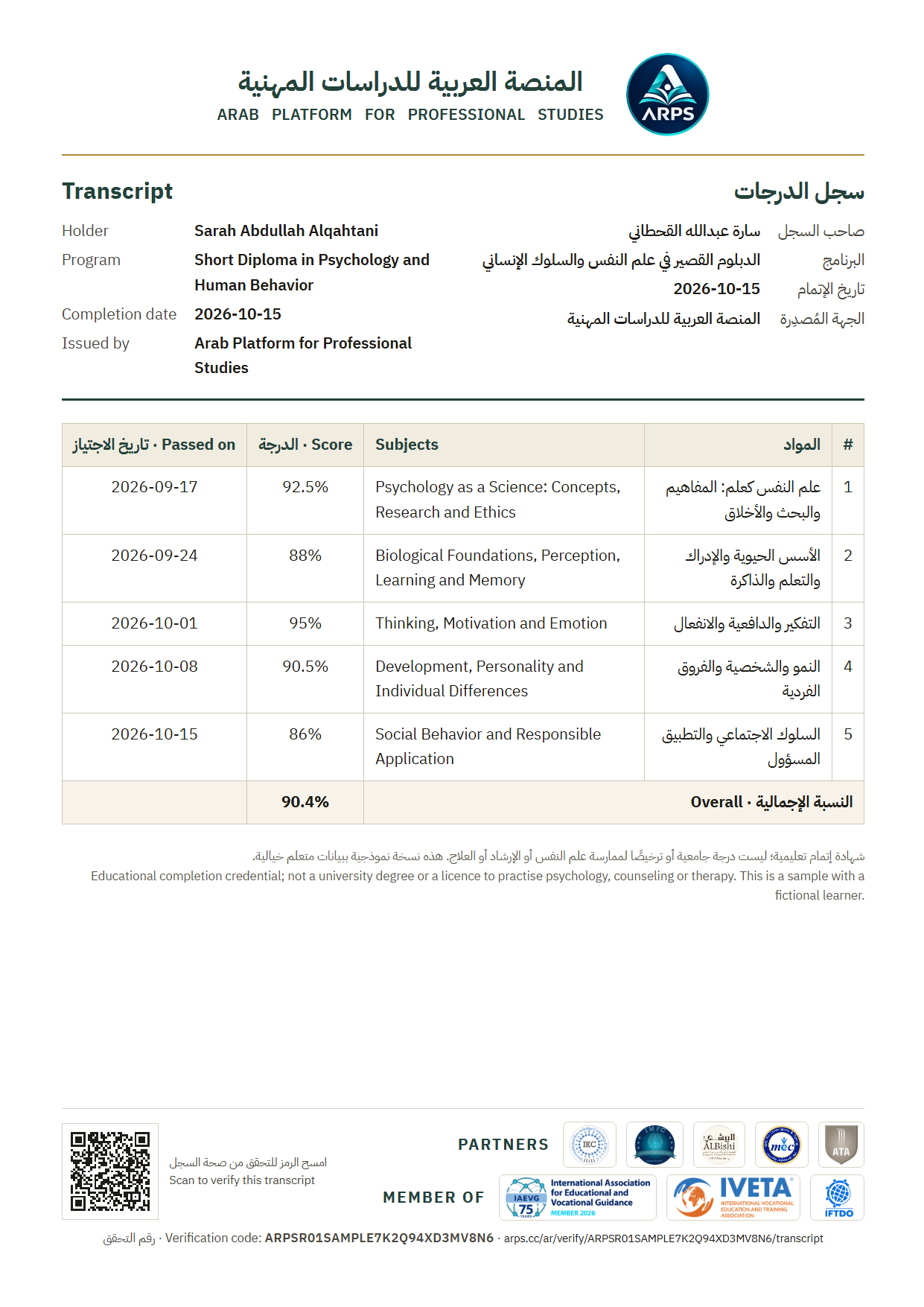
Receive a diploma transcript showing subjects and results when the credential is issued.
Assessment
Each Short Diploma contains five subjects, each with an approved assessment. A sixth final exam is not required when the five assessments adequately cover the learning outcomes.
Assessment attempts: 2 per assessment, 7 days apart
The pass mark is announced before the program is published.
Certificate
Successful completion makes the learner eligible for the Short Diploma certificate and Diploma Transcript under the credential policy.
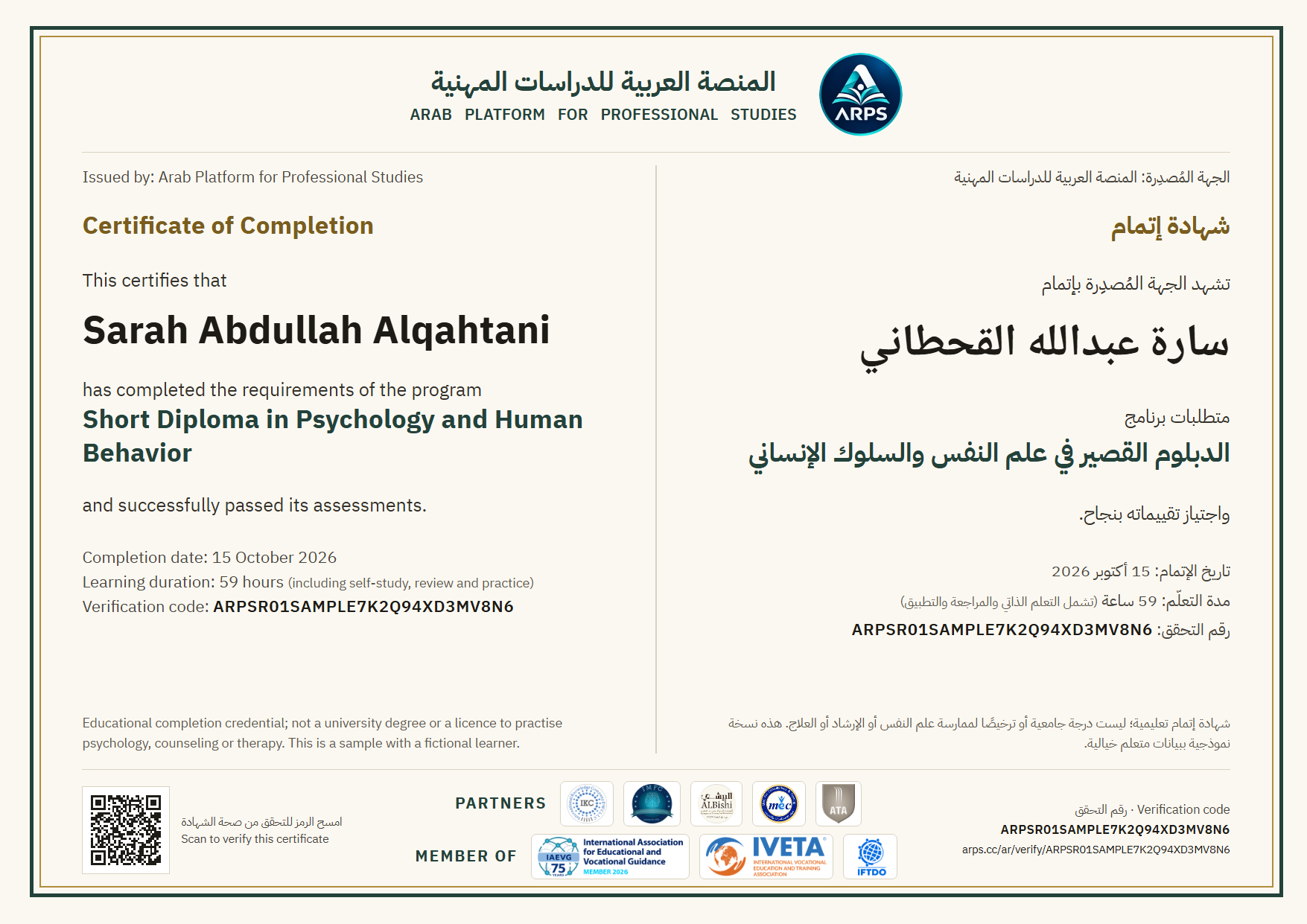
A sample from a real program in this track: Short Diploma in Psychology and Human Behavior. The learner, scores and dates are fictional; opens in a new window.
Disclaimer: Independent training completion, not a university degree or professional licence.
Program questions
Are the case figures real market statistics?
No. Cases and figures are labelled fictional; verify local data before a real decision.
Is programming a prerequisite?
No. Learners read tables, calculate simple rates and explain short decisions.
Does the diploma confer a practice licence?
No. It records learning completion under program policy and does not replace a licence or external accreditation.
Must learners use workplace data?
No. The lessons and assessments provide all figures needed for fictional practice cases.
How is learning assessed?
Self-check exercises are followed by a summative assessment for each of the five core subjects under the attempt policy; the laboratory and project subjects use lesson knowledge checks.
Show all (7)
Is Short Diploma in Digital and Knowledge Economy free, and do I get a certificate?
Yes. Short Diploma in Digital and Knowledge Economy is free on ARPS: every lesson, exercise and assessment is free, the first subject is open to read without an account, and the program is available in Arabic and English. Issuing a certificate is optional and has a published fee; it is a training completion certificate showing you passed the program's assessments, recognised by most private-sector organisations in the Gulf states and most Arab countries, and it strengthens your CV; confirming that a specific organisation accepts it remains your responsibility.
What other names is Short Diploma in Digital and Knowledge Economy known by?
The subject of this program is also known as: digital economy, knowledge economy, knowledge-based economy, data economy. Learners usually find it by searching for: digital economy course, digital economy examples, knowledge economy skills, knowledge economy examples, digital economy meaning.
A short diploma in labour-market measures, supply, demand and wages, search and matching, job quality, and employment-policy evaluation through worked hypothetical cases.
A foundational, applied diploma on why real decisions can differ from simplified models and how to analyze judgment, choice, incentives, choice architecture, and experiments without turning biases into personal diagnoses or manipulation recipes.
A foundational short diploma explaining how economists reason about choices and how prices and quantities interact in markets, then connecting those ideas to firms, macroeconomic indicators, and monetary and fiscal policy. It balances concepts, simple calculations and interpretation without requiring advanced prior economics.