Short Diploma in Health Policy and Economics is a free program on ARPS, the Arab Platform for Professional Studies. An educational diploma in health policy and economics with six subjects and a capstone, connecting access, equity, financing and economic evaluation to operational tools and a reviewable recommendation.
Important notice: Educational completion diploma; no healthcare licence, university degree or endorsement by cited organizations.
Frame a policy problem with an eligible population, period, denominator, indicator and decision option while distinguishing need, expressed demand and use.
From lesson 1, readable now without an account: Framing a Service Access Problem and Its Denominator
Health policy begins with a decision problem, not an aspiration such as 'improve access'. Specify which eligible people should receive which service, in what place and period, and which lever the decision maker can actually change. A person's potential need for a beneficial service differs from expressing demand for it, receiving an appointment, and completing effective care. Someone may need care without knowing the service exists; someone may request care but receive no slot; an attended visit may still fail to deliver the intended service. A visit count alone therefore cannot establish coverage of need. Map the pathway from a reference population through estimated need, request, offered appointment, attendance, completed service and outcome. Each transition has its own denominator, data source and missing cases. This map helps select a policy instrument: more funding does not necessarily solve scheduling, travel or quality barriers.
A free account saves your progress and takes you straight to lesson 1.
Program facts
Study fee
Free
subjects
7
lessons
24
Estimated time
77 hours
Content last reviewed
Access period
60 days
Study language
Arabic and English
About the program
How do you choose a health policy with limited resources and incomplete evidence? Define the population, service and denominator, diagnose barriers and compare instruments. Examine opportunity cost, financing, budget impact, equity and evidence limits. Operational tools cover waiting reconciliation, costing, referrals, consultation and purchasing. A capstone joins two sites, cash and capacity in an updateable recommendation. Cases are fictional; execution requires data and authority. The award is educational completion with results, not a healthcare licence or external accreditation.
Practical relevance
Learners produce denominator tables, trade-off comparisons, spending ceilings, risk logs and a checkable fictional decision memo.
Why this program
The route connects policy and economics so price is judged alongside authority, delivery and equity.
Career relevance
Relevant to learners and early-career staff in services, public health and financing who need to interpret evidence and frame bounded choices. It promises no job or professional eligibility.
Career paths this program serves
This program is a step on the paths of the following occupations. Open a path to see its other programs in study order.
Frame an access problem with a denominator and inference limits
Locate a system bottleneck and choose an authorized policy lever
Calculate opportunity cost and inspect distribution of benefit
Distinguish financing functions and purchasing incentives
Calculate incremental comparisons and budget impact
Build an implementation, evaluation and decision memo
Learning outcomes (24)
Frame a policy problem with an eligible population, period, denominator, indicator and decision option while distinguishing need, expressed demand and use.
Map a service pathway and identify a testable bottleneck while separating direct observations from a possible causal explanation.
Compare health-policy instruments against the problem, authority, implementation and equity, and identify each actor's decision role.
Link policy inputs, activities, outputs and outcomes through testable assumptions and a stopping indicator.
Compare two uses of a scarce health resource through marginal benefit and distinguish a policy rationale from a high price alone.
Calculate absolute and relative gaps between groups and interpret them alongside horizontal and vertical equity.
Calculate direct-payment burden for defined households, analyze missing observations and avoid equating recorded payment with population financial protection.
Trace the three financing functions and calculate how two fragmented pools differ from a combined fictional pool.
Compare fee-for-service, capitation and global budgets with safeguards for quality, equity and volume risk.
Frame a defined benefit decision with justified eligibility and exclusions, calculate budget impact and execution, and avoid equating spending with effect.
Specify perspective, comparator, horizon and outcome, calculate incremental cost and effect, and distinguish dominance from adoption.
Estimate incremental cash flow from eligibility, uptake and fixed costs, then test how a changed assumption affects the decision.
Weigh an effect and cost estimate against study design, missing outcomes and setting differences, then form an evidence-bounded and equitable recommendation.
Translate a policy option into phases, dependencies, ownership and stop triggers while separating implementation failure from a weak policy mechanism.
Specify process, output and outcome indicators with denominators, then compare changes in two groups while acknowledging confounding.
Integrate problem framing, equity, opportunity cost, financing, implementation and evaluation in a reviewable recommendation.
Reconciling Waiting-List Stocks and Flows through a traceable applied decision.
Minute Costs and Usable Capacity through a traceable applied decision.
Closing Referrals and Protecting Continuity through a traceable applied decision.
A Listening Session That Reaches Missing Voices through a traceable applied decision.
Purchasing a Service with Testable Acceptance Criteria through a traceable applied decision.
Capstone: Establishing the Decision File and Options through a traceable applied decision.
Capstone: Simulating Cash, Capacity and Equity through a traceable applied decision.
Capstone: Defending and Updating the Recommendation through a traceable applied decision.
Who it is for
This diploma serves learners and early-career staff in health service planning, public health, program management and financing who want a foundation in policy analysis. It also suits people who interpret access indicators, discuss scarce resources or prepare a service-choice memo. Advanced prior experience is unnecessary, but activities require simple percentage calculations and willingness to justify a choice under uncertainty. Real implementation remains subject to local evidence and authorized decision makers.
Prerequisites
Comfort with simple tables, percentages, subtraction and division is enough; a calculator may be used. No advanced economics qualification, clinical practice or knowledge of one country’s health law is required. The diploma explains terms as they arise and asks learners to name the unit and denominator behind every figure before drawing an inference.
What it does not offer
Not a professional licence, clinical or legal advice, or training to price a real insurance system.
This subject begins with access: who needs a service, who requests it, and who actually receives it? Learners distinguish residents, people and requests so a correct calculation does not become a false problem statement. They map health system functions and locate the binding constraint in capacity, workforce, information or financing rather than blaming every delay on one cause. They compare policy instruments against decision authority, stakeholder incentives and deliverability. Finally, they build a theory of change linking a decision to steps, measures, assumptions and unintended effects. Worked fictional cases ask for a conditional decision memo that states what is known, what remains unknown and which evidence would change the choice. No local clinical or legal practice is asserted.
4 lessons · 11 hours
Framing a Service Access Problem and Its Denominator2 hours
Diagnosing a Health-System Bottleneck2 hours
Choosing a Policy Instrument and Decision Actors2 hours
A Testable Theory of Change2 hours
Subject 2
Economics, Demand and Equity
Health resources are scarce, so this subject asks what is displaced when a new option receives funding. Learners begin with opportunity cost and marginal choice, then examine how asymmetric information, incentives and household travel costs shape effective demand. They compare access rates using compatible denominators and disaggregate by group so an improving average cannot conceal exclusion. They distinguish greater service use from better health, and equal spending from equitable distribution. The worked case chooses between extra appointment capacity and access support while identifying the resources each choice displaces. Its recommendation states data and delivery limits, then sets a separate measure for groups that might lose access even while the overall mean rises. The goal is a defensible first policy choice, not a clinical prescription.
3 lessons · 8.5 hours
Scarcity, Opportunity Cost and Market Failure2 hours
Measuring Equity Gaps2 hours
Out-of-Pocket Burden and Its Measurement Limits2 hours
Subject 3
Health Financing and Purchasing
This subject explains how funds are raised, pooled and spent on defined services, and why promising a benefit differs from having cash and delivery capacity. Learners analyze explicit package eligibility and compare provider payment methods by their incentives for volume, quality and equity. They inspect contract conditions and monitoring measures instead of assuming that a payment formula fixes every access barrier. In a fictional training case, coverage of a follow-up service is tested against a budget cap and risks of demand growth or cost shifting to households. Learners separate a financial commitment from expected completed services, propose protection against exclusion and specify how to detect a perverse incentive. The case asserts no actual national insurance rule or current provider contract.
3 lessons · 8.5 hours
Raising Revenue, Pooling Risk and Purchasing Care2 hours
Incentives in Provider Payment2 hours
Benefit Packages and Budget Impact2 hours
Subject 4
Economic Evaluation and Budget Impact
This subject connects value comparison with the cash needed to implement a choice. Learners define perspective, population, realistic comparator, time horizon and outcome unit; then calculate incremental cost and effect, distinguishing dominance from a ratio. A completed visit does not automatically become improved health or a quality-adjusted life year. A budget impact estimate places setup, service and maintenance in the correct periods and deducts only supported offsets. The training case compares low and high uptake against a cash ceiling. Learners then assess study design, missing outcomes and transfer to a different setting before writing a phased decision that acknowledges uncertainty and possible harm to equity. The work separates what the evidence measures from what decision makers hope it means.
3 lessons · 8.5 hours
The Economic Evaluation Question and Incremental Ratio2 hours
Budget Impact and Sensitivity Analysis2 hours
Appraising Evidence and Transferability2 hours
Subject 5
Implementation, Evaluation and Decision Memo
The final subject moves from choosing a policy on paper to the conditions for delivering it. Learners order approvals, capacity preparation, staff training, recording and opening the service; for each risk they specify an early signal, owner, response and stop trigger. They distinguish a program that never reached people from one that was delivered but did not produce the expected result. They define process, output and outcome measures with explicit denominators and periods, and calculate a difference in changes without calling it causal when a confounder remains. The final output is a decision memo joining the problem, alternatives, opportunity cost, financing, equity, delivery and evaluation plan. It names the evidence that would change the recommendation. Cases are educational, not professional authorization or ready-made local policy.
3 lessons · 8.5 hours
A Phased Implementation Plan and Its Risks2 hours
Implementation Indicators and Effect Interpretation2 hours
An Integrated Policy and Economics Decision Memo2 hours
Subject 6
Operational, Purchasing and Consultation Tools
This subject adds five practical tools for operations and purchasing decisions. Learners reconcile waiting stocks, movements and referral ages, then build a cost-per-minute card using genuinely usable capacity. They trace referral handoffs and responsibility, design listening sessions reaching experiences missing from records and compare service proposals on equivalent scope, known cash and explicit acceptance tests. Fictional cases produce reviewable worksheets and memos. Teaching distinguishes capacity from delivered care and cost calculations from funding decisions. Professional priority, contracts and privacy remain matters for authorized specialists. These artifacts support the later integrated capstone, where learners explain their choices and update them when assumptions fail.
5 lessons · 17 hours
Reconciling Waiting-List Stocks and Flows3 hours
Minute Costs and Usable Capacity3 hours
Closing Referrals and Protecting Continuity3 hours
A Listening Session That Reaches Missing Voices3 hours
Purchasing a Service with Testable Acceptance Criteria3 hours
Subject 7
Integrated Health-Service Expansion Capstone
The capstone builds an expansion decision file for two different service sites. Learners reconcile conflicting sources, fix denominators, options and authority limits, then simulate referral movements, appointment offers and cash over three months. They examine distribution of waiting and test higher demand or lower use of purchased capacity. Artifacts develop into a recommendation memo, monitoring protocol and defense against objections and new evidence. Each stage contains three productive exercises, independent solutions and marking criteria. All figures are fictional and forecasts conditional; service results are not presented as established health effects. Final handover includes calculations, indicator definitions, follow-up owners and revision triggers while preserving continuity for open requests. Authorized decision makers retain executive responsibility.
3 lessons · 14 hours
Capstone: Establishing the Decision File and Options4.5 hours
Capstone: Simulating Cash, Capacity and Equity4.5 hours
Capstone: Defending and Updating the Recommendation4.5 hours
Subjects unlock in sequence as you progress.
Strengths
A worked fictional case and decision exercise in every lesson
Six subject assessments and a separate capstone assessment.
Explicit links between financing, equity and delivery
Evidence basis
Principles draw on WHO, World Bank, CDC and NICE primary sources; case figures are authored for teaching and imply no institutional endorsement.
Reference organizations
World Health Organization
World Bank
Centers for Disease Control and Prevention
National Institute for Health and Care Excellence
Methodology
Original teaching with fictional cases and primary sources linked to bounded principles.
How the route works
Short Diplomas are relatively comprehensive learning pathways that cover a major subject through five connected learning subjects and structured assessments, with a diploma transcript available with the credential.
Self-paced sequential study. Content unlocks progressively and each subject combines reading, examples, exercises, knowledge checks, and assessment.
Build integrated knowledge in a major subject.
Study through five clear, connected learning subjects.
Complete a defined assessment for each subject.
Receive a diploma transcript showing subjects and results when the credential is issued.
Assessment
Each Short Diploma contains five subjects, each with an approved assessment. A sixth final exam is not required when the five assessments adequately cover the learning outcomes.
Assessment attempts: 2 per assessment, 7 days apart
The pass mark is announced before the program is published.
Certificate
Successful completion makes the learner eligible for the Short Diploma certificate and Diploma Transcript under the credential policy.
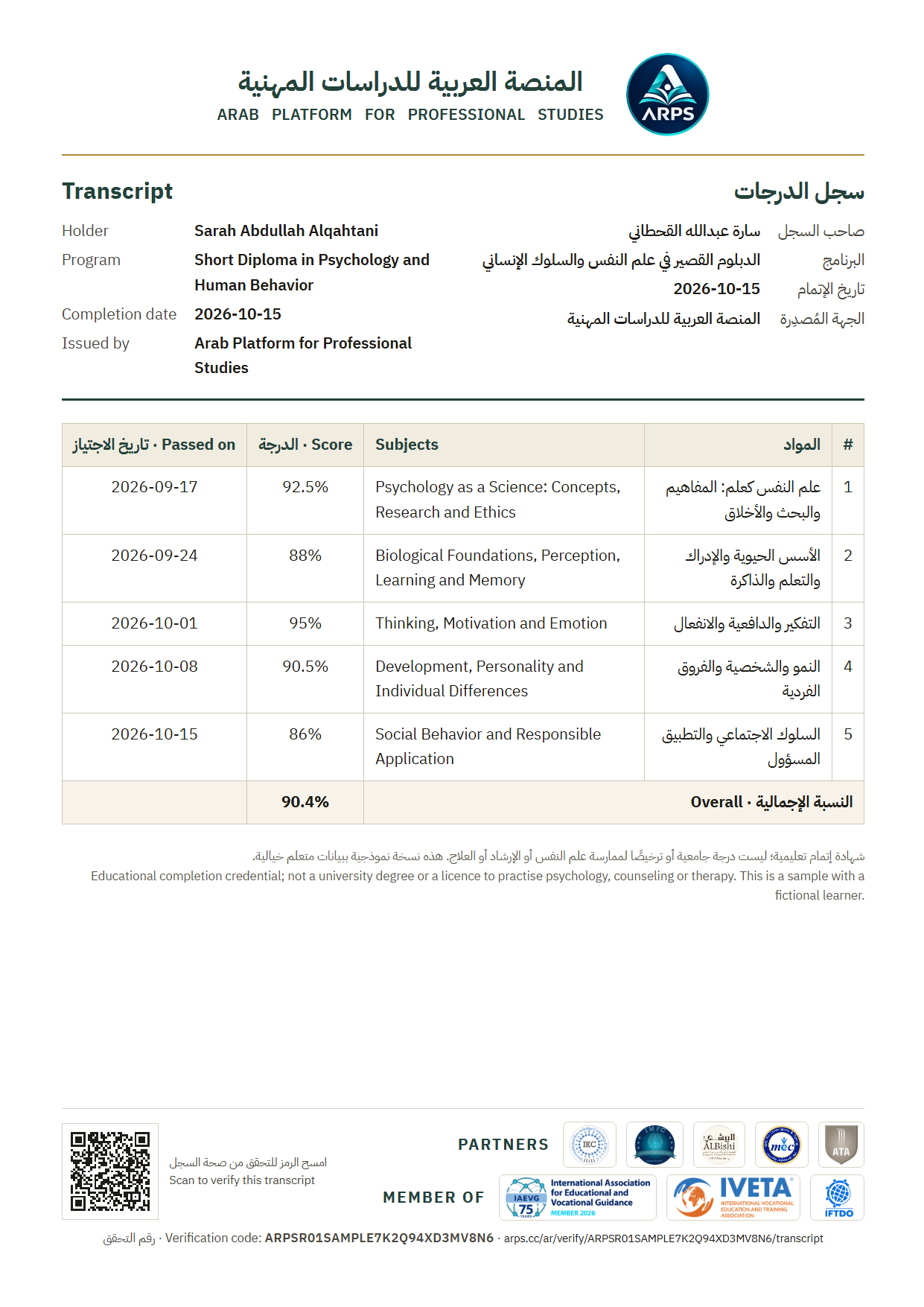
A sample from a real program in this track: Short Diploma in Psychology and Human Behavior. The learner, scores and dates are fictional; opens in a new window.
Disclaimer: Educational completion with subject results; no clinical or legal practice authorization.
Program questions
Is this a practice licence?
No. It is educational completion with subject results.
Are the city figures real?
No. Cases are explicitly fictional teaching settings.
Do visits prove health gain?
No. Visits are service outputs; health outcomes require separate measurement.
Is advanced economics required?
No. Simple arithmetic and attention to units and denominators suffice.
How are subjects assessed?
Each lesson has a knowledge check; each subject and the capstone has an assessment from a separate summative bank.
Show all (7)
Is Short Diploma in Health Policy and Economics free, and do I get a certificate?
Yes. Short Diploma in Health Policy and Economics is free on ARPS: every lesson, exercise and assessment is free, the first subject is open to read without an account, and the program is available in Arabic and English. Issuing a certificate is optional and has a published fee; it is a training completion certificate showing you passed the program's assessments, recognised by most private-sector organisations in the Gulf states and most Arab countries, and it strengthens your CV; confirming that a specific organisation accepts it remains your responsibility.
What other names is Short Diploma in Health Policy and Economics known by?
The subject of this program is also known as: health economics, health policy, healthcare economics, health policy analysis. Learners usually find it by searching for: health economics course free, health policy analyst, health policy and management, healthcare financing, health economics and outcomes research.
Learn to frame a health policy question, appraise evidence, analyze financing, cost and equity, and write a conditional recommendation with a monitoring plan. Hypothetical numerical cases support auditable decision tools while keeping inference and professional authority within clear limits.
7 subjects
30 lessons
49.5 hours
Free
Short Diplomas
Public Health, Nutrition, Wellbeing & Healthcare Management
A foundational, applied diploma in managing health services through governance, operations, capacity, quality, safety, data, budgeting, patient experience, and resilience. It makes clear what management can change and what must remain a clinical decision for qualified professionals.
6 subjects
24 lessons
65.5 hours
Free
Short Diplomas
Public Health, Nutrition, Wellbeing & Healthcare Management
A foundational diploma on foods, nutrients, dietary patterns, labels, food safety and everyday behaviour, taught as general education that can transfer across cultures without prescribing individualized therapeutic diets.
6 subjects
25 lessons
56 hours
Free
Short Diplomas
Public Health, Nutrition, Wellbeing & Healthcare Management
A foundational, applied diploma on how public health examines population health, how data, risks and health claims should be read, and how preventive or educational messages and programmes can be designed without turning population averages into individual diagnosis or advice.
6 subjects
24 lessons
57 hours
Free
Next step: a professional certification or a mini-master
Programs in the same domain that prepare you for an international certification exam or form a professional mini-master, also free.