Short Diploma in Insurance is a free program on ARPS, the Arab Platform for Professional Studies. A short diploma building insurance literacy from risk pooling through policy terms, underwriting and claims to portfolio indicators. Fictional cases progress from an expected-loss calculation to a reviewable customer decision and governance memo. Every case states its assumptions.
Important notice: Independent education, not a university degree, professional licence or interpretation of a local policy or law.
Calculate exposure-years, frequency, severity and loss cost with units and limits.
From lesson 1, readable now without an account: Exposure, Event, Hazard and Loss
Start by naming the exposure unit: the property, person or activity that could be affected by an uncertain future event. A hypothetical home value is an exposed asset, not a loss. Fire is a possible immediate cause of damage, or peril in the teaching policy. Worn wiring increases its likelihood and is a hazard, not itself the insured event. Repair cost after the event is realised loss. The entire value of the house cannot simply be entered as the claim: damage and policy terms must be checked. Replacing wiring may reduce event frequency; fire-resistant materials may reduce severity if a fire occurs. The case does not establish coverage or a payment under any actual policy.
A free account saves your progress and takes you straight to lesson 1.
Program facts
Study fee
Free
subjects
7
lessons
26
Estimated time
80.5 hours
Content last reviewed
Access period
60 days
Study language
Arabic and English
About the program
This diploma begins with exposure, peril, loss and pooling, then reads policy sections and the effects of deductibles, limits and exclusions. It moves to underwriting data quality and transfer of part of an insurer’s risk to a reinsurer, while keeping the original customer entitlement separate from the reinsurance contract.
For claims, learners reconcile an invoice with supported damage and write a decision explaining amount, evidence and review route. They then calculate loss and expense ratios, map cash timing and distinguish insurance service from finance in IFRS 17 at a conceptual level. They then move to operational decisions before buying protection, such as an interruption budget, asset valuation and policy transition, and finish with a business protection and continuity capstone. Teaching and calculations are bilingual. Cases are fictional and bounded by their assumptions.
Practical relevance
Lesson tables can help a learner examine fictional offers, ask an insurer about a deductible or limit, or read a claim letter critically. Applying the approach to a real case requires actual wording, facts and local process. Teaching figures are not market prices or rules.
Why this program
Insurance joins a contractual promise, risk calculation, claim operations and an ability to meet obligations. Viewed apart, a low-price offer can hide a tight limit or future reinsurance recovery can look like cash today. This program connects figures to wording, evidence and customer outcomes so the next decision question becomes clear.
Career relevance
Useful for people beginning in customer service, insurance operations or risk analysis who need a shared language for policies, claims and portfolio measures. Exercises practise reasoning and stating data limits; they do not establish professional competence, licensing, employment or promotion.
Career paths this program serves
This program is a step on the paths of the following occupations. Open a path to see its other programs in study order.
Distinguish exposure, peril and loss and estimate expected loss on a clear basis.
Read policy limits, deductibles and exclusions and compare offers by conditions.
Check underwriting data and calculate fictional retention and reinsurance layers.
Reconcile a claim against evidence and write a reviewable customer decision.
Calculate portfolio indicators, map a cash gap and read service result conceptually.
Show all (7)
Build an interruption budget, asset valuation record and policy-transition plan using explicit evidence and assumptions.
Produce a capstone covering protection, incident response, quality review and a traceable handover of responsibilities.
Learning outcomes (7)
Distinguish exposure, peril and loss, and calculate expected loss on a stated period and group basis.
Read policy terms, calculate deductible and limit effects, and compare offers beyond label or price.
Audit underwriting data, classify risk fairly, and calculate fictional retention and reinsurance recovery.
Reconcile a claim against evidence, wording and arithmetic, then write a clear, reviewable decision without unsupported accusation.
Calculate portfolio ratios and cash gap, and separate insurance service result from customer entitlement in a bounded governance memo.
Build an interruption budget, valuation record and policy-transition plan using explicit evidence and assumptions.
Produce a traceable protection, incident-response, review and responsibility-handover project.
Who it is for
Learners wanting a connected foundation in insurance before choosing a particular branch or market.
New customer service or claims staff seeking to understand what records establish and how decision limits are explained.
Beginning analysts who want to calculate simple indicators with matched periods and denominators and realistic cash timing.
Business owners or consumers wanting better questions when comparing fictional offers, without requiring previous technical expertise.
Prerequisites
No prior insurance employment or advanced accounting study is required.
You should be ready to read a short case and use simple percentages, multiplication and subtraction; each lesson explains its denominator and assumptions. Note each case assumption and check the worked feedback before moving to the next subject.
What it does not offer
This is not training to sell a licensed product, price an actual policy or issue a legal opinion.
It does not replace your own policy wording or advice from an appropriate accounting, regulatory or dispute specialist.
This subject begins by separating the exposed asset, the event that may damage it, a condition that increases likelihood or severity, and the financial loss after the event. Learners draw a causal map instead of treating asset value as payment. They then calculate exposure-years, event frequency, mean severity and loss cost per unit, checking denominators, observation time and incomplete records. Next, they compare dispersed risks with units that one common event could affect and use a theoretical event cap for sensitivity without inventing probabilities. Finally, they distinguish measured loss reimbursement from a fixed benefit triggered by a defined event. The subject assessment links these decisions in fictional cases and asks what remains undecidable until policy wording and evidence are examined.
4 lessons · 9.5 hours
Exposure, Event, Hazard and Loss2 hours
Frequency, Severity and Loss Cost2 hours
Pooling and Common-Event Concentration2 hours
Loss Reimbursement and Fixed Benefit2 hours
Subject 2
Policy Terms, Coverage and Offers
Learners read policy layers rather than infer cover from a product name or price: declarations, grant, exclusion, condition, endorsement and effective date. They connect a leak or theft fact to wording and evidence and write a provisional decision when facts remain incomplete. Next they calculate eligible loss under a sublimit, deductible and overall limit in an explicitly stated order, comparing the customer effect of a binding term. They decompose a teaching premium into assumed loss, expenses and volatility provision without equating historical cost with an adequate price or profit. Finally they create a clarification log for an ambiguous proposal answer, distinguishing missing, conflicting and confirmed inaccurate information while requesting only relevant evidence. The subject assessment combines these skills in bounded fictional offers and cases.
4 lessons · 9.5 hours
Policy Map and Effective Endorsement2 hours
Deductible, Sublimit and Overall Limit2 hours
Premium Components and Customer Burden2 hours
Disclosure and Neutral Clarification2 hours
Subject 3
Underwriting and Risk Transfer
The subject begins with exposure-record quality: learners remove a duplicate only after proving it, distinguish a physical asset from an asset-period record, and report a concentration range when locations are missing rather than false precision. They then write a risk-classification memo that separates observation from causality, tests a field's relevance to fire exposure, and considers fair treatment and minimal data. Next they compare quota-share and excess-of-loss reinsurance across different event sizes while keeping the customer's policy obligation separate from reinsurer recovery. Finally, they stress a correlated event that may exhaust a layer and distinguish gross loss, conditional net retention and the pre-collection cash gap. Assessment combines a data map, calculation and bounded escalation decision, without licensed underwriting practice or a finding about any real insurer's solvency.
4 lessons · 9.5 hours
Exposure and Location Data Quality2 hours
Relevant and Fair Risk Classification2 hours
Quota Share and Excess-of-Loss Layer2 hours
Correlated Event and Liquidity Stress2 hours
Subject 4
Claims and Customer Outcomes
This subject follows a claim from first notice to a reviewable outcome. Learners build a dated source and evidence log, distinguishing supported facts from open questions. They reconcile damaged quantity with an invoice and eligible repair cost, then show deductible and limit effects in a balanced calculation sheet. They inspect document discrepancies without converting them into accusations and choose focused, proportionate evidence requests. Finally they write a letter explaining the outcome and each difference between the claim and payment, with a genuine route for new evidence and review. Cases are hypothetical and do not decide an actual policy or a country's law. Success means the customer and reviewer can reconstruct and correct the decision when evidence changes.
4 lessons · 9.5 hours
First Notice and Evidence Log2 hours
Reconciling Invoice and Eligible Loss2 hours
Fair Investigation of Discrepancies2 hours
Decision Letter and Review2 hours
Subject 5
Portfolio, Solvency and Policyholder Protection
The final subject combines portfolio reading without turning a financial metric into a judgment on an individual claim. Learners calculate loss, expense and combined ratios on matched earned premium and periods, separating paid from incurred claims. They map claim due dates, cash, assets and reinsurance recovery, exposing a liquidity gap that would vanish incorrectly if delayed flows were counted as present cash. They read insurance service result and finance items in IFRS 17 conceptually, separate from customer entitlement. An integrated case produces a governance memo with reproducible figures, funding action and review of claim-letter quality. A short example cannot establish regulatory solvency or final company profit; learners identify missing evidence and specialist review.
4 lessons · 9.5 hours
Loss and Expense Ratios2 hours
Reserves, Liquidity and Asset Timing2 hours
Reading IFRS 17 Service Result2 hours
Governance Memo and Customer Outcome2 hours
Subject 6
Operational Decisions before Buying Protection
Moves learners to operational decisions that precede buying or renewing protection: an interruption budget and recovery, asset valuation, and a policy transition without a coverage gap.
3 lessons · 15 hours
Interruption Budget and Operational Recovery5 hours
Asset Valuation before Renewal5 hours
A Policy Transition without a Gap5 hours
Subject 7
Business Protection and Continuity Capstone
A capstone on protecting a small production studio and keeping its service running, from an operations map and request for quotes to a fictional incident response and a protection review and handover.
3 lessons · 18 hours
Capstone: Protecting a Small Production Studio6 hours
Capstone: Incident Response and Service Continuity6 hours
Capstone: Reviewing and Handing Over Protection6 hours
Subjects unlock in sequence as you progress.
Strengths
Five subjects connect risk pooling, policy, underwriting, claims and portfolio decisions in one pathway, followed by an operational-decisions subject and a capstone.
Worked numerical exercises expose denominator, timing and settlement-reconciliation mistakes.
Clear separation of general principles and fictional examples from any judgment requiring actual wording or local law.
Evidence basis
Official NAIC, IAIS, EIOPA, IFRS Foundation and OECD material was used within stated scopes, together with Insurance Europe explanation. Citation does not mean those bodies endorse this program or make their material local law.
Reference organizations
NAIC
IAIS
EIOPA
IFRS Foundation
OECD
Frameworks used
IAIS ICP 19 fair conduct principles — December 2024
Methodology
Scoped primary sources and original fictional cases with worked calculations and stated interpretation limits.
How the route works
Short Diplomas are relatively comprehensive learning pathways that cover a major subject through five connected learning subjects and structured assessments, with a diploma transcript available with the credential.
Self-paced sequential study. Content unlocks progressively and each subject combines reading, examples, exercises, knowledge checks, and assessment.
Build integrated knowledge in a major subject.
Study through five clear, connected learning subjects.
Complete a defined assessment for each subject.
Receive a diploma transcript showing subjects and results when the credential is issued.
Assessment
Each Short Diploma contains five subjects, each with an approved assessment. A sixth final exam is not required when the five assessments adequately cover the learning outcomes.
Assessment attempts: 2 per assessment, 7 days apart
The pass mark is announced before the program is published.
Certificate
Successful completion makes the learner eligible for the Short Diploma certificate and Diploma Transcript under the credential policy.
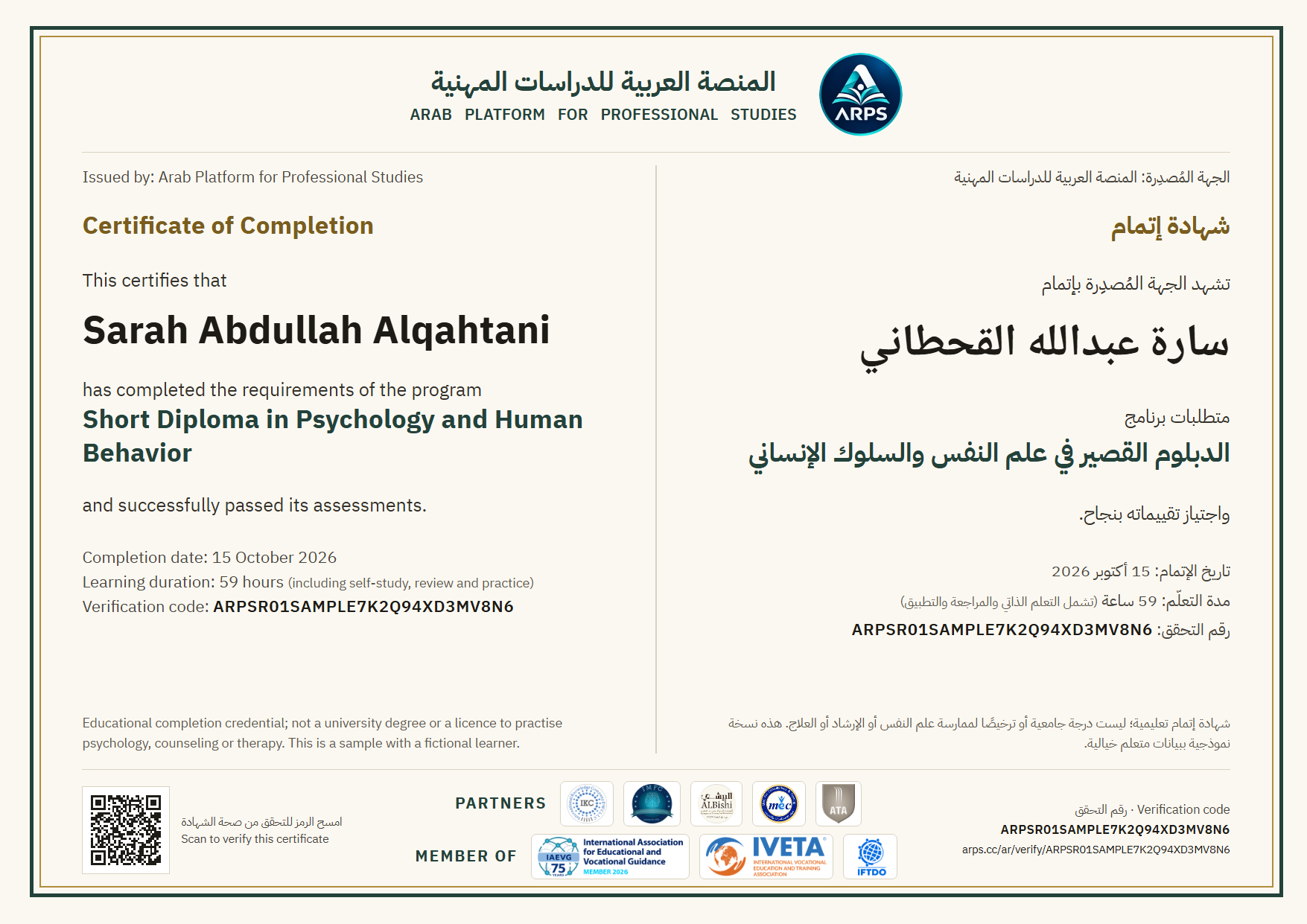
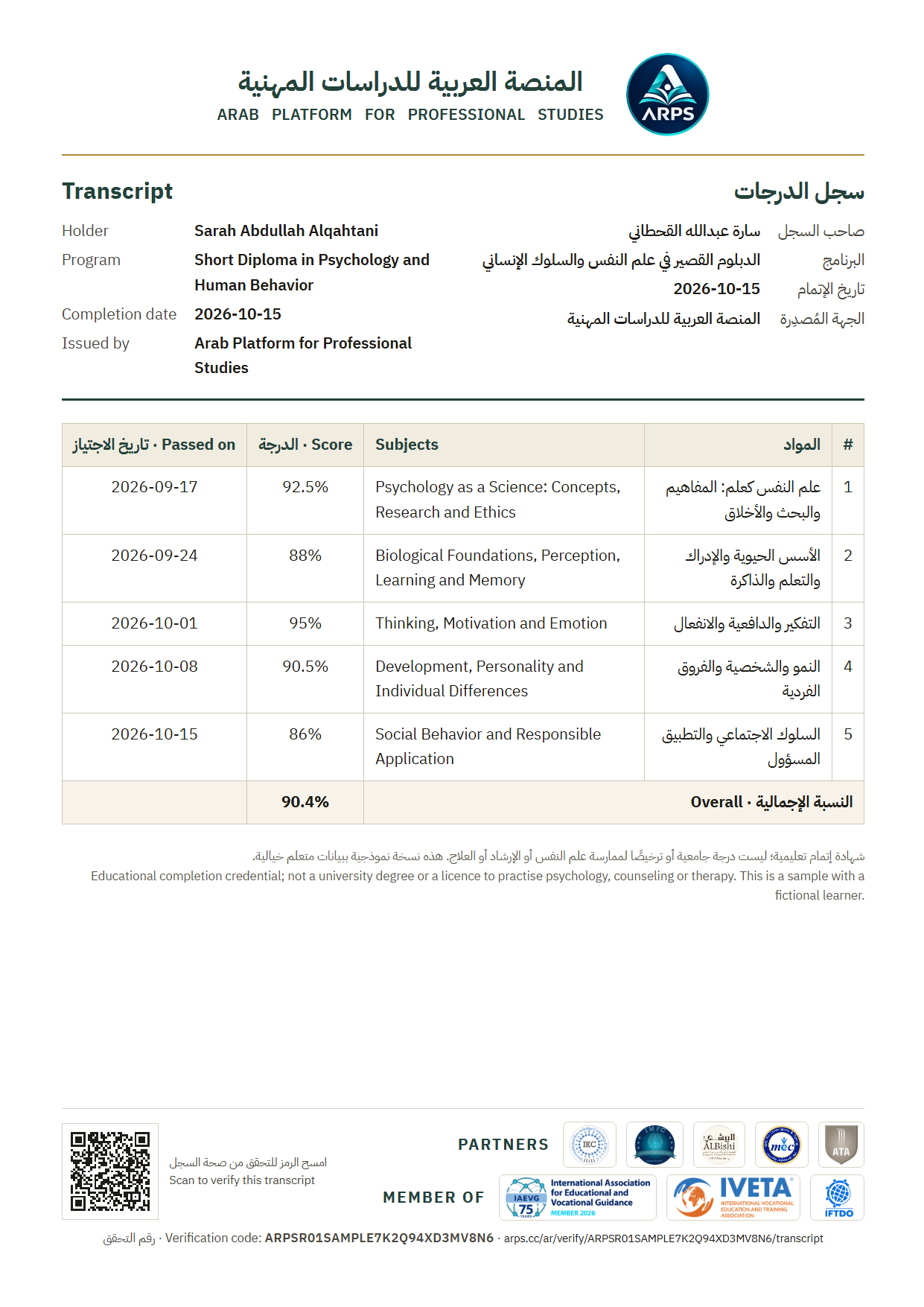
A sample from a real program in this track: Short Diploma in Psychology and Human Behavior. The learner, scores and dates are fictional; opens in a new window.
Disclaimer: Training completion, not a university degree or a licence to practise insurance.
Program questions
Will this calculate my real claim payment?
It teaches evidence matching and conditional arithmetic in stated cases. An actual decision depends on your policy, facts, applicable law and process.
Does it cover every insurance line in depth?
The focus is foundational, with property examples and general concepts; it is not comprehensive specialist training for each line.
Do I need accounting before the IFRS 17 lesson?
No. It explains the conceptual difference between service result, finance and cash, without detailed contract measurement.
Are examples tied to one country?
Arabic cities are fictional settings only. They do not set local rates, laws or settlement rules.
How does loss ratio differ from insurer profit?
Loss ratio compares incurred claims with earned premium on a defined basis. Final profit needs expenses, investment, finance, tax and other items.
Show all (8)
Does reinsurance recovery reduce the customer claim?
In these teaching cases, customer entitlement follows policy and evidence; recovery is a separate insurer-to-reinsurer claim with its own conditions and timing.
Is Short Diploma in Insurance free, and do I get a certificate?
Yes. Short Diploma in Insurance is free on ARPS: every lesson, exercise and assessment is free, the first subject is open to read without an account, and the program is available in Arabic and English. Issuing a certificate is optional and has a published fee; it is a training completion certificate showing you passed the program's assessments, recognised by most private-sector organisations in the Gulf states and most Arab countries, and it strengthens your CV; confirming that a specific organisation accepts it remains your responsibility.
What other names is Short Diploma in Insurance known by?
The subject of this program is also known as: insurance, insurance studies, insurance fundamentals, risk and insurance. Learners usually find it by searching for: short courses in insurance, short term courses in insurance, insurance fundamentals course, insurance course online, principles of insurance.
A foundational diploma on reading financial statements, linking them, and turning numbers into disciplined interpretation through cash-flow analysis, horizontal and vertical analysis, and financial ratios. The emphasis is understanding, calculation, interpretation and comparison limits—not buy/sell recommendations.
A foundational, applied diploma explaining how everyday business transactions become journal entries, balances and financial statements that support understanding of performance, cash and financial position. It moves from the accounting equation and double entry to accruals, statements, cash flows, controls and bank reconciliation.
Practise reviewable compliance and financial crime case work, from source authority and customer due diligence to transaction analysis, testable controls and confidential referral within a specialist role.
8 subjects
30 lessons
57 hours
Free
Next step: a professional certification or a mini-master
Programs in the same domain that prepare you for an international certification exam or form a professional mini-master, also free.