

Finance, Accounting, Banking, Insurance & Compliance
Certified Internal Auditor (CIA) Preparation
Bilingual CIA preparation through original audit cases mapped to the 2025 syllabus.
Free
Short Diploma in Audit and Internal Control is a free program on ARPS, the Arab Platform for Professional Studies. An applied foundation in audit and internal control, connecting risks to controls, testing and findings through fictional cases and worked practice.
Important notice: Independent education and completion credential only; no professional licence or certified auditor status.

Certificate issuance fee
$100
368 AED or 375 SAR
After you pay the certificate fee, you can print the certificate and transcript in both Arabic and English, or in English only.
Start the first subject now Fees by routeThe opening lessons of the first subject, with the reading time set for each. Approximate total time in minutes: 8
A free account saves your progress and takes you straight to lesson 1.
How can you tell whether a payment process is actually controlled? The first subject separates management ownership of controls from independent audit assessment. The next builds a causal chain from process objective to risk and control, distinguishing inherent from residual risk. You then plan an engagement with an objective, scope, criterion and test program. The fourth subject defines transaction populations and selections and interprets exceptions without projecting beyond the evidence. The final subject develops a balanced finding, cause-directed action and follow-up that separates a published policy from changed operating behavior. All case numbers and organizations are invented for learning. This is an applied foundation, not authorization to practise or a professional designation.
The process-mapping and test-planning methods can inform real work after checking local authority, policy and data-protection requirements.
A policy can look sound while permissions still allow bypass. This program shows how to move from a vague concern to a reproducible test, a bounded conclusion and an action that addresses the enabling cause.
Useful to people in audit, control, risk and operations who need to discuss evidence and findings; it offers no employment, promotion or professional-eligibility promise.
This program is a step on the paths of the following occupations. Open a path to see its other programs in study order.
A fictional purchase process separates management ownership from independent audit assessment, then links the objective to a risk, control and traceable transaction map.
This subject connects inherent and residual risk under explicit assumptions to a control that treats the failure mode and specifies owner, frequency and operating evidence.
This subject separates control design from operation, then turns engagement objective, scope and criterion into a risk-control test program and sufficient evidence.
This subject defines population, period and unit; compares directed selection with sampling; and applies walkthrough, inspection and reperformance with honest inference limits.
This subject drafts a supported finding and cause-directed action, fairly reports management disagreement, and distinguishes implementation from operating effectiveness in follow-up.
This module builds an applied audit file for a fictional distribution and services center. Learners first reconcile inventory movement and define population and cutoff, then test payroll access and the timing of salary changes. Next they calculate a supplier claim using verified progress and stated retention, distinguishing entitlement, approval and payment. The project ends with a report combining facts and evidence limits, a response to management objections and follow-up that tests operation after remediation. Learners produce population registers, test papers, a decision memorandum and a follow-up plan with reference feedback for each stage. Cases are educational rather than real organizations, and their policies and financial thresholds belong to their stated facts. Assessment values traceable reasoning, correct calculations and proportionate conclusions.
Subjects unlock in sequence as you progress.
The professional concepts are grounded in official Institute of Internal Auditors standards pages, with the U.S. GAO Green Book labeled as a federal control example; original cases and questions do not imply endorsement.
Bilingual teaching, fictional cases, solved practice and one summative per subject; current review is author self-review pending engine validation.
Short Diplomas are relatively comprehensive learning pathways that cover a major subject through five connected learning subjects and structured assessments, with a diploma transcript available with the credential.
Self-paced sequential study. Content unlocks progressively and each subject combines reading, examples, exercises, knowledge checks, and assessment.
Each Short Diploma contains five subjects, each with an approved assessment. A sixth final exam is not required when the five assessments adequately cover the learning outcomes.
Assessment attempts: 2 per assessment, 7 days apart
The pass mark is announced before the program is published.
Successful completion makes the learner eligible for the Short Diploma certificate and Diploma Transcript under the credential policy.
Every certificate has a public verification code. Verify a certificate
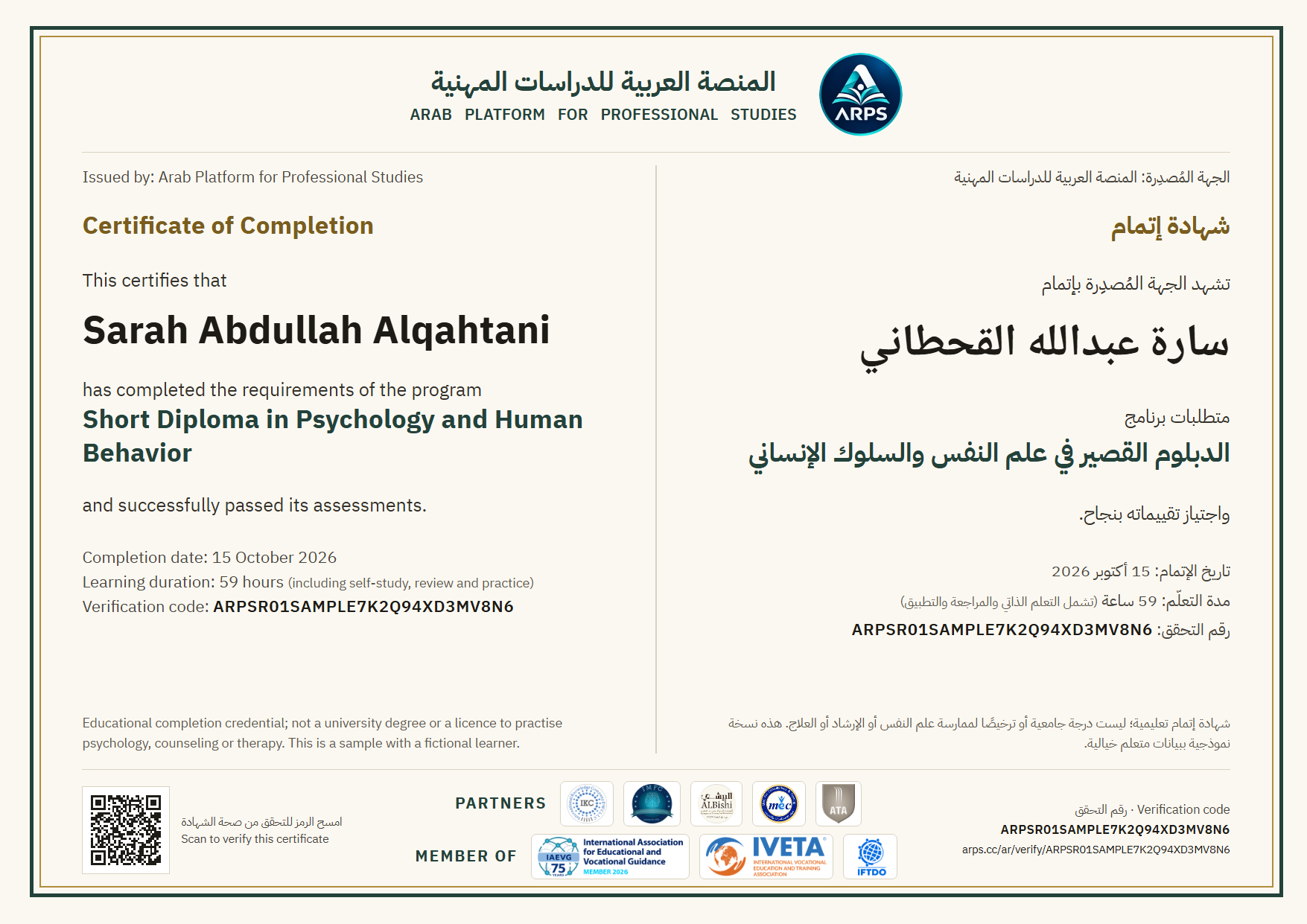
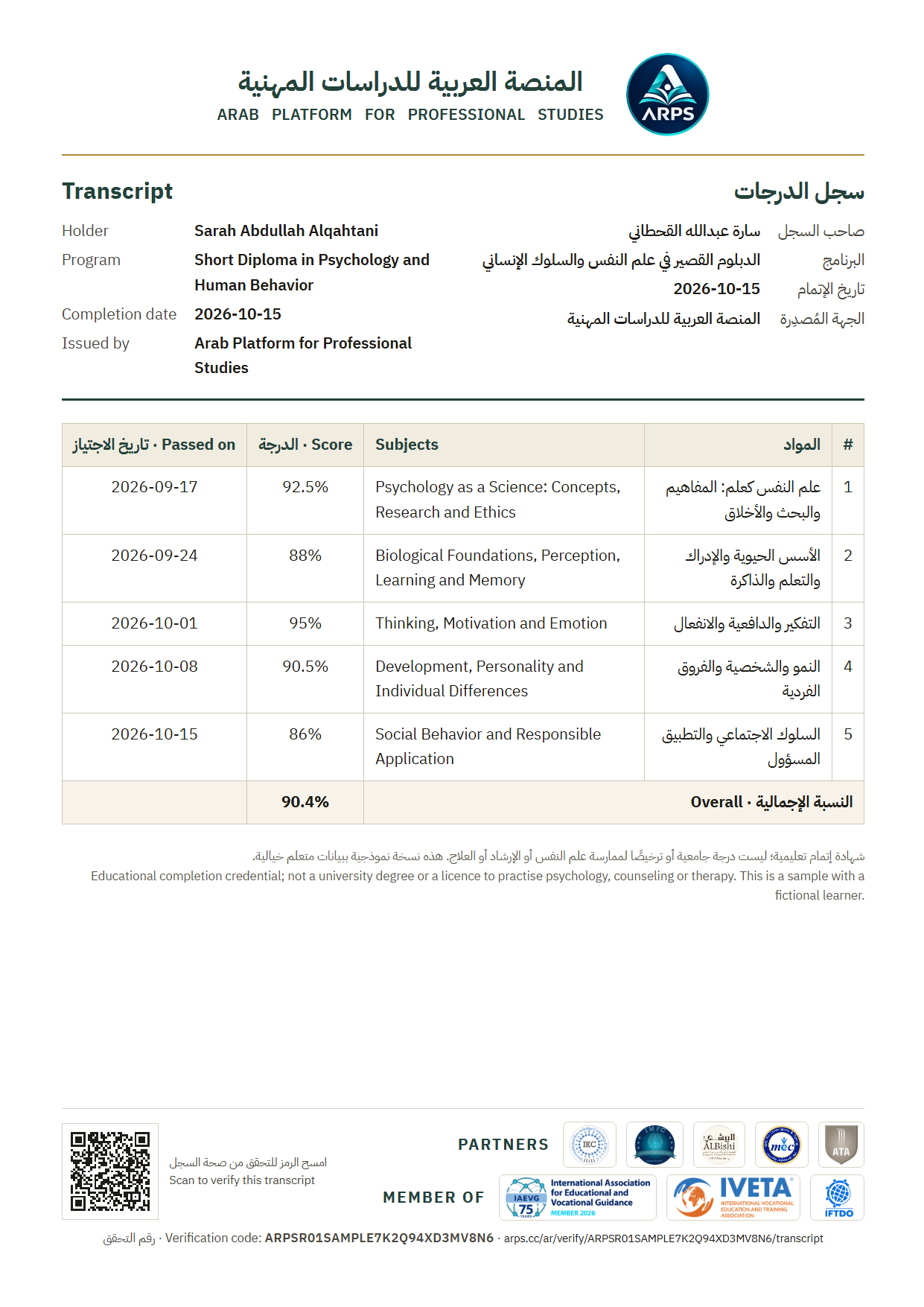
A sample from a real program in this track: Short Diploma in Psychology and Human Behavior. The learner, scores and dates are fictional; opens in a new window.
Verification example: a real issued certificate
Disclaimer: Training completion, not a university degree or professional licence.
No. It offers an educational completion credential and subject results; external professional requirements remain separate.
No. Organizations, names and numbers are fictional learning cases. Real decisions require local policy and actual evidence.
Management designs and runs controls; internal audit independently examines design and operation within its engagement scope.
Each subject has a summative assessment and a results record, with two attempts and a seven-day wait under route policy.
No official hours are stated. Nominal program duration is 30 days and the access window is 60 days.
Yes. Short Diploma in Audit and Internal Control is free on ARPS: every lesson, exercise and assessment is free, the first subject is open to read without an account, and the program is available in Arabic and English. Issuing a certificate is optional and has a published fee; it is a training completion certificate showing you passed the program's assessments, recognised by most private-sector organisations in the Gulf states and most Arab countries, and it strengthens your CV; confirming that a specific organisation accepts it remains your responsibility.
The subject of this program is also known as: internal audit, internal control, internal auditing, COSO internal control. Learners usually find it by searching for: internal audit courses online, internal audit course online free, internal control course, how to become an internal auditor, internal audit and controls training.
Connect with certified consultants, trainers, coaches and specialists in the same domain across the ARPS communities.
Programs from the same field or route that may complement what you learn here.
Finance, Accounting, Banking, Insurance & Compliance
Bilingual CIA preparation through original audit cases mapped to the 2025 syllabus.

Finance, Accounting, Banking, Insurance & Compliance
A short diploma building insurance literacy from risk pooling through policy terms, underwriting and claims to portfolio indicators. Fictional cases progress from an expected-loss calculation to a reviewable customer decision and governance memo. Every case states its assumptions. The program does not price a real policy or interpret local law.

Finance, Accounting, Banking, Insurance & Compliance
A foundational diploma on reading financial statements, linking them, and turning numbers into disciplined interpretation through cash-flow analysis, horizontal and vertical analysis, and financial ratios. The emphasis is understanding, calculation, interpretation and comparison limits—not buy/sell recommendations.

Finance, Accounting, Banking, Insurance & Compliance
A foundational, applied diploma explaining how everyday business transactions become journal entries, balances and financial statements that support understanding of performance, cash and financial position. It moves from the accounting equation and double entry to accruals, statements, cash flows, controls and bank reconciliation.