Certified Internal Auditor (CIA) Preparation is a free program on ARPS, the Arab Platform for Professional Studies. Bilingual CIA preparation through original audit cases mapped to the 2025 syllabus. Learners move through audit foundations, ethics, governance, and fraud, then engagement planning, evidence and analysis, supervision, function operations, quality, reporting, and follow-up.
Important notice: Independent training, not the official IIA exam, CIA award, or eligibility decision.
Explain Purpose, mandate, and charter in a defined audit engagement.
Resolve a case about Purpose, mandate, and charter with evidence limits.
From lesson 1, readable now without an account: Purpose, mandate, and charter
Check the exam language and date before using this course as a readiness map. Its bilingual teaching follows the 2025 CIA syllabus and the Global Internal Audit Standards effective from January 2025. The IIA says Arabic delivery remains on the 2019 syllabus through 27 December 2026 and moves to the 2025 syllabus on 28 December 2026. A candidate sitting in Arabic before that date should compare this course with the official 2019 blueprint and make a separate plan for differences; course completion alone does not establish coverage of that exam version. A candidate sitting after the transition or taking the 2025 English version can use the documented 2025 task map, while rechecking the IIA page at booking for any update. This is version guidance, not a registration or pass decision.
A free account saves your progress and takes you straight to lesson 1.
Program facts
Study fee
Free
subjects
13
lessons
39
Estimated time
103 hours
Content last reviewed
Access period
30 days
Study language
Arabic and English
About the program
Learners move through audit foundations, ethics, governance, and fraud, then engagement planning, evidence and analysis, supervision, function operations, quality, reporting, and follow-up. Original fictional cases show decision steps and inference limits; each lesson includes practice with feedback. The internal questions and diagnostic mocks are independent of the IIA examination. Teaching follows the 2025 blueprint. IIA says Arabic exams remain on the 2019 syllabus through 27 December 2026, so an earlier Arabic candidate must review version differences. This course neither awards CIA nor determines eligibility or recognized training hours. The sequence starts with internal audit's purpose and independence boundaries, then applies them to accepting and planning engagements, gathering evidence, reporting results, and following up action. Each of the thirteen units has three lessons. Every lesson presents a worked fictional case, a practice decision with feedback, and a knowledge check; separate item banks support unit assessments. Two complete practice examinations cover Parts 2 and 3, each with 100 questions in 120 minutes. The Part 1 diagnostic remains a short optional check. All items are original training material and do not predict an official result. The cases ask learners to distinguish observations from inferences. A system log may show that an approval occurred without establishing that the approval was authorized. An anomaly may justify further testing without proving fraud. A management response may close an action on paper while leaving the intended risk outcome unresolved. These judgments matter in an examination and in audit work. Learners may follow the units in order or revisit a specific domain, but should check IIA's current syllabus for their examination language and date before finalizing a study plan. The cases also distinguish audit advice from management decisions: management owns and operates controls, while internal audit evaluates evidence within its mandate. When evidence is incomplete, learners practice naming the limitation, finding alternatives, and communicating the remaining uncertainty instead of offering an unsupported conclusion.
Practical relevance
Practice covers findings, control tests, risk judgments, and action-plan review with stated case data.
Why this program
It connects audit standards to practical decisions, evidence, and inference limits in original fictional workplace cases rather than domain labels alone.
Career relevance
It suits practicing auditors who want a structured professional review before an external exam.
Career paths this program serves
This program is a step on the paths of the following occupations. Open a path to see its other programs in study order.
This module applies Foundations of Internal Auditing to 2025 CIA audit cases with evidence and inference limits.
3 lessons · 7 hours
Purpose, mandate, and charter3 hours
Assurance, advice, and independence3 hours
Services and the Three Lines Model32 min
Subject 2
Ethics and Professionalism
This module applies Ethics and Professionalism to 2025 CIA audit cases with evidence and inference limits.
3 lessons · 7 hours
Integrity and professional courage3 hours
Objectivity, conflicts, and gifts3 hours
Competency, due care, and confidentiality32 min
Subject 3
Governance Risk and Control
This module applies Governance Risk and Control to 2025 CIA audit cases with evidence and inference limits.
3 lessons · 7 hours
Governance roles and culture3 hours
Risk types, appetite, and responses3 hours
Control design, operation, and efficiency30 min
Subject 4
Fraud Risks
This module applies Fraud Risks to 2025 CIA audit cases with evidence and inference limits.
3 lessons · 7 hours
Fraud patterns and the triangle3 hours
Fraud exposure and red flags3 hours
Fraud controls and investigation boundaries30 min
Subject 5
Engagement Planning
This module applies Engagement Planning to 2025 CIA audit cases with evidence and inference limits.
3 lessons · 7 hours
Engagement objectives, scope, and criteria3 hours
Risk assessment and work program3 hours
Approach, resources, and change30 min
Subject 6
Information Gathering Analysis and Evaluation
This module applies Information Gathering Analysis and Evaluation to 2025 CIA audit cases with evidence and inference limits.
3 lessons · 7 hours
Evidence sources and reliability3 hours
Process maps and data analytics3 hours
Findings, workpapers, and conclusion30 min
Subject 7
Engagement Supervision and Communication
This module applies Engagement Supervision and Communication to 2025 CIA audit cases with evidence and inference limits.
3 lessons · 7 hours
Supervision from planning to fieldwork3 hours
Reviewing workpapers and conclusions3 hours
Engagement communication and escalation30 min
Subject 8
Internal Audit Operations
This module applies Internal Audit Operations to 2025 CIA audit cases with evidence and inference limits.
3 lessons · 7 hours
Operating methodology and external providers3 hours
Budget, resources, and staff development3 hours
Audit strategy and board relationships30 min
Subject 9
Internal Audit Plan
This module applies Internal Audit Plan to 2025 CIA audit cases with evidence and inference limits.
3 lessons · 7 hours
Audit universe and engagement sources3 hours
Risk prioritization and a dynamic plan3 hours
Coordination and reliance on assurance providers30 min
Subject 10
Quality of the Internal Audit Function
This module applies Quality of the Internal Audit Function to 2025 CIA audit cases with evidence and inference limits.
3 lessons · 7 hours
Quality program and assessments3 hours
Disclosing nonconformance3 hours
Audit performance measures30 min
Subject 11
Engagement Results and Communication
This module applies Engagement Results and Communication to 2025 CIA audit cases with evidence and inference limits.
3 lessons · 7 hours
Communicating engagement results3 hours
Recommendations, action plans, and disagreement3 hours
Closing, distribution, and correction32 min
Subject 12
Residual Risk and Follow-up
This module applies Residual Risk and Follow-up to 2025 CIA audit cases with evidence and inference limits.
3 lessons · 7 hours
Residual risk and aggregation3 hours
Risk acceptance and escalation3 hours
Confirming implementation and addressing inadequacy30 min
Subject 13
Technology, Continuity, and Business-Process Risks in Engagement Planning
This module applies Technology, Continuity, and Business-Process Risks in Engagement Planning to 2025 CIA audit cases with evidence and inference limits.
3 lessons · 7 hours
Planning technology, cyber, and privacy work3 hours
Business continuity and recovery planning3 hours
Finance, operations, and supply-chain planning30 min
Subjects unlock in sequence as you progress.
Strengths
Equivalent Arabic and English teaching with worked audit cases
Task map across the three CIA parts
Separate established evidence from potential risk
Original questions and practice with feedback
Evidence basis
Primary IIA 2025 syllabi, 2024 Standards, language-transition and topical pages, with scoped NIST guidance.
Reference organizations
The Institute of Internal Auditors
Frameworks used
NIST Cybersecurity Framework — 2.0
Methodology
Task-mapped teaching with worked cases and practice, followed by original items and review of judgment limits.
How the route works
Professional Certification Preparation programs help learners prepare for a recognized external certification through structured knowledge, review, practice questions, and readiness assessments. Arab Platform for Professional Studies (ARPS) does not administer the certification owner's official exam.
Structured self-paced study aligned to the current external certification scope, with knowledge review, practice questions, readiness checks, and internal mock assessments.
Focused preparation for a specific external certification.
Content aligned to the current official exam scope when available.
Practice questions and internal readiness assessments.
Clear separation between Arab Platform for Professional Studies (ARPS) preparation and the official external exam.
Assessment
The route includes an internal assessment for Arab Platform for Professional Studies (ARPS) completion eligibility and separate mock/readiness assessments that are not the external official exam.
Assessment attempts: 2 per assessment, 7 days apart
The pass mark is announced before the program is published.
Certificate
The Arab Platform for Professional Studies (ARPS) credential confirms completion of the preparation program only; the target professional certification requires passing the external issuer's examination under its rules.
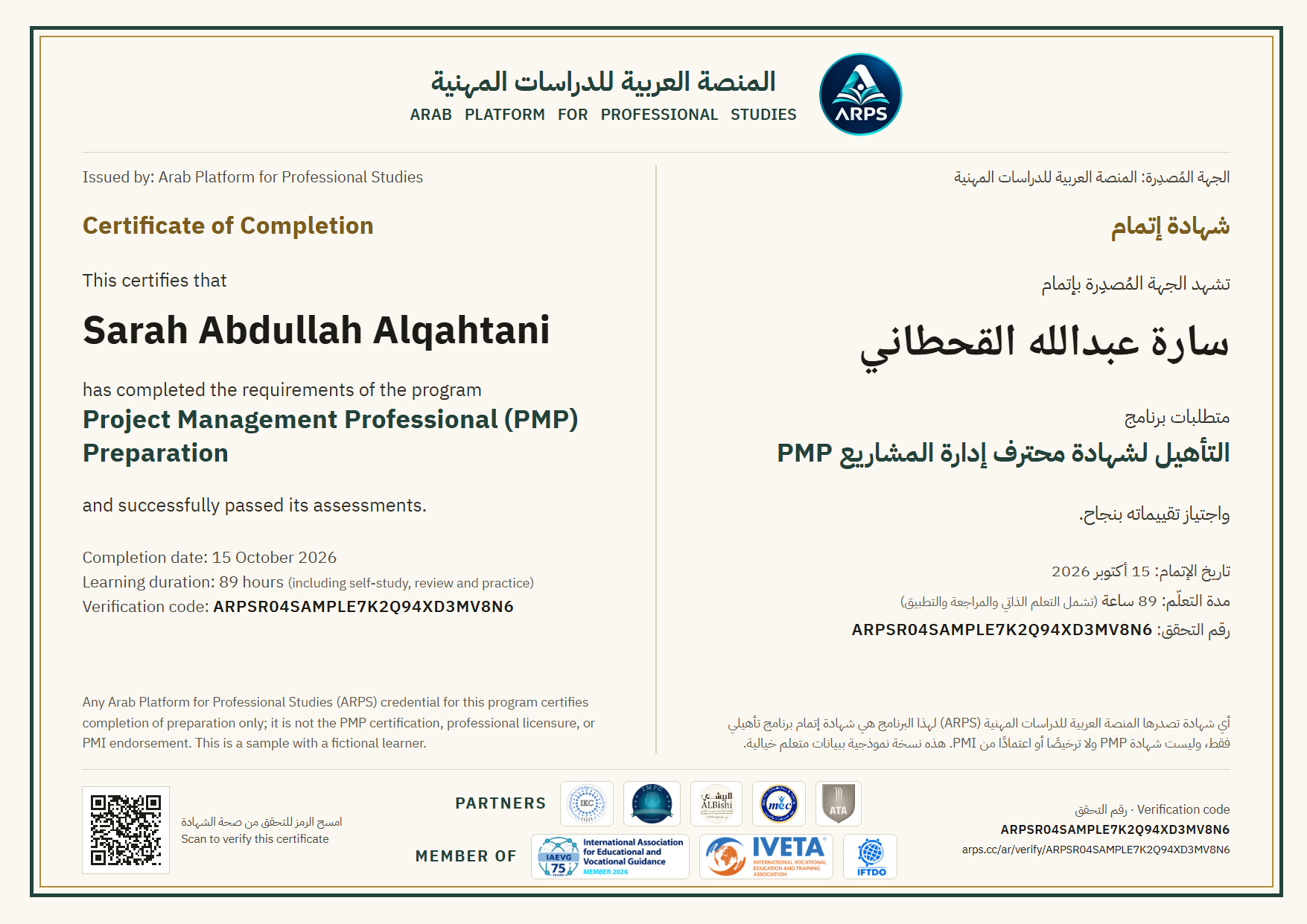
A sample from a real program in this track: Project Management Professional (PMP) Preparation. The learner, scores and dates are fictional; opens in a new window.
Disclaimer: Any internal completion credential confirms preparation study only; it is not CIA, exam eligibility, or IIA endorsement.
Program questions
Is this the official CIA exam?
No. This is independent preparation with original internal diagnostic items; IIA administers the official exam.
Does this course approve my eligibility?
No. IIA decides eligibility and registration under your own record.
Which syllabus is used?
Teaching follows the 2025 CIA blueprint. IIA says Arabic exams before 28 December 2026 remain on the 2019 blueprint; recheck at booking.
Does the mock predict an official pass?
No. The complete Part 2 and Part 3 practice examinations train judgment and timing; the short Part 1 diagnostic is optional. These results do not predict an official pass.
Does it grant recognized training hours?
No recognized hours are claimed; learning minutes are internal editorial estimates.
Show all (7)
Is Certified Internal Auditor (CIA) Preparation free, and do I get a certificate?
Yes. Certified Internal Auditor (CIA) Preparation is free on ARPS: every lesson, exercise and assessment is free, the first subject is open to read without an account, and the program is available in Arabic and English. Issuing a certificate is optional and has a published fee; it is a training completion certificate showing you passed the program's assessments, recognised by most private-sector organisations in the Gulf states and most Arab countries, and it strengthens your CV; confirming that a specific organisation accepts it remains your responsibility.
What other names is Certified Internal Auditor (CIA) Preparation known by?
The subject of this program is also known as: CIA exam prep, Certified Internal Auditor exam preparation, CIA exam review. Learners usually find it by searching for: free CIA exam prep, internal audit course online, CIA practice questions, internal audit cases and ethics, CIA prep with completion certificate, what is CIA certification, CIA exam requirements, CIA course in Arabic.
A bilingual preparation program aligned to CFA Institute’s 2026 Level I topic outline. Ten domains and forty lessons combine worked cases, separate exercises, and original practice items. It does not administer the issuer exam or guarantee a pass.
An honest note: we prepare you for the exam; we do not award the certification. Only the body that owns a certification awards it, once you meet its requirements and pass its official exam, and you register and pay for the exam with that body. The optional ARPS certificate is a training completion certificate recognised by most private-sector organisations in the Gulf states and most Arab countries, and it strengthens your CV alongside the certification.