Short Diploma in Mediation and Interpersonal Conflict Management
Short Diploma in Mediation and Interpersonal Conflict Management is a free program on ARPS, the Arab Platform for Professional Studies. A short diploma in analyzing bounded interpersonal disputes, screening mediation suitability, facilitating voluntary dialogue, and drafting agreements that can be carried out and reviewed.
Important notice: Independent education; not a university degree, professional licence or endorsement by cited organizations.
Explain the method and limits of stakeholders, escalation and absent people.
Map stakeholders, escalation and announcement authority questions.
From lesson 1, readable now without an account: Facts, interpretations and interests
When someone says, ‘He does not respect me,’ you are hearing an interpretation, not yet an observable event. A closer observation might be that the other person interrupted twice in a meeting or sent a rota after an agreed deadline. This distinction is the first tool of conflict analysis. An observation describes what was seen or heard. An interpretation assigns meaning. A position is a stated demand, such as ‘I do not want him in my meetings.’ An interest is the concern the demand tries to protect, such as being able to present work without interruption. A need may be more basic, such as safety or fair treatment, but should not be inferred from one sentence. Ask, ‘What happened specifically?’ and ‘Why did that matter to you?’ Then offer your understanding for correction. A useful dispute map does not convert one account into a verdict. It records two accounts, points of agreement, points of disagreement, and facts that still need checking. In mediation the facilitator does not decide who is telling the truth; the parties explore a voluntary resolution within a suitable process. Confidentiality and safety limits depend on the setting, so never promise absolute secrecy before explaining the agreed rules.
A free account saves your progress and takes you straight to lesson 1.
Program facts
Study fee
Free
subjects
6
lessons
25
Estimated time
61.5 hours
Content last reviewed
Access period
60 days
Study language
Arabic and English
About the program
Begin by separating observed facts from interpretations and mapping everyone affected. Check consent, authority, safety and information-sharing limits before convening dialogue. Practice listening, reframing and building a joint issue list, then generate alternatives and compare them against party-chosen criteria. Finish by drafting operational clauses and a review plan while handling disconnection, absent authority, and referral. Arab-city scenarios are fictional and do not state local legal procedures.
Practical relevance
Apply skills to team cases: map facts and interests, ask about permission, manage a break, and return each agreement clause to someone able to perform it. Every case marks what remains unknown.
Why this program
A disagreement about a date or message can grow when people jump from competing accounts to a solution no one can authorize. This program teaches how to slow the process, surface interests and constraints, and keep decisions with the parties. Authority, privacy and evidence are tested in cases, exercises and assessments.
Career relevance
Suitable for people coordinating teams or community initiatives who need a practical vocabulary for bounded disagreements. It provides educational foundations and practice, not independent professional competence or a mediation licence.
Career paths this program serves
This program is a step on the paths of the following occupations. Open a path to see its other programs in study order.
Distinguish facts, interpretations and interests while mapping affected people.
Screen consent, safety, authority and mediator-role boundaries.
Conduct separate intake and joint dialogue through questions and neutral reframing.
Generate options, compare them and test whether they can be performed.
Document full or partial agreement, review it, or close and refer the process honestly.
Learning outcomes (25)
Apply facts, interpretations and interests to a bounded case, explaining the decision and its limits.
Apply stakeholders, escalation and absent people to a bounded case, explaining the decision and its limits.
Apply screening mediation suitability and limits to a bounded case, explaining the decision and its limits.
Apply mediator role and participation agreement to a bounded case, explaining the decision and its limits.
Apply separate intake and disclosure boundaries to a bounded case, explaining the decision and its limits.
Apply reflective listening and open questions to a bounded case, explaining the decision and its limits.
Apply reframing blame as a discussable issue to a bounded case, explaining the decision and its limits.
Apply joint agenda and interruption management to a bounded case, explaining the decision and its limits.
Apply opening joint dialogue and checking consent to a bounded case, explaining the decision and its limits.
Apply distinguishing interests from fixed positions to a bounded case, explaining the decision and its limits.
Apply managing emotion and impasse without coercion to a bounded case, explaining the decision and its limits.
Apply shared list of agreed and disputed issues to a bounded case, explaining the decision and its limits.
Apply generating party-owned options to a bounded case, explaining the decision and its limits.
Apply comparing options with agreed criteria to a bounded case, explaining the decision and its limits.
Apply testing feasibility, authority and effects to a bounded case, explaining the decision and its limits.
Apply drafting a clear executable agreement to a bounded case, explaining the decision and its limits.
Apply reviewing implementation after agreement to a bounded case, explaining the decision and its limits.
Apply multiparty and remote participation to a bounded case, explaining the decision and its limits.
Apply pause, closure and referral to a bounded case, explaining the decision and its limits.
Apply branching case and defensible closure to a bounded case, explaining the decision and its limits.
Apply accessible participation and interpretation to a bounded professional file, explaining decision limits.
Apply conflicting versions without an investigative role to a bounded professional file, explaining decision limits.
Apply constructing a testable resource package to a bounded professional file, explaining decision limits.
Apply repairing implementation and renegotiating to a bounded professional file, explaining decision limits.
Apply independent mediation simulation and decision review to a bounded professional file, explaining decision limits.
Who it is for
Coordinators of workplace, community and volunteer teams who handle disagreements about dates, responsibilities and messages, and need a structured way to hear people without claiming control over their decisions.
Early-career facilitators and learners seeking a foundation in fact mapping, interests and mediation suitability before inviting people into a joint conversation.
This course does not fit someone seeking training to conduct a formal investigation, provide legal representation or manage specialist safety concerns; those need an appropriate professional route.
Prerequisites
No advanced experience or prior mediator qualification is required. Learners need to read short messages, place events in order, and distinguish what a party observed from what they inferred about another person's intent.
Be willing to work through Arabic and English cases, compare evidence, and check authority and confidentiality limits. Exercises use a simple written table or notes; a meeting platform and real dispute records are not required.
What it does not offer
Not a substitute for an institutional investigation, legal advice or a specialist safety service.
Does not grant a professional licence, external accreditation or a guarantee of resolving every dispute.
Conflict analysis begins with observable events rather than assumed intention. Separate events from interpretations, demands from the interests they protect, and let each person correct any proposed need. Map direct parties, affected people and those with implementation authority. Trace escalation to find a changeable point; acting first is not a verdict about responsibility. Before inviting a joint meeting, examine free choice, safety, ability to speak and authority to settle. Ask whether the issue needs an investigation or formal decision instead. The outcome may be provisional entry, deferral until a fact
4 lessons · 7 hours
Facts, interpretations and interests1.5 hours
Stakeholders, escalation and absent people1.5 hours
Screening mediation suitability and limits1.5 hours
Mediator role and participation agreement3.5 hours
Subject 2
Preparation, listening and trust
Preparation makes dialogue correctable and freely chosen. In separate intake, explain purpose, the right to stop and sharing limits. Distinguish what a person permits you to share, what stays private and what needs provider-rule checking. Active listening asks about an event, reflects an interest or feeling, and revises the summary when corrected. Reframing turns an accusation into an examinable question without erasing harm or deciding whether an allegation is true; a requested investigation may remain separate. A joint agenda includes authorized topics, speaking opportunities, decision authority and approval. When someone
4 lessons · 7 hours
Separate intake and disclosure boundaries1.5 hours
Reflective listening and open questions1.5 hours
Reframing blame as a discussable issue1.5 hours
Joint agenda and interruption management3.5 hours
Subject 3
Dialogue and interests
At a joint meeting, renew consent and sharing boundaries, hear each account without interruption and offer a correctable summary. Ask what interests stated positions protect, what constraints apply and what facts remain unchecked. An interest matrix separates demands from impact and implementation authority; it may reveal a shared concern without inventing identical needs. When tension rises, name observed behavior, offer a break and check continuing choice. A brief separate conversation needs an agreed purpose and sharing boundary. Impasse does not justify imposing an apology or withdrawal of an independent complaint.
4 lessons · 7 hours
Opening joint dialogue and checking consent1.5 hours
Distinguishing interests from fixed positions1.5 hours
Managing emotion and impasse without coercion1.5 hours
Shared list of agreed and disputed issues3.5 hours
Subject 4
Options, negotiation and agreement
Move from an issue map to options owned by the parties. Generate alternatives tied to needs, then wait for participants to set comparison criteria. Distinguish established facts, checks needed and differently valued effects. Test authority, resources, dependencies and effects on absent people; build a fallback for failed conditions. In an agreement, name each action, owner, deadline, completion evidence, sharing limit and review date. Separate accepted obligations from conditional steps and unresolved issues. Read the text back so each party confirms understanding and free choice. A facilitator cannot grant authority another
4 lessons · 7 hours
Generating party-owned options1.5 hours
Comparing options with agreed criteria1.5 hours
Testing feasibility, authority and effects1.5 hours
Drafting a clear executable agreement3.5 hours
Subject 5
Follow-up and integrated cases
This subject addresses work after agreement and changing process conditions. Design limited follow-up connecting each clause to evidence, an obstacle, a next step and an end date. In multiparty or remote meetings, identify affected and authorized people, check access and privacy, and pause adoption when an affected person disconnects. Distinguish a break that restores participation, closure without agreement, and referral beyond the facilitator's role. Combine the course in a live decision record and closure note stating the actual outcome: full agreement, partial agreement, no agreement or stopped process. Public communication
4 lessons · 7 hours
Reviewing implementation after agreement1.5 hours
Multiparty and remote participation1.5 hours
Pause, closure and referral1.5 hours
Branching case and defensible closure3.5 hours
Subject 6
Applied mediation design and testing project
This project combines five practical skills. Design understandable participation for someone needing support or interpretation, then compare conflicting versions and identify evidence limits. Construct a resource package with time and cost calculations and dependencies on absent owners. Review disrupted implementation, separating late performance from future amendment and setting an end to follow-up. Finally facilitate a library case with private role cards and information revealed during dialogue. Produce a preparation card, evidence record, trial package, amendment decision and separate public and private outputs. An observer examines specific interventions and their effects on understanding and choice. Fictional data support different participant-owned outcomes. The project ends with a short testable practice plan while preserving training, authority and specialist-referral boundaries.
5 lessons · 16.5 hours
Accessible participation and interpretation3.5 hours
Conflicting versions without an investigative role3.5 hours
Constructing a testable resource package3.5 hours
Repairing implementation and renegotiating3.5 hours
Independent mediation simulation and decision review3.5 hours
Subjects unlock in sequence as you progress.
Strengths
Twenty-five lessons including five integrated portfolios and a new applied project module with outputs and model feedback.
Repeated distinctions between sending, receipt and understanding, and between authority and preference.
Separate lesson checks and banks for five subject assessments.
Original fictional Arab-region cases with explicit limits on transferring principles across settings.
Evidence basis
Concepts draw on original guidance from professional, public and intergovernmental organizations, with each source linked to its supporting issue. Provider rules are used within their settings; citation does not imply endorsement.
Reference organizations
United Nations
Acas
American Arbitration Association
World Intellectual Property Organization
Frameworks used
UN Guidance for Effective Mediation — 2012
Acas workplace mediation guidance — current public guidance
Methodology
Bilingual explanation, worked cases and output-based exercises, followed by short checks and an automated subject assessment.
How the route works
Short Diplomas are relatively comprehensive learning pathways that cover a major subject through five connected learning subjects and structured assessments, with a diploma transcript available with the credential.
Self-paced sequential study. Content unlocks progressively and each subject combines reading, examples, exercises, knowledge checks, and assessment.
Build integrated knowledge in a major subject.
Study through five clear, connected learning subjects.
Complete a defined assessment for each subject.
Receive a diploma transcript showing subjects and results when the credential is issued.
Assessment
Each Short Diploma contains five subjects, each with an approved assessment. A sixth final exam is not required when the five assessments adequately cover the learning outcomes.
Assessment attempts: 2 per assessment, 7 days apart
The pass mark is announced before the program is published.
Certificate
Successful completion makes the learner eligible for the Short Diploma certificate and Diploma Transcript under the credential policy.
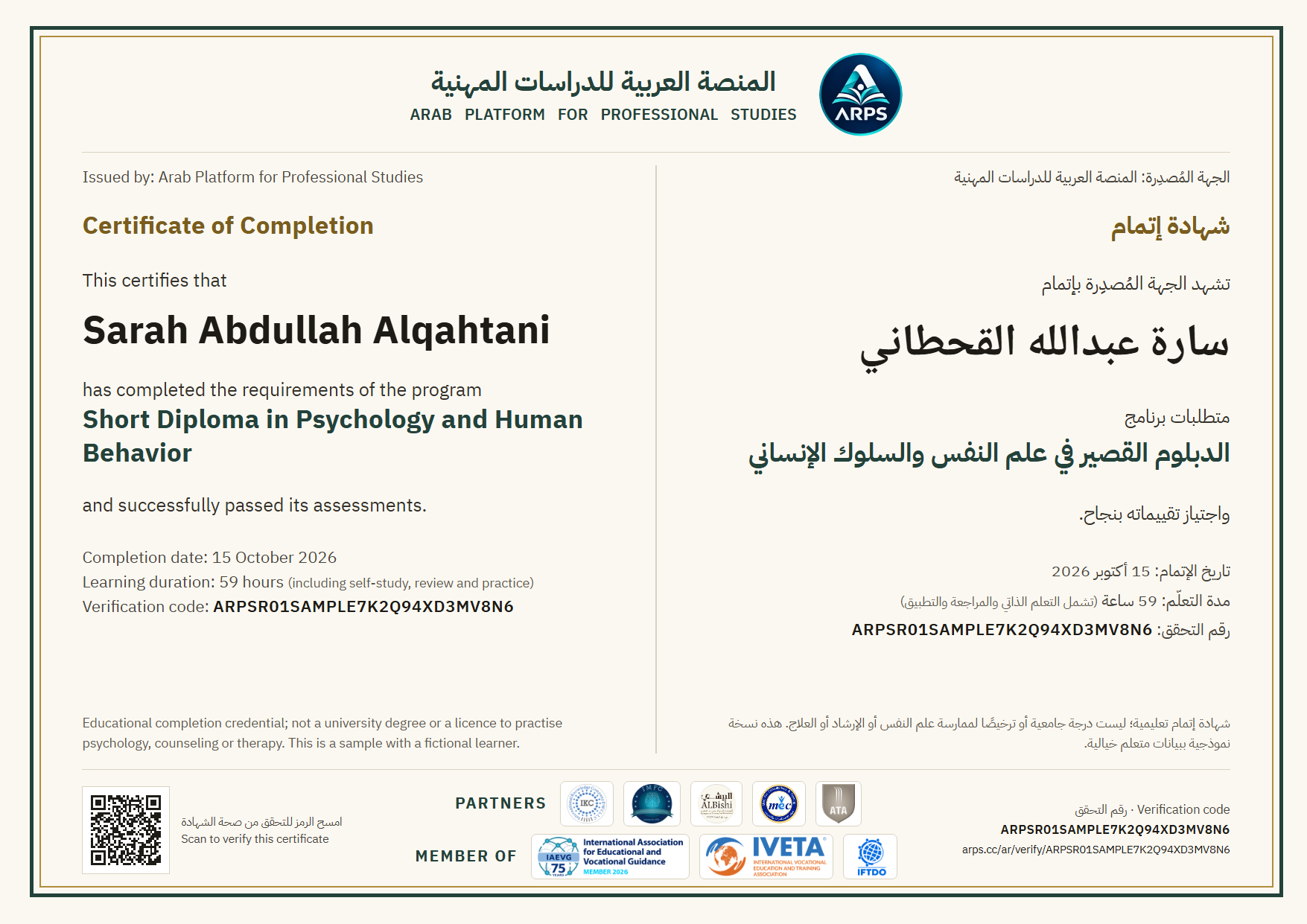
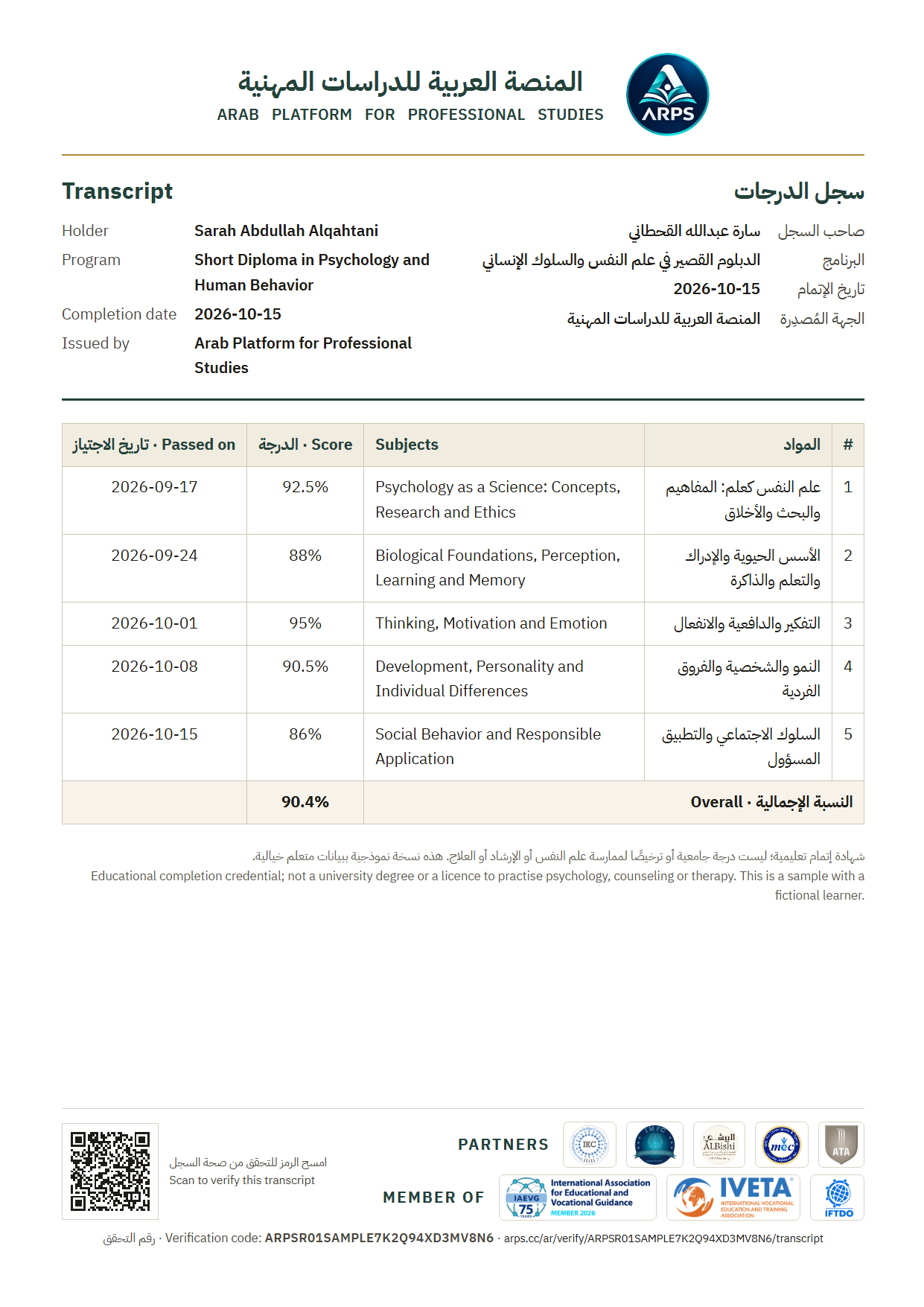
A sample from a real program in this track: Short Diploma in Psychology and Human Behavior. The learner, scores and dates are fictional; opens in a new window.
Disclaimer: Internal learning completion; no university degree or professional licence.
Program questions
Do I need prior mediation experience?
No. The programme begins with dispute analysis and suitability before dialogue and agreement.
Does completion authorize professional practice?
No. This is an internal educational completion programme, without external accreditation or a licence.
Are the Arab-city examples local rules?
No. People and settings are fictional. Check the applicable organization and legal context in real work.
How is learning assessed?
Each lesson has a short check, and each subject has an automated twenty-question assessment drawn from a larger bank under route policy.
How long is the learning path?
The path contains twenty-five lessons, five integrated portfolios, a five-stage capstone and five subject assessments. Estimated learning time comes from reading and practice rather than official credit hours.
Show all (10)
What if safety or coercion becomes a concern?
Stop assuming dialogue is suitable, stay within the facilitator role, and refer to the relevant specialist process rather than pressuring the parties.
May I repeat information from a separate intake?
Check the specific disclosure boundary and permission first. A wish to move quickly is not implied permission to share details.
Must every case end in full agreement?
No. A defensible outcome can be a partial agreement, a pause, or closure and referral that identifies what is known and still open.
Is Short Diploma in Mediation and Interpersonal Conflict Management free, and do I get a certificate?
Yes. Short Diploma in Mediation and Interpersonal Conflict Management is free on ARPS: every lesson, exercise and assessment is free, the first subject is open to read without an account, and the program is available in Arabic and English. Issuing a certificate is optional and has a published fee; it is a training completion certificate showing you passed the program's assessments, recognised by most private-sector organisations in the Gulf states and most Arab countries, and it strengthens your CV; confirming that a specific organisation accepts it remains your responsibility.
What other names is Short Diploma in Mediation and Interpersonal Conflict Management known by?
The subject of this program is also known as: mediation, conflict resolution, dispute resolution, interpersonal conflict management. Learners usually find it by searching for: mediation courses online, mediation course free, conflict resolution course, how to become a mediator, interpersonal conflict management skills, mediation skills training.
A foundational diploma for understanding family relationships in a structured way, improving communication, clarifying boundaries and roles, managing conflict and decisions, and recognizing when ordinary guidance should stop because safety and specialist referral take priority.
A six-subject foundation in general parenting and parental guidance: understanding development and behavior, communicating respectfully, building routines and boundaries, using nonviolent discipline, collaborating with schools, and supporting caregiver wellbeing, ending with an applied capstone.
A foundational, applied diploma connecting psychological wellbeing with self-awareness, stress management, sleep, movement, relationships, communication, problem-solving, decision-making and sustainable habits. It is non-therapeutic and does not use self-ratings to diagnose disorders.
Understand human behavior through concepts and evidence, not impressions alone. This diploma builds a connected foundation in psychology and links it to learning, decision-making and communication within a nonclinical educational scope.
6 subjects
25 lessons
59 hours
Free
Next step: a professional certification or a mini-master
Programs in the same domain that prepare you for an international certification exam or form a professional mini-master, also free.