Specialist Preparation Program in Instructional Design and E-Learning
Specialist Preparation Program in Instructional Design and E-Learning is a free program on ARPS, the Arab Platform for Professional Studies. Learn to diagnose a learnable performance gap, build an alignment map and storyboard for an online activity, then check access, rights, and measurement. Fictional cases produce specialist deliverables: a decision card, scenario, rubric, trial log, and handoff.
Separate a learnable classification error from an approval bottleneck in a new request log and justify the next test.
From lesson 1, readable now without an account: Distinguishing a performance gap from a learning gap
When an operations manager says, “We need a course because customer requests are late,” do not open the authoring tool yet. Lateness is a symptom; training is one possible remedy for a specific cause. First define required performance, gather evidence about actual work, and identify the portion a learning experience could address. An employee may know the procedure but be waiting for permission they cannot grant. Explaining it again will not remove the queue. A new employee may have the right tools but confuse an exception with a routine case; decision practice may help there.
Define the unit of performance before calculating a gap.“Improve service” is too broad. A checkable statement is: “After a complete request arrives, the intake worker identifies its category and routes it to the authorized team within one working day.” Specify when the clock starts and stops and which requests count. A report timed from initial receipt cannot be compared directly with one timed from data completion. The aggregate late rate locates a problem; it does not reveal its cause.
Write a five-line decision card:
expected behavior and context
observed behavior and evidence source
provisional causal explanation
a small discriminating check
and the action within your authority
Review a sample of timestamped records, observe the workflow, and speak with the worker and process owner where feasible. Remove personal details the design does not need. Neither one employee’s account nor a manager’s belief is a representative finding. Ask what changed: a tool, an approval requirement, or a category rule that recent hires have not practiced?
Separate a skill gap from a workflow barrier and a rule or incentive barrier. A skill gap is plausible when inputs, time, and permission are available but a person misses a teachable and testable step. A workflow barrier exists when the person knows the step but a system hides a field or approvals queue up. The rule itself may be ambiguous, or a measure may reward behavior opposed to the stated goal. Causes may coexist. Use a table with three questions and evidence for each answer: Does the worker know what to do? Can they do it with current tools and authority? Do records show they did it? If the person classifies a case correctly but the routing button is disabled for their account, escalate the defect to the system owner. If the button works but two categories are confused, design practice around the category boundary. When uncertain, combine a short safe simulation with a permission-log review before recommending a full course.
A free account saves your progress and takes you straight to lesson 1.
Program facts
Study fee
Free
subjects
8
lessons
30
Estimated time
53 hours
Content last reviewed
Access period
30 days
Study language
Arabic and English
About the program
Start by separating workflow barriers from knowledge gaps before proposing a lesson. Analyze the task audience, devices, language, and prerequisites, then state outcomes observable in novel cases. Choose a learning strategy, link every promise to practice and assessment evidence, and sequence the journey so the rule is available at decision time.
Author a storyboard and graduated examples, checking access to information and interaction on keyboard and phone. Work with fictional images and records to distinguish an asset's source from permission to use it and its scope. Build items and performance rubrics, trial a prototype, and document defects, repairs, and limits.
Finally, interpret reach, completion, and decision accuracy with their denominators and plan a testable improvement. Practice requires neither real customer data nor platform development. Launch, rights, and permission decisions remain with their owners; the program grants no professional license or promise of unmeasured workplace improvement.
Practical relevance
Use the method to prepare procedure training, document a storyboard, inspect a digital activity, and justify practice or an asset hold. Cases are fictional; applying them at work requires review of local rules and systems.
Why this program
An attractive course can address a permission bottleneck instead of a skill gap or test a definition instead of a work decision. This program connects cause diagnosis to authoring and evaluation so each design decision can be checked.
Career paths this program serves
This program is a step on the paths of the following occupations. Open a path to see its other programs in study order.
Distinguish a performance gap from a learning need, analyze task audience and context, map prerequisites, and write an observable outcome.
Choose a learning strategy, align outcome, activity and evidence, sequence the learner journey, and design interaction and feedback.
Produce a storyboard, examples and graduated practice, specifying accessibility, rights, data, and technical compatibility checks.
Build original decision items and performance rubrics, test a prototype, and hand off a specification preserving learning intent and authority.
Interpret learning and work measures with denominators, diagnose barriers, check an improvement, and assemble an evidenced design dossier.
Show all (8)
Design sustained practice, a branching simulation, and a graphic with adequate inputs, solutions, and checks.
Analyze item data, calibrate rubrics, and compare assessment versions within evidence limits.
Produce an integrated learning project, analyze its fictional trial, and hand off a scoped procedure change.
Learning outcomes (8)
Distinguish a performance gap from a learning need, analyze task audience and context, map prerequisites, and write an observable outcome.
Choose a learning strategy, align outcome, activity and evidence, sequence the learner journey, and design interaction and feedback.
Produce a storyboard, examples and graduated practice, specifying accessibility, rights, data, and technical compatibility checks.
Build original decision items and performance rubrics, test a prototype, and hand off a specification preserving learning intent and authority.
Interpret learning and work measures with denominators, diagnose barriers, check an improvement, and assemble an evidenced design dossier.
Design sustained practice, a branching simulation, and a graphic with adequate inputs, solutions, and checks.
Analyze item data, calibrate rubrics, and compare assessment versions within evidence limits.
Produce an integrated learning project, analyze its fictional trial, and hand off a scoped procedure change.
Who it is for
This program suits people creating online learning in workplace training teams, digital libraries, or service operations who must turn a real task into instruction, practice, assessment, and a documented handoff. It serves newer specialists and adjacent practitioners who know their work process but want a checkable design method. It does not target general teacher training, platform engineering, or authority to publish institutional assets.
Prerequisites
You should be able to read a short work procedure and a simple digital case record, then write a brief decision with its reason. The cases use fictional records and basic rates such as correct answers among submitters; the course explains the calculation when needed. You need to browse learning pages and text files on a phone or computer. Platform development and programming experience are unnecessary.
Separate learning needs from workflow barriers and specify audience, prerequisites, and an observable outcome.
4 lessons · 2.5 hours
Distinguishing a performance gap from a learning gap36 min
Learner, context, and constraint analysis36 min
Task decomposition and prerequisites36 min
Writing observable outcomes36 min
Subject 2
Planning and alignment
Choose a strategy, align practice and evidence, and sequence rules and feedback around the intended decision.
4 lessons · 2.5 hours
Choosing a learning strategy from the task34 min
Aligning outcomes, activity, and assessment38 min
Sequencing content and managing load34 min
Designing interaction and feedback36 min
Subject 3
Authoring the digital experience
Author scenes and examples while inspecting access, rights, data, media choice, and compatibility limits.
4 lessons · 2.5 hours
Writing a lesson storyboard and media specification34 min
Designing worked examples and graduated practice34 min
Accessibility and flexible learning options36 min
Rights, data, and technical choice34 min
Subject 4
Assessment and implementation
Build items and a rubric, inspect a prototype, and hand off requirements while preserving role authority.
4 lessons · 2.5 hours
Building items that measure the real decision36 min
Developing a performance rubric34 min
Testing a prototype for function and learning36 min
Handoff to platform and integration teams34 min
Subject 5
Evaluation and improvement
Interpret denominators, comments, and limited changes in a dossier distinguishing inspected facts from pending evidence.
4 lessons · 2.5 hours
Interpreting participation and learning data34 min
Gathering feedback and diagnosing barriers34 min
Choosing and checking a design change34 min
Assembling and handing off the design dossier38 min
Subject 6
Sustained practice and representation design
Design delayed retrieval, branching simulation, and an explanatory graphic with countercases and update dependencies.
3 lessons · 11.5 hours
Building a retrieval and spaced review plan4 hours
Authoring a branching simulation with consequences4 hours
Choosing graphics, explanation, and a screencast4 hours
Subject 7
Analyzing assessment quality and calibrating judgment
Analyze items, calibrate raters, and compare language and access versions within the evidence available.
3 lessons · 11.5 hours
Reading item results and diagnosing distractors4 hours
Training raters and resolving rubric disagreement4 hours
Assessment equivalence across languages and access modes4 hours
Subject 8
Capstone: designing equipment lending training
Complete a fictional lending project from scope through cases, trial analysis, handoff, and a type-specific update.
4 lessons · 15 hours
Scoping the project and agreeing evidence of success4 hours
Producing scenes, cases, and a job aid4 hours
Analyzing the capstone trial and choosing a limited repair4 hours
Handing off the project and managing a procedure change4 hours
Subjects unlock in sequence as you progress.
Strengths
Diagnose the performance gap before choosing training
Align outcomes with examples, practice, and evidence
Hand off a documented prototype separating content and platform defects
Evidence basis
Primary pages from CDC, CMU, CAST, W3C, UNESCO, and 1EdTech inform limited claims identified in the references. Instructional cases and numbers are fictional; mentioning these bodies does not imply authorship or endorsement.
Methodology
An attractive course can address a permission bottleneck instead of a skill gap or test a definition instead of a work decision. This program connects cause diagnosis to authoring and evaluation so each design decision can be checked.
Assessment
Assessments follow the program blueprint and may use module assessments, a final assessment, or a combination, under the approved attempt policy.
Assessment attempts: 2 per assessment, 7 days apart
The pass mark is announced before the program is published.
Certificate
The credential confirms completion and successful assessment; it does not represent professional licensure unless explicitly and lawfully stated.
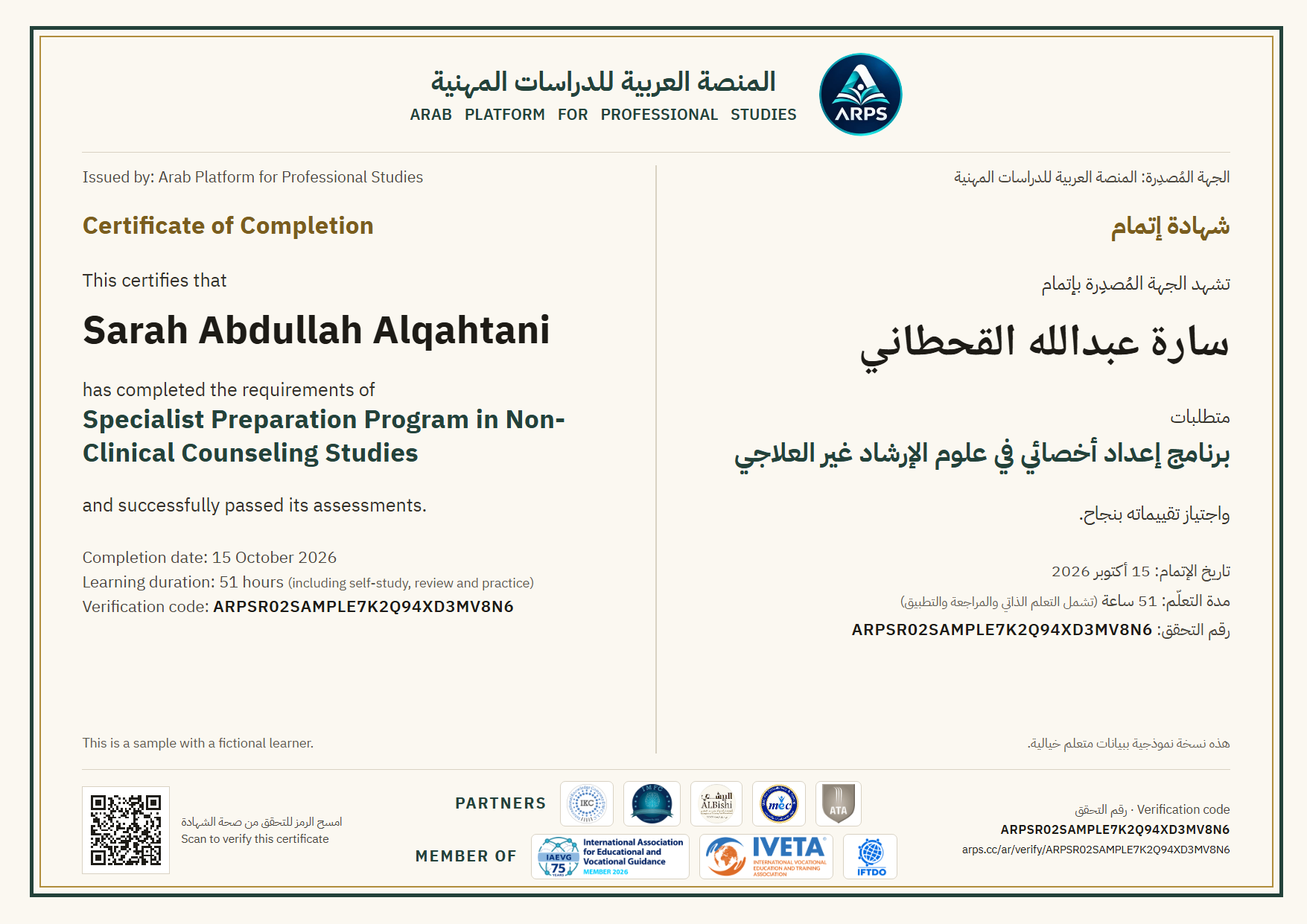
A sample from a real program in this track: Specialist Preparation Program in Non-Clinical Counseling Studies. The learner, scores and dates are fictional; opens in a new window.
No. You specify, check, and hand off a learning interaction to implementation owners rather than build an LMS or alter its permissions.
Do I need real images or customer data?
No. Fictional records and messages provide the facts needed for practice without using personal work data.
Do cited organizations endorse this program?
No. Their primary pages support limited concepts; they did not author or accredit this program.
Does a certificate authorize me to publish assets?
No. It teaches decision and referral boundaries; asset rights and publishing authority belong to institutional owners.
How do practice and assessment differ?
Practice lets you produce work and self-check against a rubric. Assessment draws original decision items from a separate bank under program policy.
Show all (8)
Does a score prove workplace improvement?
A score describes responses under assessment conditions. Transfer and operational effects require separate work evidence.
Is Specialist Preparation Program in Instructional Design and E-Learning free, and do I get a certificate?
Yes. Specialist Preparation Program in Instructional Design and E-Learning is free on ARPS: every lesson, exercise and assessment is free, the first subject is open to read without an account, and the program is available in Arabic and English. Issuing a certificate is optional and has a published fee; it is a training completion certificate showing you passed the program's assessments, recognised by most private-sector organisations in the Gulf states and most Arab countries, and it strengthens your CV; confirming that a specific organisation accepts it remains your responsibility.
What other names is Specialist Preparation Program in Instructional Design and E-Learning known by?
The subject of this program is also known as: Instructional design, E-learning design, Learning experience design, Digital course design. Learners usually find it by searching for: free instructional design course, learn instructional design online, learning needs analysis and outcome writing, how to design an e-learning course, instructional design course with completion certificate.
A practical foundation in moving from a learning problem to a coherent e-learning experience: analyze learners and context, write outcomes, align assessment and activities, structure content, select media, support accessibility, then evaluate and improve.
Practise bounded educational leadership tasks: diagnose a learning need, select a testable approach, facilitate team inquiry, allocate responsibility, and review outcomes within assigned authority.
Turn software requirements into checkable acceptance conditions and reproducible tests. Record execution and defects, then write an evidence bounded release recommendation. The program covers design, risk, accessibility, authorization, performance and automation.
10 subjects
40 lessons
53.5 hours
Free
Next step: a professional certification or a mini-master
Programs in the same domain that prepare you for an international certification exam or form a professional mini-master, also free.