Professional Mini-Master in Evidence-Based and Equitable Learning Assessment
Professional Mini-Master in Evidence-Based and Equitable Learning Assessment is a free program on ARPS, the Arab Platform for Professional Studies. An advanced program for learning assessment decisions whose evidence, limits, and fairness can be examined. Across eleven modules, learners construct an integrated assessment argument: define the skill and decision, design task and rubric, examine access and fairness, use responses to.
The learner states a bounded claim about a skill, specifies the evidence it needs, tests rival explanations, and limits the decision before selecting a tool.
From lesson 1, readable now without an account: From an assessment decision to an evidence argument
Start with the decision to be made, not with the test format. 'Measure understanding' does not say what anyone will do with the score. 'Decide who needs additional instruction in interpreting learning-progress data' identifies a use that can be evaluated. State the interpretive claim narrowly: given a short dataset, the learner can explain a change in a group rate, identify the denominator, and qualify the comparison. That is narrower than 'can analyze data'. One task cannot license a judgment about every analytic skill. Identify the decision maker and the consequences. A revisable recommendation for instruction differs from a final, high-stakes selection decision. As consequences rise, the case for diverse evidence, quality review, and fairness scrutiny becomes stronger.
A free account saves your progress and takes you straight to lesson 1.
Program facts
Study fee
Free
subjects
11
lessons
50
Estimated time
162 hours
Content last reviewed
Access period
60 days
Study language
Arabic and English
About the program
Across eleven modules, learners construct an integrated assessment argument: define the skill and decision, design task and rubric, examine access and fairness, use responses to improve learning, then pilot and govern the instrument. Lessons culminate in an applied decision dossier linking evidence to review and repair, while the integrated final tests trade-offs across all modules.
Practical relevance
Numerical exercises, appeals, and pilots lead to an executable decision dossier with explained solutions and fairness and access checks.
Why this program
A single score is often used without examining how it was produced. This program trains learners to state the claim, test alternative explanations, and match a decision's impact to evidence strength instead of hiding uncertainty behind a number.
Career relevance
Assessment designers and learning leaders can review tasks, rubrics, and results and explain their limits to decision owners.
Career paths this program serves
This program is a step on the paths of the following occupations. Open a path to see its other programs in study order.
Construct a bounded validity argument linking a learning construct to a task, evidence, and proportionate decision while comparing assessment alternatives under professional constraints.
Design a performance task and analytic rubric, testing scoring consistency and item-quality signals without extrapolating beyond the sample.
Examine fairness, access, accommodations, and outcome differences using denominators, missingness, and explicit inference limits.
Use learner-response evidence to diagnose misunderstandings, give actionable feedback, and check its uptake.
Build a decision dossier governing versions, appeals, pilots, and monitoring, and defend a decision to use or restrict a result.
Show all (7)
Evaluate assessment precision, transfer, fairness and consequences using response evidence and purpose-appropriate comparisons.
Produce an integrated assessment dossier and defend its use and limits with inspectable evidence.
Learning outcomes (7)
Construct a bounded validity argument linking a learning construct to a task, evidence, and proportionate decision while comparing assessment alternatives under professional constraints.
Design a performance task and analytic rubric, testing scoring consistency and item-quality signals without extrapolating beyond the sample.
Examine fairness, access, accommodations, and outcome differences using denominators, missingness, and explicit inference limits.
Use learner-response evidence to diagnose misunderstandings, give actionable feedback, and check its uptake.
Build a decision dossier governing versions, appeals, pilots, and monitoring, and defend a decision to use or restrict a result.
Evaluate assessment precision, transfer, fairness, and consequences using response evidence and purpose-appropriate comparisons, and justify a reviewable use decision.
Produce an integrated assessment dossier with task, rubric, access plan, and pilot protocol, and defend its use and limits with inspectable evidence.
Who it is for
This program serves experienced assessment designers, school leaders, and workplace learning leads who have designed a task, reviewed a rubric, or used results to guide support. It fits people who must explain what a score measures and where its meaning stops, review access and fairness before consequential use, and defend a decision to learners or colleagues. Academic accreditation experience is not assumed.
Prerequisites
You should be able to read a rate from a numerator and denominator, compare two rates, and express a specific observable learning outcome. The course uses these skills in short cases with supplied data; specialized analysis software is not required.
You need initial experience with a learning task, scoring rubric, or instructional support decision and a willingness to separate evidence from assumption. If you have never used a learner result, review introductory assessment principles before the advanced trade-offs in these modules.
The assessment argument: construct, evidence, and use
This module defines the skill to be inferred and the decision a result will support. The learner moves from a bounded claim to observable task evidence, builds a coverage blueprint that separates the construct from irrelevant demands, and compares assessment modes under time and access constraints. A sensitivity check tests the choice instead of treating a composite score as final. Comparing raw totals from different denominators can reverse an apparent ranking, so the learner states both bases and the inference limit. The resulting design memo names the intended evidence, a realistic alternative, and what must be checked before a consequential decision.
3 lessons · 8 hours
From an assessment decision to an evidence argument2.5 hours
Blueprinting outcomes, tasks, and evidence2.5 hours
Choosing a task portfolio under equity and resource constraints2.5 hours
Subject 2
Task and scoring architecture
This module turns an outcome into an executable and scorable task. The learner specifies response evidence, creates an analytic rubric, and examines boundary examples and rater disagreement. Small-sample item signals are read without population claims, while changes to the task and key are recorded before results are used. A rubric separates correct arithmetic from an unsupported interpretation; equal total marks can still hide disagreement on an important dimension. When an item shows an unexpected negative distinction, the team checks its key, wording, and response reasons before deleting it or retaining it. The product is a task specification another rater can apply and audit.
3 lessons · 8 hours
Writing a performance task that elicits intended evidence2.5 hours
Analytic rubrics and scorer calibration2.5 hours
Reading item and task performance before revision2.5 hours
Subject 3
Fairness and access in interpreting results
This module checks whether learners can display the intended skill through the task's language, medium, and timing. It distinguishes removal of an irrelevant barrier from assistance that changes the construct. Participation and outcome differences are read with denominators and missingness, ending in a specific fairness question and next test rather than a causal verdict from a small table. A screen-reader version should provide original numbers if rate calculation is assessed; supplying the finished percentage changes the task. Audio may show reasoning while leaving writing quality unobserved under a writing rubric. The audit records who was invited, participated, and was absent instead of treating missing work as failed learning.
3 lessons · 8 hours
Detecting construct-irrelevant demands and access barriers2.5 hours
Accommodation decisions that preserve score meaning2.5 hours
Auditing groups, denominators, and missing responses2.5 hours
Subject 4
Using evidence to improve learning
This module uses responses as evidence for instructional change. The learner designs a probe that distinguishes misconceptions, writes feedback tying evidence to a next step and uptake check, and combines signals before communicating progress. A single score or observed improvement is kept within its defensible interpretation. A raw-count choice calls for denominator practice, while correct calculation followed by an unmeasured causal claim calls for inference work; one message does not fit both. Selections, written memos, and observed discussion are read with their differing participation opportunities. A fresh transfer case checks whether feedback changed the work, allowing progress to be described through visible evidence rather than a general label.
3 lessons · 8 hours
A formative probe that reveals misconceptions and changes teaching2.5 hours
Feedback that leads to an observable revision2.5 hours
Triangulating conflicting evidence and communicating bounded conclusions2.5 hours
Subject 5
Governance, piloting, and integrated decisions
This module connects version records, access, and appeals to the decision process. The learner pilots an instrument diagnostically under advance proceed, revise, and stop rules, then builds a dossier joining outcome, task, evidence, rubric, fairness, use limits, and monitoring. Its product is an executable decision with a review and remedy route for everyone affected. If a bad key is found after multiple attempts, version and responses are preserved and all exposed attempts are reviewed, not only the appellant's. Completion, clarification requests, and rater agreement use different denominators in a pilot. The dossier names who can pause consequential use, what evidence permits restart, and how learners will hear about review.
3 lessons · 8 hours
Governing assessment records, appeals, and version changes2.5 hours
Piloting an assessment instrument and setting review triggers2.5 hours
An integrated and reviewable assessment decision dossier2.5 hours
Subject 6
Measurement precision and boundary decisions
Interpreting score differences before judgment: attempt variation, standard error near a cut score, scorer consistency and the cost of a wrong decision.
5 lessons · 15.5 hours
Variation across an individual’s attempts3 hours
Standard error near a cut score3 hours
Sampling learner work3 hours
Scorer consistency over time3 hours
The cost of a wrong decision3 hours
Subject 7
Learning transfer and task variation
Deeper evidence of transfer through near and far tasks, think-aloud evidence, balanced portfolios, collaboration and graduated prompting.
5 lessons · 15.5 hours
Near and far transfer tasks3 hours
Think aloud evidence3 hours
Building a balanced portfolio3 hours
Collaboration and individual evidence3 hours
Graduated prompting within an attempt3 hours
Subject 8
Fair comparisons across languages and settings
Fair comparison when language, context or response mode changes, including content bias, small cells and missing responses.
5 lessons · 15.5 hours
Adapting a task between languages3 hours
Content bias analysis3 hours
Differential item difficulty across groups3 hours
Comparisons with small cells3 hours
Missing responses across delivery modes3 hours
Subject 9
Progress estimation and intervention evaluation
Describing progress and evaluating interventions with linked measurements of the same participants, starting points, regression toward the mean and retention.
5 lessons · 15.5 hours
Following the same participants3 hours
Different starting points3 hours
Regression toward the mean3 hours
Comparing interventions across classes3 hours
Retention assessment3 hours
Subject 10
Institutional decisions and assessment integrity
Institutional decisions turning performance evidence into understandable judgments: performance standards, pass thresholds, AI-assisted scoring and explaining results to learners.
5 lessons · 15.5 hours
Setting a descriptive performance standard3 hours
Deliberating pass thresholds3 hours
AI assistance in scoring3 hours
Item exposure and fresh evidence3 hours
Explaining a result to the learner3 hours
Subject 11
Capstone: designing an equitable assessment
A capstone building a complete equitable assessment dossier, from decision and stakeholders to prototype, rubric, pilot and defense.
10 lessons · 31 hours
Defining the capstone decision and stakeholders3 hours
Defining the skill and inference chain3 hours
The capstone data pack3 hours
The first task prototype3 hours
The capstone rubric and anchors3 hours
The access and accommodation plan3 hours
The small pilot protocol3 hours
Analyzing the pilot results3 hours
Revision and appeal decision3 hours
Defending the final dossier3 hours
Subjects unlock in sequence as you progress.
Strengths
A traceable argument from construct to evidence and bounded decision.
Numerical cases and worked exercises showing plausible professional errors.
An integrated dossier and pilot covering fairness, access, appeals, and monitoring.
Evidence basis
Principles draw on primary testing, assessment, universal design, and feedback sources. Examples and numbers are fictional training material and do not imply accreditation or endorsement by publishers.
Reference organizations
AERA / APA / NCME
UNESCO
CAST
EEF
OECD
Frameworks used
Universal Design for Learning Guidelines — 3.0
Methodology
Assessment design links outcome, evidence, and decision while checking access and score-inference limits against scoped primary sources.
Program questions
Does this program award academic accreditation?
No. It teaches instrument design and score interpretation. Any optional completion credential follows the platform's internal policy; it is not a university degree or professional license.
What will I produce?
You build an alignment map, task, rubric, fairness analysis, pilot plan, and decision dossier specifying use, review, and pause conditions.
Do exercises require real learner data?
No. Cases and numbers are fictional. Do not put personal or confidential data into exercises; follow your organization's permissions and policies in real applications.
How does the final connect the modules?
Its integrated questions cover all seven outcomes across eleven modules. A module transcript accompanies any issued completion credential and breaks down the designated final attempt, not separate module pass tests.
Are official hours assigned?
Official hours remain unset pending route calibration. The learning-time estimate is editorial and based on required reading, practice, and assessment.
Show all (8)
Is one score enough to judge ability?
The program examines outcome, context, task, rubric, and access before using a score and limits decisions to the available evidence.
Is Professional Mini-Master in Evidence-Based and Equitable Learning Assessment free, and do I get a certificate?
Yes. Professional Mini-Master in Evidence-Based and Equitable Learning Assessment is free on ARPS: every lesson, exercise and assessment is free, the first subject is open to read without an account, and the program is available in Arabic and English. Issuing a certificate is optional and has a published fee; it is a training completion certificate showing you passed the program's assessments, recognised by most private-sector organisations in the Gulf states and most Arab countries, and it strengthens your CV; confirming that a specific organisation accepts it remains your responsibility.
What other names is Professional Mini-Master in Evidence-Based and Equitable Learning Assessment known by?
The subject of this program is also known as: learning assessment, educational assessment, assessment for learning, equitable assessment. Learners usually find it by searching for: assessment for learning examples, learning assessment tools, learning assessment strategies, assessment for learning vs assessment of learning, evidence-based assessment in education.
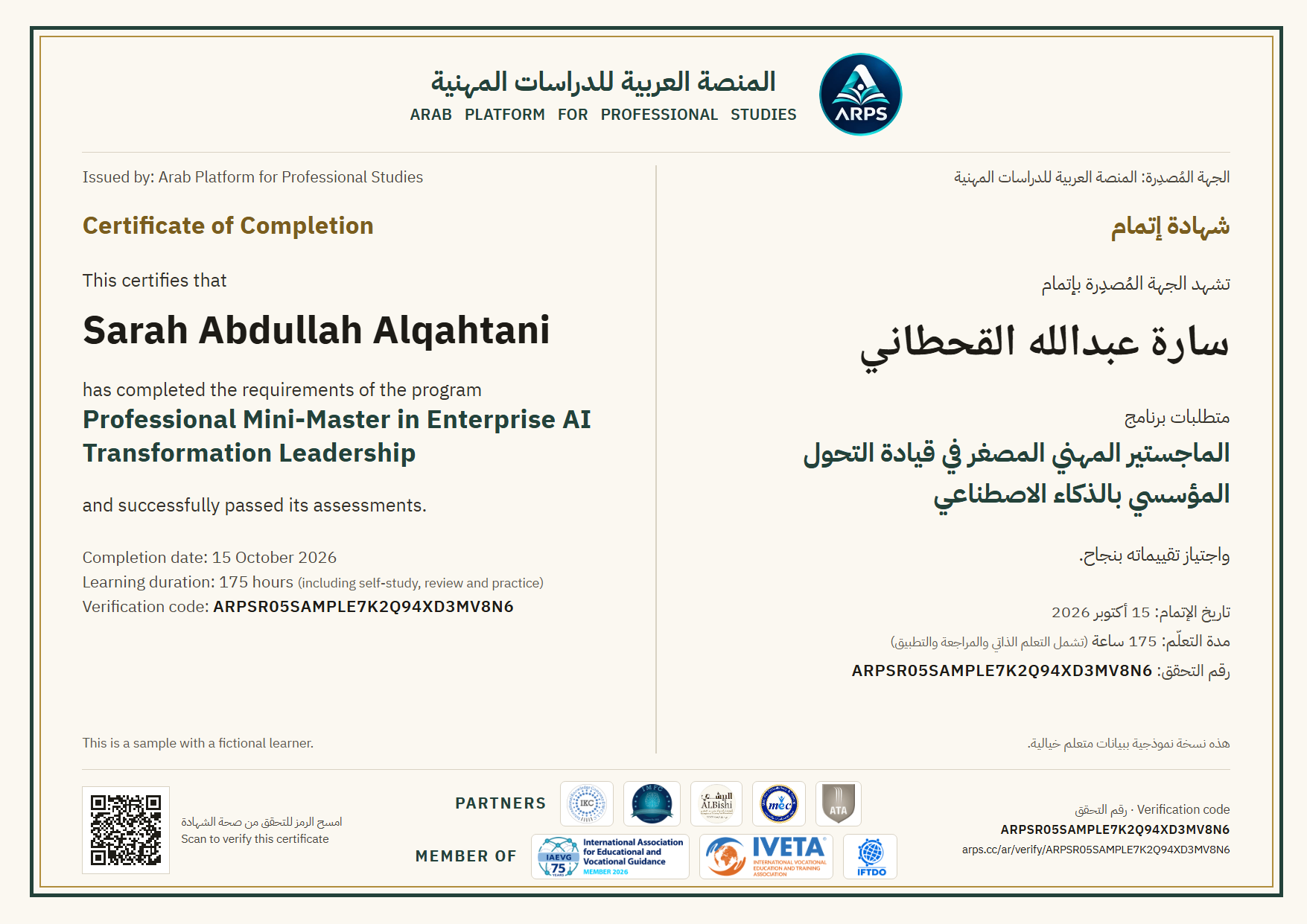
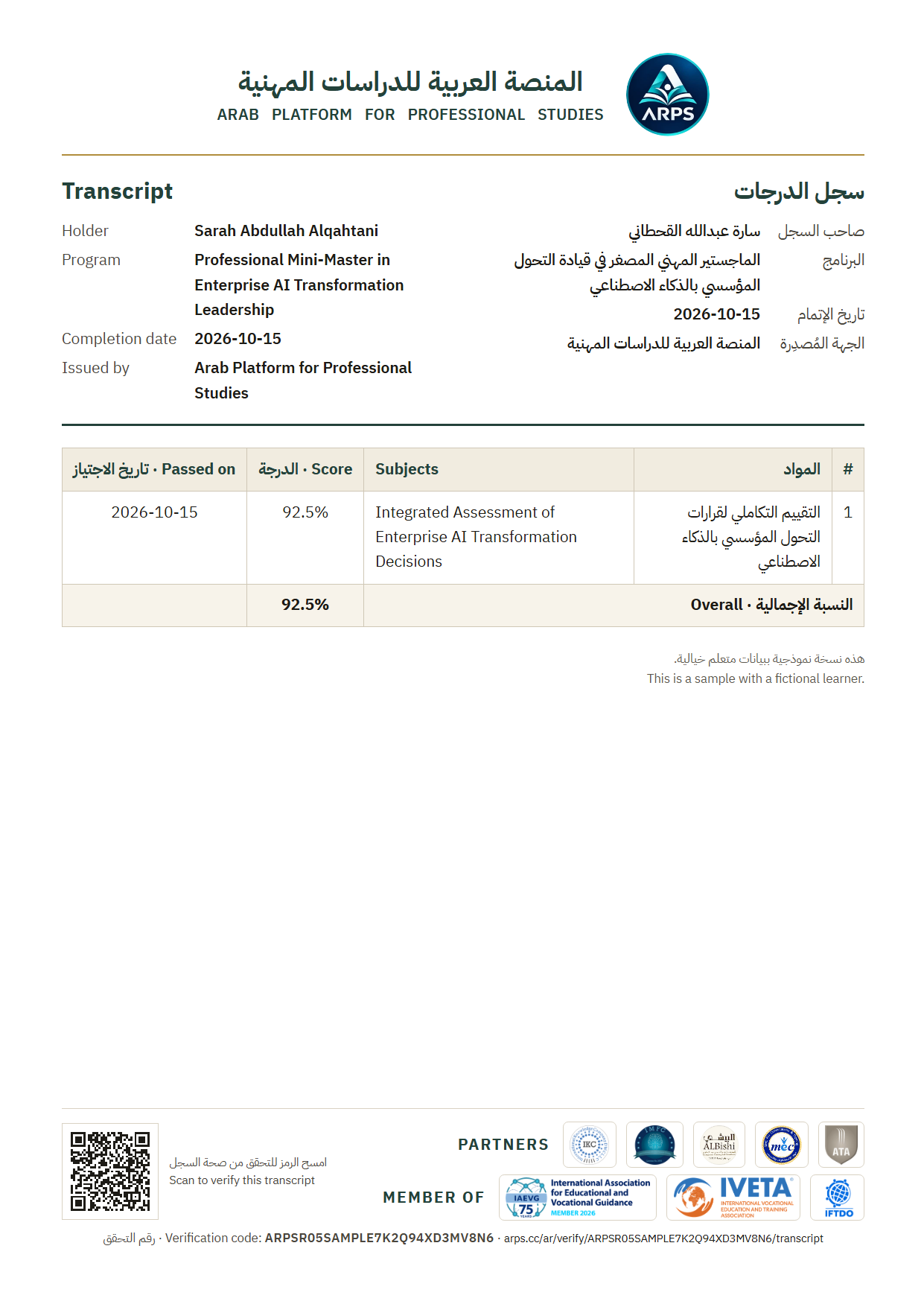
A sample from a real program in this track: Professional Mini-Master in Enterprise AI Transformation Leadership. The learner, scores and dates are fictional; opens in a new window.
Learn to diagnose a learnable performance gap, build an alignment map and storyboard for an online activity, then check access, rights, and measurement. Fictional cases produce specialist deliverables: a decision card, scenario, rubric, trial log, and handoff.
Practise bounded educational leadership tasks: diagnose a learning need, select a testable approach, facilitate team inquiry, allocate responsibility, and review outcomes within assigned authority.
An honest note: the professional mini-master is an intensive professional program; it is not an academic degree or a licence and is not equivalent to a university master's or MBA. The optional ARPS certificate is a training completion certificate showing you passed the program's assessments.