
Specialist Preparation Program in International Organizations and Global Affairs

Specialist Preparation Program in International Organizations and Global Affairs is a free program on ARPS, the Arab Platform for Professional Studies. Prepare a specialist decision file for international organizations and global affairs: map mandates, verify documents and positions, coordinate actors, assess response needs, and monitor results. Every applied task ends with an output and a clear authority boundary.

Headquarters lobby of an international body: a long row of  blank poles, delegates with folders, a semicircular assembly glimpsed through doors: cover of the ARPS program Specialist Preparation Program in International Organizations and Global Affairs Studying is completely free
Estimated time
52 hours
subjects
7
lessons
32
Study language
Arabic and English

Certificate issuance fee

$90

331 AED or 338 SAR

After you pay the certificate fee, you can print the certificate and transcript in both Arabic and English, or in English only.

Start the first subject now Fees by route

What you will learn in the first 10 minutes

The opening lessons of the first subject, with the reading time set for each. Approximate total time in minutes: 6

  1. From an organization name to a mandate map 6 min read
    • Classify an entity in the UN system, identify the source of its mandate and the decision it can support, then route a request without inferring authority from its name.

From lesson 1, readable now without an account: From an organization name to a mandate map

Begin an institutional question with the action requested, rather than the organization's name. A requester may say, ‘Send this to the United Nations.’ That does not tell us whether they seek a Member State decision, programme coordination, a legal opinion or data. Each function has a different route. Confusing them wastes time and may imply authority that does not exist. A professional routing card records five fields: the issue, the mandate holder, the source of the mandate, the expected kind of output, and the decision outside the specialist's authority. Do not fill the mandate-holder field before defining the issue and the expected output.

The UN Charter establishes six principal organs. The General Assembly is a broad forum for discussion and recommendations within its powers. The Security Council has primary responsibility for international peace and security; its decisions must be read in their own terms and legal setting. The Economic and Social Council coordinates within its field. The Secretariat performs administrative and secretariat functions. The International Court of Justice is a judicial organ under its Statute. The Trusteeship Council remains a principal organ, a classification that does not itself imply a routine operational assignment today. These are constitutional organs, not an interchangeable list of project implementers. Do not describe an Assembly recommendation as an order to a state merely because it was adopted. Equally, do not assume every Security Council text imposes the same measure. When the consequence matters, read the article, operative verb, relevant paragraph and legal context.

The UN system also includes funds, programmes, specialized agencies and other entities. UN documentation explains that funds and programmes have focused mandates and governing bodies, while specialized agencies are autonomous organizations linked to the UN by agreements. Thus ‘part of the UN family’ does not mean a common budget, identical reporting line or authority to issue a political position. In a work memo, write the entity's category and mandate source instead of relying on its logo. If the founding instrument or an official mandate page cannot be found, mark the claim ‘verification required’ rather than inventing an approval chain.

Triage a request in three layers. First classify the subject: peace and security, health, development, humanitarian operations or evidence about a position. Second identify the function: intergovernmental recommendation or decision, programme implementation, coordination, data or technical assistance. Third identify the authorized actor: organ, organization, country team or Member State. This sequence prevents a shared subject from being mistaken for a valid referral. Two entities can work on the same issue while holding different roles. Record where one mandate ends and the next referral begins instead of listing names alone.

A general ‘about’ page is not enough when the task concerns binding decisions or financial responsibility. Distinguish a charter or constitutive decision, an approved programme document, and a news item or introductory page. The first identifies authority or institutional formation; the second delimits a particular activity in time and place; the third may help locate material but cannot replace the governing instrument. Record the document symbol, date, version and language checked when available. If a mandate or plan changes, do not repeat an older training slide. This exercise does not require the specialist to issue a definitive legal interpretation. Escalate conflicting instruments or legal effect to the competent officer.

A useful mandate map is more than a decorative chart. Give each arrow a specific verb: ‘supplies data,’ ‘coordinates,’ ‘proposes,’ ‘adopts,’ ‘implements’ or ‘reviews.’ Include a Member State box when the political choice is the state's, and an operational entity box when programme follow-through is sought. Add a confidence level and a source link for each consequential claim. Finally ask: if the receiving office rejects the request, does the card explain why it was selected and identify the instrument needed for rerouting? If not, the map is not yet a work tool.

The specialist's boundary is essential. They can classify the issue, check the mandate source, propose a contact and prepare a precise referral question. They cannot announce an organization's official position, promise funding or decide judicial jurisdiction. These limits are practical: they prevent a training aid from becoming a fictitious delegation. If the evidence is incomplete, mark the request ‘pending mandate verification’ with an owner and a review date. The defensible decision is a conditional, sourced referral rather than an unsupported confident one.

Read the full lesson free
Start free

A free account saves your progress and takes you straight to lesson 1.

Program facts

Study fee
Free
subjects
7
lessons
32
Estimated time
52 hours
Content last reviewed
Access period
30 days
Study language
Arabic and English

About the program

The programme first distinguishes UN principal organs from funds, programmes and specialized agencies and asks which actor can perform a precise action under which instrument. You then retrieve official texts and compare drafts, adopted decisions, meeting records and votes without inventing a state's motive or a decision's effect. Applied units develop a stakeholder map, a coordination meeting with a decision log, and a proportionate information-sharing route. You examine the Humanitarian Programme Cycle, balancing severity, service gap and safe access, and separate urgent response from a longer development question. The fifth unit builds a results chain, defined indicators and a two-option brief showing what may be authorized now and what requires evidence or another decision owner. Two further units add specialist work files, from clause versions and bounded negotiation positions to cost allocation, inclusive listening and evaluation commissioning, and a capstone mobile-service pilot. Training cases are fictional and do not represent an organization's or state's official position. The programme grants no professional licence or authority to represent an international body and promises no job or funding. Its activities can be completed from supplied inputs without an external account or organizational data.

Practical relevance

Mandate cards, document logs, actor maps and indicator sheets support internal briefs and multi-actor initiative reviews. Learners practise presenting conditional choices and missing information so that a manager or colleague can review the reasoning under the policy of the organization where they work.

Why this program

A specialist must connect document wording to the authorized actor and feasible action, not merely know institutional names. The programme trains checks of mandate, source, denominator and escalation before a partnership, funding or impact claim is made.

Career paths this program serves

This program is a step on the paths of the following occupations. Open a path to see its other programs in study order.

What you will learn

  • Map institutional mandate and decision limits
  • Trace document, position and vote with status and version
  • Coordinate actors and data through an accountable action log
  • Separate urgent humanitarian need from development planning
  • Build indicators and an escalated decision brief
Show all (7)
  • Prepare specialist work files: compare language versions and amendment history, draft a bounded negotiation position, allocate costs, design an inclusive needs sample and listening session, revise referrals and commission an evaluation
  • Run a mobile-service pilot in a capstone, from dossier audit and pilot negotiation to results review and a continue-or-close handover
Learning outcomes (32)
  1. Classify an entity in the UN system, identify the source of its mandate and the decision it can support, then route a request without inferring authority from its name.
  2. Build a routing matrix that connects function, mandate instrument, authorized actor and escalation information.
  3. Distinguish the type and status of a UN document and extract a supported claim without converting a proposal or statement into an adopted decision.
  4. Compare regional peaceful settlement with enforcement action and draft a referral path without inventing authorization.
  5. Build a UN Digital Library query and record symbol, version, locator and check date.
  6. Link a voting record to a specific resolution and bound the inference to its subject, text and date.
  7. Weigh different forms of evidence of a state's position and distinguish agreement, conflict and non-comparability.
  8. Turn mixed evidence into a decision note separating facts, inferences, gaps and next action.
  9. Build an influence, mandate and interest map for a multi-actor intervention, selecting who is consulted and who decides.
  10. Design an authority-aware agenda and decision record linking actions to owners, dates and completion evidence.
  11. Identify minimum information for coordination, the referral path and decisions requiring separate authorization.
  12. Trade off different institutional demands and propose a staged plan with responsibilities and agreement indicators without claiming consensus.
  13. Sequence six humanitarian-cycle steps and link each to an input, output and correction decision.
  14. Balance severity, scale, access and confidence to justify a bounded priority and review possible exclusion.
  15. Design an accessible feedback route separating service comments from sensitive reports and recording response without exposing identities.
  16. Distinguish an urgent response decision from a development cooperation contribution and design a referral interface that respects both mandates.
  17. Build an input–activity–output–outcome chain and specify an indicator with baseline, denominator, source and limits.
  18. Select two of the six OECD DAC criteria for a defined evaluation question and explain limits of comparison.
  19. Reconcile differing indicator definitions and sources and propose a review decision without erasing the original record.
  20. Integrate mandate, documents, coordination, need and indicators into one conditional recommendation with escalation and handover.
  21. Compare language versions before quoting a clause using a worked professional file and a bounded decision.
  22. Reconstruct a clause amendment history using a worked professional file and a bounded decision.
  23. Prepare a bounded negotiation position using a worked professional file and a bounded decision.
  24. Allocate joint activity costs transparently using a worked professional file and a bounded decision.
  25. Choose a needs sample that reveals exclusions using a worked professional file and a bounded decision.
  26. Design an accessible listening session using a worked professional file and a bounded decision.
  27. Revise referrals when access is disrupted using a worked professional file and a bounded decision.
  28. Commission an evaluation for a decision using a worked professional file and a bounded decision.
  29. Capstone: audit a mobile-service dossier using a worked professional file and a bounded decision.
  30. Capstone: negotiate a bounded pilot using a worked professional file and a bounded decision.
  31. Capstone: review pilot results and complaints using a worked professional file and a bounded decision.
  32. Capstone: hand over a continue-or-close decision using a worked professional file and a bounded decision.

Who it is for

  • Programme, research and partnership officers in government and civil society who prepare briefs or review work across institutions and need to separate documented facts from interpretation before proposing an action.
  • It suits coordination and technical-support staff with initial experience reading reports and tables. It does not suit those seeking diplomatic delegation, a legal opinion, an external professional credential or instruction for hazardous field operations.

Prerequisites

  • Read short reports and numerical tables, and distinguish observations from inferences. The first unit teaches the required institutional categories; no previous international-law course is assumed.
  • Write a brief note, compare versions of an official text, and calculate a ratio with a defined denominator. No paid account, sensitive workplace data or state-representation experience is required; exercises provide fictional inputs.

Curriculum

  1. Subject 1 Open for free

    Mandates and institutional architecture

    Begin an organization map with the requested action and mandate source, not its logo. Distinguish the UN's principal organs from funds, programmes and specialized agencies, then label each relationship with a precise verb: decides, coordinates, implements or supplies data. Check document status before attributing a decision to a body; draft, meeting record and adopted text are different evidence. Finally compare regional peaceful settlement with enforcement action requiring scrutiny of Security Council authorization and scope. The applied cases produce a referral card, mandate matrix, document ledger and decision tree. Record what remains unknown and ask the proper authority for the governing instrument instead of promising funding, approval or a measure in an organization's name.

    4 lessons · 3.5 hours
    1. From an organization name to a mandate map 52 min
    2. Route a request through mandate and governance 50 min
    3. Resolution, draft and record: what can a document establish? 50 min
    4. Regional arrangements and the limits of Security Council referral 50 min
  2. Subject 2

    Document intelligence and positions

    This module turns global-affairs research into a route another reviewer can repeat. Define an answerable question, body, period and document type; search by symbol and alternative terms, then inspect version and clause in the official source. Link a vote to a specific resolution text rather than reducing a state's whole policy to an abstention or news story. Compare a statement, letter, meeting record and vote in a claim–source matrix, testing whether apparent differences reflect changed wording or dates. Finish with a dated decision brief that separates facts, inferences, gaps and next action. Its uncertainty register distinguishes blockers from manageable follow-up. Failure to find a document in one search does not prove that no document exists.

    4 lessons · 3 hours
    1. Retrieve an official document with a reproducible search plan 48 min
    2. Read a vote without reducing a state's position to it 48 min
    3. Analyze a position across statement, letter and vote 48 min
    4. A dated evidence brief with an uncertainty register 48 min
  3. Subject 3

    Multilateral coordination and partnerships

    Move from an actor list to coordination with accountable roles. For each stakeholder record mandate, stated interest, resource, decision power and the risk of exclusion, including people affected by an activity. Design a meeting that distinguishes information, discussion and decisions, minutes that do not turn a promise to review into approval, and an action log with owners, dates and closure proof. Draw an information flow that sends the smallest justified amount for a defined purpose, separating aggregate counts from individual referral. When funder, implementer and community priorities differ, compare feasible options and a staged plan, recording objections rather than inventing consensus. The resulting map, responsibility matrix, record and plan let each actor see the exact limit of its commitment.

    4 lessons · 3 hours
    1. Map stakeholders by function, not prominence 48 min
    2. A coordination meeting that produces a decision log 48 min
    3. Information sharing and referral within authority limits 48 min
    4. Conflicting priorities and a joint workplan 48 min
  4. Subject 4

    Humanitarian response and development

    Read the Humanitarian Programme Cycle as connected decisions: needs analysis, planning, resources, implementation, monitoring, and evaluation and reporting that feed learning back into the cycle. Prioritize by severity, scale, service gap and safe access, showing evidence confidence and keeping unknown distinct from zero. Design an accessible complaint route that separates a service-hours comment from an abuse report requiring a specialist confidential path. Then write a two-column interface note: immediate action within response authority and a longer development question requiring data and a current country instrument. Exercises produce a cycle card, priority assessment, accountability matrix and referral interface. One site report does not become a city estimate or a promise of permanent investment.

    4 lessons · 3 hours
    1. The Humanitarian Programme Cycle as a chain of decisions 48 min
    2. From needs evidence to response priority 50 min
    3. Accountability to affected people and a safe complaint pathway 48 min
    4. Connect humanitarian response with development planning 48 min
  5. Subject 5

    Monitoring, evaluation and decision

    The final module turns activity into a results chain and indicators with numerators, denominators, baselines, sources and interpretation limits. Seat places and visits are neither unique people nor impacts. Choose OECD DAC evaluation questions for a specific decision, distinguishing relevance from coherence, effectiveness from impact, and efficiency from mere cheapness. When dashboards disagree, check units, cutoff periods and completion definitions before announcing improvement. Finally integrate mandate, document status, need, resources and accountability in a two-option brief: a bounded inquiry that can be authorized today, and delivery held until named owners close its blockers with evidence. Hand over the version, decision log and claim limits so a colleague can continue without inventing organizational consent or unmeasured results.

    4 lessons · 4 hours
    1. A results chain and an indicator with a defined meaning 50 min
    2. Development evaluation criteria as practical questions 48 min
    3. When monitoring data disagree: correct rather than rationalize 48 min
    4. An integrated decision brief and auditable handover 1.5 hours
  6. Subject 6

    Specialist global-affairs work files

    This unit develops specialist work files connecting international document analysis with defined professional tasks. Compare language versions of a clause, reconstruct its amendment history and prepare negotiation options that distinguish discussion from authorized commitment. Allocate joint activity costs, identify duplicated resources and examine people missing from a needs sample. Design an accessible listening session, revise referrals when access fails and commission an evaluation for a specific decision. Self-contained fictional cases support two practical outputs per lesson with separate feedback. Legal, safety, spending and disclosure authority remains with its owners while the specialist produces understandable options, assumptions and evidence limits.

    8 lessons · 16.5 hours
    1. Compare language versions before quoting a clause 2 hours
    2. Reconstruct a clause amendment history 2 hours
    3. Prepare a bounded negotiation position 2 hours
    4. Allocate joint activity costs transparently 2 hours
    5. Choose a needs sample that reveals exclusions 2 hours
    6. Design an accessible listening session 2 hours
    7. Revise referrals when access is disrupted 2 hours
    8. Commission an evaluation for a decision 2 hours
  7. Subject 7

    Capstone: a mobile-service pilot

    The capstone integrates skills through a fictional mobile information and referral pilot. Index a mixed dossier, reconcile person counts and connect claims to evidence, then negotiate a trial matching periods, resources and access. Review conversations, people, comprehension and nonresponse while keeping service feedback separate from sensitive reports. Finish with limited continuation or orderly closure, open-case ownership and scoped handover. Four artifact-producing exercises in each lesson have distinct feedback explaining calculations, choices and boundaries. Learning concerns reasoning and usable outputs within the case; its results remain fictional. The sequence shows how user obligations continue when resources change or a pilot ends and why sending a file alone does not demonstrate completed service.

    4 lessons · 15 hours
    1. Capstone: audit a mobile-service dossier 3.5 hours
    2. Capstone: negotiate a bounded pilot 3.5 hours
    3. Capstone: review pilot results and complaints 3.5 hours
    4. Capstone: hand over a continue-or-close decision 3.5 hours

Subjects unlock in sequence as you progress.

Strengths

  • Mandate map linking each request to actor, instrument and decision owner
  • Bilingual cases with observable outputs, complete solutions and limits
  • Integrated brief connecting source, need, option and escalation

Evidence basis

Concepts draw on the Charter, UN Library guides, OCHA guidance, the development cooperation framework, the Core Humanitarian Standard and OECD evaluation criteria. Changing instruments need verification in actual use. Named-place teaching cases are fictional and imply no organizational participation.

Methodology

The method joins mandate mapping, document research, coordination, needs analysis and decision indicators with explicit authority limits.

Assessment

Assessments follow the program blueprint and may use module assessments, a final assessment, or a combination, under the approved attempt policy.

Assessment attempts: 2 per assessment, 7 days apart

The pass mark is announced before the program is published.

Certificate

The credential confirms completion and successful assessment; it does not represent professional licensure unless explicitly and lawfully stated.

Every certificate has a public verification code. Verify a certificate

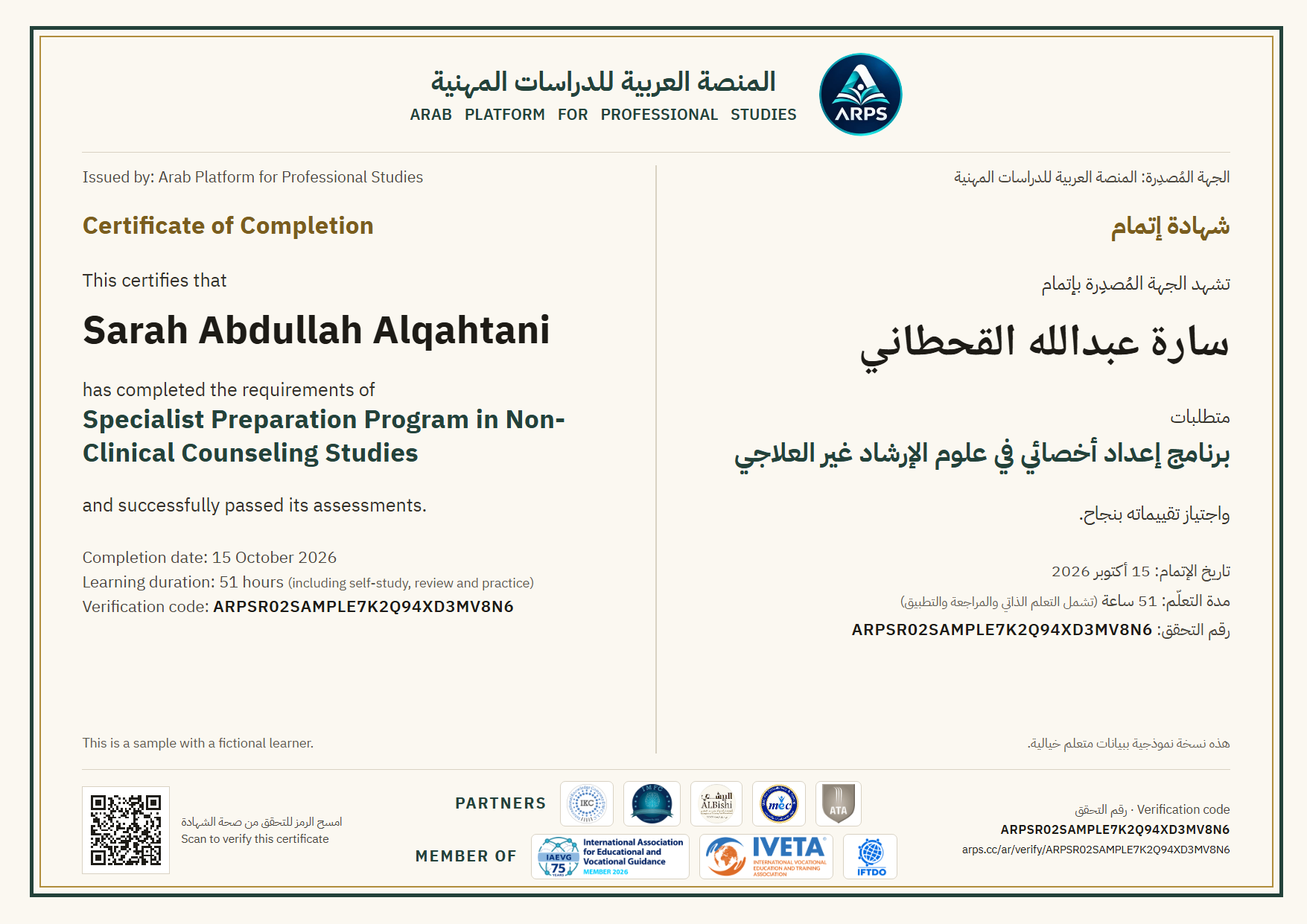
A sample from a real program in this track: Specialist Preparation Program in Non-Clinical Counseling Studies. The learner, scores and dates are fictional; opens in a new window.

Verification example: a real issued certificate

Program questions

Does this authorize me to represent an international organization?

No. It teaches decision support and referral within your organization's permissions, not external delegation or accreditation.

Do I need real workplace data?

No. Every case can be solved from its fictional inputs. Any use of workplace information follows your organization's permissions and rules.

Does it teach a particular country's law?

No. It addresses the Charter and general sources with inference boundaries; local or disputed legal questions go to qualified counsel.

How do I verify a changing UN document?

Use its symbol, version, clause and official record at a stated cutoff. Do not transfer a draft conclusion to an adopted text.

Must I buy software or a service?

No. Reading, tables and decision notes use supplied training materials; any external tool is optional and subject to workplace policy.

Show all (8)
How is progress assessed?

Each unit has formative checking and a summative assessment under central platform policy. A training attempt does not claim field-performance validation.

Is Specialist Preparation Program in International Organizations and Global Affairs free, and do I get a certificate?

Yes. Specialist Preparation Program in International Organizations and Global Affairs is free on ARPS: every lesson, exercise and assessment is free, the first subject is open to read without an account, and the program is available in Arabic and English. Issuing a certificate is optional and has a published fee; it is a training completion certificate showing you passed the program's assessments, recognised by most private-sector organisations in the Gulf states and most Arab countries, and it strengthens your CV; confirming that a specific organisation accepts it remains your responsibility.

What other names is Specialist Preparation Program in International Organizations and Global Affairs known by?

The subject of this program is also known as: international organizations, global affairs, international relations, global governance. Learners usually find it by searching for: international organizations course, international organizations jobs, global affairs jobs, international organizations list, international relations course free.

Professionals in this domain

Connect with certified consultants, trainers, coaches and specialists in the same domain across the ARPS communities.