Specialist Preparation Program in Customer Experience and Customer Service
Specialist Preparation Program in Customer Experience and Customer Service is a free program on ARPS, the Arab Platform for Professional Studies. Learn to receive, triage and document customer cases, communicate their state, and improve a bounded point of friction within specialist authority.
Write a service promise with a trigger, deadline and controllable outcome.
From lesson 1, readable now without an account: Distinguishing experience, interactions and support
A customer writes, “You answered quickly, but I had to explain the problem three times and I still do not know whether the charge was cancelled.” The system may report a good response time and a closed ticket, yet the customer has no clear outcome. A customer experience specialist begins by choosing the unit of observation. Are we examining one reply, a service case, a journey to complete a task, or the customer's accumulated view of the relationship? Calling all four “the experience” and editing only the reply may leave the source of effort untouched.
An interaction is one contact, such as a call or message. A case is a request with an opening, a status and an expected outcome; it can span several interactions. A journey is the sequence through which someone pursues a goal, such as asking about a charge, disputing it and seeing the adjustment on a statement. Experience includes what the customer perceives across that sequence and earlier context; a single ticket cannot establish all of it. Customer service is the operational function that receives questions or problems and follows resolution. It shapes experience, but other things shape it too. A reply may be courteous while a payment screen fails, or a screen may work well while an agent lacks authority to resolve a problem.
Separate four layers when recording a customer's account. First are checkable facts: time, channel, case number, request, team response and transaction state. Second is the customer's reported experience, kept in their words or an accurate summary: “I explained it three times.” Third are possible causes, such as the second channel failing to display the first channel's record; do not promote this to fact until the handoff is checked. Fourth are the effect and the request: does the customer need information, correction, an apology or a decision outside the specialist's authority? This separation prevents a fast response to the visible frustration while the underlying case is lost.
Choose the level of intervention from the evidence. If the reply is unclear but the case record is complete, revise the message and confirm what the customer needs. If information disappears between two channels, inspect the case handoff. If a policy or interface imposes an extra step on many customers, bring a documented pattern to the process owner rather than promising an individual policy change. If money or an entitlement is disputed, inspect the record and the authorization boundary before promising a remedy. A specialist cannot declare a root cause or compensation from one account, but can specify the necessary check and keep the case from falling between teams.
A free account saves your progress and takes you straight to lesson 1.
Program facts
Study fee
Free
subjects
8
lessons
34
Estimated time
58.5 hours
Content last reviewed
Access period
30 days
Study language
Arabic and English
About the program
The program begins by distinguishing an interaction from a case and a journey and by writing a checkable service promise. It then practices complaint intake, evidence checking, honest progress updates and escalation of remedies outside the specialist’s authority.
You map a bounded journey and backstage process, inspect cross-channel information transfer and run a small improvement with a measure and guardrail. You collect feedback with a fair sample, define response and resolution measures, interpret conflicting signals and test whether customers can use a help route.
The fifth unit analyzes recurring complaints, hands off a monitorable improvement, builds a knowledge answer and reviews service quality through an integrated case. Three further units add practical user research, service operations in difficult situations and an integrated returns-improvement project. Exercises use fictional data and need no workplace records. This prepares defined specialist tasks; it grants no professional license or endorsement by cited organizations.
Practical relevance
Use case, promise, journey and metric cards to improve request and complaint follow-up in an authorized workplace. Fictional examples do not claim measured business gains or remedy authority.
Why this program
A fast reply can hide an unresolved case or a journey that makes customers repeat themselves. The program connects communication with evidence, authority and outcome checks so promises and improvements are operational.
Career paths this program serves
This program is a step on the paths of the following occupations. Open a path to see its other programs in study order.
Distinguish experience levels, make a checkable service promise, and triage by effect, urgency and authority.
Build an evidenced complaint record, communicate an accurate state, and escalate an unauthorized remedy while tracking execution.
Map a bounded service journey and backstage process, test channel handoffs, and run a small guarded improvement.
Collect fair feedback, calculate defined service metrics, interpret conflicting signals, and test channel accessibility.
Test complaint causes, hand off an improvement and usable article, calibrate quality, and handle an integrated case.
Show all (8)
Use interviews, comment coding and task tests to locate customer effort before choosing a repair.
Handle difficult service situations: queues and capacity, widespread outages, de-escalation and governed automated answers.
Carry out an integrated returns-improvement project from scope to test, decision and handoff.
Learning outcomes (8)
Distinguish experience levels, make a checkable service promise, and triage by effect, urgency and authority.
Build an evidenced complaint record, communicate an accurate state, and escalate an unauthorized remedy while tracking execution.
Map a bounded service journey and backstage process, test channel handoffs, and run a small guarded improvement.
Collect fair feedback, calculate defined service metrics, interpret conflicting signals, and test channel accessibility.
Test complaint causes, hand off an improvement and usable article, calibrate quality, and handle an integrated case.
Apply practical research and user needs with practical outputs and explicit evidence limits.
Apply service operations in difficult situations with practical outputs and explicit evidence limits.
Apply integrated returns improvement project with practical outputs and explicit evidence limits.
Who it is for
Practitioners in service and customer experience teams who need defined specialist tasks
People in roles connected to requests, complaints and service journey improvement
Contact center agents, technical support staff and service supervisors who want to resolve complaints with evidence and improve journeys within their authority.
Quality coordinators and process owners who need to measure service performance and read the voice of the customer without overclaiming.
Prerequisites
Ability to read simple service records, calculate basic percentages and write a short case summary.
Comfort using simple spreadsheets to sort cases and calculate averages and rates, and reading a complaint to separate facts from opinions.
Willingness to apply the exercises to synthetic or authorized service cases only, and to set aside about ten and a half hours for learning and assessment within the 30-day access window.
Customer experience foundations and role boundaries
Read experience at interaction, case and journey levels; turn service promises and triage choices into evidence-based actions.
3 lessons · 2.5 hours
Distinguishing experience, interactions and support50 min
Writing an operational service promise50 min
Triage and prioritization58 min
Subject 2
Service execution and complaint handling
Record complaints with fact and hypothesis separated, send accurate updates and escalate remedies beyond authority while tracking execution.
3 lessons · 3 hours
Intake and fact verification54 min
Communication, expectations and follow-up54 min
Complaint resolution and escalation1 hours
Subject 3
Journey mapping and friction removal
Map a bounded journey, inspect channel handoffs, test a small change with guardrails and trace backstage dependencies.
4 lessons · 4 hours
Mapping a bounded journey56 min
Analyzing channel handoffs54 min
Running a small improvement test54 min
Service blueprint and backstage dependencies1 hours
Subject 4
Voice of customer and performance measurement
Collect fair feedback, calculate explicitly defined service measures, interpret mixed signals and test support-channel accessibility.
4 lessons · 4 hours
Designing fair feedback collection58 min
Defining and calculating service metrics58 min
Interpreting signals without overclaiming58 min
Making service channels accessible and testable1 hours
Subject 5
Improvement and operational governance
Test competing causes in complaint clusters, hand off a checkable improvement, maintain usable knowledge, calibrate service review and integrate the work.
5 lessons · 4.5 hours
Analyzing causes from case records50 min
Handing off a monitorable improvement50 min
Building a usable knowledge answer50 min
Calibrating service quality review50 min
Integrated case and quality review1 hours
Subject 6
Practical research and user needs
This unit uses research to locate effort before choosing a repair: interviews that uncover effort, comment coding, task tests without coaching and segmentation by need.
4 lessons · 7.5 hours
Interviewing to uncover effort2 hours
Coding comments into stable categories2 hours
Testing a task without coaching2 hours
Segmenting by need rather than stereotype2 hours
Subject 7
Service operations in difficult situations
This unit applies operational decisions beyond individual replies: reading queues and capacity, outage communication, respectful de-escalation, digital-use support, option costs and governing automated assistant answers.
6 lessons · 11.5 hours
Reading queues and estimating capacity2 hours
Communicating a widespread outage2 hours
De-escalating with respect2 hours
Supporting digital use without taking over2 hours
Comparing service option costs2 hours
Governing automated assistant answers2 hours
Subject 8
Integrated returns improvement project
An integrated returns-improvement project covering scope and sample, evidence reconciliation, a message test, results and decision, then handoff and recommendation.
5 lessons · 18 hours
Returns project: scope and case sample3.5 hours
Returns project: reconciling evidence3.5 hours
Returns project: test and messages3.5 hours
Returns project: results and decision3.5 hours
Returns project: handoff and recommendation3.5 hours
Subjects unlock in sequence as you progress.
Strengths
Case records separating customer report, fact and hypothesis
Service promises and metrics with explicit events and denominators
Bounded improvements with harm guardrails and outcome checks
Evidence basis
Public ISO abstracts, the CXPA framework, product documentation and official accessibility guidance are used only within their stated scope. Cases and solutions are original and fictional; citation does not imply endorsement.
Methodology
A fast reply can hide an unresolved case or a journey that makes customers repeat themselves. The program connects communication with evidence, authority and outcome checks so promises and improvements are operational.
Assessment
Assessments follow the program blueprint and may use module assessments, a final assessment, or a combination, under the approved attempt policy.
Assessment attempts: 2 per assessment, 7 days apart
The pass mark is announced before the program is published.
Certificate
The credential confirms completion and successful assessment; it does not represent professional licensure unless explicitly and lawfully stated.
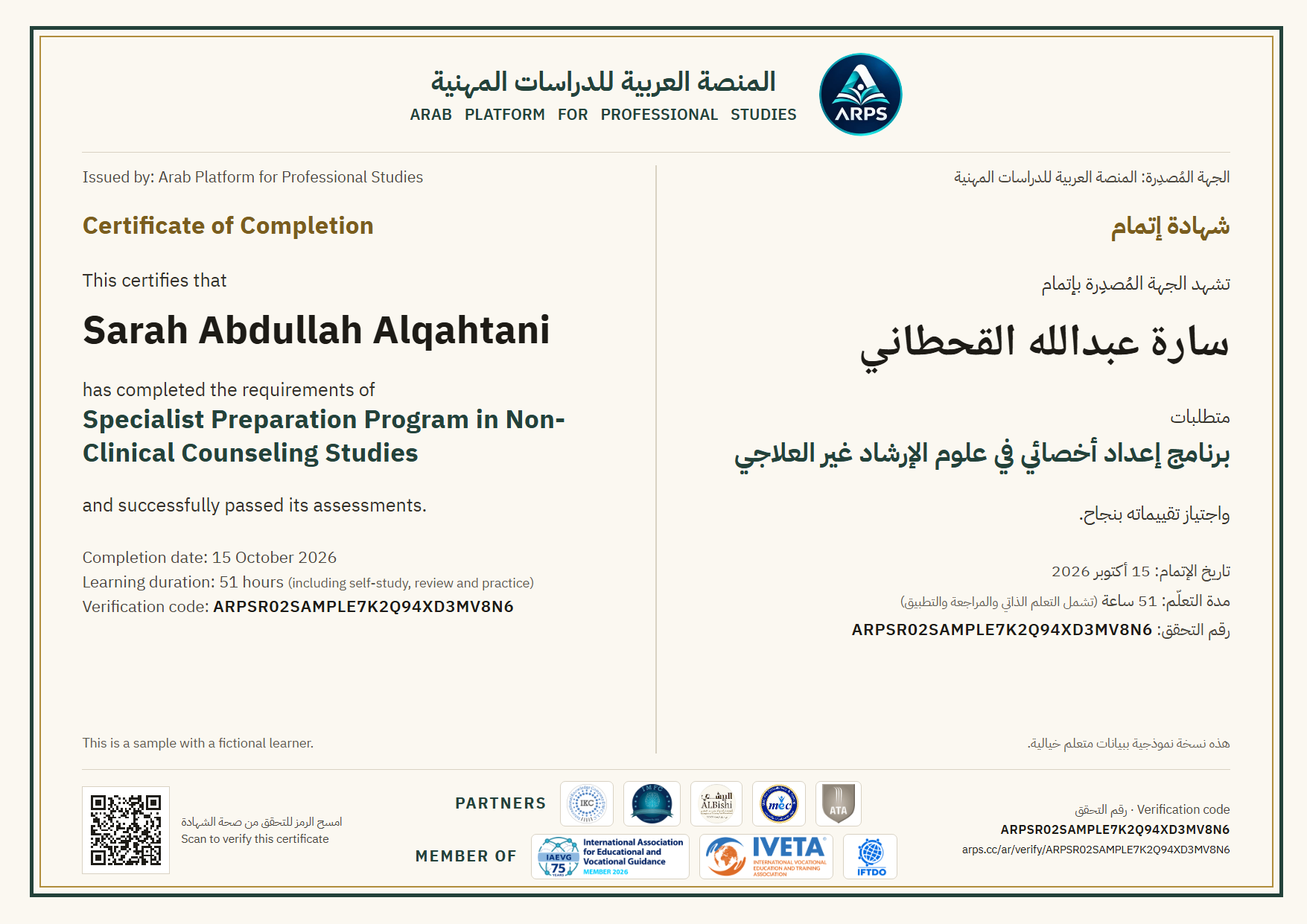
A sample from a real program in this track: Specialist Preparation Program in Non-Clinical Counseling Studies. The learner, scores and dates are fictional; opens in a new window.
Basic service experience helps, but lessons explain needed terms and provide complete fictional cases.
Do I need real workplace data?
No. Exercises use fictional cases; workplace use requires authorization and appropriate privacy and access controls.
Does this give me authority to refund fees or change policy?
No. You prepare evidence, escalation and follow-up; remedy and policy authority stays with the organization’s designated owners.
How are skills assessed?
Each lesson has a self-check and each module has a sampled automated case question. These choices assess decisions in supplied facts, not live-system performance.
Do citations mean external endorsement?
No. Public pages and specific documentation support bounded concepts; the program claims no ISO, CXPA or vendor endorsement.
Show all (7)
Is Specialist Preparation Program in Customer Experience and Customer Service free, and do I get a certificate?
Yes. Specialist Preparation Program in Customer Experience and Customer Service is free on ARPS: every lesson, exercise and assessment is free, the first subject is open to read without an account, and the program is available in Arabic and English. Issuing a certificate is optional and has a published fee; it is a training completion certificate showing you passed the program's assessments, recognised by most private-sector organisations in the Gulf states and most Arab countries, and it strengthens your CV; confirming that a specific organisation accepts it remains your responsibility.
What other names is Specialist Preparation Program in Customer Experience and Customer Service known by?
The subject of this program is also known as: customer experience, CX, customer service, customer care. Learners usually find it by searching for: free customer service course, learn customer experience online, handling customer complaints, customer service skills training, customer service course with completion certificate.
A foundational diploma that connects customer experience and customer service from journey and expectation understanding through service design, complaints, measurement and continuous improvement.
Learn to plan, execute and measure a digital campaign from business outcome to optimization decision. Build a segment, journey, message and channel plan, then execute search, content, email and landing pages before checking tracking, economics and experiments.
Learn specialist brand-management and positioning tasks: define a purchase occasion and segment, choose a comparative frame and supportable difference, govern brand cues and messages, then activate, measure and maintain the promise. Fictional cases use bounded counts and lead to reviewable working tools.
7 subjects
30 lessons
53.5 hours
Free
Next step: a professional certification or a mini-master
Programs in the same domain that prepare you for an international certification exam or form a professional mini-master, also free.