
Specialist Preparation Program in Brand Management and Positioning

Specialist Preparation Program in Brand Management and Positioning is a free program on ARPS, the Arab Platform for Professional Studies. Learn specialist brand-management and positioning tasks: define a purchase occasion and segment, choose a comparative frame and supportable difference, govern brand cues and messages, then activate, measure and maintain the promise.

Packaging design table: several paper product boxes in a row, one elevated on a pedestal under a  amber glow, a designer figurine: cover of the ARPS program Specialist Preparation Program in Brand Management and Positioning Studying is completely free
Estimated time
53.5 hours
subjects
7
lessons
30
Study language
Arabic and English

Certificate issuance fee

$90

331 AED or 338 SAR

After you pay the certificate fee, you can print the certificate and transcript in both Arabic and English, or in English only.

Start the first subject now Fees by route

What you will learn in the first 10 minutes

The opening lessons of the first subject, with the reading time set for each. Approximate total time in minutes: 6

  1. Define the purchase category and use occasion 6 min read
    • Define the category, alternatives, purchase occasion and decision unit, then mark what the evidence does not establish.

From lesson 1, readable now without an account: Define the purchase category and use occasion

A brand team may ask, 'How are we different?' before deciding what buyers actually compare. The result can be an attractive feature that never enters the purchase decision. A category here is more than a retailer's shelf label: it is the set of options a person considers to solve a need in a particular situation. A reusable lunch container may compete with another container, and sometimes with buying a prepared meal if the underlying need is getting lunch to work. The product description alone cannot settle the category boundary. Specify the situation, need and plausible options, then test them with appropriate people or behavior data. Do not call every imaginable option a proven competitor.

Start a four-field occasion card. First, who experiences the need, and who pays or approves if that is another person? Second, what event triggers the need, such as preparing for a long shift or forgetting lunch? Third, which options are actually available at that moment, including doing nothing? Fourth, what is the entry condition for comparison, such as leak resistance or ease of washing? An entry condition allows consideration; it is not automatically a superior benefit. Do not write an advertising promise yet. You are setting the comparison on which a later promise will rest.

Separate a direct alternative that performs the function in a similar way from an indirect alternative that solves the underlying need differently. This is a working distinction, not a judgment about every buyer's intent. Another container is a direct alternative. A prepared meal may be an indirect alternative when the occasion is 'I did not pack lunch.' A delivery service that does not reach this workplace, however, is not an available alternative for this occasion even though it belongs to food services. Ask whether this person could choose the option now and whether it reasonably solves the same need. A yes requires evidence about the person, timing and availability; it does not follow from an industry label.

After listing alternatives, write a testable category-boundary hypothesis: 'When packing lunch for work, employees who bring food from home compare leak-resistant containers with purpose-made food bags.' The sentence names the population, occasion and included alternatives. It remains a working hypothesis until observed behavior or suitable research supports it. In short interviews, first ask what participants did in the last relevant occasion, then what they considered. An open question before showing a brand list reduces the risk that the researcher's options shape the answer. Five interviews are not a market share estimate. Record the count, recruitment method and date, and separate reported behavior from your interpretation.

The decision unit can contain several people. A student may use a container while a parent selects and pays for it. In an organization, a purchasing officer may specify the product while staff use it. A change in decision maker changes the evidence needed. User complaints about washing matter, but procurement approval may depend on a purchasing specification and invoice. Do not assume that the person who clicks an advertisement signs the purchase. Put each role on the card, then choose research and messages appropriate to that role.

Challenge the boundary with two contrary cases. A person buying a container for leftovers at home may need a different size; they may be in the wider product market but outside the work-lunch occasion selected here. A person who buys lunch every day and never brings food from home may not compare containers now, although they could become a later audience if evidence shows that packing barriers can be resolved. Do not broaden the category to include everyone merely to inflate the audience, or narrow it until an option that actually diverts purchases disappears. Keep an 'in / out / unresolved' register with a reason for each case and a specific question for unresolved cases.

The professional output is a category-and-occasion card, not a market share report. Pass it to the research and positioning colleagues with the category definition, alternatives, decision roles and open assumptions. They should check boundary consistency: Did we include an option unavailable in this occasion? Exclude one that solves the same need? Describe a small convenience sample as broad evidence? These checks prevent a positioning statement from resting on the wrong competitive frame. The American Marketing Association describes a brand and positioning relative to competitors; the particular boundary tool taught here is a case-based execution aid, not an official rule for every market.

Read the full lesson free
Start free

A free account saves your progress and takes you straight to lesson 1.

Program facts

Study fee
Free
subjects
7
lessons
30
Estimated time
53.5 hours
Content last reviewed
Access period
30 days
Study language
Arabic and English

About the program

The program begins with what buyers actually compare when they need an offer. Build an occasion card, segment choice and evidence ledger, then select a positioning frame, parity conditions and a difference the product can deliver and support. Draft an internal positioning statement and claim ladder that keep hypotheses from becoming guarantees. Next, test brand cues, organize messages across channels, decide how a new offer relates to its parent brand and set approval rules for assets. Turn the position into a channel brief and experience map, review a creative piece and plan a bounded launch experiment. Finally, interpret tracker metrics with their denominators and update the brand register when evidence or operations change. Case data are fictional training material. Outputs are decision cards and reference solutions. This program grants no professional license or trademark-rights opinion and claims no unmeasured commercial outcome.

Practical relevance

Adapt the category and segment cards, claim ledger, asset guide, channel brief and tracker within an authorized marketing or product team. Learn to spot a promise operations cannot deliver, percentages with unlike denominators and a cue whose recognition has not been established, then specify a repair rather than a vague critique.

Why this program

A brand line can sound convincing while targeting the wrong buyer, category or proof. This program connects positioning decisions to tasks a specialist can execute, check and hand over within clear authority limits.

Career paths this program serves

This program is a step on the paths of the following occupations. Open a path to see its other programs in study order.

What you will learn

  • Define a purchase occasion and segment, audit alternatives evidence, and write a testable insight without generalizing a small sample.
  • Choose a comparison frame, parity conditions and a supportable difference, then draft a bounded position and claim ladder.
  • Inventory and test brand cues, organize messages and naming relationships, and govern asset use within rights boundaries.
  • Turn positioning into a channel brief, experience check, creative review and bounded launch test with a decision rule.
  • Define brand metrics and denominators, interpret movement cautiously, maintain positioning records and deliver a coherent integrated handoff.
Show all (7)
  • Design bounded applied research, offer tradeoff tests and equivalent bilingual service messages.
  • Deliver a linked meal-pickup brand project with evidence, channel prototype, recovery, launch experiment and product-change control.
Learning outcomes (7)
  1. Define a purchase occasion and segment, audit alternatives evidence, and write a testable insight without generalizing a small sample.
  2. Choose a comparison frame, parity conditions and a supportable difference, then draft a bounded position and claim ladder.
  3. Inventory and test brand cues, organize messages and naming relationships, and govern asset use within rights boundaries.
  4. Turn positioning into a channel brief, experience check, creative review and bounded launch test with a decision rule.
  5. Define brand metrics and denominators, interpret movement cautiously, maintain positioning records and deliver a coherent integrated handoff.
  6. Design bounded applied research, offer tradeoff tests and equivalent bilingual service messages.
  7. Deliver a linked meal-pickup brand project with evidence, channel prototype, recovery, launch experiment and product-change control.

Who it is for

  • For people in marketing, product management, customer research and communications who help prepare a brand or campaign brief and want to execute specialist tools themselves. It suits readers of a simple table and working copy, even without previous brand leadership. It is not for those seeking legal clearance of a trade name, professional licensing or a full organization-wide strategic consulting mandate; those decisions belong to authorized specialists and owners.

Prerequisites

  • Learners need a basic understanding of products, customers and alternatives, plus the ability to read simple fractions and percentages and distinguish an observation from an inference. Ordinary writing and spreadsheet tools are enough; cases supply their own numbers and do not require purchasing research services or real organizational data. Campaign brief familiarity helps but is optional. Category, segment and denominator are explained when first used.

Curriculum

  1. Subject 1 Open for free

    Category, buyer, and evidence

    Start from an actual choice occasion rather than a broad demographic label.

    4 lessons · 2.5 hours
    1. Define the purchase category and use occasion 28 min
    2. Select a serviceable audience segment 36 min
    3. Audit market evidence and competitor claims 36 min
    4. Write a testable positioning insight 36 min
  2. Subject 2

    Position design and proof

    Use the selected group's evidence to choose the category in which buyers compare the offer.

    4 lessons · 2.5 hours
    1. Choose a competitive frame and points of parity 36 min
    2. Select a meaningful and supportable difference 36 min
    3. Draft and stress-test a positioning statement 36 min
    4. Build a claim-to-proof ladder 38 min
  3. Subject 3

    Distinctive assets and the brand system

    Move from brand meaning to the cues that help people identify the source of an offer.

    4 lessons · 2.5 hours
    1. Inventory and test distinctive brand cues 36 min
    2. Turn positioning into a message hierarchy 38 min
    3. Choose an offer's naming relationship to its parent brand 36 min
    4. Write an asset-use brief and approval controls 32 min
  4. Subject 4

    Activation and experience

    Bring positioning to the place where a customer takes action.

    4 lessons · 2.5 hours
    1. Turn the position into a channel brief 36 min
    2. Check customer experience against the promise 36 min
    3. Review creative work against positioning 36 min
    4. Plan a bounded launch experiment 36 min
  5. Subject 5

    Measurement and maintenance

    Close by measuring awareness, consideration and use separately, with a stable question, denominator and period for each metric.

    4 lessons · 4.5 hours
    1. Specify brand-tracker questions and denominators 34 min
    2. Interpret tracker movement without false causality 36 min
    3. Maintain the position and brand-asset register 36 min
    4. Assemble and audit an integrated brand handoff 2.5 hours
  6. Subject 6

    Applied research and offer tradeoffs

    Work on the decisions that precede a brand message. Screen people for relevant recent experience, then separate observed behavior from explanations. Build a codebook for pickup barriers and use contrary cases rather than discard them. Test timing and price tradeoffs with otherwise comparable cards. Read the complete basket price separately from time and effort. Finally test booking and readiness meaning across two languages through the action each reader expects. Produce a research invitation, observation record, offer comparison and meaning map. Use these to select a useful next learning step without generalizing a small sample or treating simulated choice as a market purchase forecast.

    5 lessons · 18.5 hours
    1. Recruit and screen positioning research participants 3.5 hours
    2. Observe choice and code purchase barriers 3.5 hours
    3. Test offer tradeoffs without leading questions 3.5 hours
    4. Read price and total buyer cost 3.5 hours
    5. Test meaning across two service languages 3.5 hours
  7. Subject 7

    Capstone: a meal pickup service brand

    Build one connected brand project for a fictional meal-pickup service. Index buyer, rival, operations, package and rights evidence, then divide the promise into claims to release or hold. Prototype the pickup point while distinguishing cue recognition, service understanding and finding the counter. Write a delay response that respects employee authority and tells the customer what happens next. Design a bounded launch governed by capacity and a predeclared measurement rule. Finish with a handoff linking claims to evidence, placement and owner, then handle a changed lid while retaining valid work. The output is a reviewable training project with worked responses, criteria and an explicit plan for later authorized live execution.

    5 lessons · 18.5 hours
    1. Build a pickup-promise evidence dossier 3.5 hours
    2. Prototype name and cues at the pickup point 3.5 hours
    3. Write service recovery after a broken promise 3.5 hours
    4. Design a launch test with capacity constraints 3.5 hours
    5. Deliver the project and handle a late change 3.5 hours

Subjects unlock in sequence as you progress.

Strengths

  • Decision cards link positioning to purchase occasion and proof
  • Practice tests claims against product and service delivery
  • An integrated handoff connects messages and cues to channels and measures

Evidence basis

Specific concepts draw on the listed professional and research sources within their stated limits. Cities, cases and numbers are fictional training scenarios, not local statistics or endorsements by source organizations. The original working aids need adaptation and verification before use in a real organization.

Methodology

Apply brand decisions to worked cases with explicit evidence limits.

Assessment

Assessments follow the program blueprint and may use module assessments, a final assessment, or a combination, under the approved attempt policy.

Assessment attempts: 2 per assessment, 7 days apart

The pass mark is announced before the program is published.

Certificate

The credential confirms completion and successful assessment; it does not represent professional licensure unless explicitly and lawfully stated.

Every certificate has a public verification code. Verify a certificate

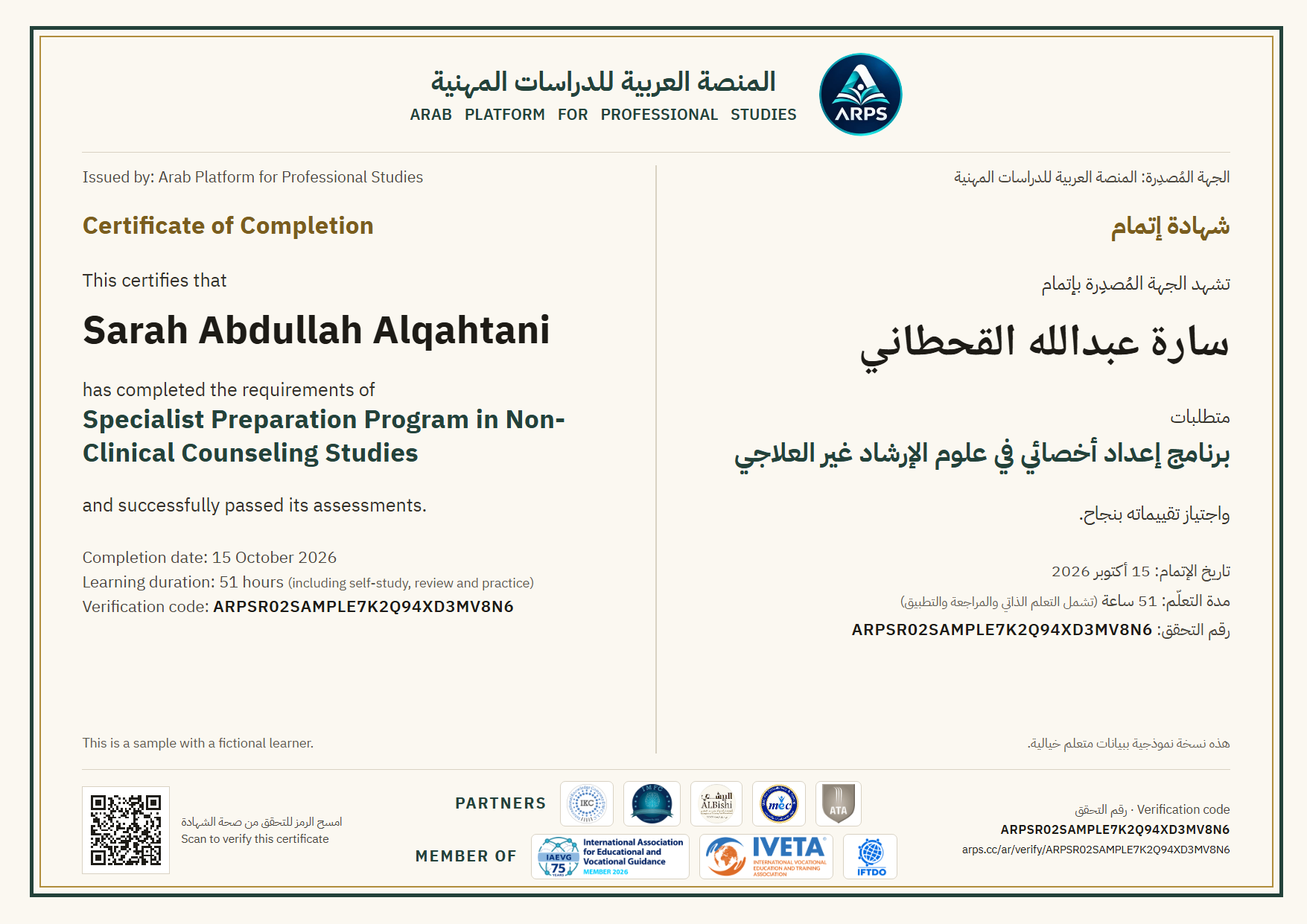
A sample from a real program in this track: Specialist Preparation Program in Non-Clinical Counseling Studies. The learner, scores and dates are fictional; opens in a new window.

Verification example: a real issued certificate

Program questions

What is the first practical output?

Start with a decision table naming the need occasion, alternatives and evidence limits; use it to choose a group before writing a positioning statement.

Do I need my company's data?

No. All required cases and numbers are fictional and supplied in the lessons. Use authorized data and your organization's policy when adapting tools to real work.

Does this program clear a trademark?

No. It teaches asset inventory and referral of rights questions. Buyer recognition of a name or cue does not establish permission to use or register it in a market.

Will a tracker prove my campaign worked?

It teaches stable questions, denominators and comparability checks. A metric moving after a campaign does not by itself establish cause without a suitable research design.

How do exercises differ from assessments?

Exercises are self-check practice with inputs and reference criteria, not credential scores. Each module assessment draws four applied questions from its bank under route policy.

Show all (8)
Is prior brand leadership required?

No. Readers of a basic brief and table can learn specialist tools. Budget approval, legal decisions and organization-wide consulting remain with authorized owners.

Is Specialist Preparation Program in Brand Management and Positioning free, and do I get a certificate?

Yes. Specialist Preparation Program in Brand Management and Positioning is free on ARPS: every lesson, exercise and assessment is free, the first subject is open to read without an account, and the program is available in Arabic and English. Issuing a certificate is optional and has a published fee; it is a training completion certificate showing you passed the program's assessments, recognised by most private-sector organisations in the Gulf states and most Arab countries, and it strengthens your CV; confirming that a specific organisation accepts it remains your responsibility.

What other names is Specialist Preparation Program in Brand Management and Positioning known by?

The subject of this program is also known as: brand management, branding, brand positioning. Learners usually find it by searching for: brand management course, brand positioning strategy, how to become a brand manager, free branding course.

Professionals in this domain

Connect with certified consultants, trainers, coaches and specialists in the same domain across the ARPS communities.