Professional Mini-Master in Data-Driven Digital Growth and Marketing Strategy
Professional Mini-Master in Data-Driven Digital Growth and Marketing Strategy is a free program on ARPS, the Arab Platform for Professional Studies. Build digital growth decisions from paid demand and retention, not click counts alone. The program combines five advanced foundational modules and five extension modules across fifty lessons.
Choose a value and guardrail metric that distinguishes customer and business outcomes from traffic volume.
From lesson 1, readable now without an account: Growth value and decision metrics
When a marketing team says growth reached 30%, first ask what grew. Visits or opened accounts may rise while orders with a positive contribution margin fall. Growth that can guide investment is an increase in a defined form of customer value after costs and delayed effects are considered. Start with the value model before selecting a dashboard. For a subscription business, management may need the contribution of a customer cohort after service and acquisition costs, rather than registrations alone. For a marketplace connecting buyers and sellers, counting one side is insufficient: buyer numbers can rise while sellers cannot fulfill demand. State the unit of the decision explicitly: a new customer, a completed order, or a cohort that joined in a given month. Fixing that unit makes comparisons across channels and periods interpretable.
A free account saves your progress and takes you straight to lesson 1.
Program facts
Study fee
Free
subjects
10
lessons
50
Estimated time
160 hours
Content last reviewed
Access period
60 days
Study language
Arabic and English
About the program
The program combines five advanced foundational modules and five extension modules across fifty lessons. Growth economics, measurement, demand, conversion, retention and integrated decisions lead into customer evidence, data reliability, offer design, lifecycle experiments and causal designs under constraints. A capstone develops a fictional subscription-company dossier into contribution and cash models, experiments, retention planning and a conditional funding portfolio. Original cases, examples and exercises include distinct feedback and Arabic questions with English twins. You distinguish observed outcomes, incremental effects and planning assumptions, and determine when evidence supports a tranche, repair or further observation. Workplace uploads are unnecessary, and source publishers do not externally accredit the program.
Practical relevance
Use authorized, de-identified work data if available, or complete every exercise from the built-in fictional cases. You will draft a metric contract, experiment hypothesis, cohort value comparison and a budget recommendation with a review date and loss boundary.
Why this program
Visits and registrations can rise while customer value falls after discounts and refunds. This program connects diagnosis, measurement, experiments and finance so an early proxy does not become a final spending decision. It shows when data or service repair should come before buying another audience, and what evidence supports scaling or waiting.
Career relevance
Designed for growth, digital marketing, product and analytics managers with relevant foundational experience. It develops professional judgment and communication with finance and product teams, without promising employment, income, professional licensure or a university degree.
Career paths this program serves
This program is a step on the paths of the following occupations. Open a path to see its other programs in study order.
Build a value and measurement model fit for a growth decision
Allocate demand channels using incremental contribution and real margin
Design a causal experiment and interpret its effect and limitations
Choose retention interventions from cohort economics and value
Integrate evidence into a staged investment plan with monitoring
Show all (10)
Build marketing decision evidence from neutral surveys and reconciled account and transaction data with explicit uncertainty.
Evaluate prices, bundles and incentives by contribution, capacity and cannibalization and choose suitable staged funding.
Evaluate lifecycle interventions using correct age-based denominators, incremental response, contribution and contact guardrails.
Select causal designs for geographic, timing, interaction and spillover constraints, explaining assumptions and precision limits.
Build and defend a responsible growth investment portfolio using reconciled evidence, contribution modeling, experiments, retention planning and stress review.
Learning outcomes (10)
Build a value and measurement model fit for a growth decision
Allocate demand channels using incremental contribution and real margin
Design a causal experiment and interpret its effect and limitations
Choose retention interventions from cohort economics and value
Integrate evidence into a staged investment plan with monitoring
Build marketing decision evidence from neutral surveys and reconciled account and transaction data with explicit uncertainty.
Evaluate prices, bundles and incentives by contribution, capacity and cannibalization and choose suitable staged funding.
Evaluate lifecycle interventions using correct age-based denominators, incremental response, contribution and contact guardrails.
Select causal designs for geographic, timing, interaction and spillover constraints, explaining assumptions and precision limits.
Build and defend a responsible growth investment portfolio using reconciled evidence, contribution modeling, experiments, retention planning and stress review.
Who it is for
Growth, digital marketing, product and analytics managers with related experience
Digital marketing, growth and performance managers who want to link marketing spend to real, measurable value.
Founders of digital ventures, marketing analysts and product managers who make acquisition, conversion and retention decisions and need causal evidence rather than traffic volume indicators.
Prerequisites
Ability to calculate basic rates and contribution margin and read a channel table
Initial experience with customer journeys, campaigns or site analytics
Willingness to use only synthetic or authorized data and to respect user consent and privacy in every exercise involving tracking or marketing messages.
Build a value and measurement model fit for a growth decision
4 lessons · 4.5 hours
Growth value and decision metrics1 hours
Unit economics and cohort quality1 hours
Event contract and measurement identity1 hours
Consent and data quality1 hours
Subject 2
Demand and acquisition portfolio
Allocate demand channels using incremental contribution and real margin
4 lessons · 5 hours
Segment research and demand opportunity1 hours
Organic discovery and search intent1 hours
Paid acquisition and bidding constraints1 hours
Attribution versus incremental channel impact1 hours
Subject 3
Conversion and causal experimentation
Design a causal experiment and interpret its effect and limitations
4 lessons · 5 hours
Journey leakage diagnosis1 hours
Experiment design and estimand1 hours
Reading effect and uncertainty1 hours
Offer and page experience1 hours
Subject 4
Retention and lifetime value
Choose retention interventions from cohort economics and value
4 lessons · 5 hours
Retention cohorts and time to event1.5 hours
Lifecycle timing and messaging1.5 hours
Lifetime value under margin and uncertainty1 hours
Churn intervention and win-back1 hours
Subject 5
Integrated decisions and governance
Integrate evidence into a staged investment plan with monitoring
4 lessons · 5 hours
Growth forecasting with scenarios1 hours
Constrained budget allocation1 hours
Executive dashboard and decision rights1 hours
Integrated responsible growth case1.5 hours
Subject 6
Customer evidence and data reliability
Build marketing decision evidence from neutral surveys and reconciled account and transaction data with explicit uncertainty.
6 lessons · 23.5 hours
Separating barriers from polite survey answers4 hours
Merging accounts without inflating customer value4 hours
Late data and decision-time reconstruction4 hours
Testing instrumentation readiness before launch4 hours
Reconciling search, survey and billing evidence4 hours
Value of information and further measurement4 hours
Subject 7
Offer design and profitable expansion
Evaluate prices, bundles and incentives by contribution, capacity and cannibalization and choose suitable staged funding.
6 lessons · 23.5 hours
Price tests when buyer volume changes4 hours
Bundles and product cannibalization4 hours
Free-shipping thresholds and basket size4 hours
Referral incentives and sustainable rewards4 hours
Two-sided marketplace balance during campaigns4 hours
Staged funding for a channel with setup cost4 hours
Subject 8
Advanced lifecycle decision experiments
Evaluate lifecycle interventions using correct age-based denominators, incremental response, contribution and contact guardrails.
6 lessons · 23.5 hours
First value and activation survivor bias4 hours
Churn hazard by subscription age4 hours
Resurrection after lapse and cohort boundaries4 hours
Account expansion and recurring revenue contraction4 hours
Targeting customers helped by intervention4 hours
Message fatigue and long-run contact effects4 hours
Subject 9
Causal designs under practical constraints
Select causal designs for geographic, timing, interaction and spillover constraints, explaining assumptions and precision limits.
6 lessons · 23.5 hours
Geo experiments when user assignment is unavailable4 hours
Difference-in-differences and before-after limits4 hours
Reducing experiment variance with preperiod data4 hours
Message-price interaction in four groups4 hours
Experiment portfolios and multiple metrics4 hours
Treatment spillovers and network effects4 hours
Subject 10
Responsible growth investment capstone
Build and defend a responsible growth investment portfolio using reconciled evidence, contribution modeling, experiments, retention planning and stress review.
6 lessons · 34.5 hours
Turning a company dossier into a funding question5.5 hours
Building an auditable contribution model5.5 hours
Designing experiments that separate alternatives5.5 hours
Retention plan with service and privacy constraints6 hours
Assembling a budget portfolio under stress5.5 hours
Defending and updating the investment recommendation6 hours
Subjects unlock in sequence as you progress.
Strengths
Cohort and margin calculations linking acquisition to customer value
Causal experiments that separate measurement failure from behavior change
An integrated capstone with budget, capacity and monitoring decisions
Evidence basis
Definitions of measurement, search, advertising and journey tools draw on primary publisher documentation. Limits on p-value interpretation draw on the American Statistical Association statement. Case figures are explicitly educational assumptions; the cited organizations do not accredit this program.
Reference organizations
Google
Microsoft Research
American Statistical Association
Methodology
Definitions of measurement, search, advertising and journey tools draw on primary publisher documentation. Limits on p-value interpretation draw on the American Statistical Association statement. Case figures are explicitly educational assumptions; the cited organizations do not accredit this program.
Program questions
Do I need to code?
The lessons do not require programming. They assume basic comfort with rates, tables and campaigns, and explain event and experiment examples so you can review their meaning with an analytics team.
How do the modules connect?
The first five modules establish decision foundations; modules six through nine deepen evidence, offers, lifecycle and causal design. Module ten integrates their outputs into a funding capstone, building on valid previous work rather than rewriting it.
What do the cases and exercises involve?
Each lesson includes explanation and a fictional numerical application with a solution or check criteria. Exercises compare cohort margins, design tests, reconcile purchase events and choose interventions.
How does the final assessment work?
The integrated assessment covers all fifty lessons through topic quotas and uses questions separate from practice. Attempt results follow the platform’s internal assessment policy; questions do not represent invented learner grades or external accreditation.
Is the credential externally accredited?
The optional internal completion credential follows central platform settings. It is neither a university degree nor accreditation by Google, Microsoft or a statistical body. Learner results follow transcript policy and never contain invented grades.
Show all (8)
Must I upload workplace data?
No. The included fictional cases are sufficient. For workplace application, use authorized, de-identified data, respect privacy choices and do not upload customer records or secrets to unapproved tools.
Is Professional Mini-Master in Data-Driven Digital Growth and Marketing Strategy free, and do I get a certificate?
Yes. Professional Mini-Master in Data-Driven Digital Growth and Marketing Strategy is free on ARPS: every lesson, exercise and assessment is free, the first subject is open to read without an account, and the program is available in Arabic and English. Issuing a certificate is optional and has a published fee; it is a training completion certificate showing you passed the program's assessments, recognised by most private-sector organisations in the Gulf states and most Arab countries, and it strengthens your CV; confirming that a specific organisation accepts it remains your responsibility.
What other names is Professional Mini-Master in Data-Driven Digital Growth and Marketing Strategy known by?
The subject of this program is also known as: data-driven marketing, growth marketing, digital growth strategy. Learners usually find it by searching for: data-driven marketing course, learn digital growth strategy, free growth marketing program, customer retention analytics, online program with completion certificate.
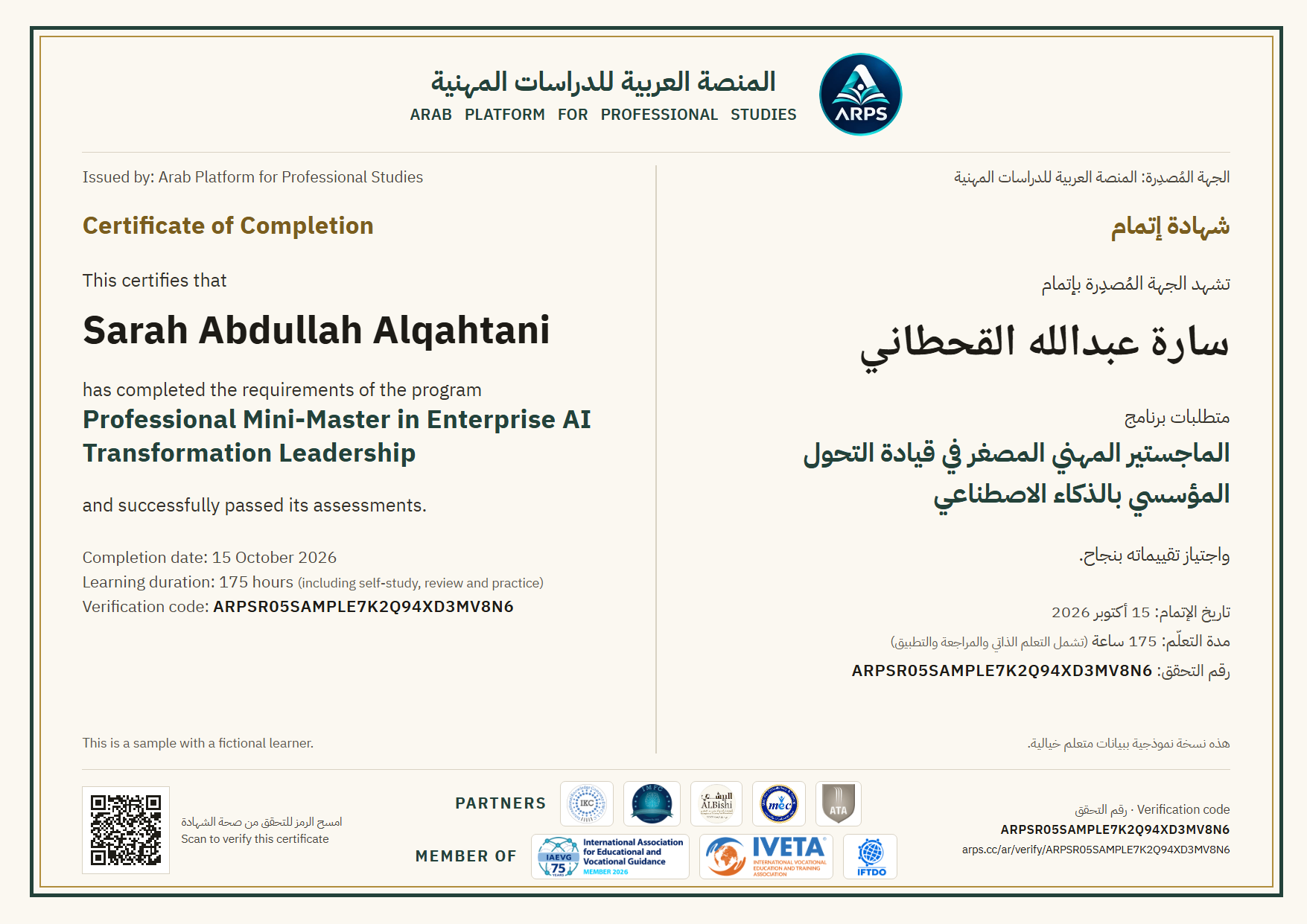
A sample from a real program in this track: Professional Mini-Master in Enterprise AI Transformation Leadership. The learner, scores and dates are fictional; opens in a new window.
Learn to plan, execute and measure a digital campaign from business outcome to optimization decision. Build a segment, journey, message and channel plan, then execute search, content, email and landing pages before checking tracking, economics and experiments.
An honest note: the professional mini-master is an intensive professional program; it is not an academic degree or a licence and is not equivalent to a university master's or MBA. The optional ARPS certificate is a training completion certificate showing you passed the program's assessments.