Specialist Preparation Program in Business Development and Commercial Growth
Specialist Preparation Program in Business Development and Commercial Growth is a free program on ARPS, the Arab Platform for Professional Studies. An applied specialist program in opportunity discovery, commercial offers, deal progression and growth measurement with explicit evidence and authority limits.
Scope a commercial opportunity and decision rights: execute the named specialist task with a checked output.
From lesson 1, readable now without an account: Scope a commercial opportunity and decision rights
A business development team receives three signals in one week. An existing customer asks whether the service can cover other branches. A distributor requests a price list. A salesperson notices more visits to an old product page. All three might be called “growth opportunities,” yet they mean different things. The first is a request from a known customer. The second is an untested claim about a partner's reach. The third is traffic that may reflect curiosity rather than buying intent. A specialist turns each signal into a small, checkable discovery decision. The specialist does not announce a new market or promise revenue on the strength of these signals.
An opportunity is a specific hypothesis about a reachable customer, a problem that matters to that customer, and a viable way for the organization to address it. A signal starts the hypothesis; it does not confirm it. When a customer says, “We need this for our branches,” ask how many branches, whether the same problem exists at each one, who approves the purchase, when the need arises, and whether the current service covers the differences among sites. Answers can support an early estimate or test. A request for price is not acceptance of that price: the buyer might only be comparing suppliers.
Before entering an opportunity in a shared record, distinguish an observation, an interpretation, an authorized action, and a decision requiring approval. Observation: “The operations manager asked twice this month about activating three branches.” Interpretation: “There may be expansion demand in the account.” A permitted specialist action might be to conduct a short discovery call and document requirements and likely service costs. A special price commitment, altered contract term, or use of delivery capacity outside the plan belongs to whoever holds that authority. Actual decision rights vary by organization; use the team's written policy rather than assuming a universal rule.
A useful opportunity card needs a small set of precise fields. Record the segment and account, the reason for interest in the person's own words, the alternative currently used, the potential cost of the problem, evidence and date for each assertion, untested assumptions, the next step and its owner, and a threshold for continuing or stopping. State the scope: are we expanding within existing branches, entering a new city, or changing the product? Mixing those paths corrupts market and delivery cost estimates. The “cost of the problem” should capture delay or waste described by the customer, rather than an invented sales figure.
A free account saves your progress and takes you straight to lesson 1.
Program facts
Study fee
Free
subjects
7
lessons
34
Estimated time
54.5 hours
Content last reviewed
Access period
30 days
Study language
Arabic and English
About the program
The program begins by converting market signals into testable hypotheses, then choosing a segment the organization can reach and serve. Learners practice problem interviews and bottom-up sizing while comparing opportunity with delivery capacity.
The second stage connects the value proposition to the customer job and deal economics. It tests channels and messages without conflating attribution with incremental impact. Learners then map pipeline stages, buying stakeholders, proposals and partnerships.
The third stage separates weighted forecasts from commitments, measures acquisition and retention, and reviews growth choices under limited resources. Later units cover operating data and sales capacity, links between growth, customer experience and cash, and an integrated market-entry capstone. Cases are fictional teaching devices and do not promise financial outcomes or contract authority.
Practical relevance
Opportunity records, segment and channel comparisons, buyer maps and cohort metrics can support recommendations to accountable owners. Pricing, contracts and product commitments remain with authorized decision makers.
Why this program
The program connects opportunity discovery, commercial execution and measurement in reviewable specialist decisions. Each module includes solved cases and practice with assumptions and limits.
Career paths this program serves
This program is a step on the paths of the following occupations. Open a path to see its other programs in study order.
The module connects four distinct specialist tasks with evidence, authority limits and applied decisions.
4 lessons · 3 hours
Scope a commercial opportunity and decision rights42 min
Segment and select a serviceable market42 min
Interview customers and map alternatives42 min
Size an opportunity without false precision42 min
Subject 2
Offer economics and routes to market
The module connects four distinct specialist tasks with evidence, authority limits and applied decisions.
4 lessons · 2.5 hours
Build a testable value proposition40 min
Model deal economics and contribution42 min
Choose a route to market40 min
Design an offer and message test40 min
Subject 3
Pipeline, proposal and partnership
The module connects four distinct specialist tasks with evidence, authority limits and applied decisions.
4 lessons · 3 hours
Qualify opportunities in a pipeline42 min
Map stakeholders and buying process40 min
Draft a credible commercial proposal42 min
Evaluate a commercial partnership42 min
Subject 4
Growth measurement and portfolio review
The module connects four distinct specialist tasks with evidence, authority limits and applied decisions.
4 lessons · 2.5 hours
Forecast pipeline revenue42 min
Measure acquisition costs and experiment return40 min
Identify retention and expansion signals40 min
Review the growth portfolio and handoff42 min
Subject 5
Operate business development with reliable data and sales capacity
This unit addresses operating decisions when data, capacity and commercial promises conflict. Learners clean opportunity records and define conversion denominators before investigating lost deals through evidence that distinguishes different causes. They screen tender eligibility before investing proposal effort and design packages with explicit usage, support and cost boundaries. They then create a sales aid tied to observable behavior and allocate accounts by workload and opportunity while protecting customer continuity. Cases combine arithmetic, communication and ownership coordination. Outputs are reviewable records and bounded recommendations for responsible managers. Pricing approval, contractual commitments and operational system changes remain with authorized owners.
6 lessons · 13.5 hours
Clean opportunity records before conversion analysis2.5 hours
Analyze lost deals without premature blame2.5 hours
Screen a tender and decide whether to bid2.5 hours
Design packages that protect service economics2.5 hours
Build an evidence-based sales aid2.5 hours
Allocate sales territories by workload and opportunity2.5 hours
Subject 6
Connect growth to customer experience, cash and delivery
This unit connects sales growth with the work following the initial customer promise. Learners hand agreed scope into delivery, define a useful first-value event and review collections before recommending further spending. They design a consent-based referral process, compare demand with service capacity and coordinate concurrent growth tests so results remain interpretable. Every task uses fictional inputs, concrete outputs and separate feedback criteria. Specialist analysis remains a bounded recommendation. Changes to financial terms, information sharing or service commitments require authorized approval. The unit helps learners distinguish activity from customer value, collected cash from expected revenue, and feasible delivery from a growing list of promises.
6 lessons · 13.5 hours
Hand off a sale into service onboarding2.5 hours
Define and measure a customer first-value event2.5 hours
Review collections before funding growth2.5 hours
Build a consent-based customer referral process2.5 hours
Balance growth promises against delivery capacity2.5 hours
Manage a portfolio of concurrent growth tests2.5 hours
Subject 7
Integrated capstone for market entry and growth
The capstone integrates the program into one working dossier for a service entering a new segment. Learners audit conflicting evidence, design a willingness-to-pay test and prepare an offer the organization can deliver. They compare two sales routes using customer quality, contribution and operational dependence, then plan activation and retention for the starting cohort. Finally, they defend a conditional recommendation and hand it to accountable owners. Outputs include evidence records, calculations, decisions and follow-up plans rather than a generic essay. Feedback describes acceptable alternatives and inference limits. Assessment criteria examine arithmetic, promise-capacity consistency, authority and the evidence that would change a later decision.
6 lessons · 13.5 hours
Capstone: audit a conflicting opportunity dossier2.5 hours
Capstone: test a segment willingness to pay2.5 hours
Capstone: prepare a deliverable commercial offer2.5 hours
Capstone: choose a route to market from evidence2.5 hours
Capstone: build a cohort activation and retention plan2.5 hours
Capstone: defend and hand over a growth decision2.5 hours
Subjects unlock in sequence as you progress.
Strengths
Solved commercial cases and checked practice in every lesson.
Explicit separation of observed evidence, hypothesis and commercial commitment.
A linked path from market discovery through deal economics to retention.
Evidence basis
Research, experiment, economics, pipeline and retention methods draw on primary publisher pages in the references. Case figures are fictional; citing a publisher does not imply endorsement.
Methodology
The program connects opportunity discovery, commercial execution and measurement in reviewable specialist decisions. Each module includes solved cases and practice with assumptions and limits.
Assessment
Assessments follow the program blueprint and may use module assessments, a final assessment, or a combination, under the approved attempt policy.
Assessment attempts: 2 per assessment, 7 days apart
The pass mark is announced before the program is published.
Certificate
The credential confirms completion and successful assessment; it does not represent professional licensure unless explicitly and lawfully stated.
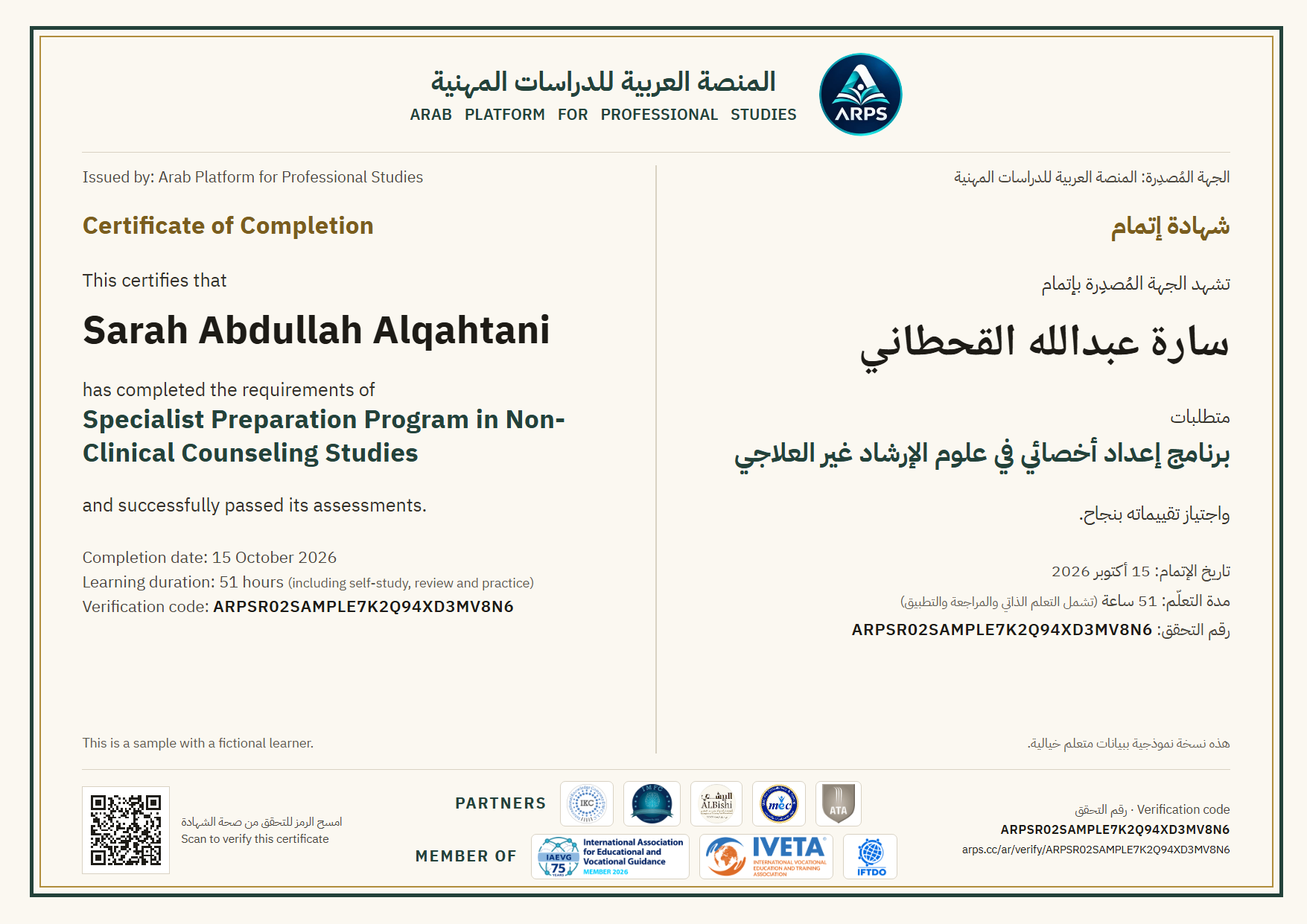
A sample from a real program in this track: Specialist Preparation Program in Non-Clinical Counseling Studies. The learner, scores and dates are fictional; opens in a new window.
No. Learners practice proposal preparation and deal analysis and escalate commitments to authorized owners.
Do the cases promise growth results?
No. Figures are fictional, and real outcomes depend on market, product, delivery and testing.
How are skills checked?
Each lesson has a learning check, and each module has an applied assessment from an original bilingual item bank under platform policy.
Do I need pricing authority?
No. Learners analyze the impact of price and refer approval to the responsible owner.
Do examples contain real customer data?
No. Cases and figures are fictional and used to practice bounded decisions.
Show all (8)
Does this cover every market?
It teaches a general method whose assumptions must be tested locally; it does not replace market research.
Is Specialist Preparation Program in Business Development and Commercial Growth free, and do I get a certificate?
Yes. Specialist Preparation Program in Business Development and Commercial Growth is free on ARPS: every lesson, exercise and assessment is free, the first subject is open to read without an account, and the program is available in Arabic and English. Issuing a certificate is optional and has a published fee; it is a training completion certificate showing you passed the program's assessments, recognised by most private-sector organisations in the Gulf states and most Arab countries, and it strengthens your CV; confirming that a specific organisation accepts it remains your responsibility.
What other names is Specialist Preparation Program in Business Development and Commercial Growth known by?
The subject of this program is also known as: business development, BD, commercial growth, bizdev. Learners usually find it by searching for: free business development course, learn business development online, finding new business opportunities, commercial proposals and deal management, business development course with completion certificate.
A foundational, applied diploma that connects market and account selection to value proposition, then turns opportunities into a trackable pipeline and covers qualification, partnerships, negotiation, growth economics and deal learning. It separates forward-looking opportunity indicators from realized revenue and uses fictional cases without growth promises or spam playbooks.
Learn to plan, execute and measure a digital campaign from business outcome to optimization decision. Build a segment, journey, message and channel plan, then execute search, content, email and landing pages before checking tracking, economics and experiments.
Learn specialist brand-management and positioning tasks: define a purchase occasion and segment, choose a comparative frame and supportable difference, govern brand cues and messages, then activate, measure and maintain the promise. Fictional cases use bounded counts and lead to reviewable working tools.
7 subjects
30 lessons
53.5 hours
Free
Next step: a professional certification or a mini-master
Programs in the same domain that prepare you for an international certification exam or form a professional mini-master, also free.