Professional Mini-Master in Evidence Synthesis and Research Integrity for Professional Decisions
Professional Mini-Master in Evidence Synthesis and Research Integrity for Professional Decisions is a free program on ARPS, the Arab Platform for Professional Studies. Build a traceable evidence synthesis with certainty and interest judgments for a conditional professional decision. Across nine modules and a ten-lesson capstone, frame decisions, search and screen, extract effects, and examine bias, certainty, and accountability.
From lesson 1, readable now without an account: Evidence decision and mandate
Imagine the appointments director telling an evaluation team, “Prove evening appointments are better.” Before searching, ask better for whom, on which outcome, against what comparison, and over what period. The desired conclusion is embedded in the request. It may encourage selection of favorable evidence while obscuring costs and harms. This evidence dossier supports a bounded organizational choice whose limits can be inspected. It does not claim to identify every study or produce a publishable systematic review. Write the available choices first: keep the current schedule, run a limited evening pilot, or expand evening sessions. Identify the affected groups, decision owner, and deadline.
A free account saves your progress and takes you straight to lesson 1.
Program facts
Study fee
Free
subjects
10
lessons
50
Estimated time
156.5 hours
Content last reviewed
Access period
60 days
Study language
Arabic and English
About the program
Across nine modules and a ten-lesson capstone, frame decisions, search and screen, extract effects, and examine bias, certainty, and accountability. The program contains fifty lessons with applied knowledge-check banks. Finish with evidence and calculations plus a recommendation, pilot, stopping, and update plan. Constructed teaching cases and numbers remain distinct from published methodological sources.
Practical relevance
Use fictional service-support cases or a general professional decision to build a search log, extraction table and decision brief.
Why this program
One finding may look decisive until its denominator, missing outcomes or sponsor influence is examined. The program develops a way to surface those limits while still making a reasoned professional choice.
Career relevance
For research, evaluation and evidence-review leads with foundational experience; it does not award an academic degree or professional license.
Career paths this program serves
This program is a step on the paths of the following occupations. Open a path to see its other programs in study order.
Define a bounded evidence mandate and trace search, eligibility and interests before judgment.
Extract denominators and effects, and appraise result bias and analytic independence.
Choose a defensible synthesis and interpret heterogeneity and missing evidence without cherry-picking.
Judge outcome-specific certainty and apply integrity and updates to a conditional decision.
Build an integrated decision dossier, test thresholds and present an auditable implementation plan.
Show all (7)
Run reproducible search, screening and extraction and judge comparisons that depend on clusters, rare events, follow-up time and multiple arms.
Interpret contextual differences and keep research use accountable when sources are corrected, citations are generated automatically or professionals disagree.
Learning outcomes (5)
Define a bounded evidence mandate and trace search, eligibility and interests before judgment.
Extract denominators and effects, and appraise result bias and analytic independence.
Choose a defensible synthesis and interpret heterogeneity and missing evidence without cherry-picking.
Judge outcome-specific certainty and apply integrity and updates to a conditional decision.
Build an integrated decision dossier, test thresholds and present an auditable implementation plan.
Who it is for
This program serves research and evaluation leads, evidence-review staff, and program managers in services, education, or health who contribute to decisions informed by several studies. It is advanced professional learning for people with foundational experience reading reports and interpreting denominators. Learners build an auditable decision brief. It is unsuitable for someone seeking an academic master's degree, a professional license, or certification that their review is publishable.
Prerequisites
You should have read an applied study report and be able to identify its question, outcome, and comparison. You need to calculate simple proportions from numerators and denominators and understand that uncertainty can change a decision. A spreadsheet is useful for extraction and search logs. You may consult guidance in Arabic or English. Prior meta-analysis experience and access to private organizational data are not required.
Begin with a defined decision rather than an unbounded search. Specify population, intervention, comparator, twelve-week completion, and what happens if evidenc
4 lessons · 4 hours
Evidence decision and mandate1 hours
Stakeholders and interests1 hours
A bounded search protocol1 hours
Screening and exclusion trail1 hours
Subject 2
Extraction and risk of bias
Extraction retains each arm's denominator, unit of analysis, time point and outcome definition. Three papers from one trial are not three trials. For 42/60 and
4 lessons · 4 hours
Extraction and unit of analysis1 hours
Effect estimates and fair comparison1 hours
Result-level risk of bias1 hours
Funding and analytical independence1 hours
Subject 3
Synthesis and missing evidence
Before combining numbers, ask whether populations, interventions, comparators, outcomes and time points align enough for an average to mean anything. Similar +6
4 lessons · 4 hours
When results may be combined1 hours
Structured narrative synthesis1 hours
Heterogeneity and sensitivity1 hours
Missing evidence and reporting bias1 hours
Subject 4
Certainty, integrity and updating
Certainty is outcome specific. Completion evidence may be more precise than a small access subgroup estimate; confidence does not transfer automatically. A posi
4 lessons · 4 hours
Outcome-specific certainty1 hours
From evidence to decision1 hours
Authorship and data integrity1 hours
Traceability and updating1 hours
Subject 5
Decision dossier and implementation
The decision dossier joins the question, evidence table, outcome-specific certainty, alternatives, and operating conditions. In the fictional teaching case, a +6-point effect acros
4 lessons · 4 hours
Integrated decision dossier1 hours
Stress-testing alternatives1 hours
Implementation and evaluation1 hours
Defensible professional briefing57 min
Subject 6
Reproducible evidence operations
Builds search, screening and extraction procedures that a colleague can reproduce, with benchmark testing, reviewer calibration, version control and an auditable handover.
5 lessons · 22.5 hours
Search sensitivity with benchmark records4.5 hours
Reviewer calibration before screening4.5 hours
Versioning and reversing screening decisions4.5 hours
Piloting an extraction dictionary4.5 hours
Auditable data handover4.5 hours
Subject 7
Comparisons requiring statistical judgment
Examines comparisons that depend on data structure, including cluster trials, outcome direction, rare events, follow-up time and multi-arm trials.
5 lessons · 22.5 hours
Reading cluster trials without pseudoreplication4.5 hours
Aligning outcome directions before synthesis4.5 hours
Rare outcomes and absolute interpretation4.5 hours
Different follow-up times and time-to-event outcomes4.5 hours
Multiple arms and shared comparators4.5 hours
Subject 8
Interpreting contextual differences
Investigates why findings differ and how evidence transfers to a local decision, using effect modifiers, qualitative evidence, time series and distributions.
5 lessons · 22.5 hours
Mediators and effect modifiers4.5 hours
Integrating qualitative evidence with effects4.5 hours
Transportability to a local service4.5 hours
Time series for an operational change4.5 hours
Showing distributions rather than means alone4.5 hours
Subject 9
Accountability in research use
Makes research use accountable by handling retractions, verifying machine-generated citations, limiting data to what is necessary, recording dissent and updating by value of information.
5 lessons · 22.5 hours
Responding to retractions and corrections4.5 hours
Verifying machine-generated citations4.5 hours
Consent and minimum necessary data4.5 hours
Professional dissent and disagreement records4.5 hours
Updating by value of information4.5 hours
Subject 10
Capstone: service redesign evidence dossier
A ten-lesson capstone that builds an evidence dossier for redesigning access to a fictional guidance service, from commissioning and protocol to synthesis, certainty, costing, a stoppable pilot and handover.
10 lessons · 44.5 hours
Commissioning the access redesign dossier4.5 hours
Capstone protocol and deviations4.5 hours
Delivering an auditable screening package4.5 hours
Extracting the capstone evidence set4.5 hours
Choosing and defending a synthesis method4.5 hours
Outcome-specific certainty dossier4.5 hours
Implementation costing and budget limits4.5 hours
A stoppable access pilot4.5 hours
Defending the dossier under conflicting objections4.5 hours
Archive handover and post-decision review4.5 hours
Subjects unlock in sequence as you progress.
Strengths
Five original modules plus five advanced additions, including a connected ten-lesson capstone.
Guided applications with solutions and critique criteria.
The original integrated final is preserved, with bilingual checks for new lessons and two capstone outputs.
Evidence basis
PRISMA, Cochrane and ICMJE guide scoped reporting, appraisal and disclosure; the case figures are not drawn from them.
Reference organizations
Cochrane
PRISMA
ICMJE
Methodology
Sources guide appraisal and synthesis; teaching-case figures remain fictional.
Program questions
Do I need research experience?
Foundational experience reading studies and rates helps; start with preparatory learning if these are new.
How do the modules connect?
They move from question and search to extraction, synthesis, certainty and the decision dossier.
Do I need workplace data?
No; all applications can use the fictional cases.
How does assessment work?
The original integrated final and its module subscores remain. Each new lesson adds Arabic and English knowledge checks, alongside a capstone with tasks, feedback, and explicit criteria.
Is the credential an academic master’s degree?
No; it names an internal professional mini-master program, not a university degree or license.
Show all (8)
Must I upload confidential research data?
No; use fictional data and do not upload information you are not authorized to share.
Is Professional Mini-Master in Evidence Synthesis and Research Integrity for Professional Decisions free, and do I get a certificate?
Yes. Professional Mini-Master in Evidence Synthesis and Research Integrity for Professional Decisions is free on ARPS: every lesson, exercise and assessment is free, the first subject is open to read without an account, and the program is available in Arabic and English. Issuing a certificate is optional and has a published fee; it is a training completion certificate showing you passed the program's assessments, recognised by most private-sector organisations in the Gulf states and most Arab countries, and it strengthens your CV; confirming that a specific organisation accepts it remains your responsibility.
What other names is Professional Mini-Master in Evidence Synthesis and Research Integrity for Professional Decisions known by?
The subject of this program is also known as: evidence synthesis, systematic review, research integrity. Learners usually find it by searching for: evidence synthesis course, systematic review training, research integrity course, free systematic review course.
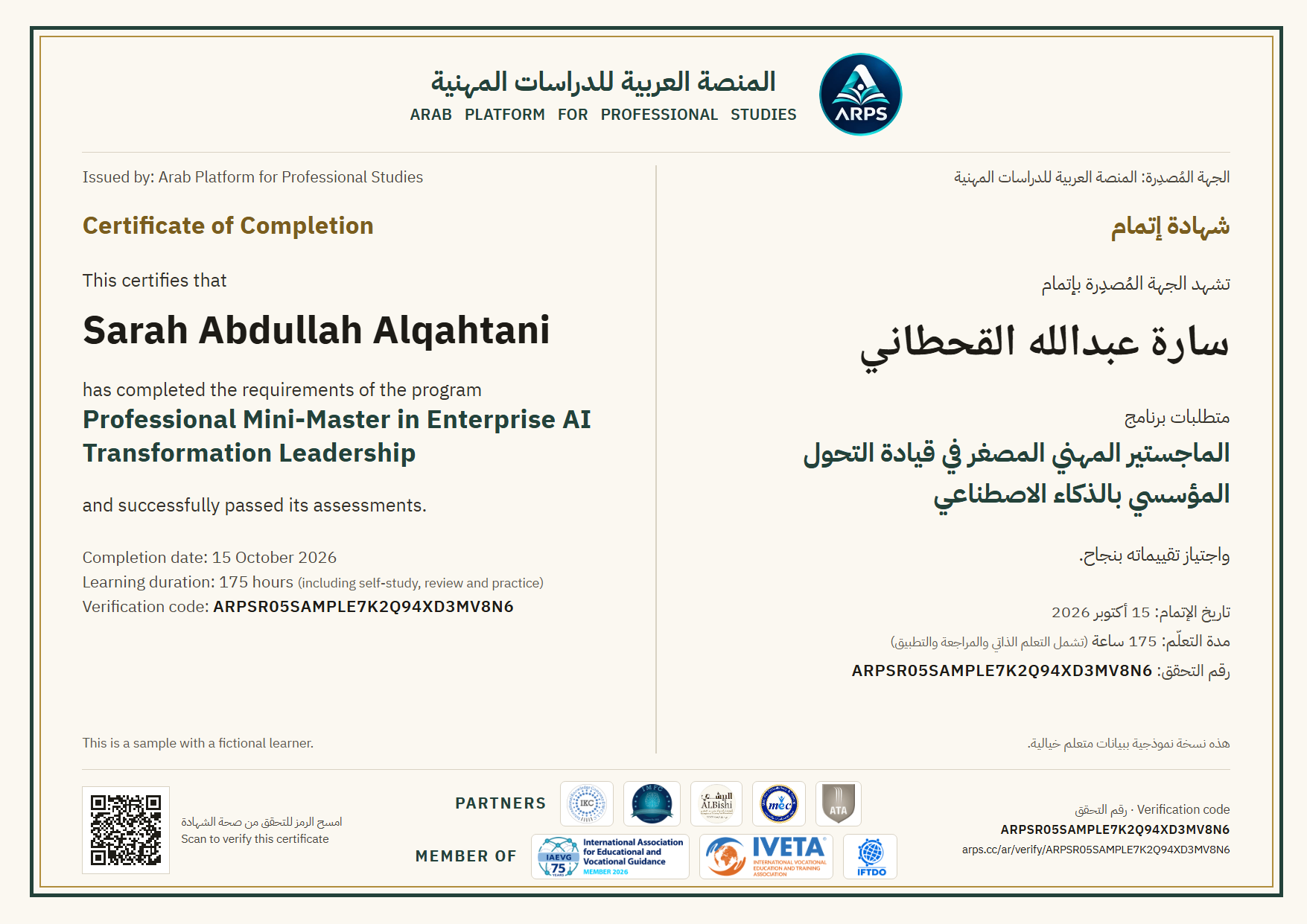
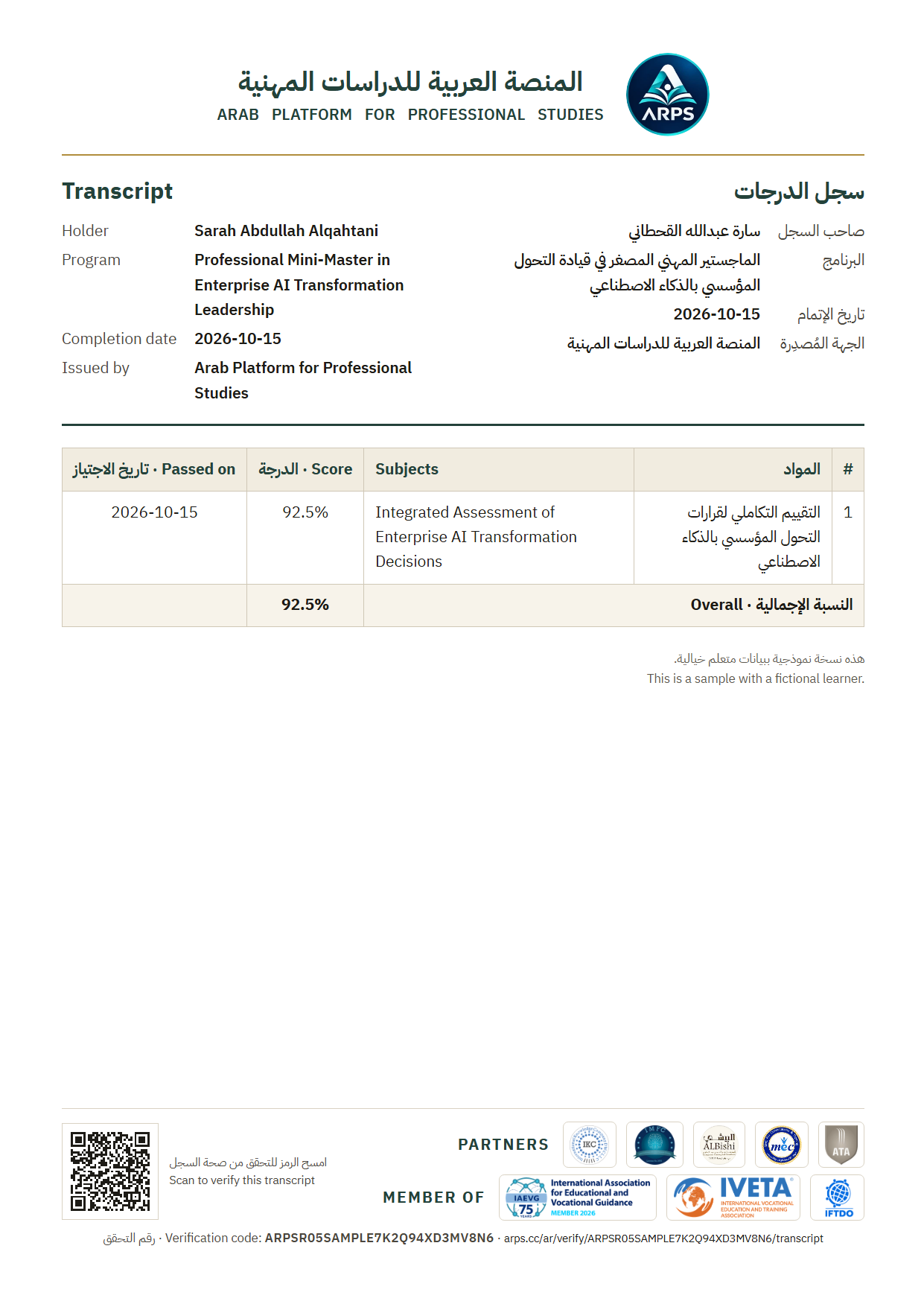
A sample from a real program in this track: Professional Mini-Master in Enterprise AI Transformation Leadership. The learner, scores and dates are fictional; opens in a new window.
Learn to frame a claim, trace digital copies, test place and time, and preserve evidence while protecting people. Finish with a case file that separates supported findings from unproven causes and links each conclusion to evidence and search limits.
An honest note: the professional mini-master is an intensive professional program; it is not an academic degree or a licence and is not equivalent to a university master's or MBA. The optional ARPS certificate is a training completion certificate showing you passed the program's assessments.