Specialist Preparation Program in Information Verification and Open Research
Specialist Preparation Program in Information Verification and Open Research is a free program on ARPS, the Arab Platform for Professional Studies. Learn to frame a claim, trace digital copies, test place and time, and preserve evidence while protecting people. Finish with a case file that separates supported findings from unproven causes and links each conclusion to evidence and search limits.
Design a search log that distinguishes an original source from an indexed result and records each query's coverage limits.
From lesson 1, readable now without an account: Decompose a claim into testable units
Verification begins by identifying the proposition to be judged, before choosing a search tool. One sentence can contain four assertions: an event occurred, at a named place, in a specified period, with a stated magnitude. Separate them before searching. 'Complaints increased this week at the centre' is not a single operational question. What counts as a complaint? Which centre? When does the week start and end? Is the increase an absolute count or a share of all transactions? If a field is missing, record it as unspecified and identify the original record that might resolve it. Do not silently supply an answer.
A working claim card retains the quoted wording, the account or channel on which it appeared without treating that account as the original creator, a link and capture time, and a decomposition into subject, predicate, quantity, denominator, place and period. Add evidence that could support each unit, evidence that could contradict it, and the person allowed to decide. These fields prevent a narrow observation from becoming a broad conclusion. Suppose a queue log lists 11 late requests among 38 requests on a specified day. The ratio is 11÷38≈28.9% of requests, not 28.9% of customers: a customer could submit several requests. Nor may we divide 11 by 42 because 42 comes from a separate count of people. A claim about people requires a lawful, appropriately minimized way to count affected unique people and all relevant people over the same period. A matching percentage is meaningless when numerator and denominator count different things.
A free account saves your progress and takes you straight to lesson 1.
Program facts
Study fee
Free
subjects
8
lessons
35
Estimated time
50.5 hours
Content last reviewed
Access period
30 days
Study language
Arabic and English
About the program
The program starts with a practical question: exactly what does the circulating material claim, and what are its counted unit, period and place? You prepare a claim card, a reproducible search log and a map of sources that may be copying one origin. Next you examine image versions, separating page, archive, file and upload times, and interpret metadata and signed provenance within their limits.
For visual verification, compare independent landmarks from plausible viewpoints, test time indicators cautiously and mark what video cuts leave unknown. Preserve the received copy and its hash, make a safer derivative when needed, and record conflicts, corrections and referrals to an authorized owner when disclosure could harm someone.
Finally, write both a public finding and a technical note, then challenge them by changing an influential input. The integrated case combines a partial log, an older image, an edited clip and a sensitive identifier. All teaching cases are hypothetical. This program teaches bounded documentation and reasoning; it grants no professional license, independent publication authority or guarantee that every circulating item can be resolved.
Practical relevance
Apply the workflow when reviewing a circulating report, image or operations log while protecting people in the material. Produce a claim card, copy timeline, landmark comparison, custody record and correction note; refer sensitive decisions to the person authorized to make them.
Why this program
An image with a caption and several links can look well supported even when it is an older copy repeated from one source. This program supplies a reviewable method for separating observation from interpretation, weighing alternatives and phrasing a result within the evidence.
Career paths this program serves
This program is a step on the paths of the following occupations. Open a path to see its other programs in study order.
Split a claim into testable units and build a search log and source-dependence map.
Trace image copies, fields and times without assuming capture time or caption truth.
Test place and time hypotheses using landmarks and cuts while stating precision limits.
Preserve original evidence, protect identifiers, document conflicts and refer safety decisions.
Weigh evidence, write a bounded finding, and revise it after an adversarial case review.
Produce a reproducible verification dossier from records, documents and testimony, and defend its limits.
Learning outcomes (21)
Produce a claim card that distinguishes events from people, names the time window and place, and states what the evidence cannot establish.
Design a search log that distinguishes an original source from an indexed result and records each query's coverage limits.
Map a claim's citation chain and determine which observations are genuinely independent before weighing them.
State a bounded finding for each claim unit and justify a hold or escalation when evidence or safety prevents publication.
Build a copy timeline and explain why the oldest indexed hit is neither necessarily the original file nor its capture date.
Extract fields from a specific image copy, separate recorded values from interpretation, and test time and place conflicts without jumping to a manipulation claim.
Interpret a Content Credentials validation result by signature, identity and edit chain without equating it to event truth.
Convert timestamps using stated offsets and build a bounded timeline without treating page publication as event time.
Turn scene details into testable geographic features and generate competing candidates instead of accepting the caption's city.
Test camera position and bearing with three ordered landmarks and sight lines, rejecting a match based on a similar facade alone.
Use shadows and changing scene clues to bound a conditional time window without claiming an exact hour or date from one image.
Index a short video's shots, cuts and audio, then distinguish what frames show from claims requiring the full file or independent evidence.
Create an acquisition and handling log linking a working copy to a preserved original and byte hash, separating file integrity from content truth.
Identify necessary data and design restricted original, reviewer copy and public copy with justified redactions.
Handle conflicting evidence without cherry-picking and issue a versioned correction showing what changed, when and why.
Choose a concrete containment and escalation action when material may expose a person or drive a consequential decision, without waiting to resolve every claim.
Build support, contradiction and indeterminate matrices by claim unit and issue a descriptive finding without an invented confidence percentage.
Produce a concise public finding and an auditable technical explanation that identify supported and unresolved units without overclaiming.
Challenge a case file from a competing interpretation, identify evidence that would change the decision, and update only the affected finding.
Run the complete workflow from mixed inputs to a bounded finding with provenance, time, place, safety and adversarial review.
Produce a reproducible verification dossier from records, documents and testimony, defending its limits with traceable evidence.
Who it is for
This program suits news editors, fact checkers, content researchers, communication teams and response staff who need to examine a digital claim before repeating it. It also helps practitioners receiving photographs, short clips or partial tables who must state what the available evidence supports, what remains outside the examined scope, and how to protect identifiable people while respecting publication authority.
Prerequisites
Learners need ordinary web browsing and search skills, the ability to keep links and observations in a simple table, and comfort calculating a percentage from a known numerator and denominator. The lessons do not require forensic credentials, programming, personal data or paid tools. Supplied hypothetical cases are enough for practice; applying the method to real cases requires the relevant organization's permission, privacy rules and safety process.
This module turns a compound post into separate claims that can each be tested. The learner defines the counted unit, denominator, period and place, then writes a question showing what evidence could establish or change the finding. An open search log records the exact query, time and opened page; an absent indexed result does not prove the page never existed. A source chain distinguishes independent reporting from copies of one notice. The learner then makes a bounded decision: which observation is supported, which gap remains, and when a safety claim or publication decision must go to an authorized owner. The output is a reviewable claim card and verification plan, not a verdict on an unexamined event.
4 lessons · 3 hours
Decompose a claim into testable units46 min
A reproducible open research plan46 min
Source independence and citation chains46 min
Decision, hold and escalation thresholds46 min
Subject 2
Digital provenance and temporal context
This module traces image copies without treating the oldest observed result as the original or its camera time. The learner builds a timeline that separates page publication, archive capture, file time and upload. Exif is read as data carried by a particular copy: a missing field or changed modification time is not, by itself, proof of tampering. Valid C2PA provenance can bind signed assertions within its trust scope, but it does not certify the event described by a new caption. Finally, known time offsets are converted to a common reference while an offset-free camera field remains unresolved. The output is a copy and time record that keeps observations apart from assumptions about camera accuracy, place and cause.
4 lessons · 3 hours
Earliest observed appearance and image copies46 min
Reading metadata and its limits46 min
Signed provenance and what validation means46 min
Reconcile event, upload and archive times46 min
Subject 3
Visual location and scene verification
The learner extracts visible landmarks and proposes more than one candidate location, then tests left-right and front-back relationships from plausible camera viewpoints. A similar facade or a caption is insufficient: reference images can be dated, incomplete or cropped before the decisive landmark. Shadow evidence is treated as a conditional time clue depending on place, season and geometry, not a precise clock from one image. For video, each cut is logged, and the order of published shots is kept separate from the real event sequence; a continuous original is sought when available. The output is a reasoned location and time hypothesis that names alternatives, the defensible precision and what remains outside the frame.
4 lessons · 3 hours
Extract landmarks and build competing location hypotheses46 min
Match viewpoint and landmark order46 min
Visual time windows and seasonal clues46 min
Inspect short video and sequence limits46 min
Subject 4
Evidence preservation, privacy and safety
This module preserves the received file without alteration, recording its URL, acquisition time and hash while linking each derivative to its purpose. Matching hashes across later checks support fixity of that received copy; they do not prove scene truth or earlier camera time. The learner minimizes visible identifiers, since a blurred face may still be reidentified through a school, date and nearby home landmark together. When an original record conflicts with a published finding, the learner checks definition, time and place before correcting the statement, retaining what the earlier version said and why it changed. Exposed witness details are contained promptly, independently of a disputed statistic. The output is a custody record, a safer display decision and a referral path for authorized review.
4 lessons · 3 hours
Preserve originals and chain of custody46 min
Minimize data and protect people during verification46 min
Conflicts and corrections in the verification record46 min
Escalation for harm and identity exposure46 min
Subject 5
Finding and integrated case file
The final module combines earlier methods into a finding that weighs evidence for each defined claim rather than voting by URL count. The learner tests an alternative explanation and separates co-occurrence from proof that one event caused another. A public summary must retain the technical report's period, denominator and observed units; it names what remains unresolved and what record could change the result. Adversarial review changes one concrete input, recalculates numerator and denominator, and records the effect while preserving the prior version. The integrated case includes a partial operations log, an older image, a cut video and a sensitive identifier. Completion requires a bounded finding for each part, containment of exposed data and referral of an unsupported cause. Another reviewer should be able to retrace and challenge the file.
4 lessons · 4 hours
Weigh evidence and test alternative explanations46 min
Write the finding for public and technical readers46 min
Adversarial review and decision sensitivity46 min
An integrated, reviewable verification case file1.5 hours
Subject 6
Reading records and documents carefully
The sixth module trains careful reading of records and documents: cleaning a report register without losing its audit trail, testing a percentage with a missing denominator, distinguishing similarly named organizations, comparing document versions and amended policies, and investigating gaps in a publication register.
5 lessons · 9.5 hours
Clean a report register without losing its audit trail2 hours
Test a percentage with a missing denominator2 hours
Distinguish organizations with similar names2 hours
Compare document versions and amended policies2 hours
Investigate gaps in a publication register2 hours
Subject 7
Working with people and reviewing outputs
The seventh module covers working with people and reviewing outputs: requesting clarification without leading a witness, testing a public copy after redaction, resolving reviewer disagreement about claim scope, and designing a reproducible methods note.
4 lessons · 7.5 hours
Request clarification without leading a witness2 hours
Test a public copy after redaction2 hours
Resolve reviewer disagreement about claim scope2 hours
Design a reproducible methods note2 hours
Subject 8
Capstone: a rumor about a public library closure
The capstone applies the method to a rumor about a public library closure, from defining the case, building a provenance register, reconstructing opening hours and auditing affected-user counts to an adversarial review and delivery of a dossier with defended limits.
6 lessons · 11.5 hours
Define the case brief before collecting evidence2 hours
Build a provenance register from mixed inputs2 hours
Reconstruct library hours from conflicting records2 hours
Audit the number of affected library users2 hours
Challenge the capstone finding2 hours
Deliver the dossier and defend its limits2 hours
Subjects unlock in sequence as you progress.
Strengths
Claim framing and verification plan
Digital provenance and temporal context
Finding and integrated case file
Evidence basis
Methods are linked to the listed references; teaching cases are fictional and mentioning a source does not imply endorsement.
Methodology
An image with a caption and several links can look well supported even when it is an older copy repeated from one source. This program supplies a reviewable method for separating observation from interpretation, weighing alternatives and phrasing a result within the evidence.
Assessment
Assessments follow the program blueprint and may use module assessments, a final assessment, or a combination, under the approved attempt policy.
Assessment attempts: 2 per assessment, 7 days apart
The pass mark is announced before the program is published.
Certificate
The credential confirms completion and successful assessment; it does not represent professional licensure unless explicitly and lawfully stated.
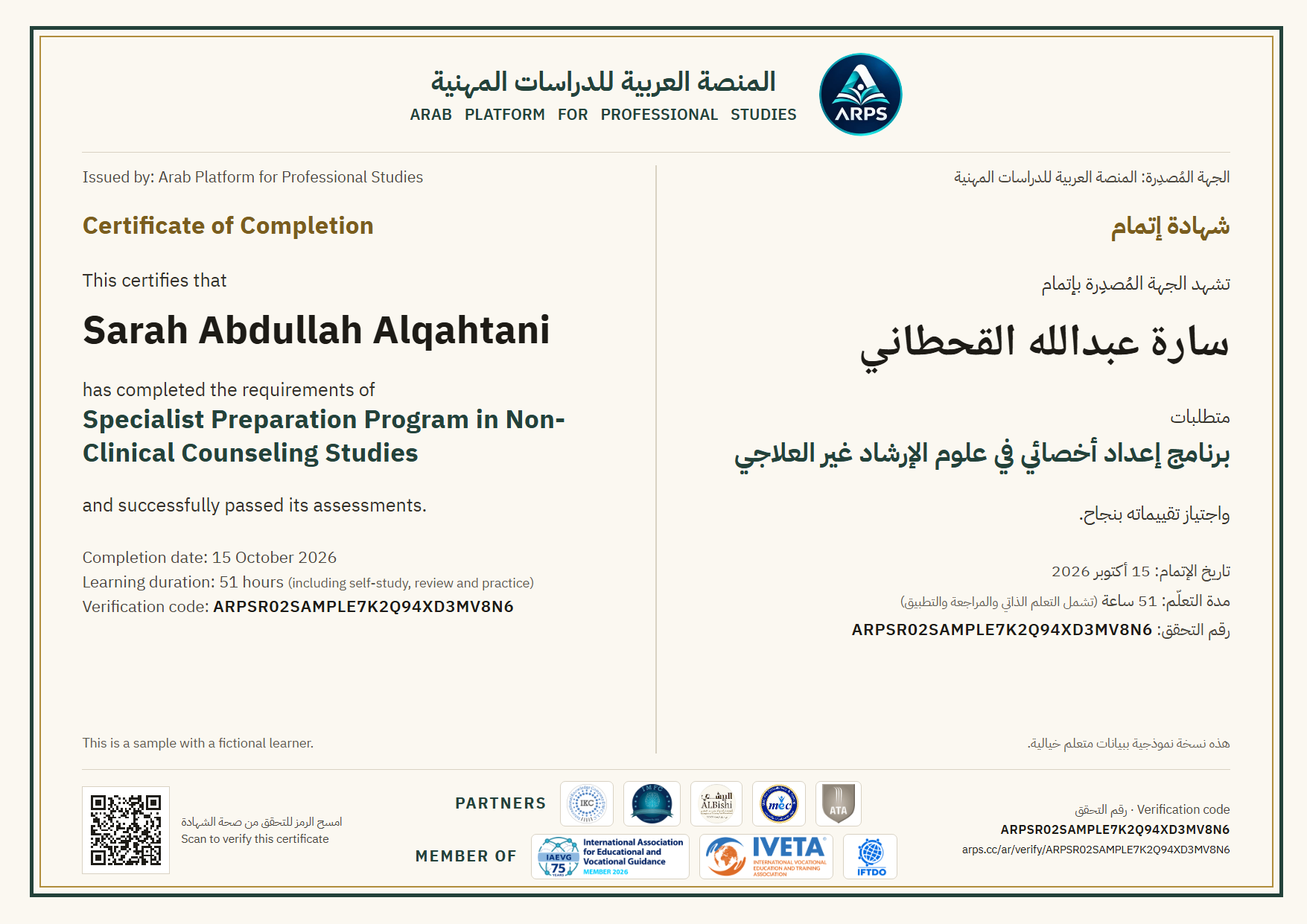
A sample from a real program in this track: Specialist Preparation Program in Non-Clinical Counseling Studies. The learner, scores and dates are fictional; opens in a new window.
It bounds the circulation history of that copy in the examined sources. Today's alleged event needs separate evidence.
Do exercises need real people's data?
No. The supplied cases are hypothetical and teach how to protect identifiers in authorized work.
Does the program authorize publication or a legal conclusion?
No. Its output is a bounded verification record; publication and legal decisions belong to authorized roles.
Does a file hash prove the scene is true?
It can test the fixity of received bytes across checks, not the truth of the depicted event.
What if capture time is missing from a copy?
Record the missing field and seek an original or independent indicators; absence alone is not proof of tampering.
Show all (7)
Is Specialist Preparation Program in Information Verification and Open Research free, and do I get a certificate?
Yes. Specialist Preparation Program in Information Verification and Open Research is free on ARPS: every lesson, exercise and assessment is free, the first subject is open to read without an account, and the program is available in Arabic and English. Issuing a certificate is optional and has a published fee; it is a training completion certificate showing you passed the program's assessments, recognised by most private-sector organisations in the Gulf states and most Arab countries, and it strengthens your CV; confirming that a specific organisation accepts it remains your responsibility.
What other names is Specialist Preparation Program in Information Verification and Open Research known by?
The subject of this program is also known as: fact-checking, OSINT, open source research, information verification. Learners usually find it by searching for: OSINT course, fact checking course, open source investigation training, free OSINT course.
Learn to carry out research-method tasks from question framing and evidence search through data collection, analysis and reporting, with documented decisions and ethical boundaries.
Learn to frame an advisory decision, scrutinise signals and trend data, construct coherent scenarios, stress-test options and give revisable advice under uncertainty.
This short diploma shows learners how to turn a broad question about the future into a bounded decision that can be examined. They frame its horizon and system, record signals with source limits, compare measurable trends, and construct distinct, coherent scenarios. They then stress-test present options, design small reversible trials, and choose signposts that could change a decision. All case figures are fictional; worked solutions retain denominators, assumptions, and inference limits. Each subject includes observable practice and a summative assessment. Completion is educational and does not confer a professional licence or consulting authorization.
6 subjects
26 lessons
81.5 hours
Free
Next step: a professional certification or a mini-master
Programs in the same domain that prepare you for an international certification exam or form a professional mini-master, also free.