
Specialist Preparation Program in Research Methodology

Specialist Preparation Program in Research Methodology is a free program on ARPS, the Arab Platform for Professional Studies. Learn to carry out research-method tasks from question framing and evidence search through data collection, analysis and reporting, with documented decisions and ethical boundaries.

Field research scene: a figurine with a clipboard interviewing at a doorway of a paper apartment block, a sampling grid drawn on the pavement: cover of the ARPS program Specialist Preparation Program in Research Methodology Studying is completely free
Estimated time
52.5 hours
subjects
8
lessons
32
Study language
Arabic and English

Certificate issuance fee

$90

331 AED or 338 SAR

After you pay the certificate fee, you can print the certificate and transcript in both Arabic and English, or in English only.

Start the first subject now Fees by route

What you will learn in the first 10 minutes

The opening lessons of the first subject, with the reading time set for each. Approximate total time in minutes: 7

  1. From problem to question 7 min read
    • Turn a practical problem into a researchable question and documented evidence-search plan

From lesson 1, readable now without an account: From problem to question

Research starts with a practical problem, but a problem is not yet a research question. “Too many people leave” identifies neither the population, time frame nor outcome to be explained. Before selecting a survey or statistical test, identify the decision maker and the decision the evidence should inform. A request to count departures is descriptive. A request to examine how shift arrangements relate to departure is associational. A request to estimate the effect of changing shifts is causal and calls for a stronger design. Replacing “describe” with “prove an effect” changes the evidence required, not merely the title.

Build a question card with four fields:

  • the population to which the finding may apply
  • the phenomenon, exposure or intervention
  • a comparator if the question needs one
  • and an outcome with a measurement window

A qualitative question about workers' experiences does not require two comparison groups. When a comparison matters, specify it before collection. “Employees” is broad; “service-centre staff employed at the start of the study quarter” defines whom the records can follow. “Satisfaction” needs an operational definition. “Leaving employment within six months” is checkable if a trustworthy record exists. A precise definition does not make the record complete; test its limits separately.

Separate the study aim, question and hypothesis. An aim states the work to be done, such as estimating departures over a defined period. A question states what the data should answer. A hypothesis is a specific expectation that can be tested when the design permits; it is not mandatory for every exploratory or qualitative project. Specify the unit of analysis as well. Is one record a person, a shift or a team? A person appearing in several shifts does not become several independent people when calculating a departure rate. Name the start and end points and the possible data source so feasibility can be checked before a conclusion is promised.

Stress-test the question with three challenges. Can the available data distinguish the proposed outcome from a nearby one? A contract-end field may combine resignations and scheduled contract endings. Does the data frame cover the people to whom the result will be generalized? One centre does not support a claim about all centres. Does the design support the verb? Comparing people who chose flexible shifts with those who did not can show an association, while differences in prior circumstances offer competing explanations. Narrow the verb or plan how to address those differences. Refer any participant-risk or data-access issue to the responsible authority; a well-written question is no permission to collect data.

Make the card's completion criterion observable: population, analysis unit, phenomenon or variables, time window, allowed type of inference, proposed data source and at least one limitation. If a field remains uncertain, record an open decision with an owner and date rather than inventing an answer. A reviewer can then compare the eventual report with the intended inquiry. Clear reporting of purpose and procedures matters for that comparison.

A researchable question and a decision-ready question differ. You may estimate departures accurately while a manager needs to know whether to alter a particular policy. Keep “intended use” separate from “study finding” on the question card. If departures exceed an agreed threshold, the appropriate next step may be investigating reasons rather than immediately cancelling shifts. Set a minimum data requirement too: a register that cannot distinguish resignation from planned contract ending cannot answer a resignation question, however correct its arithmetic. This requirement drives feasibility assessment before collection.

A team may ask how many people leave, why they leave and whether a new policy would prevent it. These are three questions. The first needs reliable description, the second may need qualitative understanding or analysis of factors, and the third needs an effect comparison. Prioritize and connect them. A descriptive pattern may guide interview selection; interviews may reveal that “flexibility” means different things and change the intervention definition before effect testing. An answer to one question is not evidence for another without a methods bridge.

Check feasibility as well: authorized access, sufficient follow-up time for the outcome, enough events to describe without identifying individuals, and an owner prepared to act on the type of evidence available. If not, narrow scope or propose a small feasibility study instead of promising a decisive report. Express assumptions so they can be tested, such as completeness of departure codes, rather than “the data are accurate.” Such precision prevents a later dispute about what the study actually meant.

Read the full lesson free
Start free

A free account saves your progress and takes you straight to lesson 1.

Program facts

Study fee
Free
subjects
8
lessons
32
Estimated time
52.5 hours
Content last reviewed
Access period
30 days
Study language
Arabic and English

About the program

Turn a practical problem into a researchable question, then build a search and screening record another reviewer can trace. Select a design, sample and measure that fit the question, and identify likely bias before collecting data. Practice a collection protocol, codebook and cleaning log that preserves raw records. Separate statistical description from inference, interpret uncertainty and qualitative material, and finish by reviewing report claims, selecting a design-specific reporting guide and handing over a file showing what was done and what needs specialist review.

Practical relevance

Use the steps in a workplace survey, evidence review or small mixed-method project with the supplied fictional cases. Authority to collect human-participant data, approve specialized analysis or make clinical decisions remains with the responsible institution.

Why this program

A report can sound convincing while outcome definitions change, records disappear without a trail, or an association is called a cause. The specialist learns to connect each decision to the question, evidence and limits.

Career paths this program serves

This program is a step on the paths of the following occupations. Open a path to see its other programs in study order.

What you will learn

  • Turn a practical problem into a researchable question and documented evidence-search plan
  • Justify design, sample and measures against the question, constraints and bias
  • Build data collection, quality-control and analysis plans that separate description from inference
  • Interpret findings and limitations without exceeding evidential or causal support
  • Document ethics and transparency and prepare an auditable report
Show all (7)
  • Apply analysis decisions to workplace data, including follow-up time, repeated measures, instrument consistency and missing outcomes
  • Control a study before execution and complete an integrated applied research project with a reproducible dossier
Learning outcomes (5)
  1. Turn a practical problem into a researchable question and documented evidence-search plan
  2. Justify design, sample and measures against the question, constraints and bias
  3. Build data collection, quality-control and analysis plans that separate description from inference
  4. Interpret findings and limitations without exceeding evidential or causal support
  5. Document ethics and transparency and prepare an auditable report

Who it is for

  • Practitioners carrying out defined research tasks under institutional oversight
  • Team members who need traceable methods and cautious interpretation
  • Early-career researchers and graduate students who need to build a coherent research protocol and an auditable report.
  • Analysts and staff in planning and quality departments who collect field data or surveys and want to interpret them without overstating conclusions.

Prerequisites

  • Read simple tables and distinguish observation from inference.
  • Ability to read a short research article or data report and grasp its main idea, plus familiarity with averages, percentages and simple charts.
  • Ability to use a spreadsheet to enter and sort data, and willingness to practice only with synthetic or authorized data while respecting confidentiality and participant rights in every worked example.

Curriculum

  1. Subject 1 Open for free

    Question and evidence map

    From problem to question; Reproducible evidence search; Screening and relevance; From gap to protocol

    4 lessons · 2 hours
    1. From problem to question 38 min
    2. Reproducible evidence search 14 min
    3. Screening and relevance 38 min
    4. From gap to protocol 16 min
  2. Subject 2

    Design, sample and measurement

    Selecting a design; Sampling frame and bias; Variables and measures; Confounding, power and sample size

    4 lessons · 56 min
    1. Selecting a design 14 min
    2. Sampling frame and bias 12 min
    3. Variables and measures 14 min
    4. Confounding, power and sample size 16 min
  3. Subject 3

    Data collection and stewardship

    Standardized collection procedure; Data register and codebook; Cleaning with an audit trail; Interviews and qualitative coding

    4 lessons · 52 min
    1. Standardized collection procedure 12 min
    2. Data register and codebook 14 min
    3. Cleaning with an audit trail 12 min
    4. Interviews and qualitative coding 14 min
  4. Subject 4

    Analysis and interpretation

    Description before inference; Intervals and test assumptions; Integrating quantitative and qualitative findings; Causality, sensitivity and limitations

    4 lessons · 50 min
    1. Description before inference 12 min
    2. Intervals and test assumptions 12 min
    3. Integrating quantitative and qualitative findings 12 min
    4. Causality, sensitivity and limitations 14 min
  5. Subject 5

    Ethics and auditable reporting

    Participant review and consent; Privacy and responsible sharing; Writing methods and results; Claim review and research handoff

    4 lessons · 50 min
    1. Participant review and consent 12 min
    2. Privacy and responsible sharing 12 min
    3. Writing methods and results 12 min
    4. Claim review and research handoff 14 min
  6. Subject 6

    Analysis decisions in workplace data

    This unit applies Analysis decisions in workplace data to defined research tasks. Begin with the information needed for a decision, examine the source and comparison unit, and build a traceable procedure. Exercises supply fictional inputs and require written products; feedback explains a defensible response and its limitations. Each lesson adds a different situation to previously learned methods. Preserve definitions, versions and denominators, and distinguish observed findings from possible explanations. Finish with a handover another colleague can inspect, including what requires authorized specialist review before use with actual workplace records.

    4 lessons · 14.5 hours
    1. Follow-up time and rates 3.5 hours
    2. Repeated measures within teams 3.5 hours
    3. Checking instrument consistency 3.5 hours
    4. Missing-outcome scenarios 3.5 hours
  7. Subject 7

    Study controls before execution

    This unit applies Study controls before execution to defined research tasks. Begin with the information needed for a decision, examine the source and comparison unit, and build a traceable procedure. Exercises supply fictional inputs and require written products; feedback explains a defensible response and its limitations. Each lesson adds a different situation to previously learned methods. Preserve definitions, versions and denominators, and distinguish observed findings from possible explanations. Finish with a handover another colleague can inspect, including what requires authorized specialist review before use with actual workplace records.

    4 lessons · 14.5 hours
    1. Precision and response budgets 3.5 hours
    2. Cognitive piloting of a questionnaire 3.5 hours
    3. Consistent evidence extraction 3.5 hours
    4. Pre-analysis plans and amendments 3.5 hours
  8. Subject 8

    Integrated applied research project

    This unit applies Integrated applied research project to defined research tasks. Begin with the information needed for a decision, examine the source and comparison unit, and build a traceable procedure. Exercises supply fictional inputs and require written products; feedback explains a defensible response and its limitations. Each lesson adds a different situation to previously learned methods. Preserve definitions, versions and denominators, and distinguish observed findings from possible explanations. Finish with a handover another colleague can inspect, including what requires authorized specialist review before use with actual workplace records.

    4 lessons · 14.5 hours
    1. Project brief and alternatives 3.5 hours
    2. Field rehearsal and start decision 3.5 hours
    3. Reproducible analysis dossier 3.5 hours
    4. Defending findings and corrections 3.5 hours

Subjects unlock in sequence as you progress.

Strengths

  • A traceable record of the question, search and amendments
  • Applied cases linking design, sampling and analysis to bias
  • A research handover linking claims to findings, limitations and references

Evidence basis

Concepts draw on cited primary sources, including design-specific reporting guidance and statistical and ethics references. Workplace examples are fictional. A reporting checklist does not establish study validity, and funder policies do not apply to every project.

Methodology

A report can sound convincing while outcome definitions change, records disappear without a trail, or an association is called a cause. The specialist learns to connect each decision to the question, evidence and limits.

Assessment

Assessments follow the program blueprint and may use module assessments, a final assessment, or a combination, under the approved attempt policy.

Assessment attempts: 2 per assessment, 7 days apart

The pass mark is announced before the program is published.

Certificate

The credential confirms completion and successful assessment; it does not represent professional licensure unless explicitly and lawfully stated.

Every certificate has a public verification code. Verify a certificate

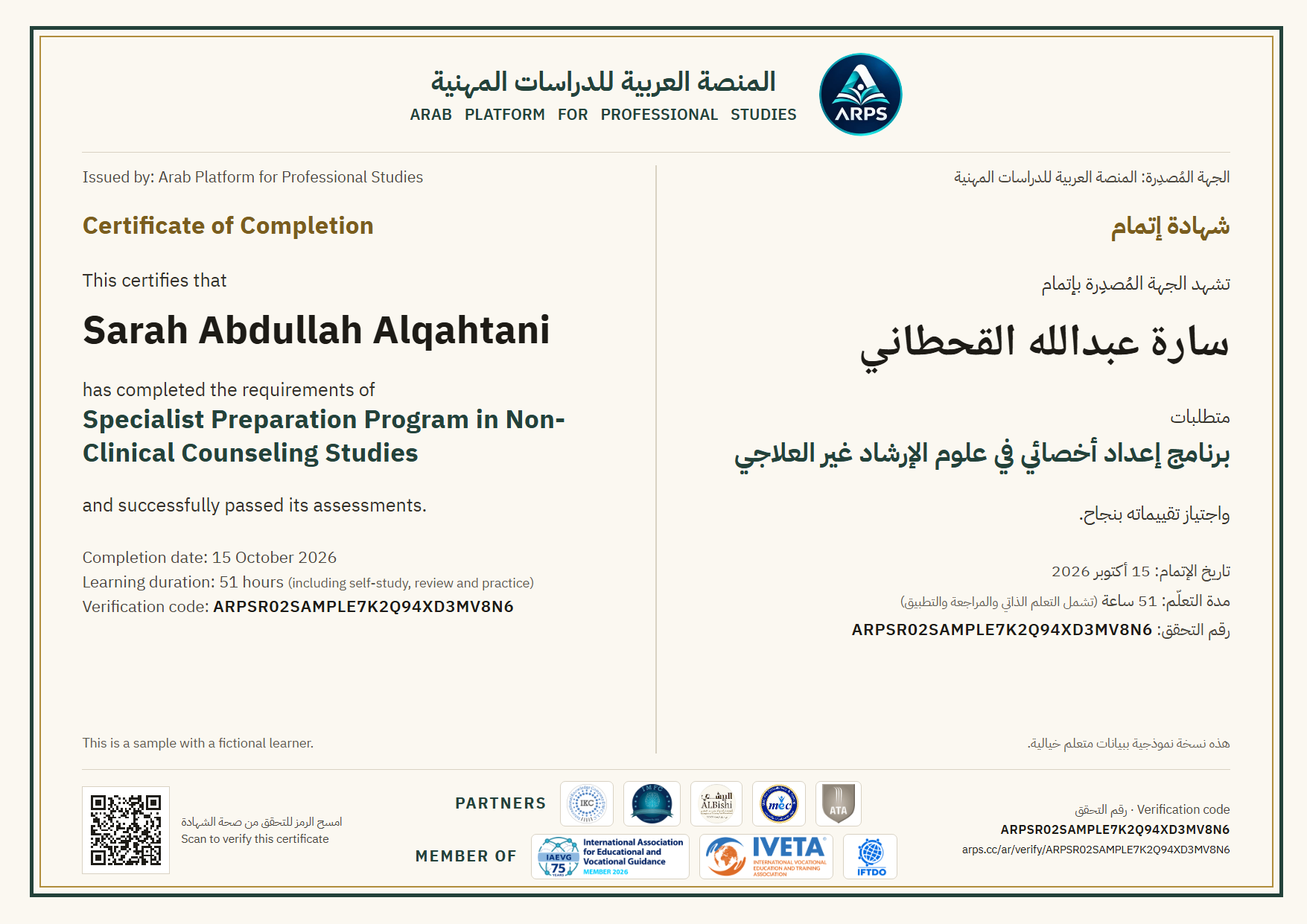
A sample from a real program in this track: Specialist Preparation Program in Non-Clinical Counseling Studies. The learner, scores and dates are fictional; opens in a new window.

Verification example: a real issued certificate

Program questions

Do I need an existing project to practice?

No. Lessons provide fictional cases and feedback. Applying the methods to workplace data requires institutional authorization.

Does this replace ethics approval?

No. It teaches you to recognize and document referral points; review and approval belong to the authorized body.

Does a STROBE checklist prove validity?

No. It supports complete reporting of observational studies; bias and appropriateness require separate appraisal.

Does an observational comparison establish causation?

It can describe association and examine competing explanations; a group difference alone does not establish an effect.

What do the assessments measure?

Lesson checks test one decision per lesson, and module assessments draw two cases from separate banks. Correct choices alone do not demonstrate performance in a live study.

Show all (7)
Is Specialist Preparation Program in Research Methodology free, and do I get a certificate?

Yes. Specialist Preparation Program in Research Methodology is free on ARPS: every lesson, exercise and assessment is free, the first subject is open to read without an account, and the program is available in Arabic and English. Issuing a certificate is optional and has a published fee; it is a training completion certificate showing you passed the program's assessments, recognised by most private-sector organisations in the Gulf states and most Arab countries, and it strengthens your CV; confirming that a specific organisation accepts it remains your responsibility.

What other names is Specialist Preparation Program in Research Methodology known by?

The subject of this program is also known as: Research Methods, Research Methodology, Scientific Research Methods. Learners usually find it by searching for: free research methodology course, learn research methods online, how to frame a research question, data collection and analysis for research, research ethics.

Professionals in this domain

Connect with certified consultants, trainers, coaches and specialists in the same domain across the ARPS communities.