Short Diploma in Foresight and Trend Analysis is a free program on ARPS, the Arab Platform for Professional Studies. This short diploma shows learners how to turn a broad question about the future into a bounded decision that can be examined. They frame its horizon and system, record signals with source limits, compare measurable trends, and construct distinct, coherent scenarios.
Important notice: Independent educational completion diploma; no professional licence or external endorsement.
Apply framing the foresight question to case data and justify the resulting decision and limits.
From lesson 1, readable now without an account: Framing the foresight question
Imagine a municipal library deciding this year whether to enlarge its reading room, expand digital borrowing, or pilot a mobile service. “How many visitors will come next year?” is useful for operations, but it cannot settle a commitment that is hard to reverse. Visitor counts might rise while time spent inside falls. A group that cannot reach the building might grow without appearing in the visitor series. Foresight starts with the decision to improve and explores distinct plausible futures; it does not claim to know a single future.
A free account saves your progress and takes you straight to lesson 1.
Program facts
Study fee
Free
subjects
6
lessons
26
Estimated time
81.5 hours
Content last reviewed
Access period
60 days
Study language
Arabic and English
About the program
This short diploma shows learners how to turn a broad question about the future into a bounded decision that can be examined. They frame its horizon and system, record signals with source limits, compare measurable trends, and construct distinct, coherent scenarios. They then stress-test present options, design small reversible trials, and choose signposts that could change a decision. A capstone then builds a decision file for a fictional reading-centre network facing simultaneous disruptions. All case figures are fictional; worked solutions retain denominators, assumptions, and inference limits. Each subject includes observable practice and a summative assessment. Completion is educational and does not confer a professional licence or consulting authorization.
Practical relevance
Learners produce framing and signal cards, trend tables, scenarios, and a worked decision brief.
Why this program
It links futures questions to reviewable decisions across five assessed subjects.
Career relevance
It supports uncertainty-aware service and planning decisions without claiming licensed practice.
Career paths this program serves
This program is a step on the paths of the following occupations. Open a path to see its other programs in study order.
Frame a decision-linked foresight question with horizon and boundaries, and test assumptions and a scanning rule.
Record traceable signals and compare sources, interpretations, and interactions before prioritizing tests.
Calculate comparable trends and separate conditional projection from unproven causal attribution.
Construct coherent divergent scenarios and backcast a desired outcome while comparing group effects.
Stress-test present options and design a trial, signposts, and a revisable decision brief.
Deliver an integrated foresight decision file for a fictional network under simultaneous disruptions after freezing evidence, collecting independent estimates, testing story consistency, allocating reserves and running a tabletop exercise.
Learning outcomes (6)
Frame a decision-linked foresight question with horizon and boundaries, and test assumptions and a scanning rule.
Record traceable signals and compare sources, interpretations, and interactions before prioritizing tests.
Calculate comparable trends and separate conditional projection from unproven causal attribution.
Construct coherent divergent scenarios and backcast a desired outcome while comparing group effects.
Stress-test present options and design a trial, signposts, and a revisable decision brief.
Deliver a traceable, revisable foresight decision file after testing its resources and assumptions.
Who it is for
The program suits learners and professionals in planning, services, education, and community work who need a structured foundation for interpreting change and uncertainty. Advanced foresight experience is unnecessary. Learners should be comfortable reading simple tables, calculating basic percentages, discussing decision alternatives, and distinguishing fictional case data from published evidence.
Prerequisites
Learners need professional reading ability in their chosen language, basic familiarity with fractions, percentages, and small tables, and the ability to write a short reasoned decision. No statistics software, professional licence, or external certification syllabus is required. Essential terms are introduced in the lessons, and calculations show denominators and results so that learners can check their own work.
What it does not offer
Professional licensing or consultant authorization
This subject starts with a present choice whose consequences may last years. Learners distinguish forecasting, planning, and foresight, then write a framing card with horizon, boundary, and success criteria. They map service flows and affected people to expose assumptions that carry the option, testing a manager's assertion against shipment records rather than choosing a convenient story. A scan brief then states source rules, measurement cadence, and a decision-review trigger. Fictional library, distribution, and transit cases keep visits distinct from people, shipments from customers, and raw counts from comparable rates. The resulting output is a neutral question, a system boundary, and a monitoring rule a decision maker can use. A decision card then separates eligibility bounds from preferences and stages reversible commitments before a difficult-to-cancel contract.
4 lessons · 12.5 hours
Framing the foresight question3 hours
System boundaries and assumptions3 hours
The scan brief and decision rule2.5 hours
Decision criteria and reversibility3 hours
Subject 2
Scanning signals and appraising evidence
This subject turns a story or observation into a verifiable signal card: what was seen, by whom, when, with what possible meaning and rival explanation? Learners use STEEP prompts to widen search and map interactions across domains instead of filing them in isolated boxes. They compare logs, interviews, and repeated news reports: reposts do not create independent evidence, and a small interview group cannot supply a population rate. Fictional cases calculate query, ticket, and completion shares with the correct denominators while revealing phone users absent from page-view data. Learners finish by prioritizing signal tests through evidence strength, possible consequence, and cost of obtaining better information, without assigning false precision. An origin register closes the sequence by deduplicating reposts, preserving denominators and measurement changes, and assigning a date and owner before escalation.
4 lessons · 12 hours
A traceable signal card2.5 hours
STEEP scanning and interactions2.5 hours
Triangulation and signal priority3 hours
The scanning register and signal review3 hours
Subject 3
Measuring and interpreting trends
This subject moves from signals to measured trends. Learners specify a metric's numerator, denominator, period, and coverage before comparing observations, exposing the effects of a newly added service area or unequal month lengths. They separate level, absolute increment, and relative growth and mark seasonality and changed completion definitions instead of drawing a misleading smooth line. Rival driver paths explain why a registration increase cannot be assigned to an app launched alongside a campaign without separating evidence. A bounded projection compares additions of five, fifteen, and twenty requests against capacity of 160 and prepares temporary coverage where needed. The output is a reproducible trend table, a limited interpretation, and sensitivity analysis showing when a choice changes. Learners decompose an average into segment outcomes and weights, then use a conditional range to decide when confirmed demand warrants reserve capacity.
4 lessons · 12 hours
Metric definitions and comparability2.5 hours
Levels, seasonality and breaks2.5 hours
Drivers and bounded projection2.5 hours
Decomposing trends and bounding projections3 hours
Subject 4
Constructing plausible scenarios
This subject uses trends and signals to create plausible scenarios rather than predictions. Learners select two uncertainties that can change the service choice without redescribing the same variable, then test all four combinations without invented probabilities. They write contrasting stories with causal transitions from today to the decision horizon and repair a contradiction between “weak connectivity” and assumed universal home streaming. They next work backward from a desired result to present prerequisites, scheduling staff training and a shared record before launch. Group effects matter: similar overall averages can hide a large access gap between connected and offline users. The output is a coherent scenario matrix, a dependency chain, and a distributional comparison. They also inspect axis interactions and observable branch points so a plausible-looking story does not conceal contradictory access or support assumptions.
4 lessons · 12 hours
Selecting critical uncertainties2.5 hours
Divergent and coherent scenarios2.5 hours
Backcasting and distributional effects3 hours
Interactions and branch points in scenarios3 hours
Subject 5
Stress-testing decisions and monitoring
The final subject connects alternative futures to present options. Learners compare a fixed center, flexible points, and a digital channel under different connectivity and settlement conditions, calculating cost per completed request rather than stopping at operating cost. They design a bounded trial with baseline, success measure, and a stop rule that protects urgent cases even when the overall mean improves. Signposts track assumptions that could reverse the recommendation: digital completion, telephone waits, and support cost, each with definition, threshold, and owner. A final brief separates observations from scenarios and states an initial move plus scale or review conditions. The result is a defensible, revisable decision, not a claim to know which future will occur. The decision brief becomes an adaptive pathway with measurement and action owners, giving harm containment priority over trial continuation or expansion.
4 lessons · 12.5 hours
Stress-testing options across scenarios3 hours
Low-regret moves and bounded experiments3 hours
Signposts and the integrated decision brief3 hours
Adaptive pathways and switching governance3 hours
Subject 6
Capstone: a reading-centre network under simultaneous disruptions
A capstone that builds a decision file for a fictional reading-centre network facing simultaneous disruptions, from frozen evidence and independent estimates to reserve allocation, a tabletop exercise and a challengeable recommendation.
6 lessons · 21 hours
Freezing evidence and preserving challenge3 hours
Independent estimates before group discussion3 hours
Testing story consistency with a conflict matrix3 hours
Allocating reserves under joint resource failure3 hours
A tabletop exercise with timed event cards3 hours
Handing over a challengeable recommendation3 hours
Subjects unlock in sequence as you progress.
Strengths
Five subjects connect scanning, trends, scenarios, and decisions, followed by an applied capstone
Worked applications preserve denominators and inference limits
A separate summative assessment for every subject
Evidence basis
Primary institutional guidance supports methods; all regional case figures are fictional teaching data.
Reference organizations
OECD
UNDP
UK Government Office for Science
Methodology
Methods follow published institutional guidance; city cases and numbers are original fictional exercises with worked solutions and explicit limits.
How the route works
Short Diplomas are relatively comprehensive learning pathways that cover a major subject through five connected learning subjects and structured assessments, with a diploma transcript available with the credential.
Self-paced sequential study. Content unlocks progressively and each subject combines reading, examples, exercises, knowledge checks, and assessment.
Build integrated knowledge in a major subject.
Study through five clear, connected learning subjects.
Complete a defined assessment for each subject.
Receive a diploma transcript showing subjects and results when the credential is issued.
Assessment
Each Short Diploma contains five subjects, each with an approved assessment. A sixth final exam is not required when the five assessments adequately cover the learning outcomes.
Assessment attempts: 2 per assessment, 7 days apart
The pass mark is announced before the program is published.
Certificate
Successful completion makes the learner eligible for the Short Diploma certificate and Diploma Transcript under the credential policy.
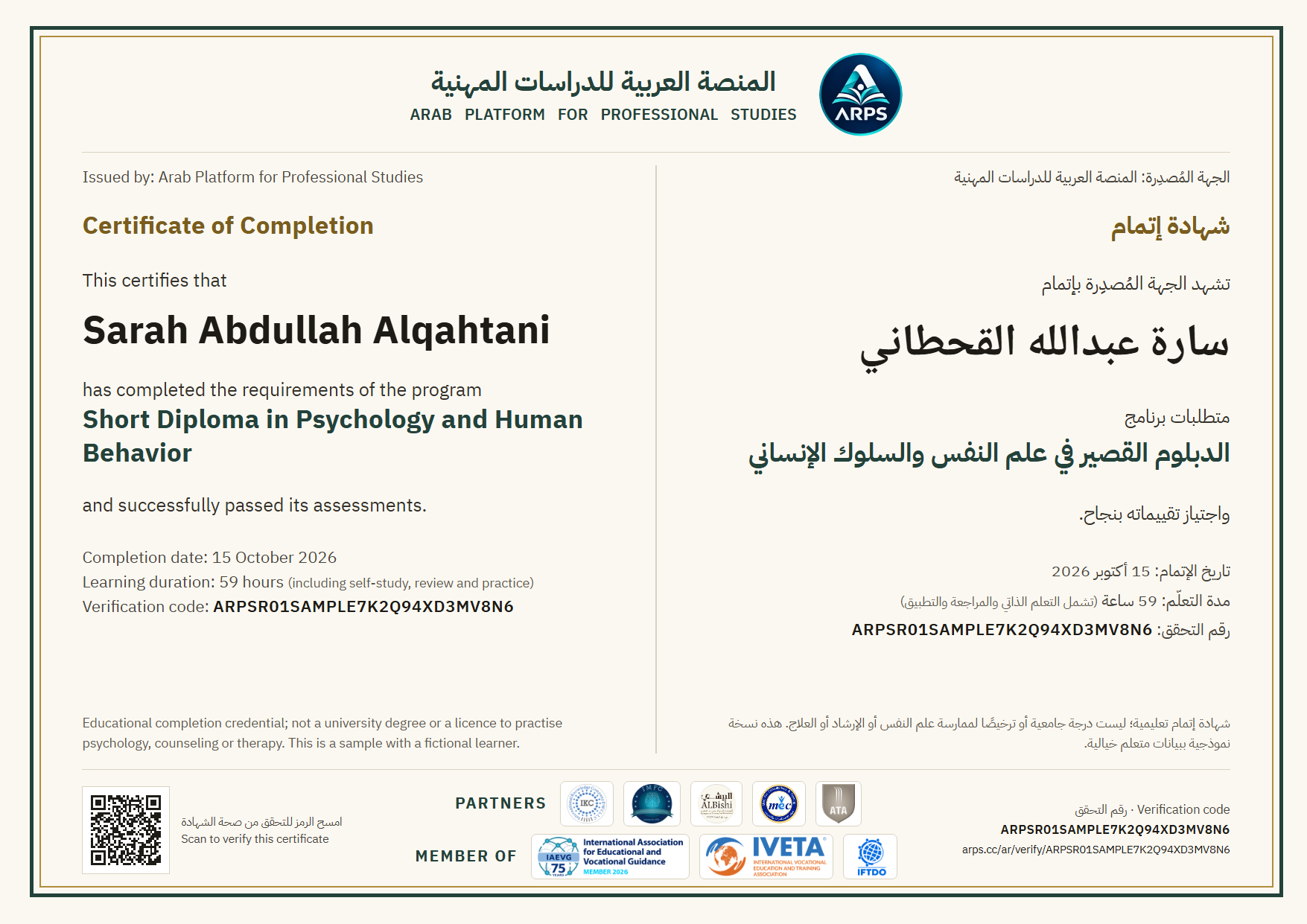
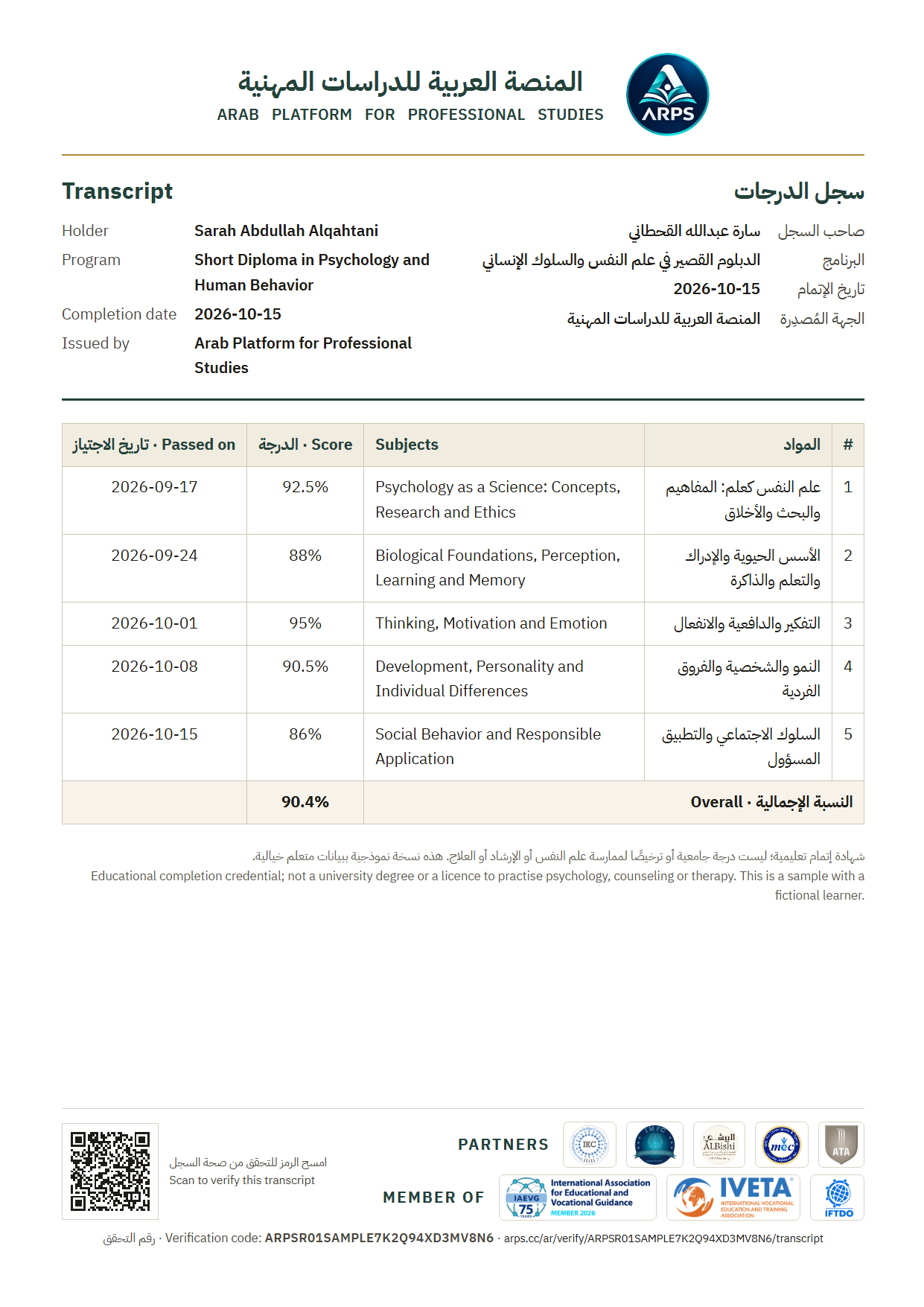
A sample from a real program in this track: Short Diploma in Psychology and Human Behavior. The learner, scores and dates are fictional; opens in a new window.
Disclaimer: Educational completion, not a university degree or professional licence.
Program questions
Does this program grant a licence?
No. It is educational completion, with no professional authorization or external endorsement.
Are city-case figures real?
No. Each regional example is explicitly marked as a fictional training scenario.
How is learning assessed?
Each lesson has a check and every subject has its own automatically scored summative assessment with explanations under route policy.
Do I need advanced statistics?
No. Basic percentages and small tables are enough; lessons work through denominators, relative change, and percentage points.
How should scenarios be used?
Use them to stress-test present options across plausible futures, not as certain predictions or automatically equal-probability outcomes.
Show all (7)
Is Short Diploma in Foresight and Trend Analysis free, and do I get a certificate?
Yes. Short Diploma in Foresight and Trend Analysis is free on ARPS: every lesson, exercise and assessment is free, the first subject is open to read without an account, and the program is available in Arabic and English. Issuing a certificate is optional and has a published fee; it is a training completion certificate showing you passed the program's assessments, recognised by most private-sector organisations in the Gulf states and most Arab countries, and it strengthens your CV; confirming that a specific organisation accepts it remains your responsibility.
What other names is Short Diploma in Foresight and Trend Analysis known by?
The subject of this program is also known as: strategic foresight, futures thinking, trend analysis, futures studies. Learners usually find it by searching for: strategic foresight course, strategic foresight methodology, trend analysis example, futures thinking free course, scenario planning methods.
Learn to frame an advisory decision, scrutinise signals and trend data, construct coherent scenarios, stress-test options and give revisable advice under uncertainty.
Learn to frame answerable questions, collect traceable accounts, analyse them and integrate quantitative data when the shared question warrants it. The sequence moves from design and ethics through coding, joint displays, reporting and a decision brief, then an applied capstone.
A short diploma that builds a structured way to examine claims, arguments, evidence, and numbers. It moves from argument structure and logic to probability, evidence quality, fallacies, and belief revision, using country-neutral applications transferable to work and everyday decisions.
A foundational, applied diploma on turning a broad idea into a clear research question, then into a design, sample, measurement plan, analysis, interpretation and transparent report.
6 subjects
24 lessons
57 hours
Free
Next step: a professional certification or a mini-master
Programs in the same domain that prepare you for an international certification exam or form a professional mini-master, also free.