Short Diploma in Qualitative and Mixed Methods Research
Short Diploma in Qualitative and Mixed Methods Research is a free program on ARPS, the Arab Platform for Professional Studies. Learn to frame answerable questions, collect traceable accounts, analyse them and integrate quantitative data when the shared question warrants it. The sequence moves from design and ethics through coding, joint displays, reporting and a decision brief, then an applied capstone.
Important notice: Foundational methods education; it is not professional accreditation, independent ethics approval or proof of research competence.
Distinguish a meaning question from rate or effect estimation.
Justify qualitative, quantitative or mixed design against the decision need.
State the inference boundary of each design.
From lesson 1, readable now without an account: From a broad problem to an answerable qualitative question
Begin with a question that the intended evidence can answer, rather than with the name of a collection tool. ‘The library is poor’ is an unbounded judgment: whose experience, which service and what circumstances are involved? Qualitative inquiry can examine meanings, steps and obstacles in participants’ accounts. It therefore helps to separate the observed issue from an assumed explanation. Low workshop attendance may justify an inquiry, but it does not establish why people stayed away. A few interviews cannot estimate the proportion of all library users who experienced a particular obstacle.
A free account saves your progress and takes you straight to lesson 1.
Program facts
Study fee
Free
subjects
6
lessons
29
Estimated time
73.5 hours
Content last reviewed
Access period
60 days
Study language
Arabic and English
About the program
The programme starts with a common evidence problem: a log describes what happened and accounts explain how people experienced the journey, yet the team has not decided which question each source can answer. You will frame a bounded question, distinguish a case from shared experience and theory-building inquiry, and select a qualitative or mixed design for the inference sought. You will plan purposeful recruitment, intelligible consent and disclosure safeguards, then collect interviews, observation and documents with their provenance and context.
In the second half you prepare a qualitative corpus, apply codes with explicit boundaries and build themes tested against countercases. You will decide when numeric evidence serves a common question and how convergent, explanatory sequential and exploratory sequential designs differ. A joint display makes agreement, divergence and gaps visible before you write a claim bounded by its evidence. A decision brief then defines a small measurable action and a rule for adjusting it, and a capstone traces residential maintenance experience across research waves through to the study handover. Regional cases are clearly hypothetical training scenarios; their figures are not presented as real population or service data.
Practical relevance
Exercises produce a question matrix, recruitment plan, interview guide, deviation log, codebook, joint display and decision brief. Worked solutions show how the inference changes when a denominator, sequence or countercase changes.
Why this program
A pile of quotations can be mistaken for strong evidence, and a percentage can be placed beside an account without analysis of their connection. This programme trains you to trace each claim to a case, denominator or observation and to name what the available evidence cannot settle.
Career relevance
Useful for research, evaluation and improvement teams in education and public services: learners practise a small protocol, excerpt analysis, reporting review and decision briefs. It makes no promise of professional licensing or unsupervised field competence without further training.
Career paths this program serves
This program is a step on the paths of the following occupations. Open a path to see its other programs in study order.
Frame a research question that separates lived experience from prevalence or causal testing.
Choose a qualitative or mixed design and document where its strands connect.
Construct purposeful sampling and collection plans protecting consent, identity and context.
Code a qualitative corpus and develop themes that withstand countercases.
Build a joint display and integrated inference that retain different denominators.
Show all (7)
Write a transparent report and decision brief linked to a follow-up test.
Apply qualitative and mixed-methods skills in a capstone that follows participants across waves, reconciles records with accounts, and hands over a traceable, correctable study package.
Learning outcomes (5)
Frame a bounded question and justify a feasible qualitative or mixed methods design.
Select informative cases, protect consent and identity, and collect traceable interviews, observations and documents.
Prepare a qualitative corpus, code excerpts and develop themes bounded by evidence and countercases.
Select an appropriate mixed sequence and build a joint display and bounded integrated inference.
Write a transparent report linking findings and limits to a measurable follow-up decision brief.
Who it is for
Learners and professionals who need a structured foundation for qualitative or mixed inquiry in education and public services, and who want to turn a vague problem into a reviewable evidence plan without assuming advanced prior experience.
Evaluation and service improvement teams who read usage logs alongside interviews and need to separate what each strand establishes, display their disagreements and limitations, and resist forcing both into a single unsupported answer.
Research assistants and report writers who audit the path from excerpt to code and theme, or from numerator and denominator to inference, and need clear wording for scope and countercases.
Prerequisites
No advanced research training is required. Learners need to read short texts and simple tables and distinguish a person from a source document. The programme starts with question boundaries and explains terms before analytical use.
Willingness to write short memos and revise a decision when contrary evidence appears is useful. Training cases can be completed with pen and paper or a text document; no particular qualitative or statistical software is required.
What it does not offer
It does not replace institutional ethics review or real participant consent in a field project.
It does not guarantee population representation or turn temporal association into causal proof.
It is not training for clinical trials, legal advice or independent professional accreditation.
A useful qualitative question bounds experience and context without presuming a cause. The question determines evidence: interviews.
5 lessons · 8 hours
From a broad problem to an answerable qualitative question1.5 hours
Matching the inquiry approach to the question1.5 hours
Choosing a qualitative approach and bounding the case1.5 hours
Why and when to integrate two strands1.5 hours
A feasible, reviewable small-study protocol1.5 hours
Subject 2
Sampling, ethics and data collection
Purposive sampling follows the question and seeks variation and countercases. Consent is bounded by purpose, use and audience; deleting a name cannot authorise broader sharing.
5 lessons · 8.5 hours
Purposive sampling and variation in experience1.5 hours
Participation consent and disclosure in narratives1.5 hours
Interview guides and neutral probes1.5 hours
Observation, documents and source provenance1.5 hours
Reflexivity and a collection-deviation log1.5 hours
Subject 3
Qualitative analysis and interpretive credibility
A corpus inventory distinguishes sources from cases and preserves version, permission and context during segmentation. First-cycle coding links a specific excerpt to a tag, evidence and limit.
5 lessons · 8.5 hours
Preparing a qualitative corpus without losing context1.5 hours
First-cycle coding grounded in excerpt and context1.5 hours
Codebooks and resolving coding disagreements1.5 hours
From codes to themes and disconfirming cases1.5 hours
Testing credibility and limits of interpretation1.5 hours
Subject 4
Mixed methods designs and integration
A convergent study first analyses each strand and then aligns them on a comparable concept and period..
5 lessons · 8.5 hours
Convergent design and strand comparison1.5 hours
Explanatory sequential follow-up to a numeric pattern1.5 hours
From qualitative concept to tested measurement item1.5 hours
Building a joint display that preserves discordance1.5 hours
Integrated inference and its boundaries1.5 hours
Subject 5
Reporting evidence and decision briefs
Methods reporting states question, recruitment, interviewer, instrument version, analysis, deviations and limits. Present a specific theme with evidence, countercase and limit.
5 lessons · 8.5 hours
Reporting methods for a reviewable study1.5 hours
Reporting themes with excerpts and countercases1.5 hours
Writing mixed results and the integration point1.5 hours
Limitations and transferability of insight1.5 hours
Decision brief linking evidence to the next test1.5 hours
A capstone that applies research skills to a fictional study of residential maintenance experience, from following households across waves and reconstructing event time to participatory interpretation and handing over the study package.
4 lessons · 18 hours
Following household trajectories across research waves4.5 hours
Reconstructing event time across records and accounts4.5 hours
A participatory interpretation session that retains competing interests4.5 hours
Handing over a study package and managing later corrections4.5 hours
Subjects unlock in sequence as you progress.
Strengths
A continuous sequence from question and recruitment through analysis, integration and decision, with two solved exercises per lesson.
Clearly marked fictional training cases across Arab settings that are never presented as actual field data.
Separate assessment banks with explanations for options and explicit inference boundaries.
Method sources and reporting guidance with stated scope, separated from local ethics decisions.
Evidence basis
Concepts draw on published methodological resources from NIH, CDC and UK Data Service, reporting guidance SRQR, COREQ and GRAMMS, and a published joint-display example. Each source is used within its scope; a funder or disciplinary guide is not presented as universal law.
Reference organizations
NIH OBSSR
CDC
UK Data Service
EQUATOR Network
Frameworks used
SRQR qualitative reporting — 2014
GRAMMS mixed methods reporting — 2008
Methodology
Learning moves from question and design to collecting and coding accounts, then tests integration and reporting. Each claim is tied to a source within its scope.
How the route works
Short Diplomas are relatively comprehensive learning pathways that cover a major subject through five connected learning subjects and structured assessments, with a diploma transcript available with the credential.
Self-paced sequential study. Content unlocks progressively and each subject combines reading, examples, exercises, knowledge checks, and assessment.
Build integrated knowledge in a major subject.
Study through five clear, connected learning subjects.
Complete a defined assessment for each subject.
Receive a diploma transcript showing subjects and results when the credential is issued.
Assessment
Each Short Diploma contains five subjects, each with an approved assessment. A sixth final exam is not required when the five assessments adequately cover the learning outcomes.
Assessment attempts: 2 per assessment, 7 days apart
The pass mark is announced before the program is published.
Certificate
Successful completion makes the learner eligible for the Short Diploma certificate and Diploma Transcript under the credential policy.
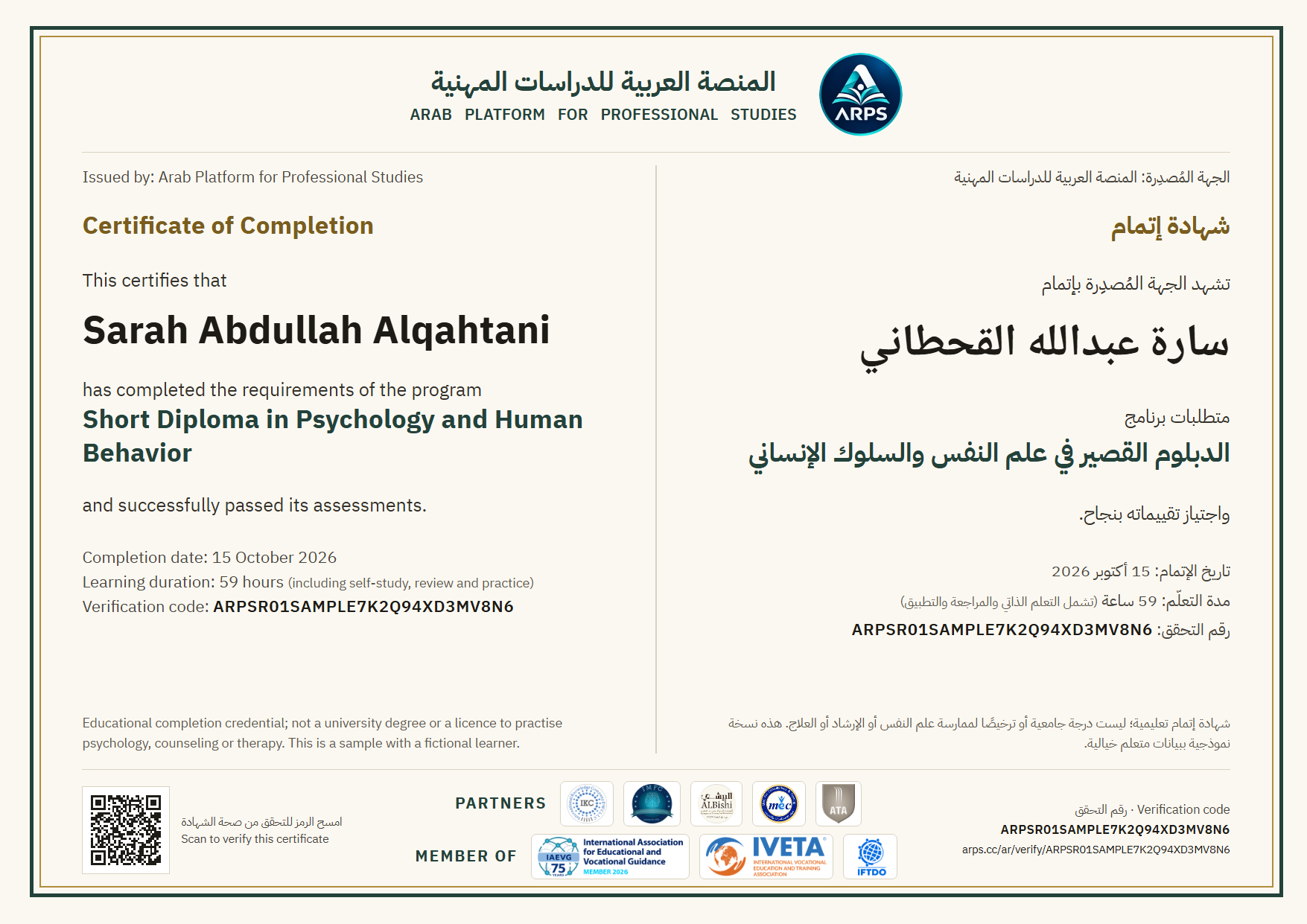
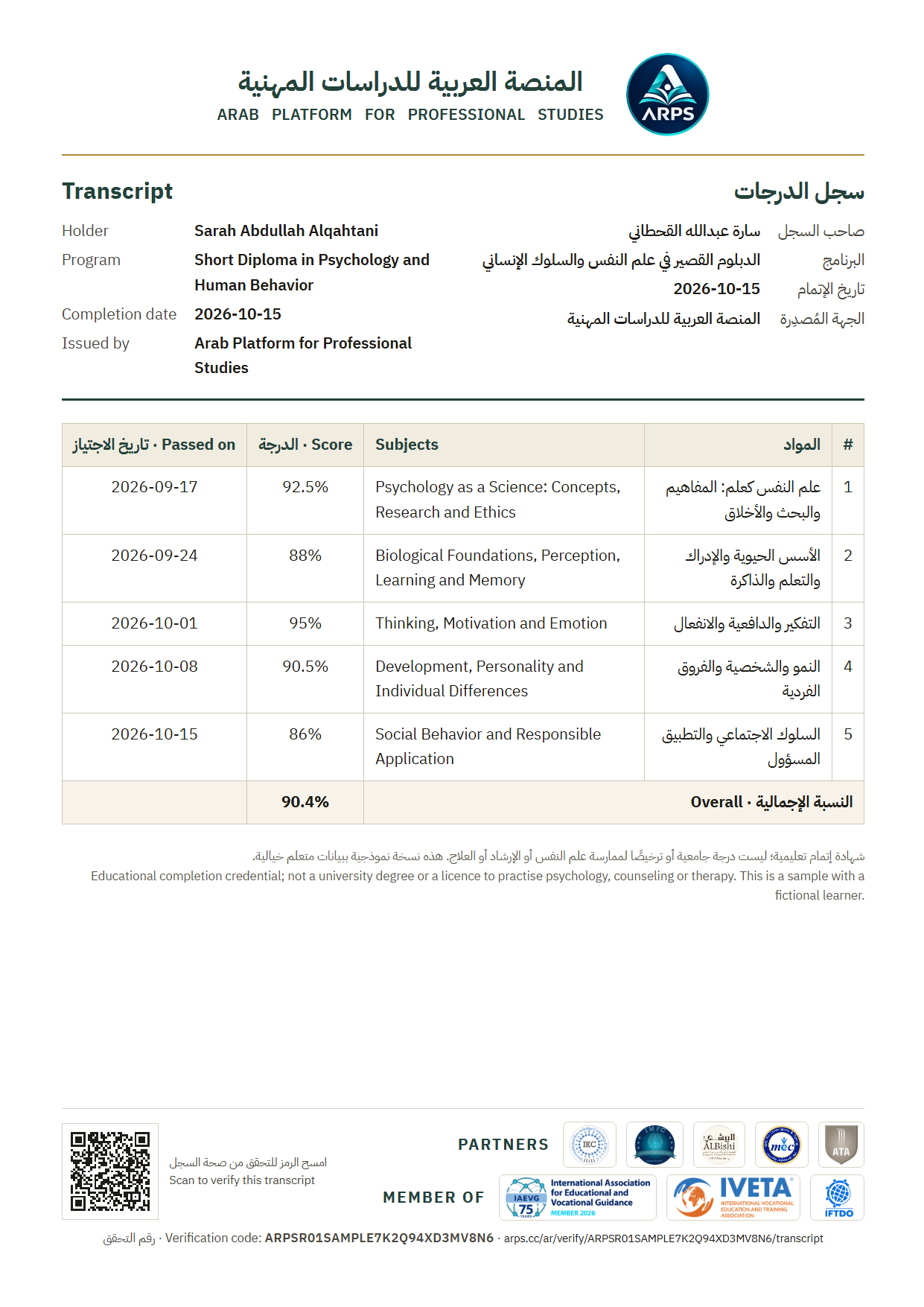
A sample from a real program in this track: Short Diploma in Psychology and Human Behavior. The learner, scores and dates are fictional; opens in a new window.
Disclaimer: A training completion credential under central policy when requirements are met; not a university degree, research licence or external accreditation.
Program questions
Do I need coding or statistical software?
No. Question matrices, coding and joint displays can be completed in writing. Software can organise work but cannot define cases, denominators or analytic decisions for you.
Is any report with a table and quotations mixed methods?
No. Mixed inquiry needs a shared question and an explicit integration point showing what the strands added together or where they diverged.
Can interviews estimate how common a problem is?
Purposeful interviews illuminate experience and possible mechanisms. Estimating prevalence calls for a consistent measure, denominator and sample suited to that question.
Do reporting checklists certify quality?
They can reveal missing information in a report, but do not by themselves validate interpretation, consent or sampling decisions.
Can findings transfer to every service?
Transfer depends on a description of context, mechanism, resources and limits, followed by a test in the new setting rather than an assumption that services are identical.
Show all (7)
Is Short Diploma in Qualitative and Mixed Methods Research free, and do I get a certificate?
Yes. Short Diploma in Qualitative and Mixed Methods Research is free on ARPS: every lesson, exercise and assessment is free, the first subject is open to read without an account, and the program is available in Arabic and English. Issuing a certificate is optional and has a published fee; it is a training completion certificate showing you passed the program's assessments, recognised by most private-sector organisations in the Gulf states and most Arab countries, and it strengthens your CV; confirming that a specific organisation accepts it remains your responsibility.
What other names is Short Diploma in Qualitative and Mixed Methods Research known by?
The subject of this program is also known as: qualitative research, mixed methods research, qualitative methods, mixed methods. Learners usually find it by searching for: qualitative research course online, qualitative research course free, mixed methods research course, qualitative data analysis, qualitative and quantitative research.
This short diploma shows learners how to turn a broad question about the future into a bounded decision that can be examined. They frame its horizon and system, record signals with source limits, compare measurable trends, and construct distinct, coherent scenarios. They then stress-test present options, design small reversible trials, and choose signposts that could change a decision. All case figures are fictional; worked solutions retain denominators, assumptions, and inference limits. Each subject includes observable practice and a summative assessment. Completion is educational and does not confer a professional licence or consulting authorization.
A short diploma that builds a structured way to examine claims, arguments, evidence, and numbers. It moves from argument structure and logic to probability, evidence quality, fallacies, and belief revision, using country-neutral applications transferable to work and everyday decisions.
A foundational, applied diploma on turning a broad idea into a clear research question, then into a design, sample, measurement plan, analysis, interpretation and transparent report.
Learn to frame a claim, trace digital copies, test place and time, and preserve evidence while protecting people. Finish with a case file that separates supported findings from unproven causes and links each conclusion to evidence and search limits.
8 subjects
35 lessons
50.5 hours
Free
Next step: a professional certification or a mini-master
Programs in the same domain that prepare you for an international certification exam or form a professional mini-master, also free.