
Specialist Preparation Program in Learning and Development

Specialist Preparation Program in Learning and Development is a free program on ARPS, the Arab Platform for Professional Studies. Diagnose workplace performance gaps, design suitable practice, deliver across shifts, and evaluate learning and workplace use within a specialist role. Begin with an unspecified learning request and distinguish skill needs from tool or process constraints.

Corporate learning studio with a VR headset on a stand, a coaching pair of figurines and a wall of blank course cards: cover of the ARPS program Specialist Preparation Program in Learning and Development Studying is completely free
Estimated time
54 hours
subjects
8
lessons
36
Study language
Arabic and English

Certificate issuance fee

$90

331 AED or 338 SAR

After you pay the certificate fee, you can print the certificate and transcript in both Arabic and English, or in English only.

Start the first subject now Fees by route

What you will learn in the first 10 minutes

The opening lessons of the first subject, with the reading time set for each. Approximate total time in minutes: 10

  1. From course request to a bounded diagnostic brief 5 min read
    • Turn an initial training request into a bounded, testable L&D intake brief and identify who can authorise each next decision.
  2. Separating a skill gap from a work-system fault 5 min read
    • Distinguish a trainable knowledge/skill gap from workflow, tool, opportunity and incentive constraints using observed task evidence.

From lesson 1, readable now without an account: From course request to a bounded diagnostic brief

An L&D specialist often receives a short message: “We need customer service training.” That message proposes a solution; it does not specify the problem the solution should address. The first professional task is to turn it into a testable diagnostic brief. The brief answers six questions: who requested the work and who can decide; which role and task are affected; what workplace behaviour is expected; what happens now and what evidence shows it; when a decision is needed; and which constraints change the options. Asking these questions neither rejects the request nor promises a course before the cause of the gap is understood.

Distinguish three people who may or may not be the same: the sponsor who seeks and funds a result, the process owner who defines the performance standard and can change the workflow, and the learner who performs the task. A sales director might fund training while a contact-centre supervisor defines the complaint-handling steps and releases staff for practice. If the process owner is absent, excellent materials can be built for a standard the team cannot use. Record a named person or role rather than “management”; specify who can approve the diagnostic scope, performance standard, staff time, final material and release decision. An unresolved authority is an open decision to escalate before development effort is committed.

Next, state the difference between desired and observed performance in observable terms. “Improve communication” is too broad. “Verify the customer, restate the issue and check agreement before proposing a remedy on each eligible call” is behaviour that can be observed. A numerical indicator alone is not a substitute for behaviour. More complaints may come from long waits caused by staffing or a broken system rather than conversation skill. Record each metric with its denominator, period and source; then seek a work sample, short interview or observation to locate the failure. A manager's claim that “everyone needs training” is a hypothesis, not a baseline.

Use a one-page intake brief. At the top, state the next decision: conduct a bounded diagnosis before selecting an intervention, or develop an intervention because a reliable diagnosis already exists. Below it place the task and role, approximate audience, performance standard, available and missing evidence, constraints, decision date and approver. Also state what lies outside scope. In the contact-centre example, the specialist may review complaint coding and an authorised sample of calls. They cannot independently extract personal recordings or change system access. Employee and customer data access follows organisational policy and authorised decisions; it is not a detail to defer until launch.

Order the interview questions to make good use of colleagues' time. Begin with the claimed business result; ask for one specific successful and one unsuccessful task; compare them; then ask what has changed in tools, incentives and workload. Test whether the employee can perform the task under ordinary conditions. This is more useful than a general satisfaction survey. If the sponsor cannot define success, propose a provisional operational definition for the process owner to approve. Do not attribute that definition to the sponsor as an agreed fact. When sponsor and supervisor accounts conflict, record both and identify evidence that could distinguish them rather than choosing the more senior account.

There are three useful exit decisions. “Continue diagnosis” fits when a task, provisional standard and legitimate evidence route exist. “Pause for authority” fits when the standard owner, data access or realistic decision window is missing. “Route a likely non-learning cause” fits when initial evidence points to a process, tool or incentive beyond employee skill. Routing does not end the L&D role: the specialist can document a need for a job aid or coordination with operations, but should not label a system repair a training course. This early decision protects learner time and makes subsequent work reviewable.

Separate facts, assumptions and decisions in the brief. A fact might be “12 of 80 complaint records reviewed by a supervisor lacked a reason code during one specified week.” An assumption is “employees do not know the codes.” A decision is “inspect a sample of the input screen and interview two agents before selecting a response.” These numbers are hypothetical and do not establish a general quality rate for the centre. Twelve divided by 80 is 15% of that sample only; a sample selected from complex complaints cannot be generalised to all calls. The brief is good when it directs the next evidence and decision, not when it uses many words.

Read the full lesson free
Start free

A free account saves your progress and takes you straight to lesson 1.

Program facts

Study fee
Free
subjects
8
lessons
36
Estimated time
54 hours
Content last reviewed
Access period
30 days
Study language
Arabic and English

About the program

Begin with an unspecified learning request and distinguish skill needs from tool or process constraints. Translate tasks into capability evidence and testable outcomes, choose a fitting response and design cases with feedback. Develop facilitator and learner assets from one approved rule, pilot a bounded task, and operate across shifts while separating access from proficiency. Plan workplace opportunity, define indicators with counts and denominators, and write conclusions limited by the evidence. The final module covers decision authority, build-or-buy appraisal, learning records and periodic improvement. Cases are fictional. The programme claims neither measured business impact nor external accreditation nor authority to alter organisational policy. The extension adds interviewing, sampling, observation and survey practice, sustained retrieval, peer coaching and asset maintenance. A fictional returns capstone integrates diagnosis, prototyping, pilot operation, scale interpretation and maintenance handover.

Practical relevance

Use an intake brief, capability map, worked case, decision aid and evaluation plan in fictional workplace situations, then adapt the method to authorised work after checking actual rules.

Why this program

Course requests can become events before a gap is diagnosed. This programme connects diagnosis, intervention, workplace application and evaluation while keeping rule and data decisions with their owners.

Career paths this program serves

This program is a step on the paths of the following occupations. Open a path to see its other programs in study order.

What you will learn

  • Separate a training request from performance diagnosis, map the task and evidence, then prioritise intervention options within capacity.
  • Turn diagnosis into measurable outcomes and a fit-for-cause response, then build progressive practice and accessible delivery routes.
  • Verify the rule with its owner, align facilitator and learner materials, pilot the affected decisions, and operate access across shifts.
  • Separate learning from workplace application, design assessment and evaluation measures, and interpret results with denominators and uncertainty.
  • Assign decision rights, compare build and buy, protect learning data and review when to keep, revise, scale or stop.
Learning outcomes (36)
  1. Turn an initial training request into a bounded, testable L&D intake brief and identify who can authorise each next decision.
  2. Distinguish a trainable knowledge/skill gap from workflow, tool, opportunity and incentive constraints using observed task evidence.
  3. Map a role into observable tasks, proficiency levels and evidence of current versus future capability.
  4. Prioritise a bounded L&D backlog with transparent criteria, sensitivity checks and authority for tradeoffs.
  5. Write measurable learning and workplace outcomes with conditions, standards and evidence matched to the diagnosed task.
  6. Select an intervention that fits the cause, task, learner context and authority, including a non-training option.
  7. Design authentic progressive practice with a worked model, observable checks and feedback tied to errors.
  8. Select accessible learning modalities from task demands, device, schedule and language constraints, with an equivalent route to the same outcome.
  9. Run a traceable subject-matter review that resolves factual disagreement and version changes before release.
  10. Produce a facilitator run sheet and learner job aid with consistent steps, examples, feedback and version control.
  11. Run a bounded pilot, separate content defects from channel and process faults, and decide change severity.
  12. Operate a delivery run sheet that coordinates access, prerequisites, exceptions and evidence without confusing attendance with learning.
  13. Build a transfer plan with opportunity, manager support, point-of-use aid and observable follow-up.
  14. Build an assessment blueprint and single-answer items that sample taught decisions fairly, with explicit scoring and distractor reasoning.
  15. Choose process and outcome evaluation questions, indicators, baseline, collection method and interpretation limits before delivery.
  16. Interpret L&D results with denominators, missing data, comparison limits and a restrained decision memo.
  17. Assign distinct sponsor, process, content, operations and data decisions and escalate unresolved authority before release.
  18. Compare build/buy/vendor options by total cost, task fit, access, data and maintenance, then present a bounded recommendation.
  19. Define a minimum learning-data inventory, purpose, access, retention owner and escalation path without inventing a legal period.
  20. Run a review cadence that chooses keep, revise, scale or stop using defined signals, dependencies and learning limits.
  21. Interviewing without leading the answer using the supplied case and checking the resulting decision.
  22. Sampling records across shifts and rare cases using the supplied case and checking the resulting decision.
  23. Observation that two observers can interpret consistently using the supplied case and checking the resulting decision.
  24. A short survey with one construct per item using the supplied case and checking the resulting decision.
  25. Eliciting expert reasoning from a critical incident using the supplied case and checking the resulting decision.
  26. Using entry assessment to route learners to practice using the supplied case and checking the resulting decision.
  27. Facilitating a case discussion when answers differ using the supplied case and checking the resulting decision.
  28. Scheduling retrieval across working weeks using the supplied case and checking the resulting decision.
  29. Preparing peers to observe and coach performance using the supplied case and checking the resulting decision.
  30. Comparing learning routes without hiding group differences using the supplied case and checking the resulting decision.
  31. Maintaining learning assets after a work-rule change using the supplied case and checking the resulting decision.
  32. Capstone: diagnosing returns requests using the supplied case and checking the resulting decision.
  33. Capstone: prototyping returns practice using the supplied case and checking the resulting decision.
  34. Capstone: running a cross-shift pilot using the supplied case and checking the resulting decision.
  35. Capstone: interpreting results and deciding scale using the supplied case and checking the resulting decision.
  36. Capstone: defending a recommendation and handing over maintenance using the supplied case and checking the resulting decision.

Who it is for

  • Practitioners seeking practical capability in organisational learning and development
  • Professionals in related roles who need applicable tools and procedures
  • Learning and development specialists and training coordinators moving from delivering courses to diagnosing performance and designing measurable interventions.
  • HR business partners and team supervisors who receive training requests and need evidence-based decisions about them.

Prerequisites

  • Basic familiarity with work procedures, tables and simple rates.
  • Practical experience contributing to the design, delivery or coordination of training in an organisation, even in a supporting role.
  • Ability to read a job description or work procedure and turn it into observable tasks.
  • Comfort using simple tables to record evidence, priorities and pilot results.
  • Willingness to apply the exercises to a real or hypothetical training request within the 30-day access window.

Curriculum

  1. Subject 1 Open for free

    Performance and learning diagnosis

    Separate a training request from performance diagnosis, map the task and evidence, then prioritise intervention options within capacity.

    4 lessons · 3 hours
    1. From course request to a bounded diagnostic brief 46 min
    2. Separating a skill gap from a work-system fault 46 min
    3. Capability mapping from task to evidence 46 min
    4. Prioritising needs when capacity is limited 44 min
  2. Subject 2

    Designing applicable interventions

    Turn diagnosis into measurable outcomes and a fit-for-cause response, then build progressive practice and accessible delivery routes.

    4 lessons · 3 hours
    1. From performance gap to testable outcome 44 min
    2. Choosing an intervention that addresses the cause 44 min
    3. Worklike practice and feedback that changes decisions 44 min
    4. A learning format the audience can actually use 44 min
  3. Subject 3

    Developing and implementing materials

    Verify the rule with its owner, align facilitator and learner materials, pilot the affected decisions, and operate access across shifts.

    4 lessons · 3 hours
    1. A subject expert review that produces decisions, not a ceremonial signature 44 min
    2. Facilitator and learner materials from one decision 44 min
    3. A pilot and a useful defect log 44 min
    4. Running learning across shifts and exceptions 44 min
  4. Subject 4

    Transfer and measurement

    Separate learning from workplace application, design assessment and evaluation measures, and interpret results with denominators and uncertainty.

    4 lessons · 3 hours
    1. Moving learning into work 44 min
    2. An assessment blueprint for the decision taught 44 min
    3. An evaluation plan built around a decision 44 min
    4. Reading results without claiming more than they show 44 min
  5. Subject 5

    Operating the L&D function

    Assign decision rights, compare build and buy, protect learning data and review when to keep, revise, scale or stop.

    4 lessons · 3 hours
    1. Who decides what in L&D? 44 min
    2. Comparing build and buy within authority 44 min
    3. Learning records and the data actually needed 44 min
    4. Continuous improvement through an explicit decision 46 min
  6. Subject 6

    Field evidence with interpretable meaning

    Gather interview, sampling, observation and survey evidence, then elicit expert decision clues. Produce trialled collection tools and interpretations with explicit limits.

    5 lessons · 9.5 hours
    1. Interviewing without leading the answer 2 hours
    2. Sampling records across shifts and rare cases 2 hours
    3. Observation that two observers can interpret consistently 2 hours
    4. A short survey with one construct per item 2 hours
    5. Eliciting expert reasoning from a critical incident 2 hours
  7. Subject 7

    Sustained practice and maintainable delivery

    Route entry support, facilitate discussion and retrieval, and prepare peer coaching. Compare learning routes and maintain assets while separating access from performance.

    6 lessons · 11.5 hours
    1. Using entry assessment to route learners to practice 2 hours
    2. Facilitating a case discussion when answers differ 2 hours
    3. Scheduling retrieval across working weeks 2 hours
    4. Preparing peers to observe and coach performance 2 hours
    5. Comparing learning routes without hiding group differences 2 hours
    6. Maintaining learning assets after a work-rule change 2 hours
  8. Subject 8

    Integrated returns-handling capstone

    Integrate diagnosis, design, pilot delivery, scale interpretation and maintenance handover in a fictional returns file, linking evidence, resources and authority.

    5 lessons · 14 hours
    1. Capstone: diagnosing returns requests 3 hours
    2. Capstone: prototyping returns practice 3 hours
    3. Capstone: running a cross-shift pilot 3 hours
    4. Capstone: interpreting results and deciding scale 3 hours
    5. Capstone: defending a recommendation and handing over maintenance 3 hours

Subjects unlock in sequence as you progress.

Strengths

  • Performance diagnosis before course selection
  • Work-decision practice with feedback
  • Evaluation separating learning, application and impact

Evidence basis

CIPD, ATD, CDC and NIST sources support the stated locations. Cases are fictional and some CIPD pages provide public overviews only. Mention does not imply endorsement.

Methodology

Course requests can become events before a gap is diagnosed. This programme connects diagnosis, intervention, workplace application and evaluation while keeping rule and data decisions with their owners.

Assessment

Assessments follow the program blueprint and may use module assessments, a final assessment, or a combination, under the approved attempt policy.

Assessment attempts: 2 per assessment, 7 days apart

The pass mark is announced before the program is published.

Certificate

The credential confirms completion and successful assessment; it does not represent professional licensure unless explicitly and lawfully stated.

Every certificate has a public verification code. Verify a certificate

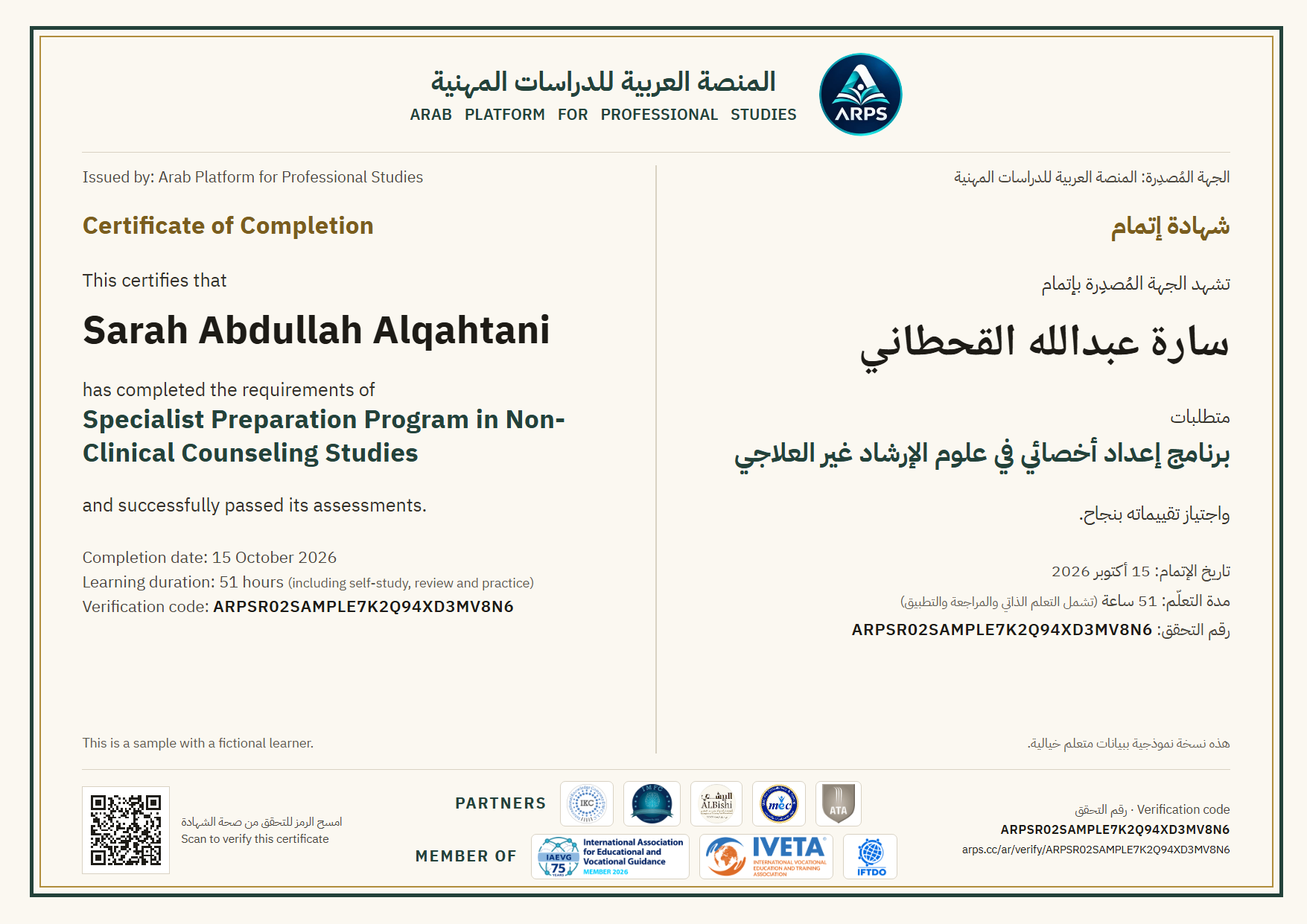
A sample from a real program in this track: Specialist Preparation Program in Non-Clinical Counseling Studies. The learner, scores and dates are fictional; opens in a new window.

Verification example: a real issued certificate

Program questions

Does this programme grant professional licensure?

No. It teaches defined specialist tasks without external accreditation or authority to change organisational procedure.

Do I need workplace data?

No. Teaching cases are fictional; later workplace use requires organisational permission.

Does test success prove workplace impact?

No. The test checks case decisions; workplace follow-up needs opportunity and separate evidence.

How do exercises differ from assessment?

Exercises are ungraded self-practice with worked feedback; assessments draw original decision items by module blueprint.

How is study time estimated?

Reading, practice and assessment time are editorial estimates based on text and tasks, not official accredited hours.

Show all (8)
Must I buy a platform?

No. Cases can be solved with the supplied text and data without a paid external account.

Is Specialist Preparation Program in Learning and Development free, and do I get a certificate?

Yes. Specialist Preparation Program in Learning and Development is free on ARPS: every lesson, exercise and assessment is free, the first subject is open to read without an account, and the program is available in Arabic and English. Issuing a certificate is optional and has a published fee; it is a training completion certificate showing you passed the program's assessments, recognised by most private-sector organisations in the Gulf states and most Arab countries, and it strengthens your CV; confirming that a specific organisation accepts it remains your responsibility.

What other names is Specialist Preparation Program in Learning and Development known by?

The subject of this program is also known as: learning and development, L&D, training and development, workplace learning. Learners usually find it by searching for: free learning and development course, learn training design online, training needs analysis, measuring training impact, L&D course with completion certificate.

Professionals in this domain

Connect with certified consultants, trainers, coaches and specialists in the same domain across the ARPS communities.