Professional Mini-Master in Strategic People Analytics and Workforce Planning
Professional Mini-Master in Strategic People Analytics and Workforce Planning is a free program on ARPS, the Arab Platform for Professional Studies. Build defensible workforce decisions from data definitions and quality through skill gaps, option evaluation, and delivery. Five advanced modules develop workforce decisions, data, forecasting, talent options, evaluation, and governance, followed by a multi-site service capstone.
Translate a service-level threat into a decision statement, horizon, alternatives, and a falsifiable success rule.
From lesson 1, readable now without an account: From business question to testable decision
Imagine a technology service company saying, 'We need more analysts.' That is a proposed remedy, not yet a workforce-planning problem. Delays might reflect too few people, knowledge concentrated in one shift, a change in the mix of requests, or a slow approval step. Start with a decision question: which business result is current capacity failing to deliver, over what horizon, and which alternatives can the accountable leader actually choose? CIPD frames workforce planning as balancing the supply of people and skills against demand. A headcount snapshot therefore cannot settle the matter. People analytics brings people data and business context to a problem. The two practices meet when an analysis informs an executable choice, instead of producing a dashboard and then looking for a use for it.
A free account saves your progress and takes you straight to lesson 1.
Program facts
Study fee
Free
subjects
6
lessons
50
Estimated time
182 hours
Content last reviewed
Access period
60 days
Study language
Arabic and English
About the program
Five advanced modules develop workforce decisions, data, forecasting, talent options, evaluation, and governance, followed by a multi-site service capstone. This version contains fifty bilingual lessons, extending preserved cases and practice and adding eleven project lessons. Learners create a demand-supply workbook, transition and funding memo, pilot protocol, and response and handover pack. All case numbers are fictional, with explicit inference, privacy, fairness, and authority limits. Learning requires no real employee data and confers no external acceptance or accreditation.
Practical relevance
Apply the methods to a familiar process after excluding sensitive personal data: define demand and capacity, calculate a skill gap, compare two options, and set activation conditions. The complete fictional cases also support practice without employer data.
Why this program
Total headcount can look sufficient while a critical skill or month has a shortage. An aggregate indicator may move with case mix, and a voluntary intervention may look effective because of participant selection. Decisions therefore need defined data, timed scenarios, and causal and fairness review rather than a lone hiring number.
Career relevance
The program suits people analysts, workforce planners, HR managers, and operations leaders responsible for capability decisions. It develops professional judgment without promising a job, promotion, or external accreditation.
Career paths this program serves
This program is a step on the paths of the following occupations. Open a path to see its other programs in study order.
Advanced application in Frame the workforce decision and its evidence through worked professional cases.
7 lessons · 22 hours
From business question to testable decision3 hours
Unit of analysis and people data model3 hours
Metric denominators and cohort construction3 hours
Data fitness and operational privacy3 hours
Causality in people decisions3 hours
Segmentation and aggregate-rate reversals3 hours
Metric contract and evidence brief3 hours
Subject 2
Forecast demand, supply, and skills
Advanced application in Forecast demand, supply, and skills through worked professional cases.
8 lessons · 25 hours
Demand drivers and workload translation3 hours
Demand scenarios and model limits3 hours
Internal workforce flows3 hours
Skill inventory and transferability3 hours
Headcount and skill gaps under uncertainty3 hours
External labour signals and transfer limits3 hours
Capacity buffer and service shock3 hours
Backtest forecast error and bias3 hours
Subject 3
Design the talent portfolio
Advanced application in Design the talent portfolio through worked professional cases.
8 lessons · 25 hours
Build, buy, borrow, and automate3 hours
Hiring funnel and capacity3 hours
Internal mobility and succession3 hours
Targeted retention and cost3 hours
Allocate budget across options3 hours
External capacity and vendor boundaries3 hours
Stage gates and reversal decisions3 hours
Learning transfer into work3 hours
Subject 4
Evaluate impact, fairness, and models
Advanced application in Evaluate impact, fairness, and models through worked professional cases.
8 lessons · 25 hours
Design a credible intervention comparison3 hours
Read differences and sensitivity assumptions3 hours
Attrition prediction and calibration3 hours
Decision disparity and potential harm3 hours
Value of a pilot and when to stop a model3 hours
Interviews and mixed evidence3 hours
Decision thresholds and error costs3 hours
Model documentation and vendor acceptance3 hours
Subject 5
Integrated decision, governance, and delivery
Advanced application in Integrated decision, governance, and delivery through worked professional cases.
8 lessons · 25 hours
Governance and decision rights3 hours
Decision dashboard with limits3 hours
Stress test labour market shocks3 hours
Investment memo and phased delivery3 hours
Critique and update the final plan3 hours
Adoption and workforce communication3 hours
Integrated case and alternative review3 hours
Respond when a live plan deviates3 hours
Subject 6
Multi-site service workforce planning capstone
A multi-site service capstone covering charter, data, demand, skills, transition waves, pilot, development access, vendor terms, funding, outage, and handover.
11 lessons · 48.5 hours
Charter a multi-site service workforce project4.5 hours
Audit a conflicting project data pack4.5 hours
Model seasonal demand and effort4.5 hours
Map skill supply and transition risk4.5 hours
Cost a three-wave transition portfolio4.5 hours
Design a roster-plan pilot protocol4.5 hours
Review fairness of development access4.5 hours
Agree vendor data and capability terms4.5 hours
Defend funding before a divided committee4.5 hours
Build a ninety-day plan and outage drill4.5 hours
Review and hand over the project outputs4.5 hours
Subjects unlock in sequence as you progress.
Strengths
Quantitative cases connecting demand and skills to timing and service limits
Intervention and forecast comparison with causality, fairness, and risk checks
Fifty lessons, independent practice, and a multi-site capstone with original new-lesson questions and an integrated assessment across six modules
Evidence basis
CIPD, ILO, OECD, O*NET, and primary methodological sources support planning and analysis concepts; case numbers are fictional. The EEOC example is limited to US context and is not a legal verdict.
Reference organizations
CIPD
ILO
OECD
Methodology
CIPD, ILO, OECD, O*NET, and primary methodological sources support planning and analysis concepts; case numbers are fictional. The EEOC example is limited to US context and is not a legal verdict.
Program questions
Do I need real employee data?
No. Lessons include complete fictional cases. In practice, follow your organization's privacy and access rules.
How is capacity measured?
The lessons distinguish people, contractual FTE, and productive hours, comparing demand and supply in the same unit and period.
What are the fairness example's limits?
Examples use a US screening heuristic for initial review, not a legal judgment on a particular hiring decision.
How do I test a workforce forecast?
Start with volume, effort, and supply drivers, then compare plan with actuals and decompose the variance instead of hiding it in an average.
When can training close a gap?
When proficiency is verified in a work task, arrives by the need date, and leaves other services within their limits.
Show all (8)
What does the final assessment cover?
It integrates quantitative and interpretive decisions from six modules, including the service-network capstone. The final assessment selects fifty questions, and every lesson has a knowledge check; it provides no external accreditation.
Is Professional Mini-Master in Strategic People Analytics and Workforce Planning free, and do I get a certificate?
Yes. Professional Mini-Master in Strategic People Analytics and Workforce Planning is free on ARPS: every lesson, exercise and assessment is free, the first subject is open to read without an account, and the program is available in Arabic and English. Issuing a certificate is optional and has a published fee; it is a training completion certificate showing you passed the program's assessments, recognised by most private-sector organisations in the Gulf states and most Arab countries, and it strengthens your CV; confirming that a specific organisation accepts it remains your responsibility.
What other names is Professional Mini-Master in Strategic People Analytics and Workforce Planning known by?
The subject of this program is also known as: people analytics, HR analytics, workforce planning, strategic workforce planning. Learners usually find it by searching for: people analytics course, learn workforce planning, free HR analytics program, skills gap analysis, online program with completion certificate.
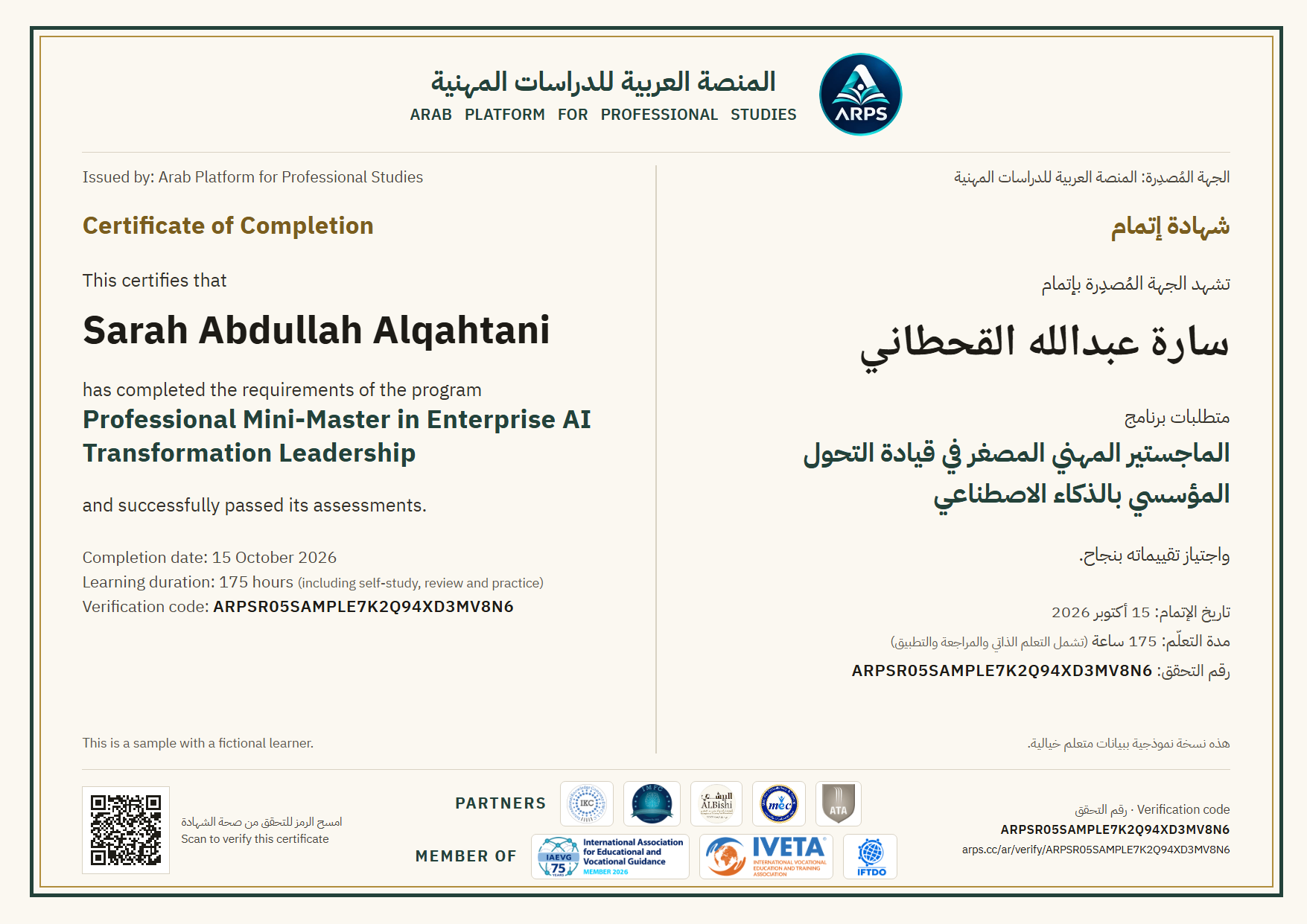
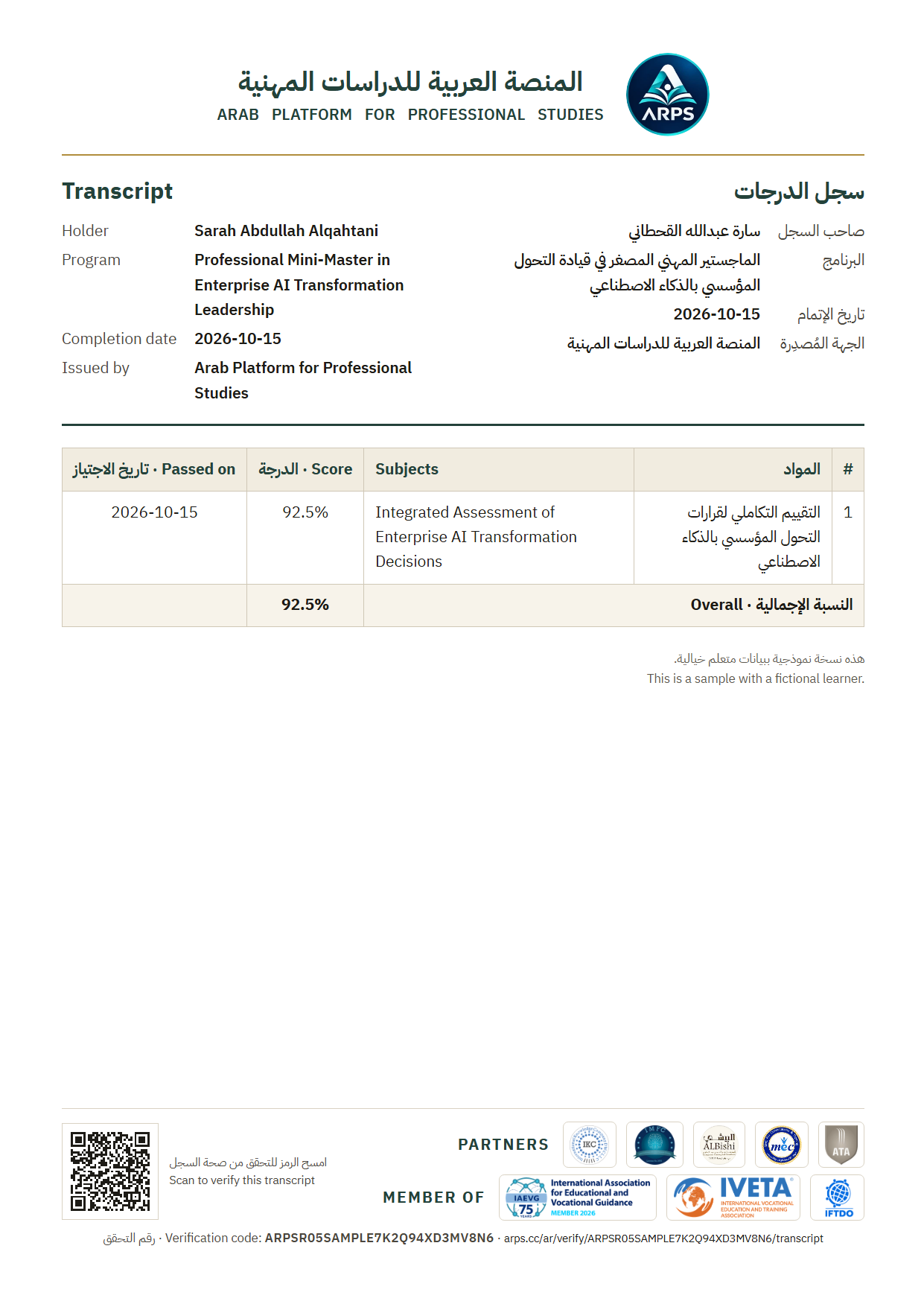
A sample from a real program in this track: Professional Mini-Master in Enterprise AI Transformation Leadership. The learner, scores and dates are fictional; opens in a new window.
A consultant preparation programme in workforce planning and HR analytics: diagnose capacity and skill gaps, compare interventions, and make evidence-based, reviewable recommendations.
An honest note: the professional mini-master is an intensive professional program; it is not an academic degree or a licence and is not equivalent to a university master's or MBA. The optional ARPS certificate is a training completion certificate showing you passed the program's assessments.