Short Diploma in Workforce Planning and HR Analytics
Short Diploma in Workforce Planning and HR Analytics is a free program on ARPS, the Arab Platform for Professional Studies. A short diploma linking service demand to workforce capacity and skills, then using trustworthy HR analytics to review decisions. Across six assessed subjects, you frame a workforce planning question, reconcile a workforce baseline, estimate demand, supply and gaps, define people.
Important notice: Foundational training completion, not a professional licence or accredited hours.
Turn a service goal into a testable capacity question with a unit, denominator, period and decision.
From lesson 1, readable now without an account: Frame the workforce decision
Workforce planning starts with a defined business decision, not an isolated vacancy count. Ask what service must be delivered, how often, to what time or quality standard, by whom and over which horizon. If a manager at a hypothetical service centre says, ‘We need five employees,’ that is an answer before the question. The underlying issue might be more transactions, longer handling time per transaction, scarce skill for complex cases or uneven shifts. Planning relates work demand to available capacity and skills, then selects a response that can be reviewed. CIPD's workforce-planning factsheet recommends linking the plan to organisational strategy, relevant data, supply and demand, and periodic review. We use that sequence as a reasoning frame, not as a universal staffing formula.
A free account saves your progress and takes you straight to lesson 1.
Program facts
Study fee
Free
subjects
6
lessons
24
Estimated time
74.5 hours
Content last reviewed
Access period
60 days
Study language
Arabic and English
About the program
Across six assessed subjects, you frame a workforce planning question, reconcile a workforce baseline, estimate demand, supply and gaps, define people metrics with explicit denominators, choose an intervention with an outcome check, and finish with a capstone that turns these steps into a defensible, executable workforce plan. Fictional worked cases and exercises ask for decision tables and provide inspectable solutions. The course makes limits of averages, missing data, privacy and causal inference visible so an attractive number does not become an unsupported service promise.
Practical relevance
Exercises produce decision cards, flow bridges, skill matrices, gap tables and monitoring views.
Why this program
Planning and analytics are taught as one decision sequence, from hours and skills demand through a cover choice to its measured effect, instead of isolating metrics from the work they serve.
Career relevance
Useful for people who contribute to capacity schedules or HR reports and want to explain figures with clear limits.
Career paths this program serves
This program is a step on the paths of the following occupations. Open a path to see its other programs in study order.
Frame a measurable service question with clear unit, period and denominator.
Reconcile workforce hours and available skills without double counting.
Estimate demand, supply and gaps under alternative scenarios.
Define people metrics and inspect data quality and inference limits.
Compare gap responses and measure implementation, outcome and quality.
Prepare a defensible operating plan linking backlog, cover and budget to a shift trial and a continuity handover.
Learning outcomes (20)
Turn a service goal into a testable capacity question with a unit, denominator, period and decision.
Reconcile mixed-status employee records into usable FTE capacity without double counting.
Build a role-skill matrix that distinguishes people counts from capability coverage and prioritises the gap.
Convert service volume, handling time and productive hours to FTE demand and expose sensitivity.
Construct internally consistent driver scenarios and calculate a capacity decision threshold.
Translate a task change into capacity hours and skills, separating automation of a step from elimination of a role.
Build an opening-to-closing workforce bridge that separates entries, exits and transfers and reconciles the record.
Estimate capability at the need date while separating potential, qualified and confirmed supply.
Compare demand and supply in matching units and periods, then interpret a conditional surplus or deficit.
Define numerator, denominator, period and source for people metrics and test completeness and consistency.
Calculate comparable group rates and separate descriptive differences from causal claims.
Design an aggregate planning view without exposing individuals or turning group patterns into individual judgements.
Compare skill-gap interventions by readiness time, cost, reversibility and service effect.
Tie a gap response to an owner, date and operating trigger, then interpret deviation before revising the plan.
Combine baseline, demand, supply, gap and response in a plan with an impact check that states what data cannot prove.
Turn productive-hour totals into qualified cover at the need date, checking shifts and the source team before promising service.
Compare forecast and actual demand by period and skill, measure error without positive and negative cancellation, and revise a conditional cover trigger.
Build a dated skill-supply bridge that separates candidates, trainees and tested independent workers from confirmed hours and deducts coaching time without double counting.
Release a metric dashboard with definition, owner, period and trustworthy refresh date, distinguishing a threshold signal from causal evidence before employee-impacting action.
Test one cover decision against simultaneous demand and supply shocks, then set measurable continue, stop and restart conditions without overstating causality.
Who it is for
Learners and early-career HR practitioners seeking a structured foundation for connecting headcount and skills with service demand and interpreting metrics before presenting them to managers. The programme uses applicable teaching decisions and does not assume prior experience with advanced modelling.
It also suits supervisors and operations coordinators reviewing shifts or backlogs, and report writers checking denominators, periods, record quality and privacy.
Prerequisites
Basic knowledge of people counts versus work hours, simple tables, multiplication, division and percentages is enough. Lessons explain minutes-to-hours conversion, rate denominators and full-time equivalents before using them in decisions.
No licence, advanced statistics or specific software is required. Bring an interest in a service or team whose demand and resources you can imagine, and a willingness to revisit assumptions.
What it does not offer
It is not legal training or a licence for regulated professional practice.
It does not state accredited hours or an external credential blueprint.
Applied work in Planning question and workforce baseline with a solved decision and observable exercise outputs.
4 lessons · 10 hours
Frame the workforce decision3 hours
Clean the baseline and define capacity3 hours
Segment roles and critical skills3 hours
Schedule capacity against dated service demand1 hours
Subject 2
Estimate future demand
Applied work in Estimate future demand with a solved decision and observable exercise outputs.
4 lessons · 9.5 hours
Workload drivers and productivity3 hours
Demand scenarios and uncertainty3 hours
Demand for skills and emerging roles3 hours
Backtest forecasts and revise assumptions1 hours
Subject 3
Forecast supply and gaps
Applied work in Forecast supply and gaps with a solved decision and observable exercise outputs.
4 lessons · 9.5 hours
Workforce flows and retention3 hours
Internal and external supply3 hours
Headcount and skill gap analysis3 hours
Track succession and skill readiness1 hours
Subject 4
Trustworthy HR analytics
Applied work in Trustworthy HR analytics with a solved decision and observable exercise outputs.
4 lessons · 9.5 hours
Metric dictionary and data quality3 hours
Group comparisons and inference3 hours
Privacy, fairness and reporting3 hours
Govern dashboards and interpret triggers1 hours
Subject 5
Choose and evaluate a response
Applied work in Choose and evaluate a response with a solved decision and observable exercise outputs.
4 lessons · 9.5 hours
Compare hire, develop and redesign options3 hours
Implement and monitor the plan3 hours
Integrated case and impact evaluation3 hours
Stress-test and reverse a workforce response1 hours
Subject 6
Capstone: a defensible and executable workforce plan
A capstone in which learners prepare a resource decision for a fictional service: allocating backlog against service commitments, building a cover portfolio within a transition budget, designing an evaluable shift trial, then simulating the decision meeting and continuity handover.
4 lessons · 19.5 hours
Allocate backlog against service commitments5 hours
Build a cover portfolio within a transition budget5 hours
Design a fair and evaluable shift trial5 hours
Simulate the decision meeting and continuity handover5 hours
Subjects unlock in sequence as you progress.
Strengths
One decision chain connects service question, demand, supply, gap and response.
Bilingual exercises have numeric inputs, observable outputs, solutions and marking checks.
Duplicates, skills, timing, privacy and limits of inference are made explicit.
Evidence basis
General concepts draw on inspected public CIPD pages and ISO, OECD and NIST overviews recorded in the source log. Cases and numbers are fictional learning material; no inaccessible standard formulas or city statistics are reproduced, and local legal decisions remain outside this diploma.
Reference organizations
CIPD
ISO
OECD
NIST
Methodology
Lessons use fictional case data and inspectable calculations, separating public-source facts from exercise assumptions.
How the route works
Short Diplomas are relatively comprehensive learning pathways that cover a major subject through five connected learning subjects and structured assessments, with a diploma transcript available with the credential.
Self-paced sequential study. Content unlocks progressively and each subject combines reading, examples, exercises, knowledge checks, and assessment.
Build integrated knowledge in a major subject.
Study through five clear, connected learning subjects.
Complete a defined assessment for each subject.
Receive a diploma transcript showing subjects and results when the credential is issued.
Assessment
Each Short Diploma contains five subjects, each with an approved assessment. A sixth final exam is not required when the five assessments adequately cover the learning outcomes.
Assessment attempts: 2 per assessment, 7 days apart
The pass mark is announced before the program is published.
Certificate
Successful completion makes the learner eligible for the Short Diploma certificate and Diploma Transcript under the credential policy.
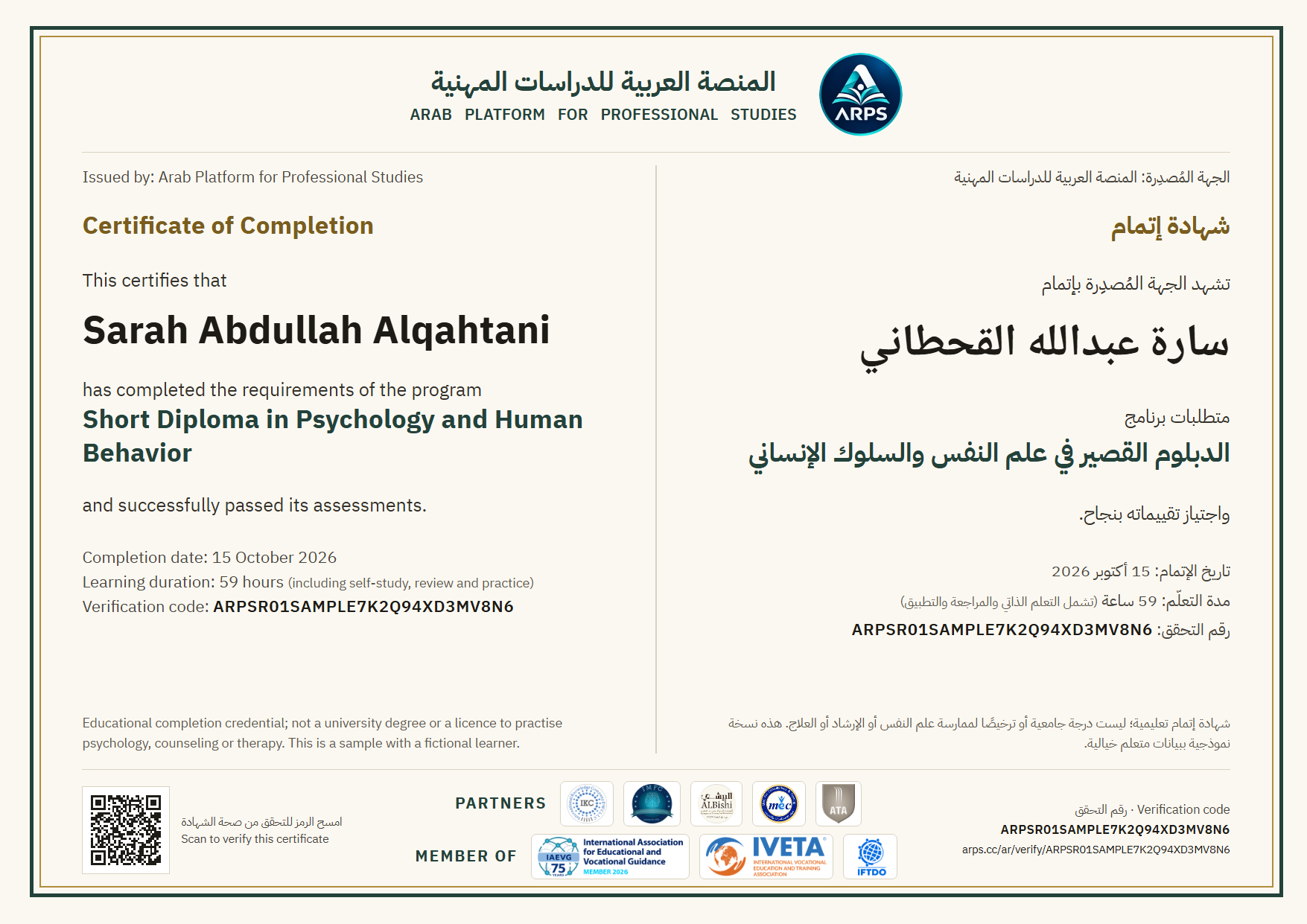
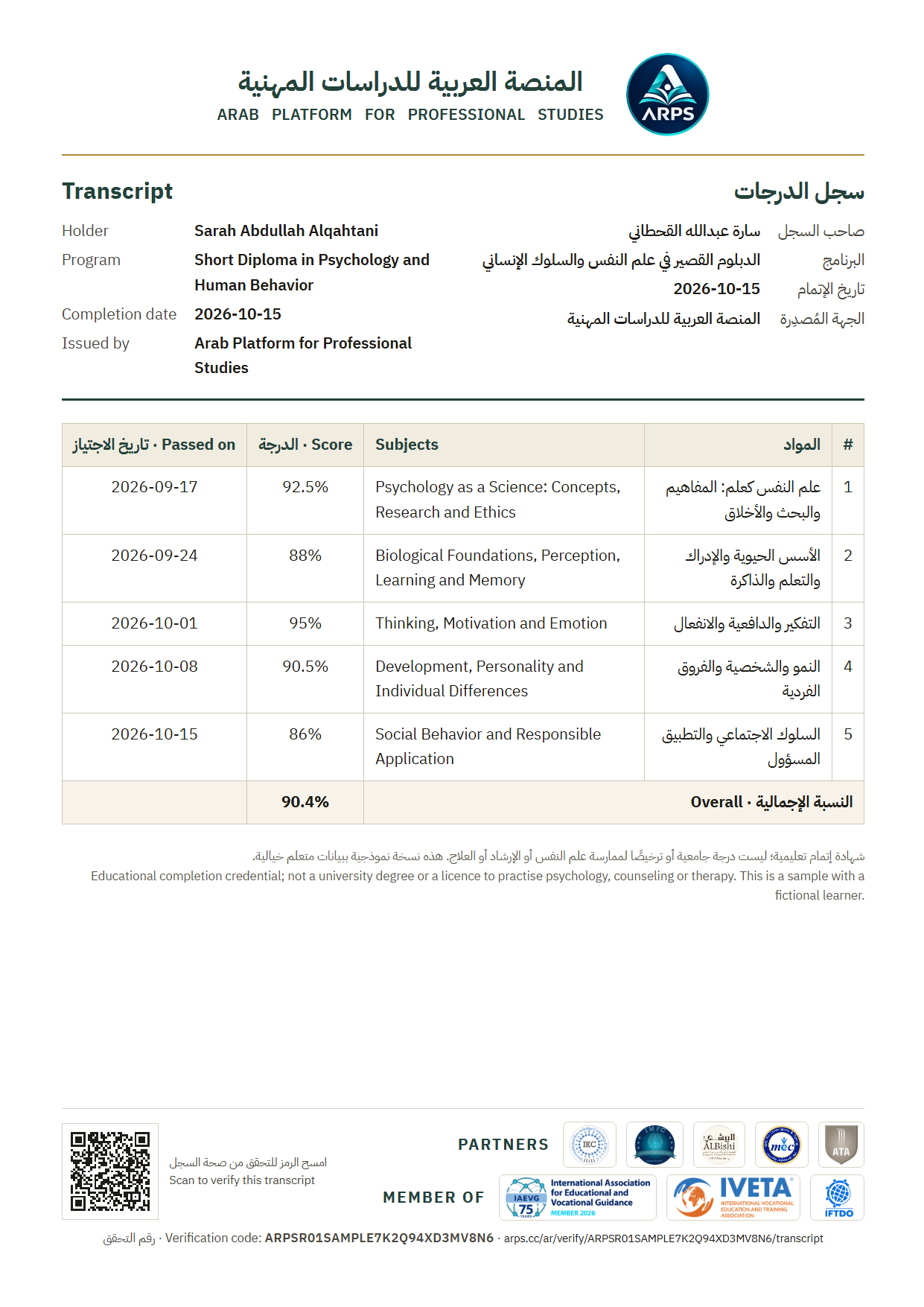
A sample from a real program in this track: Short Diploma in Psychology and Human Behavior. The learner, scores and dates are fictional; opens in a new window.
Disclaimer: Training completion, not a university degree or professional licence.
Program questions
Do I need advanced statistics?
No. Lessons explain denominators, rates and converting case minutes to hours before scenario analysis.
Are the regional case figures real organisational data?
No. Every named regional case is labelled a hypothetical training scenario and its numbers exist only for practice.
Will I practise building a plan?
You build a decision card, supply and demand bridges, a gap matrix and a monitoring plan that can be adapted to your own evidence.
Does the course teach one country's employment rules?
No. Teaching is geographically neutral; any local duty requires separate verification from the relevant source.
What are the limits of the analytics covered?
You practise description, comparison, data quality, privacy and causal limits, without automated individual decisions from group averages.
Show all (7)
Is Short Diploma in Workforce Planning and HR Analytics free, and do I get a certificate?
Yes. Short Diploma in Workforce Planning and HR Analytics is free on ARPS: every lesson, exercise and assessment is free, the first subject is open to read without an account, and the program is available in Arabic and English. Issuing a certificate is optional and has a published fee; it is a training completion certificate showing you passed the program's assessments, recognised by most private-sector organisations in the Gulf states and most Arab countries, and it strengthens your CV; confirming that a specific organisation accepts it remains your responsibility.
What other names is Short Diploma in Workforce Planning and HR Analytics known by?
The subject of this program is also known as: workforce planning, HR analytics, people analytics, strategic workforce planning. Learners usually find it by searching for: hr analytics course, workforce planning tools, workforce planning analyst, hr analytics dashboard, people analytics course free.
A consultant preparation programme in workforce planning and HR analytics: diagnose capacity and skill gaps, compare interventions, and make evidence-based, reviewable recommendations.
A foundational, applied diploma showing how HRM connects organisational needs with workforce planning, role design, recruitment and selection, performance, learning, reward, engagement, people data and ethics. Cases are fictional and country-neutral, with no advanced prior experience assumed.
A foundational diploma that connects learning-needs analysis with objectives, design, facilitation, learning transfer, evaluation and organizational capability. Learners practice making explainable, measurable L&D decisions rather than simply scheduling courses or collecting satisfaction surveys.
6 subjects
25 lessons
63 hours
Free
Next step: a professional certification or a mini-master
Programs in the same domain that prepare you for an international certification exam or form a professional mini-master, also free.